
 admin
admin 
If customers still see “@gmail.com” or “@outlook.com” on your invoices, quotes or enquiry replies, you’re quietly losing trust before the conversation even starts. The fix is simple: professional email hosting Australia businesses actually trust, built around your own domain name.
This guide covers everything you need to know before choosing an email hosting provider in Australia what it is, why it matters, what features actually count, and how to pick a plan that won’t leave you fighting spam or losing important messages.
What Is Email Hosting and How Is It Different From Free Email?
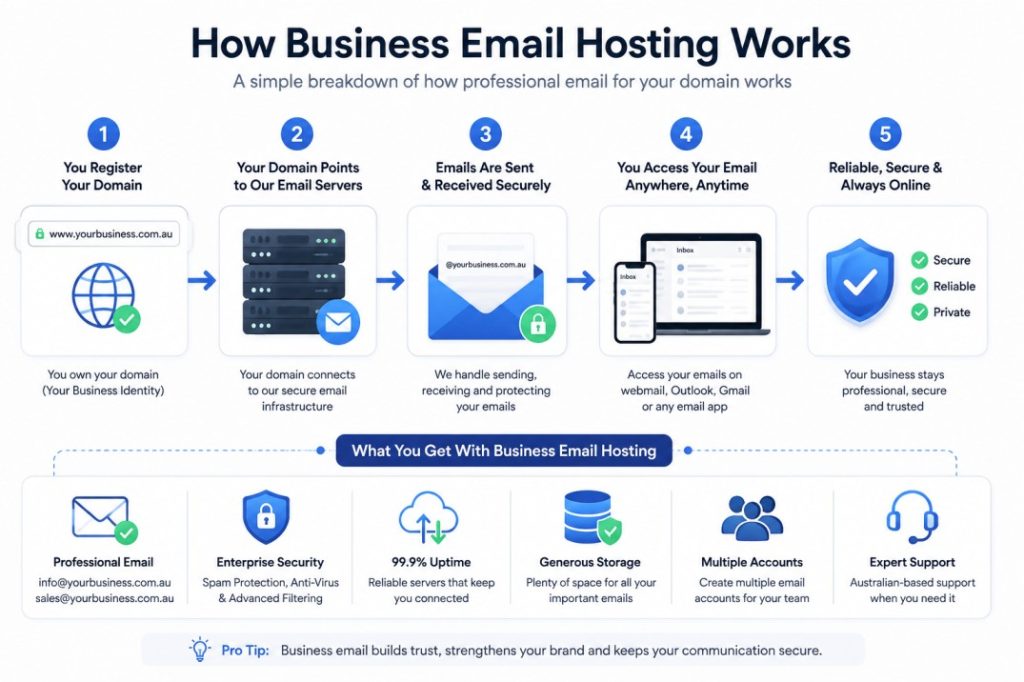
Email hosting is a dedicated service that lets you send, receive and store email using your own domain name for example, sales@yourbusiness.com.au instead of a generic Gmail or Hotmail address. Unlike web hosting, which stores your website’s files, email hosting is purpose-built for one job: getting business communication delivered reliably, securely and privately.
Free email providers are fine for personal use, but they were never designed for business. They can’t offer a custom domain address, they scan messages for advertising purposes, and deliverability can suffer once you’re sending order confirmations, invoices or client updates at volume. Dedicated business email hosting solves all three problems at once.
Why Professional Email Hosting Matters for Australian Businesses
It Builds Instant Credibility
A branded email address signals that a business is established and legitimate. Customers are far more likely to trust and respond to a message from info@yourcompany.com.au than from a free, generic inbox. For freelancers, tradespeople and small businesses competing against bigger names, this is one of the cheapest credibility upgrades available.
It Protects You From Spam, Phishing and Malware
Business inboxes are a constant target. Proper email hosting includes spam filtering, virus scanning and encrypted connections that catch threats before they ever reach your team, rather than leaving everyone to manually sort junk from genuine enquiries.
It Keeps Your Data Local
Where your email is actually stored matters. Hosting your inbox on Australian infrastructure typically means faster webmail load times, a stronger alignment with local privacy expectations, and no unexpected currency conversion charges tacked onto your monthly bill.
It Scales With Your Team
As a business grows from a solo operator to a small team, professional email hosting makes it easy to add new mailboxes, set up department addresses like support@ or admin@, and manage everyone’s access from one dashboard something free email accounts were never built to handle.
Key Features to Look for in Email Hosting Australia Plans
Not all email hosting is equal. Before choosing a provider, check that the plan includes the following.
Custom Domain Email Addresses
Your provider should let you create unlimited-feeling, professional addresses on your own domain think name@yourbusiness.com.au rather than forcing you onto a shared or generic domain.
Generous, Scalable Storage
Business inboxes fill up fast once PDFs, invoices and image attachments start piling up. Look for a plan with enough storage per mailbox so your team isn’t forced to delete important historical threads just to keep receiving new mail.
Advanced Spam and Virus Protection
Strong filtering (such as SpamAssassin-based scanning) should be standard, not an add-on. It’s the difference between a clean, usable inbox and one buried in junk and phishing attempts.
IMAP, POP3 and SMTP Support
These protocols let your mailboxes sync properly across every device Outlook, Apple Mail, Thunderbird, iPhone and Android so your team can read and reply from wherever they’re working.
Secure Webmail Access
A browser-based webmail option, protected with SSL, means you can log in and check messages securely from any device, even when you’re away from your usual computer.
Forwarders and Autoresponders
Unlimited forwarders let you route addresses like sales@ to a shared inbox without paying for extra mailboxes, while autoresponders handle out-of-office replies automatically.
Local, Responsive Support
When email breaks, it breaks at the worst possible time. Look for a host offering real support not just a ticket queue that takes days to respond.
How to Choose the Best Email Hosting for Your Business
Picking a plan comes down to three practical questions.
- How many mailboxes do you actually need right now? Solo operators need very different plans to a five-person team.
- How much storage will your business realistically use? Businesses sending lots of attachments (invoices, contracts, design files) should size up rather than start too small.
- Do you need advanced management tools? Growing teams often benefit from more granular control over accounts, quotas and permissions as the business expands.
Reviewing current and expected mailbox numbers before you sign up saves the hassle of migrating everything again a few months later.
Setting Up Email Hosting: What the Process Actually Looks Like
Switching to proper email hosting in Australia is far simpler than most business owners expect. In general, the process looks like this:
- Choose a plan based on the number of mailboxes and storage your business needs.
- Connect your domain either register a new one or point your existing domain’s DNS/MX records to your new email host, with no need to transfer domain registration.
- Create your mailboxes through an easy-to-use control panel, setting passwords and quotas for each account.
- Sync your devices, configuring Outlook, Apple Mail or your phone’s mail app using the provided IMAP/POP3/SMTP settings.
- Migrate old messages, if needed a good provider’s support team can help transfer historical emails from your previous host so nothing important gets lost.
Common Email Hosting Mistakes Australian Businesses Make
- Staying on free email too long. It’s an easy habit to fall into, but it costs credibility with every message sent.
- Choosing a plan with too little storage. Running out of space mid-project is disruptive and avoidable.
- Ignoring spam protection quality. Weak filtering means wasted time and increased phishing risk.
- Not planning for growth. Adding mailboxes one at a time on an unsuitable plan often costs more long-term than choosing the right tier upfront.
- Overlooking support quality. Email issues need fast answers check what support actually looks like before signing up, not after something breaks.
Email Hosting vs. Web Hosting: Do You Need Both?
It’s a common point of confusion. Web hosting stores your website’s files and makes your site accessible online, while email hosting is a dedicated service for sending and receiving mail through your domain. Many web hosting plans include basic email, but a dedicated email hosting plan generally offers better deliverability, more robust spam protection and greater flexibility as your business grows which is why many businesses run the two side by side rather than relying on hosting-included email alone.
Frequently Asked Questions About Email Hosting Australia
Is email hosting different from having an email address through Gmail? Yes. Gmail provides a free, generic email service, while email hosting gives you a professional mailbox on your own custom domain, along with stronger spam protection, more storage control and no third-party ad scanning of your messages.
Can I keep my current domain when switching email hosts? Yes. You don’t need to transfer your domain registration you can simply update your domain’s DNS or MX records to point to your new email host and start sending from your existing domain right away.
Will custom domain email work with Outlook and Apple Mail? Yes. Standard email hosting supports IMAP, POP3 and SMTP, which means it syncs cleanly with Outlook, Apple Mail, Thunderbird and the built-in mail apps on iPhone and Android.
How much does professional email hosting cost in Australia? Pricing varies based on the number of mailboxes and storage included, and can range from a few dollars a month for a single professional mailbox up to higher-tier plans for growing teams needing multiple accounts and larger storage allowances.
Can I migrate my existing emails to a new host? Yes, in most cases. A good hosting provider’s support team can guide you through migrating historical email data from your previous provider so you don’t lose important message history during the switch.
Do I need email hosting if I already have web hosting? Not always, but it’s often worth considering separately. Basic email included with web hosting can be limited in storage and spam protection compared to a plan built specifically for business email.
Final Thoughts
A generic free email address might feel like a minor detail, but for an Australian business, it’s often the very first impression a customer forms. Moving to dedicated, professional email hosting Australia businesses rely on is a small change that pays off in trust, security and day-to-day reliability from spam protection and device syncing to simply looking like the established business you are.
If you’re ready to set up a custom domain mailbox, compare plans, or need help migrating existing emails, our support team can walk you through the options and get your business communicating professionally in minutes.