

Description
Advanced Redirect Manager is a powerful yet user-friendly WordPress plugin designed to give you complete control over your website’s URLs, redirects, and link health.
Create and manage all standard redirects (301, 302, 307 and 308), including advanced wildcard rules. Serve specific HTTP error responses such as 403 (Forbidden), 410 (Gone) and 451 (Unavailable For Legal Reasons) for content that should no longer be accessible.
The plugin also monitors HTTP errors, including 404 (Not Found), helping you identify broken URLs, inaccessible resources, and potential issues affecting your visitors.
With its configurable 404 logging system, you can enable or disable error recording whenever you need it, without affecting the redirect engine.
Advanced Redirect Manager also includes flexible Query String handling, allowing you to choose exactly how URL parameters are matched and transferred during redirects.
What truly sets the plugin apart is its proactive Link Scanner. Don’t wait for visitors to report broken links. Its intelligent scanner checks your posts and pages, identifying both internal and external broken links before they can negatively affect your website’s user experience and search engine visibility.
Whether you’re migrating a website, restructuring your content, managing complex URL patterns, or maintaining a healthy link structure, Advanced Redirect Manager provides the tools you need in one package.
Why Choose Advanced Redirect Manager?
- Complete URL Control: Manage standard redirects (301, 302, 307 and 308) and serve specific HTTP error responses such as 410 (Gone), 403 (Forbidden) and 451 (Unavailable For Legal Reasons).
- Advanced Query String Management: Choose between Ignore, Exact, Original + Pass and Exact + Pass to control how URL parameters are matched and transferred.
- Powerful Wildcard Redirects: Redirect entire directories or URL patterns using a single rule (e.g. /blog/* to /articles/$1).
- 404 Error Logging: Automatically capture 404 errors and identify URLs visitors are trying to access.
- Configurable 404 Logging: Enable or disable 404 error recording directly from the plugin settings.
- One-Click Redirect Creation: Turn a logged 404 URL into a redirect rule directly from the error log.
- Proactive Broken Link Scanner: Find and fix broken links throughout your content before search engines or visitors encounter them. Checks both internal and external URLs.
- SEO-Friendly: Maintain a clean URL structure, manage redirects correctly and identify broken links that could affect your website’s SEO.
- Performance-Oriented: Built with performance in mind, using WordPress Object Cache to minimize database queries.
- Developer-Friendly: Clean, structured and object-oriented code.
Features in Detail
Redirect Rules Tab
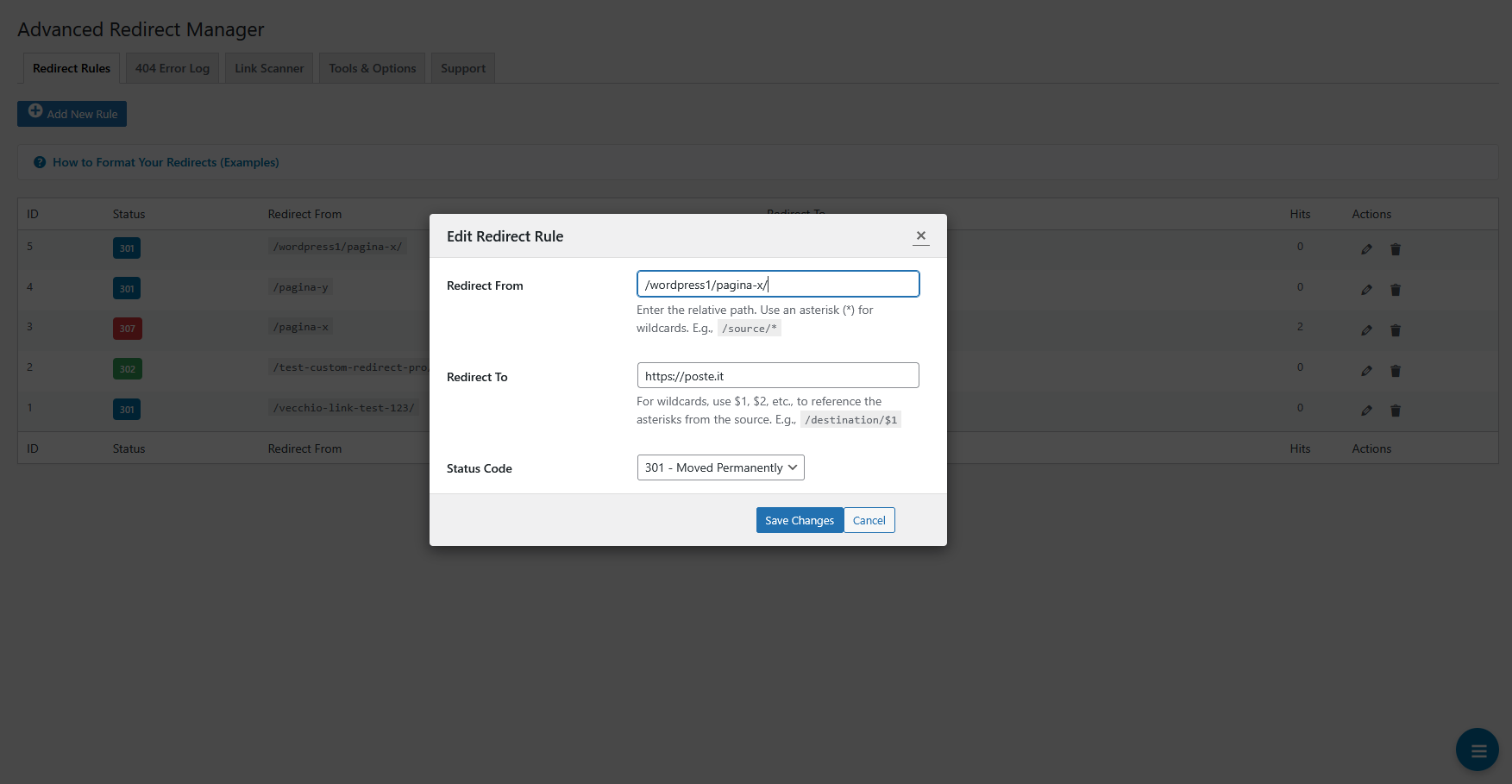
- Add, Edit and Delete Rules: Manage all your redirects from a single AJAX-powered table.
- Standard HTTP Redirects: Choose between 301, 302, 307 and 308 status codes.
- HTTP Error Responses: Serve 410 (Gone), 403 (Forbidden) and 451 (Unavailable For Legal Reasons) responses for specific URLs.
- Wildcard Support: Use an asterisk (
*) to match URL patterns. Use$1,$2in the destination URL to reference captured values. - Query String Modes: Choose how incoming query parameters are matched and transferred:
- Ignore: Match the URL path only. Do not transfer query parameters.
- Exact: Require an exact match of the URL path and query string. Do not transfer original parameters.
- Original + Pass: Match the URL path only and transfer the original query parameters.
- Exact + Pass: Require an exact query string match and transfer the original parameters when the rule matches.
- Destination Parameter Priority: When transferring original parameters, parameters already configured in the destination take precedence in case of name collisions.
- Smart “Redirect To” Search: Start typing in the “Redirect To” field to search for posts, pages and categories on your website.
- Hit Counter & Last Used: Track how many times each redirect has been used and see the date of its last use.
- In-context Help: Access examples and instructions for URL formats, wildcards and Query String Modes directly from the plugin interface.
HTTP Error Logging
- 404 Error Monitoring: Record requests that result in a 404 (Not Found) response.
- 404 Logging Toggle: Enable or disable 404 error recording directly from the plugin interface.
- Request Details: Capture relevant information such as the requested URL, timestamp, referrer and user agent.
- One-Click Redirect Creation: Create a redirect rule directly from a logged 404 entry, with the requested URL pre-filled.
- Filtered Logging: Ignore common bot traffic and irrelevant requests, such as requests for non-existent files, to keep the logs useful.
- Log Management: Manage and clear recorded error entries.
Disabling 404 logging does not affect redirect processing or existing redirect rules. Previously recorded log entries are retained.
HTTP error monitoring does not override or bypass access restrictions imposed by WordPress, the web server or other security plugins.
Link Scanner Tab
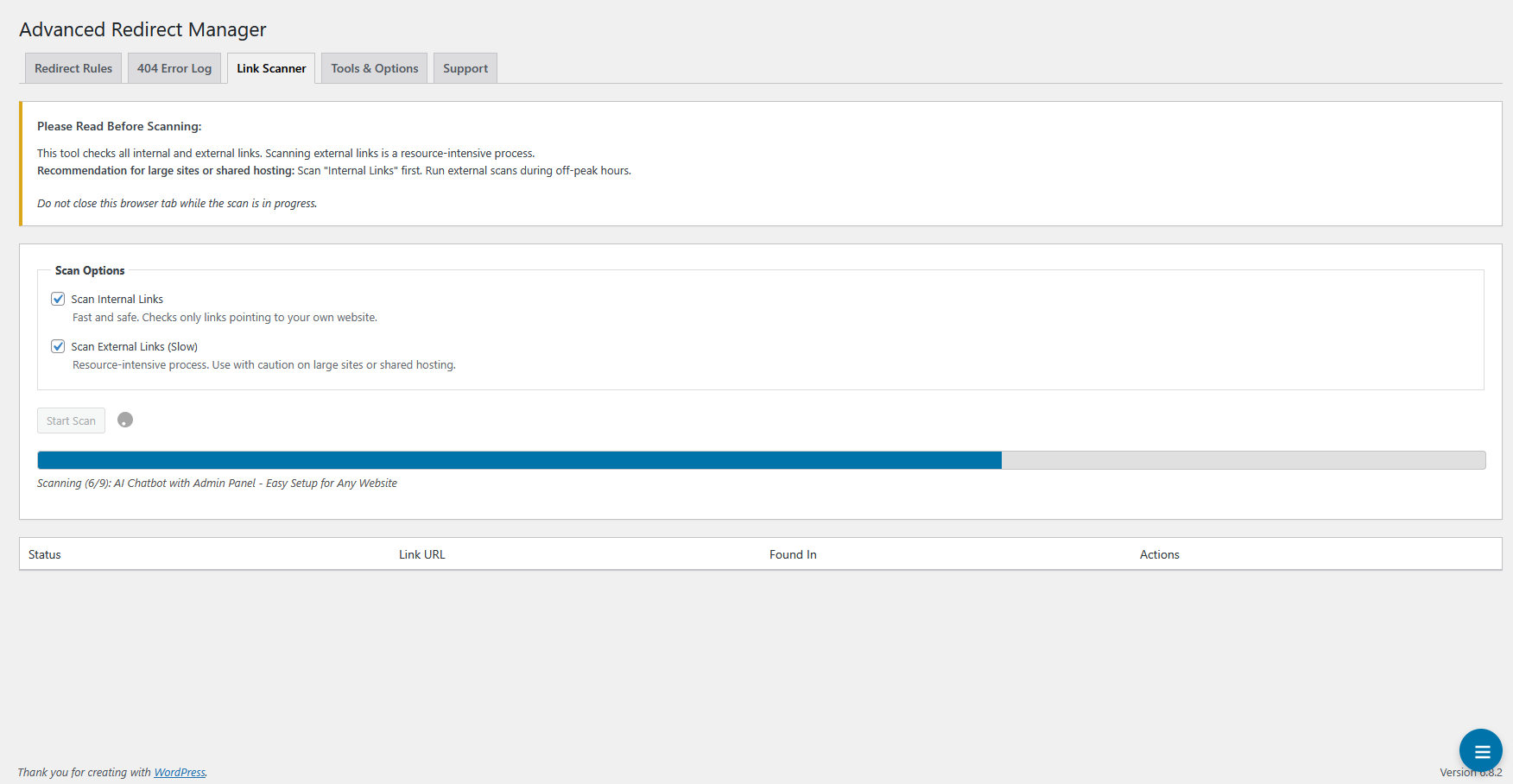
- Scan Internal & External Links: Choose to scan links pointing to your own website, external websites, or both.
- Intelligent Chunking: Process website content in small batches to help prevent server timeouts, making scanning suitable for large websites and shared hosting.
- Actionable Results: Identify broken links, including HTTP 4xx and 5xx responses and connection errors, showing the exact post or page where each link was found.
- Contextual Actions:
- For internal broken links, create a redirect rule directly from the results.
- For external broken links, use the “Edit Post” action to open the relevant content and fix the link.
Tools & Options Tab
- Import/Export via CSV: Back up redirect rules to a CSV file or migrate them to another website. The importer can handle new rules and update existing ones.
- Bulk Actions:
- Reset all redirect hit counters to zero.
- Permanently delete all redirect rules, with multiple confirmations to prevent accidental deletion.
Installation
- Upload the
advanced-redirect-managerfolder to the/wp-content/plugins/directory. - Activate the plugin through the ‘Plugins’ menu in WordPress.
- Go to Settings > Redirect Manager to start creating redirect rules and monitoring your site.
The plugin automatically starts recording 404 errors when 404 logging is enabled.
FAQ
Does this plugin affect my site’s performance?
Advanced Redirect Manager has been developed with performance as a priority. The redirection engine uses the built-in WordPress Object Cache to reduce repeated database queries.
On websites with a persistent object cache, such as Redis or Memcached, this can further reduce database activity when processing redirects.
The Link Scanner runs only when manually started and uses AJAX chunking to avoid processing the entire website in a single request.
What’s the difference between a 301, 302, 307 and 308 redirect?
- 301 (Moved Permanently): A permanent redirect. It tells search engines that a page has moved permanently. Browsers may change the original request method from POST to GET.
- 308 (Permanent Redirect): A permanent redirect that preserves the original request method. A POST request remains a POST request at the destination.
- 302 (Found): A temporary redirect. It indicates that the requested resource is temporarily available at another URL. The original request method may be changed by the client.
- 307 (Temporary Redirect): A temporary redirect that preserves the original request method.
Use permanent redirects when a URL has permanently changed and temporary redirects when the change is not permanent.
What’s the difference between 403, 404, 410 and 451?
- 403 (Forbidden): The server understands the request but refuses to authorize access to the requested resource.
- 404 (Not Found): The requested resource could not be found.
- 410 (Gone): The resource has been permanently removed and is no longer available.
- 451 (Unavailable For Legal Reasons): Access to the resource is denied for legal reasons.
Advanced Redirect Manager can monitor 404 errors and serve configured 410 and 451 responses through redirect rules.
What are Query String Modes?
Query String Modes determine how URL parameters appearing after the ? character are handled when a redirect rule is processed.
The plugin provides four modes:
- Ignore: Matches the URL path only. Query string parameters are ignored and are not transferred to the destination.
- Exact: Requires an exact match of both the URL path and the configured query string. Original parameters are not transferred.
- Original + Pass: Matches the URL path only, regardless of the incoming query string, and transfers the original query parameters to the destination.
- Exact + Pass: Requires an exact match of the URL path and configured query string. When the rule matches, original query parameters are transferred to the destination.
When original parameters are transferred, parameters already configured in the destination take precedence if their names collide.
What happens when destination and original query parameters have the same name?
Destination parameters take precedence over original parameters.
For example, if the incoming URL is:
/products?color=red&size=42
And the destination is:
/new-products/?color=blue
With a Pass mode, the resulting destination is:
/new-products/?color=blue&size=42
The destination’s color=blue value is preserved, while the original size=42 parameter is transferred.
Can I use wildcards? How do they work?
Yes! Use an asterisk (*) in the “Redirect From” field. Each wildcard captures part of the URL. You can then use $1, $2, and so on in the “Redirect To” field to reference the captured values.
Example:
- Redirect From:
/products/category-*/item-* - Redirect To:
/shop/$1/product/$2
This redirects /products/category-books/item-123 to /shop/books/product/123.
Wildcards are greedy, meaning they match as many characters as possible, including slashes.
Can I disable 404 error logging?
Yes. You can enable or disable 404 error logging directly from the plugin interface.
When logging is disabled, no new 404 entries are recorded. Existing log entries are retained, and the redirect engine continues to work normally.
Does the Link Scanner run automatically in the background?
No. To avoid unexpected server load, the Link Scanner must be started manually from the plugin’s administration page.
What happens when I uninstall the plugin?
Upon uninstallation (by clicking “Delete” in the Plugins screen), Advanced Redirect Manager removes its custom database table, plugin options and related transients.
Your plugin data will be permanently deleted.
If you only deactivate the plugin, your redirect rules and stored data are retained for when you reactivate it.
Screenshots




Changelog
2.0.0
- Major Release: Advanced Redirect Manager moves from the 1.0.x series to version 2.0.0.
- New Feature: Added visitor IP address logging for 404 errors.
- New Feature: Added Query String Modes with four options: Ignore, Exact, Original + Pass and Exact + Pass.
- New Feature: Added Original + Pass support to transfer original query parameters to the destination URL.
- New Feature: Added Exact + Pass support to match the configured query string and transfer original parameters when the rule matches.
- New Feature: Added support for HTTP 403 (Forbidden) redirect rules.
- New Feature: Added an ON/OFF control for 404 error logging.
- Enhancement: Improved query string handling, including destination parameter priority when original and destination parameters have the same name.
- Enhancement: Updated redirect rule management and in-context documentation to explain the available Query String Modes.
- Enhancement: Improved compatibility with modern PHP versions and WordPress coding standards.
- Fix: Fixed deprecated PHP usage and addressed related compatibility issues.
- Fix: Improved validation and handling of redirect rules and query string parameters.
- Fix: Preserved compatibility with existing redirect rules during the Query String Mode updates.
- Fix: Removed the redundant Original mode while retaining Ignore as the single path-only mode without parameter transfer.
- Tweak: Updated plugin documentation and help texts for the 2.0.0 release.
1.0.3
- New Feature: Added support for serving 410 Gone and 451 Unavailable For Legal Reasons status codes for specific URLs.
- Enhancement: The status code selector in the rule editor is now grouped by category (Permanent, Temporary, Error) for a better user experience.
- Enhancement: Added distinct status badges and colors for the new 410 and 451 codes in the main redirect table for easy identification.
- Tweak: Updated plugin documentation and help texts to include information about the new 410 and 451 status codes.
1.0.2
- New Feature: Added the “NewCodeByte Apps” section and a dedicated tab to showcase other available plugins from the author.
1.0.1
- New Feature: Added support for 308 Permanent Redirects, the modern and more precise alternative to 301 redirects.
- Enhancement: Improved sanitization and validation of user inputs and server variables, following WordPress security standards.
- Enhancement: Improved compatibility with newer PHP and WordPress versions and addressed deprecated notices.
- Enhancement: Improved the AJAX-powered table loading mechanism for a smoother and more reliable administration experience.
1.0
- Initial public release.
- Let the redirects begin!