

Description
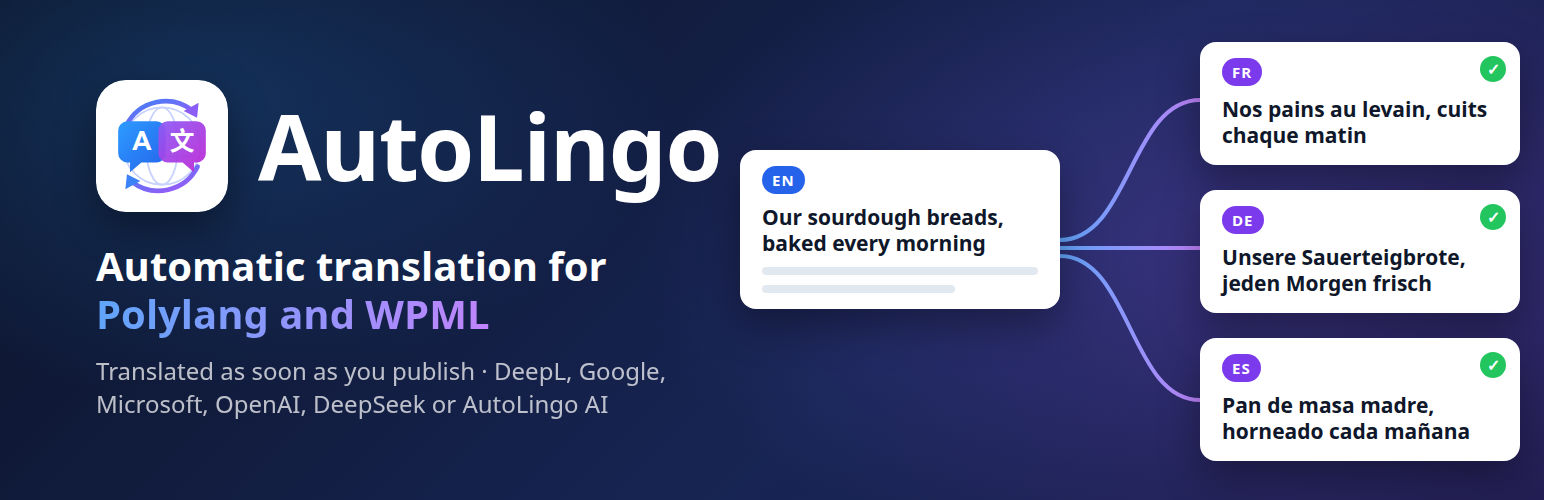
AutoLingo translates your Polylang or WPML site automatically. Publish a post in your language and AutoLingo creates its translations in every other language, with DeepL, Google Translate, Microsoft Translator, OpenAI (ChatGPT) or DeepSeek, on your own API keys, with no markup.
The free version includes
- All five providers, with automatic fallback when a quota runs out: about 3,000,000 free characters a month with free DeepL, Google and Microsoft accounts
- Translation on publish, a Translate link in the post list and the editor, and the whole site in one click from the admin (or with WP-CLI)
- Categories, tags, menus and image alt text, not just posts
- Gutenberg, the Classic Editor and shortcode builders (Divi, WPBakery, Flatsome)
AutoLingo Pro adds Elementor, Bricks and Beaver Builder, Divi (module texts and Theme Builder), Contact Form 7, SEO meta (Yoast, RankMath, SEOPress, The SEO Framework), ACF fields and WooCommerce, plus AutoLingo AI with no API key.
Features (Free)
- Translate Gutenberg content (title, blocks, excerpt) on publish or manually
- Manual translate button in the post editor and post list
- Translate the whole site from Settings → AutoLingo → Tools: one button creates every missing translation, a few seconds per request so that no host or cache time limit stops it, with no shell access needed (or
wp pdat translate-missing,translate-all) - Review before publishing: new translations can be published right away, saved as drafts, or left pending review; updates keep the status a translation has
- Repair tools: translations whose address is still the original’s get one from their translated title, and the old address redirects to the new one; duplicates linked to no original are listed and can be moved to the trash, the translation kept getting its clean address back (
wp pdat repair,wp pdat duplicates) - Nav menu translation (Polylang and WPML)
- Five providers: DeepL (Free and Pro, auto-detected from the
:fxkey suffix), Google Translate, Microsoft Translator, OpenAI and DeepSeek - Automatic fallback: when the selected provider runs out of quota, the next one that has a key translates — free DeepL, Google and Microsoft accounts add up to about 3,000,000 characters a month
- Credit balance check before each translation
- Admin alert + dashboard widget when credit runs low
- Category and tag translation — term names (and descriptions) are genuinely translated via your chosen provider, not just linked to an existing Polylang/WPML translation
- Image alt text translation — when a translated media item exists, its alt text is translated too, not just copied
- Image alt and title text inside your content (Gutenberg images, HTML) translated in the same call as the rest
- Context-aware: the provider is told what it translates (blog post, page, product, category, menu item) for better short texts
- Post meta copy on creation (theme settings, page templates, layout options)
- Shortcode-based builders (Divi, WPBakery, Flatsome) — the text between shortcodes is translated, the shortcodes are preserved verbatim
Features (Pro)
AutoLingo Pro adds:
- Page builder support: Elementor, Beaver Builder, Bricks Builder
- Divi and DiviFlash: the texts in module settings (button labels, tab, toggle and blurb titles, headings, image alt text); Theme Builder headers, footers and body layouts shown in each page’s language; Divi menu modules show the translated menu
- Contact Form 7: labels, submit button, placeholders, visitor messages and auto-reply translated; each page shows the form of its language
- SEO meta translation: Yoast SEO, RankMath, SEOPress, The SEO Framework
- ACF field translation: text, textarea, wysiwyg, link, repeater, flexible content
- WooCommerce: custom product attributes, variations and purchase note; without Polylang for WooCommerce or WooCommerce Multilingual, translated products also get prices, variations and linked products, with a shared stock
- Theme and plugin strings: Polylang’s Languages → Translations or WPML String Translation (site title, widgets, cookie banner, plugin texts)
- Lingo, the review agent: rereads each translation next to its original, like a proofreader, fixes what it is sure about and lists the rest
- Lingo, the assistant: ask in your own words (“translate my products into Spanish as drafts”), from any admin page; Lingo looks at the site and proposes the actions, which run only when you confirm them
Lingo, the review agent (Pro)
Machine translation is fast, not flawless: a price or an opening time that changes, a sentence left in the original language, a brand name translated word for word. After each translation, Lingo rereads it next to its original, the title, excerpt, content passage by passage, Elementor, Bricks and Beaver Builder texts, and SEO fields, and checks the meaning, numbers and names, passages left untranslated, your glossary, grammar, fluency and the tone you chose.
- “List the points to check”: each point shows the passage, a suggestion and why, with Apply and Ignore buttons in the editor; a point you ignore does not come back
- “Fix the sure ones, list the others”: the corrections any professional would make are applied for you
- Translations created as drafts can be published once Lingo finds nothing to check
- The whole site at once from Settings → AutoLingo → Tools, or
wp pdat review - Reviews with AutoLingo AI (no key, on the same monthly credit)
Pages built with Elementor, Bricks or Beaver Builder are reread text by text, and a fix is written back into the builder’s own data (Beaver Builder global modules, shared between pages, are left alone).
Lingo, the assistant (Pro)
Settings → AutoLingo → Lingo is a chat: say what you want, in your language. Lingo looks at the site (what is missing, a page by its title, the review points) and answers with real numbers, then proposes the actions: translate what is missing, by content type, language and status; translate pages again; repair translations; move duplicates to the trash; have translations reread; translate menus and theme strings; change a setting; add a glossary term.
- Nothing changes until you confirm: each proposal is a card with Confirm and Cancel, and the card says what will run, written by AutoLingo from the action itself, not by the AI
- Site content is treated as data: text written for an AI in a title or a page is detected, Lingo warns you, and actions that delete or change settings are not proposed after reading it
- Every confirmed action goes to the AutoLingo log (who, what, when; the previous value of a changed setting); at most 40 messages an hour per person
- With AutoLingo AI, on the same monthly credit as translation (no key); Lingo never uses another AI
- One click away on every admin page: a Lingo item in the top bar and a Lingo bubble in the corner open the chat in a panel (the bubble can be turned off); the conversation stays in your browser tab
Page builder support (Pro)
- Elementor —
_elementor_data(JSON), all common widget types - Beaver Builder —
_fl_builder_data(serialized PHP), global nodes skipped - Bricks Builder —
_bricks_page_content_2(JSON), nested items (accordion, tabs)
Shortcode-based builders (Divi, WPBakery, Flatsome) are supported on the free plan — the text between shortcodes is translated and the shortcodes are preserved verbatim. With AutoLingo Pro, the texts kept in Divi and DiviFlash module settings (button labels, tab, toggle and blurb titles, headings, image alt text) are translated too, and Theme Builder layouts follow each page’s language; colours, sizes, links and other settings are left as they are.
SEO plugin support (Pro)
- Yoast SEO — title, meta description, focus keyword
- RankMath — title, description, focus keyword
- SEOPress — title, description
- The SEO Framework — title, description
- SEO template variables (
%%title%%,%sep%,%sitename%…) are preserved automatically - Translations whose SEO title or description stayed in the source language (copied by hand, or translated before the SEO module was on) are found and translated in Settings → AutoLingo → Tools or with
wp pdat repair
ACF (Pro)
Translates text, textarea, wysiwyg, and link (title only) fields, including repeater and flexible_content layouts.
WooCommerce (Pro)
Translates custom product attributes (name + pipe-separated values), variation descriptions and the purchase note.
Without Polylang for WooCommerce or WooCommerce Multilingual (which keep translated products in sync themselves), AutoLingo makes each translation sellable like its source: same product type, prices and sale dates, tax, stock and shipping settings, images and downloads; one variation per source variation, with its attributes pointing at the translated ones; upsells, cross-sells and grouped products pointing at their translations. Saving the source updates its translations, and the stock is shared: a sale, a refund or an edit in any language sets the same stock everywhere. The SKU is never copied, as WooCommerce wants it unique. For products translated before, wp pdat sync-products brings the whole catalogue in line without translating the texts again (--dry-run, --ids=, --lang=).
Theme and plugin strings (Pro)
Themes and plugins declare their interface texts for translation: site title and tagline, widgets, footer and header texts, cookie banner, e-mail templates. Settings → AutoLingo → Tools fills in the missing translations, language by language, or wp pdat translate-strings does it from the command line. Translations already entered are never changed; date and time formats, addresses and placeholders such as %s or {title} are kept as they are.
- Polylang — the strings of Languages → Translations.
- WPML — the strings of WPML String Translation (version 5 or later), each translated from the language it is written in and marked complete. You pick the domains to translate; those of installed plugins and themes, which their own .mo files translate, are left out by default (
wp pdat translate-strings --list-domains,--domains=).
Reliability
- Exponential back-off retry on HTTP 429 (rate limit): 2 s → 4 s → 8 s, up to 3 retries
- Dual lock (static + transient) prevents duplicate translations on Gutenberg REST saves
- Translation log viewer in the admin (DB-backed, 30-day retention)
- Integration test suite — 54 tests covering all modules
External Services
This plugin optionally connects to one of four external translation APIs depending on which provider you choose in Settings → AutoLingo. No data is ever sent without an explicit translation action and a valid API key that you supply yourself.
DeepL
What it is: DeepL is a machine translation service. This plugin uses the DeepL REST API to translate your post content.
What data is sent: The text content of your posts (title, body, excerpt) is sent to DeepL’s servers for translation. If you use the Glossary feature, your glossary terms (source and target words) are also sent to create a DeepL glossary. No personally identifiable information about your site visitors is transmitted.
When it is sent: Only when a translation is triggered — either manually via the Translate button, automatically on publish (if enabled in settings), via WP-CLI, or when syncing a glossary.
Service endpoint: api.deepl.com (Pro) or api-free.deepl.com (Free plan)
- Terms of Service: https://www.deepl.com/legal/terms
- Privacy Policy: https://www.deepl.com/privacy
OpenAI
What it is: OpenAI provides the GPT language model API. This plugin uses the gpt-4o-mini model to translate your post content when OpenAI is selected as the provider.
What data is sent: The text content of your posts is sent to OpenAI’s servers. No visitor data is transmitted.
When it is sent: Only when a translation is triggered manually or on publish.
Service endpoint: api.openai.com
- Terms of Service: https://openai.com/policies/terms-of-use
- Privacy Policy: https://openai.com/policies/privacy-policy
DeepSeek
What it is: DeepSeek provides a GPT-compatible language model API. This plugin uses the deepseek-chat model to translate your post content when DeepSeek is selected as the provider.
What data is sent: The text content of your posts is sent to DeepSeek’s servers. No visitor data is transmitted.
When it is sent: Only when a translation is triggered manually or on publish.
Service endpoint: api.deepseek.com
- Terms of Service: https://chat.deepseek.com/downloads/DeepSeek%20Terms%20of%20Use.html
- Privacy Policy: https://cdn.deepseek.com/policies/en-US/deepseek-privacy-policy.html
Microsoft Translator
What it is: Microsoft Translator (Azure AI Translator, Text API v3) provides machine translation. This plugin uses it to translate post content when Microsoft Translator is selected as the provider, or when it takes over because the selected provider’s quota is used up.
What data is sent: The text content of your posts is sent to Microsoft’s servers. No visitor data is transmitted.
When it is sent: Only when a translation is triggered manually or on publish, and only if you entered a Microsoft Translator key.
Service endpoint: api.cognitive.microsofttranslator.com
- Terms of Service: https://www.microsoft.com/licensing/terms/productoffering/MicrosoftAzure/MCA
- Privacy Policy: https://privacy.microsoft.com/privacystatement
Google Cloud Translation
What it is: Google Cloud Translation API provides machine translation. This plugin uses it to translate post content when Google Translate is selected as the provider.
What data is sent: The text content of your posts is sent to Google’s servers. No visitor data is transmitted.
When it is sent: Only when a translation is triggered manually or on publish.
Service endpoint: translation.googleapis.com
- Terms of Service: https://cloud.google.com/terms
- Privacy Policy: https://policies.google.com/privacy
Configuration
- Get one or more API keys. Free tiers: DeepL API Free (500,000 characters a month, key ends with
:fx), Google Cloud Translation (500,000), Microsoft Translator (2,000,000). - Paste the keys under Settings → AutoLingo and pick the provider to use first. When its quota runs out, the next provider with a key translates.
- Check the source language (the one you write in) and the target languages.
- Choose which content types to translate (default: posts and pages, plus products when WooCommerce is active).
WP-CLI Commands
wp pdat audit — list all source posts with translation status per language
wp pdat audit --format=csv — same output as CSV
wp pdat translate-missing --dry-run — simulate without creating anything
wp pdat translate-missing — translate only missing translations
wp pdat translate-all — translate or update all source posts
wp pdat repair --dry-run — list the translations with SEO fields or an address left in the source language; without `--dry-run`, translate them (the old address redirects)
wp pdat duplicates [--trash] — list the posts of a target language linked to no original that duplicate a translation; `--trash` moves them to the trash
wp pdat review [--ids=] [--lang=] [--all] [--dry-run] — (Premium) Lingo rereads the translations not reviewed yet, or changed since, and lists or fixes what it finds
wp pdat alt [--ids=] [--dry-run] — (Premium) AutoLingo AI writes the alternative text of the images that have none
wp pdat fix-dates [--dry-run] — gives the translations dated the day they were created their original's publication date
wp pdat ask "…" — (Premium) asks Lingo, the assistant, in plain words; it answers and lists the actions it proposes, without running them
wp pdat translate-options — translate ACF Options Page fields
wp pdat audit-acf — list all translatable ACF fields
Installation
- Set up your languages in Polylang or WPML first (at least two languages).
- In Plugins → Add New, search for “AutoLingo”, then install and activate it.
- Go to Settings → AutoLingo and paste at least one API key (DeepL, Google, Microsoft, OpenAI or DeepSeek).
- Publish a post: it is translated into every target language.
On a new install, AutoLingo takes its source and target languages from Polylang or WPML: your default language is the source, the others are the targets. You can change them in the settings.
Via WP-CLI:
wp plugin install autolingo-polylang-translate --activate
FAQ
Which DeepL plan do I need?
Both plans work. The Free plan gives 500,000 characters/month at no cost — the key ends with :fx. The Pro plan is billed per character with no monthly cap.
Is it free to use?
The free plugin is free. Translation itself is billed by the provider you choose, on your own account — and DeepL, Google and Microsoft each have a free monthly quota. Enter several keys and AutoLingo uses them one after the other: when one quota runs out, the next provider translates. That is about 3,000,000 free characters a month, with no AutoLingo translation subscription.
I published a post and nothing was translated. Why?
AutoLingo only translates posts written in the source language set under Settings → AutoLingo. If that language is not one of your site’s languages, the settings page says so. Also check that at least one API key is saved and that “Auto-translate” is on. Every request, with its error if any, is listed in the translation log.
Does the free version translate Elementor pages?
No. Elementor, Beaver Builder and Bricks content is translated by AutoLingo Pro. Gutenberg, the Classic Editor and shortcode builders (Divi, WPBakery, Flatsome) are translated by the free version; Divi’s module settings and Theme Builder layouts need AutoLingo Pro.
Does it work with Polylang free or only Polylang Pro?
It works with both Polylang (free) and Polylang Pro.
Will it overwrite my existing translations?
No translation you edited by hand is overwritten: when the source post changes, AutoLingo skips that translation and notes it in the translation log. Otherwise, auto-translate on publish updates the translations when the source changes. translate-missing only creates translations that do not exist yet; translate-all also updates the others.
Are shortcodes translated?
No. Shortcodes ([contact-form-7 …], [vc_row], Divi modules, etc.) are replaced by neutral placeholders before sending to the translation API and restored verbatim in the output; with AutoLingo Pro, the text settings of Divi and DiviFlash modules (a button label, a tab title) are translated, in the shortcode itself. This protection applies to all five providers (DeepL, Google Translate, Microsoft Translator, OpenAI, DeepSeek). SEO template variables (%%title%%, %sep%) are also preserved automatically.
What about scripts, styles and structured data in my content?
A Divi Code module or an HTML block can hold code. AutoLingo never sends that code to the translation provider, and only translates the texts a visitor reads in it:
- Structured data (
<script type="application/ld+json">): the texts (name, headline, description, FAQ questions and answers) are translated,inLanguagetakes the language of the translation, and the page’s address points to the translated page. - CSS: the words of
content: "…"values (a label shown with::before). Icons and symbols stay. - JavaScript: only in a script you mark with
data-autolingo="translate", as in<script data-autolingo="translate">. Its texts are translated ('Montant hors taxes (€)'), and the locale it formats numbers with (toLocaleString('fr-FR')) follows the page. IDs, classes, selectors, compared values, object keys and URLs stay as they are. Without the attribute a script is never changed: only its author knows which strings the code depends on.
To turn marked scripts off on a whole site: add_filter( 'autolingo_translate_script_strings', '__return_false' );
What happens if the DeepL rate limit is hit?
The plugin retries automatically up to 3 times with exponential back-off (2 s, 4 s, 8 s). If all retries fail the error is logged and the translation is skipped for that request.
Does it work with Polylang and WPML?
Yes. AutoLingo supports both Polylang (free and Pro) and WPML via an adapter layer — the same translation logic works with whichever multilingual plugin is active. Posts are translated on publish, in bulk, or via WP-CLI, using DeepL, Microsoft Translator, OpenAI, DeepSeek or Google Translate.
Screenshots


Changelog
1.13.3
- Labels written in CSS (content: “…”, such as a table’s mobile labels shown with ::before) are translated. Icons and symbols are left alone
- A script marked data-autolingo=”translate” has its texts translated: the labels a calculator or a form writes with JavaScript, and the locale it formats numbers with (‘fr-FR’ becomes the page’s language). Unmarked scripts are never changed
1.13.2
- DiviFlash: FAQ questions and the other texts of DiviFlash modules are translated (Pro)
- Divi: a module’s tablet, phone and hover texts are translated, the Text module’s included (Pro)
- Structured data written by hand in the content (a
- Scripts and styles in the content are no longer sent to the translation provider: an AI provider could otherwise rewrite code, and they cost characters
- Internal links keep their anchor (#section) when they are pointed to the translated page
1.13.1
- Divi (module settings, Theme Builder, menu modules) and Contact Form 7 are now part of AutoLingo Pro, like the other page builders. The free version still translates the text between Divi shortcodes and keeps the shortcodes as they are
1.13.0
- Catalan is now a target language, with every provider: DeepL (a standard DeepL language on every plan, Free included), Google, Microsoft, OpenAI, DeepSeek and AutoLingo AI
- Divi and DiviFlash: the texts kept in module settings are translated: button labels, tab, toggle and blurb titles, headings, image alt text. Colours, sizes, links and other settings are left as they are
- Menus with Polylang: a translated menu now takes the theme locations of its original (Appearance → Menus → Manage Locations), so visitors see it in their language without a manual step. A location that already has a menu for that language keeps it
- Contact Form 7: forms are translated like pages: the labels, the submit button, placeholders, the messages visitors see and the auto-reply. A page shows the form of its own language, with the same [contact-form-7] shortcode. Menu and checkbox options are kept, as they are the values the form sends
- Divi Theme Builder: headers, footers and body layouts are translated, and each page shows the ones of its language. A Divi menu module shows the translated menu. Divi’s clean-up of unused layouts no longer trashes the translations of a layout still in use
- A provider per language: Settings → Provider per language picks a provider for one language (DeepL for Catalan, for example) while the others use the default one
1.12.5
- Security: a translation can no longer add code its original does not hold (scripts, frames, forms, onclick-style attributes, javascript: links). An AI provider receives the page’s HTML, and a passage written to steer it could otherwise have come back as a script on the translated page. Code that is in the original, such as an administrator’s HTML block, is kept
- Security: saved API keys are no longer written into the settings page. The field shows the key’s last four characters; leave it empty to keep the key, or tick “Delete” to remove it
1.12.4
- Long pages no longer stop with “Maximum execution time of 30 seconds exceeded”: while it translates, AutoLingo gives PHP up to 5 minutes where the host allows it, and finishes the work even if the browser stops waiting
1.12.3
- Repair tool: the translations AutoLingo made before 1.12.2, dated the day they were created, get their original’s publication date back (Settings → AutoLingo → Tools, or
wp pdat fix-dates). Only AutoLingo’s own translations of posts listed by date are changed
1.12.2
- A new translation keeps the publication date of its original. It used to be dated the day it was created, so a language added later listed old articles as the newest ones on the blog and the home page
1.12.1
- Premium: a “Write alt text (AutoLingo AI)” button next to the Alternative text field, in the media library’s image details (grid view), on the media edit screen and in the media window of the block editor. It fills the field in place, so an image inserted right after carries the new text
1.12.0
- Premium: AutoLingo AI writes the alternative text of images that have none. It looks at each image and writes one short sentence in the image’s language, then AutoLingo translates it onto the image’s translations. From the media library (a link on each image and a bulk action, list view), for every image at once from Settings → AutoLingo → Modules, for new uploads (option), or with
wp pdat alt. An alt text already there is never replaced; each image counts 500 characters of the AutoLingo AI allowance - Premium: an image inserted in a post without alt text shows the media library’s alt text, in the page’s language (option, on by default); the post itself is not changed
- The caption, description and title of a translated media item are now translated too, not only its alt text; a text edited by hand on the translation is kept
1.11.4
- GreenShift: Advanced text, heading and button blocks are translated in their settings too, so they no longer need recovering in the editor (which brought the original language back)
- GreenShift accordions, title boxes, progress bars, togglers, counters and countdowns: their labels are translated
1.11.3
- Buttons with bold or other formatting no longer show “u003cstrongu003e” on the translated page: the escapes WordPress writes in block settings were lost when the translation was saved
- GreenShift: element blocks (buttons, headings, texts) stay valid after translation, their text setting and their HTML now match
- The block settings to translate are read from the plugins’ and theme’s wpml-config.xml, as WPML does: GreenShift, Kadence and any plugin that supports WPML are covered
1.11.2
- Kadence Blocks: buttons, tab titles, testimonials, icon lists, counters, tables of contents and the other texts Kadence keeps in a block’s settings are now translated
- Kadence tabs stay valid in the editor after translation: their titles and anchors follow the translated titles
- Texts kept in block settings are also translated for WordPress’s search and navigation blocks; other plugins can add theirs with the
autolingo_block_text_attributesfilter
1.11.1
- Long pages no longer time out with OpenAI or DeepSeek: a Gutenberg page is now translated block by block, several blocks per request (about 4,000 characters, changeable with the
autolingo_chat_batch_charsfilter), instead of the whole page in one request that could take more than 60 seconds - The requests of one page go to OpenAI or DeepSeek at the same time: a long page takes about as long as one request (a 29,000-character page: 13 s instead of 78 s)
- Each block goes through the translation memory: a page translated again only sends the blocks that changed
- DeepL: a page of more than 50 blocks is sent in several requests (DeepL’s limit); Google Translate: several blocks per request instead of one request per block
- An OpenAI account with no credit left is recognised again (OpenAI changed its error code): the next provider with a key translates instead
1.11.0
- Lingo (the assistant and the reviewer) now works only with AutoLingo AI, included with Pro: it no longer uses an OpenAI or DeepSeek key
- Lingo answers in the language of your admin (your profile’s language), whatever language you write in
- Lingo is one click away on every admin page: a Lingo item in the top bar and a Lingo bubble in the corner open the chat in a panel, without leaving the page; the conversation follows you from page to page and into the Lingo tab
- The bubble can be turned off under the chat in the Lingo tab; the top bar item stays
- Next to the Storekind assistant, the two bubbles sit side by side and only one panel is open at a time
1.10.2
- Lingo, the assistant, is sharper: it gives the exact count of what you ask for (Spanish and German products, not the site’s total), keeps to one page when you ask about one, answers in your language and with your form of address, says settings in plain words, names only the real tabs of the settings, and explains how to do what no action does (adding a language)
- A proposal that would do nothing is withdrawn and Lingo corrects its answer
- The review card counts the translations of the language asked for
1.10.1
- German translation of the plugin (de_DE): the whole admin, Lingo and the assistant included
- French translation completed: 74 texts of the admin were still in English (dashboard widget, menus, API keys, DeepL glossary, modules)
- Lingo’s review of the whole site stops at once when AutoLingo AI refuses, whatever the admin language
1.10.0
- Premium: Lingo, the assistant. A chat in Settings → AutoLingo → Lingo: ask in your own words, Lingo looks at the site and proposes the actions (translate what is missing, translate again, repair, duplicates, review, menus, strings, settings, glossary); nothing runs until you confirm each one
- Premium: Lingo, the review agent, now rereads pages built with Elementor, Bricks and Beaver Builder, and fixes them in the builder’s own data
1.9.0
- Premium: Lingo, the review agent. After each translation it rereads it next to the original, like a proofreader (meaning, numbers and names, passages left untranslated, glossary, grammar, fluency, tone), fixes what it is sure about and lists the rest in the editor, with Apply and Ignore. Choose it in Settings → AutoLingo → Modules; the whole site at once from the Tools tab or with
wp pdat review - Premium: a translation created as a draft can be published once Lingo finds nothing to check
1.8.2
- When AutoLingo gives a translation a new address (repair tool, duplicates), the Redirection rules that sent that address to the old one are disabled: they would now send visitors in a loop
1.8.1
- Moving a duplicate to the trash gives the translation kept its clean address back, when it had the duplicate’s plus -2, -3…; the -2 address redirects to it
- The repair tool also finds these addresses when the duplicates were trashed before 1.8.1
1.8.0
- Translate the whole site from the admin: Settings → AutoLingo → Tools creates every missing translation with one button, a few seconds per request, so it works on hosts with no WP-CLI and behind caches that cut long requests
- Review before publishing: new translations can be published right away (default), saved as drafts, or left pending review (Settings → Languages & content)
- Fix: updating a translation published it again, even one you had unpublished or one still under review
- Repair tool (Tools tab, or
wp pdat repair): translations with the address of their original get one from their translated title, and the old address redirects to the new one; Premium: SEO titles, descriptions and focus keywords left in the source language are translated - Duplicates tool (Tools tab, or
wp pdat duplicates --trash): posts of a target language linked to no original, with the title of a translation, are listed and can be moved to the trash - Premium, RankMath: its fields are now read under their real names (
rank_math_title,rank_math_description,rank_math_focus_keyword) - The “Menus & strings” settings tab is now “Tools”
1.7.1
- Premium, WooCommerce:
wp pdat sync-productsgives the translations made before 1.7 the type, prices, stock, variations and linked products of their source, for the whole catalogue at once, without translating their texts again
1.7.0
- Premium, WooCommerce: without Polylang for WooCommerce or WooCommerce Multilingual, a translated product now gets the type, prices, stock and shipping settings, images, variations and linked products of its source, so it can be sold; saving the source updates it, and the stock is shared between languages. Products translated before get this the next time their source is saved, or all at once with
wp pdat sync-products(1.7.1) - Fix: the translation of a variable product with its own attributes found no variation on its product page
- The SKU is never copied to translations (WooCommerce wants it unique)
1.6.0
- Premium: theme and plugin strings are now translated with WPML String Translation (version 5 or later) too: each string from the language it is written in, marked complete; pick the domains to translate in Settings → AutoLingo → Menus & strings, or with
wp pdat translate-strings --list-domains/--domains= - Fix: a new translation got its source’s settings stored as text instead of arrays (an ACF link, a theme’s page settings…), and lost the backslashes of JSON settings
- ACF flexible content now covered by the test suite (tested with Secure Custom Fields)
1.5.1
- The settings page is organised in tabs: Provider, Languages & content, Modules, Glossary & memory, Menus & strings, WP-CLI
- Premium: theme and plugin strings are translated in short requests that carry on by themselves, so a host or cache time limit no longer stops them; a request cut short shows a clear message instead of a JavaScript error
- Fix: on WordPress 7.1, the dashboard widget’s title was split, with the globe on the left and the text on the right
- New screenshots
1.5.0
- Premium: translate the strings of Polylang’s Languages → Translations (site title, widgets, cookie banner and other plugin texts) from Settings → AutoLingo or with
wp pdat translate-strings. Only missing translations are filled in; formats, addresses and placeholders are kept
1.4.10
- Fix: with Polylang and a language prefix in the address, images and files lost their address in translated pages and answered 404. Pages translated before this fix need translating again
1.4.9
- Fix: with WPML, a post published in the block editor showed its new translation as needing an update in the posts list
- The settings page links to the 90-second demo video
1.4.8
- Fix: with Polylang, publishing a new post in the block editor created its translation twice (one linked, one left unlinked)
- Fix: the dashboard widget showed “DeepL Credit” and a DeepL plan when AutoLingo AI was the provider
- Readme: a translation you edited by hand is kept when the source post changes
1.4.7
- Free version: the AutoLingo box in the post editor says when a page is built with Elementor, Bricks or Beaver Builder, whose layout the free version does not translate
- Free version: the settings page lists the active plugins whose content only Pro translates (page builders, Yoast SEO, Rank Math, SEOPress, The SEO Framework, ACF, WooCommerce)
- Readme: a clearer description of what the free version includes
1.4.6
- New installs take their source and target languages from Polylang or WPML (default language → source, the others → targets). The French → English defaults translated nothing on most sites. Existing settings are not changed
- The settings page warns when the source language is not one of the site’s languages, since nothing is translated then
- “AutoLingo Pro” links go to the WordPress pricing on auto-lingo.com
- Readme: installation, configuration and two new FAQ entries
1.4.5
- Premium: Freemius SDK updated to 2.13.5 (security hardening of admin notices and the opt-in flow)
1.4.4
- Fix (WPML): with English set up as “en-us” (WPML 5’s default), nothing was translated — WPML language codes now match AutoLingo’s
- Fix (WPML): editing a source post detached its translation, so the next save created a duplicate
- Fix (WPML): posts created and published in one go (REST API, WP-CLI, imports) were not translated
- Fix (WPML): translated categories and tags could be filed under the wrong language on sites where term IDs and term taxonomy IDs differ
- Fix (WPML): translated menus are now French menus linked to their source, with their items (they used to be English and empty)
- Tested on a real WPML 5.2 site
1.4.3
- Fix: with AutoLingo AI, a translated title or alt text could keep the Markdown code fence the AI wrapped it in (“
html …“). The fence is now removed, also from the translations already in the translation memory - Fix: when a translation fails, the log now gives the real cause (for example the AutoLingo AI characters of the month used up) instead of “DeepL error”, whichever provider failed; WP-CLI shows it too
1.4.2
- Fix: with AutoLingo AI, some translated posts lost their block structure (the block markers came back altered from the AI and were not put back). They are now recovered, or the text is translated again piece by piece
1.4.1
- Fix: translating a post or page that links to another post of the site stopped with a fatal error (since 1.4.0), and the translation was not created
1.4.0
- Premium: AutoLingo AI is included: translation with no API key, 1,000,000 characters a month, packs of 10,000,000 characters from the settings. Used automatically when the selected provider has no key, and last when the others run out of quota
1.3.0
- Image alt and title text inside your content (Gutenberg images, HTML) is translated, in the same call as the rest
- Better translations of short texts: the provider is told what it translates (blog post, page, product, category, menu item, image alt text) — DeepL context, OpenAI / DeepSeek instructions
1.2.0
- Microsoft Translator as a fifth provider (free tier: 2,000,000 characters a month)
- Automatic fallback: when the selected provider runs out of quota (DeepL 456, Microsoft free quota, Google daily limit, OpenAI / DeepSeek balance), AutoLingo translates with the next provider that has a key — DeepL, Microsoft, Google, then OpenAI and DeepSeek. Free DeepL, Google and Microsoft accounts add up to about 3,000,000 characters a month. A provider out of quota is skipped for an hour; any other error is still reported. Can be switched off in the settings.
- The settings page shows every API key field while the fallback is on
1.1.30
- Translate category and tag names when no translation exists yet — when a source term has no linked translation on Polylang/WPML, its name (and description) is now genuinely translated via your provider and created as a real linked term, instead of tagging the translated post with the untranslated source term
1.1.29
- Translate image alt text (
_wp_attachment_image_alt) — when the media library item itself has a translated counterpart, its alt text is now genuinely translated instead of left in the source language
1.1.28
- Complete the WP.org asset set — plugin icon and banner were never inside the folder the release pipeline actually syncs to SVN, so the listing showed a placeholder icon and no banner on every release; also adds the 2 missing screenshots (settings page, post list)
1.1.27
- Add estimated time and money saved (vs. a translation agency) to the dashboard widget
- Add a real dashboard-widget screenshot to the WP.org listing (screenshot #3) — previously the listing’s 3 screenshot captions had no images behind them because the release pipeline never synced an assets directory to SVN
1.1.26
- Fix “Tested up to” being stuck at 7.0 — WP.org excludes plugins with an outdated value from search results entirely
- Fix plugin name mismatch between readme.txt and the plugin file header
- Add a dismissible admin notice inviting a WP.org review after 20 successful translations
1.1.25
- Add WPML support via adapter pattern — all translation logic now works with Polylang or WPML, whichever is active
- Introduce
AutoLingo_Multilingual_Adapterinterface and dedicated adapters for Polylang and WPML - Skip WPML internal post meta (
_icl_,_wpml_) during meta copy, alongside existing Polylang exclusions
1.1.24
- Rename plugin to “AutoLingo — Automatic Translation for Polylang” for clarity
- Rewrite readme copy (title, description, FAQ) to target “Polylang automatic translation”
- Split Features into Free / Pro sections — page builders, SEO, ACF and WooCommerce are clearly marked as Pro
1.1.23
- Fix HTML tags (,
1.1.22
- Add [notranslate]…[/notranslate] shortcode: wrap any passage to have it reproduced verbatim in every language — brand names, codes, or quotes are never sent to the translation API
1.1.21
- Reduce synchronous save time: batch title, content and excerpt into a single DeepL API call instead of three sequential requests (3× fewer HTTP round trips per target language)
- Skip API entirely when post content is unchanged since last translation (hash-based detection)
- Add configurable async translation threshold: posts above N characters are translated in the background via WP-Cron; admin settings show WP-Cron status and pending job count
- Improve async translation settings UI: explicit on/off toggle with WP-Cron health indicator
1.1.19
- Fix custom HTML blocks (wp:html) not being protected on large posts — replaced fragile regex with strpos-based scanner; now works regardless of block content size
1.1.18
- Skip translation of custom HTML blocks (wp:html), embed blocks (wp:embed), code blocks (wp:code) and preformatted blocks (wp:preformatted) — their inner content is now preserved verbatim and never sent to the translation API
1.1.17
- Fix Elementor hook firing for free users —
elementor/document/after_saveis now gated on premium, preventing unwanted API calls on free installs
1.1.7
- WordPress.org compliance: remove premium license gating — all features (page builders, SEO, ACF, WooCommerce) are now fully available without a license
- Convert inline
<script>and<style>tags towp_enqueue_script()/wp_enqueue_style()/wp_add_inline_script()/wp_add_inline_style() - Fix ACF options key prefix:
options_→pdt_acf_to avoid collision with global namespace - Set Freemius
is_premium => falseandis_org_compliant => truefor WP.org compliance - Rename plugin: “AutoLingo — Translation for Polylang” (remove DeepL trademark from name)
1.1.6
- Fix shortcode and SEO-variable protection not applying when Google Translate or OpenAI is the active provider — protection is now applied universally in the translation wrapper
1.1.5
- Add module toggle checkboxes in settings for page builders, SEO, ACF, and WooCommerce
- Settings page: module checkboxes now saved per-option (pdt_module_*)
- Docs (EN + FR): two-card pricing section, updated hero and FAQ
1.1.4
- Resolve all WordPress Plugin Check issues for WordPress.org submission
- Fix
wp_redirect→wp_safe_redirectin manual translate handler - Add ABSPATH guard to CLI file
- Escape all dynamic output (CSS vars, numeric values) throughout admin pages
- Gate all
error_log()calls onWP_DEBUG_LOG - Remove
load_plugin_textdomain()(auto-loaded since WordPress 4.6) - Integration tests now save and restore source/target language settings
1.1.3
- Fix SEO meta (Yoast, RankMath, SEOPress) not re-translating when updated independently from post content
1.1.2
- Fix Elementor Flexbox Container (v4+) translation — atomic $$type format now handled
1.1.1
- Rebranded to AutoLingo — slug renamed to
autolingo-polylang-translate, Plugin URI updated toauto-lingo.com - Multi-provider architecture — DeepL, Google Translate, and OpenAI share a common provider interface
1.1.0
Bug fixes
* Polylang language not correctly assigned to the translated post after creation
* DeepL HTTP 400 on complex Gutenberg content — resolved by wrapping in a <div>
* ACF url and email field types are no longer sent to DeepL
* Polylang internal taxonomies excluded from term sync
* Admin notices now use transients instead of GET parameters (security fix)
Page builders
* Elementor — widget settings translated via _elementor_data
* Beaver Builder — module settings translated via _fl_builder_data; global nodes skipped
* Bricks Builder — elements and nested items translated via _bricks_page_content_2
* Shortcode protection for Divi, WPBakery, Flatsome, Contact Form 7
SEO
* Yoast SEO, RankMath, SEOPress, The SEO Framework meta fields translated
* SEO template variables preserved via <span translate="no">
WooCommerce
* Custom product attributes translated (name + pipe-separated values)
* Purchase note (_purchase_note) translated
* Price, stock, SKU excluded from meta copy
Technical
* Automatic post meta copy on translation creation
* DeepL HTTP 429 retry with exponential back-off (2 s → 4 s → 8 s)
* Integration test suite: 18 tests covering all modules
* Full i18n — French (fr_FR) translation included
* Freemius SDK integrated for license management
1.0.0
- Initial release