

Description
Burnpedia Image Maker is not affiliated with, endorsed by or sponsored by
Pinterest, Inc. Pinterest is their trademark, named here only to say what the
images are for and where the one optional feature posts them.
Every post you publish deserves a Pin, and making one is usually a trip to another
website: export the photo, upload it somewhere, fight a template, download it,
come back. This plugin puts the whole thing inside WordPress.
It is a Pinterest pin designer that lives in your dashboard – a pin maker
that already knows the post you are writing about, so there is no upload step and
no second tab. It is made by Burnpedia.
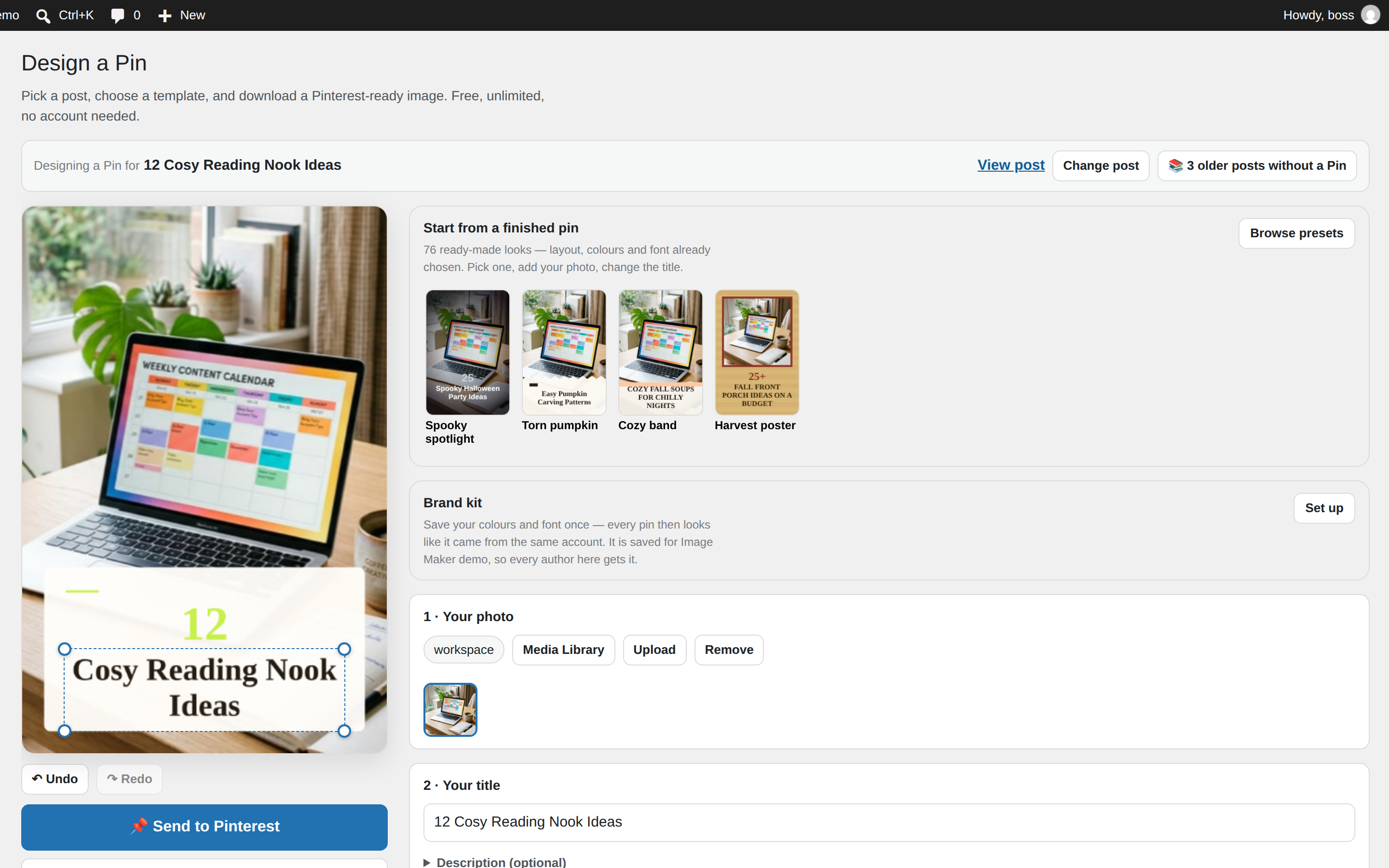
Open a post and the canvas is already composed — the featured image in place,
the post title as the headline, a sensible template, a 2:3 Pinterest canvas, the
permalink attached. Change what you want and download it. Most Pins take under a
minute.
Do I need an account? No — not to design, download or save to your Media
Library: all of that runs in your browser and on your own site, with no limit,
no watermark and no sign-up. A free account at
burnpedia.app is needed only for two optional things:
posting the finished Pin to Pinterest for you, and AI help that writes a Pin’s
words or makes its background photo (AI help also uses Burnpedia points). Both
are described under External services below.
How Burnpedia Image Maker is different
- It starts from the post, inside WordPress. The canvas opens with the
post’s featured image, title and permalink in place: nothing to upload, no
second tab. - The design work never leaves your site. Templates, editing, downloading
and saving to the Media Library run in your browser and on this site, and
send nothing to Burnpedia or anywhere else. - Made for the Pinterest shape. Every pin template is a real design built
for a tall 2:3 Pin, not a filter, with a warning when a size is a poor fit. - The Pin goes back into the post, as its featured image or appended to it,
from the same screen.
What you get
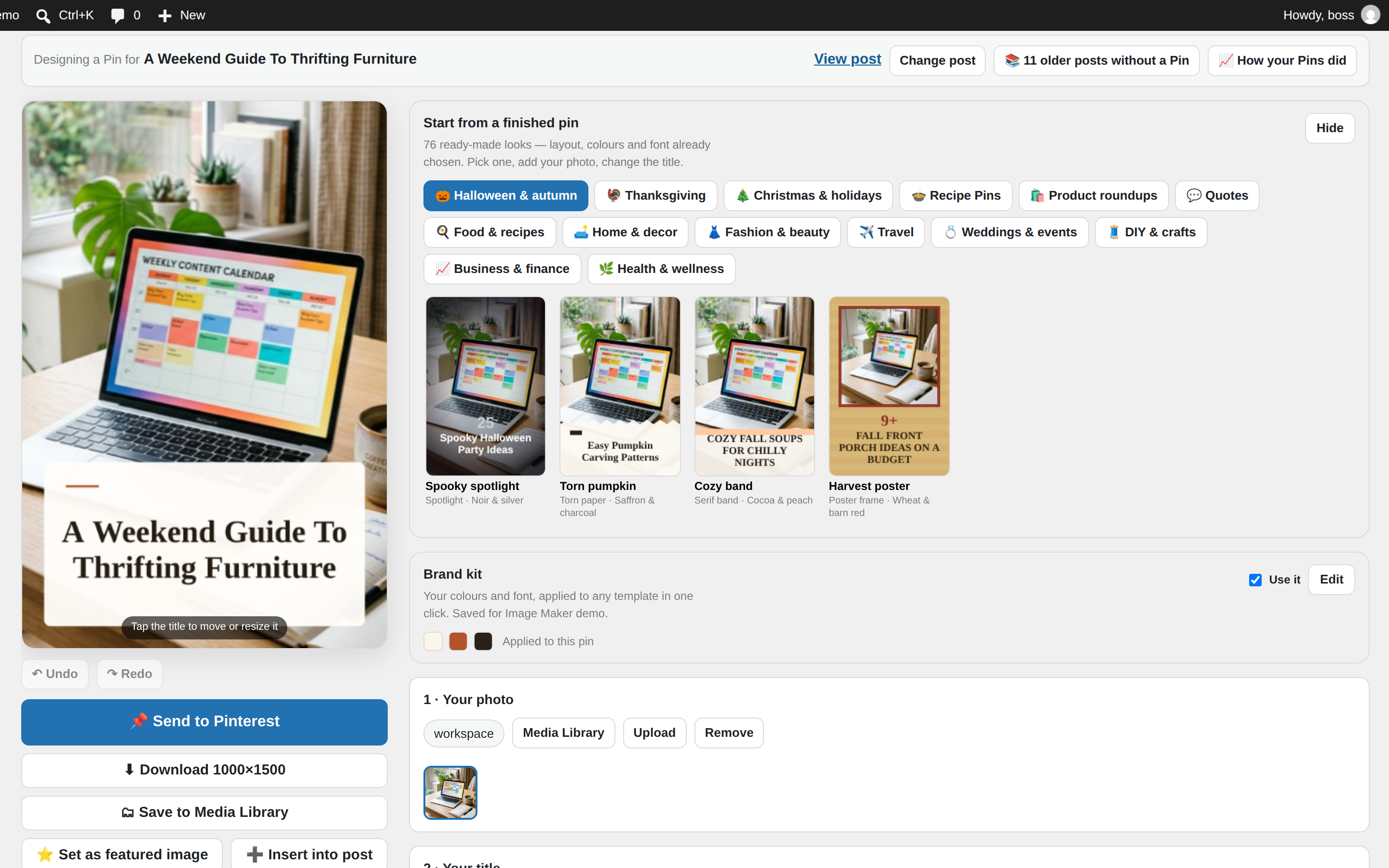
- 130 templates across two families — text laid over a full-bleed photo, and
layouts that hold the photo inside a designed frame (magazine cover, side split,
ticket stub, arch pair, window pane, and many more). - 40 colour palettes, or your own brand colours.
- Your photos — the post’s featured image, any image already in the post, your
Media Library, or a file from your computer. Crop with 1–4× zoom and pan. - Text you can move — drag the headline anywhere on the canvas, resize it,
restyle it. Seven type choices, colour, size and a legibility scrim. - Extra elements — up to 12 text blocks, badges and stickers.
- A brand kit — your logo, your colours, your font, saved for this site, so
every Pin from this blog looks like this blog and every author here gets it.
Start it in one click from your theme’s own colours, and carry it to the other
sites you run if you have a Burnpedia account. - Any size from 400 to 3000 pixels, exported as PNG, JPG or WebP, with a
warning when a shape is a poor fit for Pinterest. - A set of Pins for one post – draw up to six at once, each on a different
template and using a different one of the post’s photos, then send them all
with one press. They go out one a day. - Optional AI help – have the Pin title and description written for you, or
a background photo generated from a sentence. The price in Burnpedia points and
your balance are shown before you press, a failed attempt costs nothing, and
the photo is saved to your Media Library. An administrator can also let
editors and authors use it, with a daily limit per person. - Seasonal and niche template packs – holiday packs appear about two months
before the day (Halloween, Thanksgiving, Christmas, New Year, Valentine’s Day,
Easter, summer, back to school), alongside packs for recipes, product
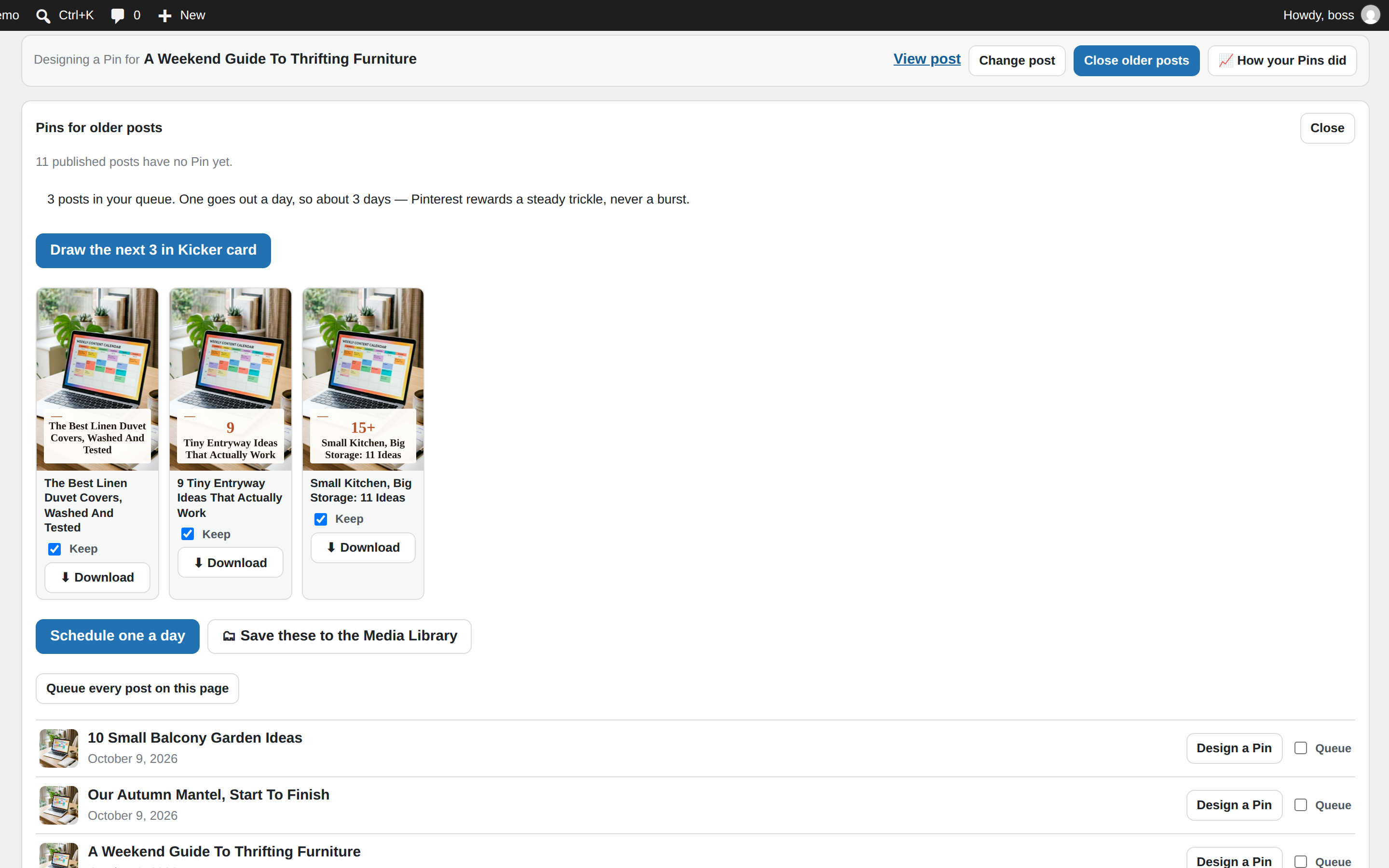
roundups and quotes. - Pins for your older posts – a list of every published post that has no
Pin yet, with a Design a Pin button on each. Tick the ones you want and they
go out one a day, never on a day that is already full. - A Pin drafted when you publish – with a brand kit saved, every new post
gets a Pin drawn in your brand and template, waiting in the editor for you to
approve, edit or discard. Nothing is posted until you press approve. - How your Pins did – views, saves, close-ups and visits to your site for
the Pins sent from this site, and which of your templates people save most.
New Pins start with small numbers, and the screen says so. - Undo and redo, and an autosaved draft so a closed tab does not lose work.
What you can do with a finished Pin
- Download it — full resolution, no watermark, ever.
- Save it to your Media Library.
- Set it as the post’s featured image.
- Insert it into the post (it asks first, and it only ever appends).
- Send it to Pinterest — optional, and the only part that needs an account.
Nothing is locked
There is no pro version of the editor, no watermark and no trial, and nothing in
the editor stops working without an account. Two optional extras are services
Burnpedia runs, and they are the only things that can cost anything: posting to
Pinterest, which is metered by how many Pins a day you post, and AI help, which
uses Burnpedia points and shows the price before you press. Everything else here
is simply free.
External services
This plugin is a client for Burnpedia (https://burnpedia.app), a Pinterest
scheduling service we operate. It is used for two optional features: sending a
finished Pin to Pinterest, and AI help in the editor.
Nothing is sent until you take one of the steps below. With no API key saved, a
request leaves this site only in these four cases, each described below: you
press Connect this site, you switch on the optional install count, you press
Send report on the Report a bug screen, or you open the More plugins
screen (which asks WordPress.org, not Burnpedia). Nothing happens on activation.
There is no third-party asset — every script,
style and font in this plugin is served from your own site.
No request to Burnpedia carries your site’s address in its headers: each
one sets its own User-Agent (WordPress’s default one names the site). The More
plugins list is not one of them: WordPress fetches it itself, through
plugins_api() as Plugins → Add New does, with that default User-Agent.
Where a request does send the site’s address, a permalink or an image address,
the list below says so.
Pressing Connect this site makes exactly one kind of request, and it carries
nothing about you or your site:
POST https://burnpedia.app/api/site-connect/claim— after you press
Connect this site, while you are approving the connection on burnpedia.app.
Sends: two random strings this site generated for that one connection, and the
plugin’s name and version. Receives: a short status word – whether you have
approved it yet – and, once you have, your new API key, which the plugin saves
for you. Nothing else comes back. Your site’s address and name are shown on the
approval page because they travel in the link your browser opens; this request
does not carry them, not even in its User-Agent header. If you approve nothing,
no key is ever created and the request stops on its own after fifteen minutes.
When a key is saved, these requests are made, and only these:
GET https://burnpedia.app/api/v1/me— when an administrator opens the Send
panel or the Connection screen, and when a key is saved; and, only if an
administrator has switched on AI help for the team, when an editor or author
opens the AI panel (so the price is shown before they press anything). Sends:
your API key. Receives: your plan, how many Pins you have posted today, your
AI points balance and prices, and whether a Pinterest account is connected.GET https://burnpedia.app/api/v1/boards— when an administrator opens the
Send panel, to list your Pinterest boards. Sends: your API key. Receives: board
names and ids.-
POST https://burnpedia.app/api/v1/pins— only when you press Send to
Pinterest. Sends: your API key, the public URL of the Pin image you just
saved to your Media Library, the Pin title, the post’s permalink, and the board
you chose (or a board name taken from the post title). Pinterest then downloads
the image from your site at that URL. -
GET https://burnpedia.app/api/v1/analytics/site— only when an administrator
opens How your Pins did in the editor, at most once every fifteen minutes.
Sends: your API key and this site’s address. Receives: the impressions, saves
and clicks Burnpedia has already recorded for Pins that link to this site. It
does not ask Pinterest anything. -
GET https://burnpedia.app/api/v1/brand-kit— only when an administrator
presses Use my account’s kit here in the Brand kit panel. Sends: your API
key. Receives: the colours, font and logo address saved on your Burnpedia
account, so the same brand can be used on more than one site. -
PUT https://burnpedia.app/api/v1/brand-kit— only when an administrator
presses Save to my Burnpedia account. Sends: your API key and this site’s
brand kit – three colour values, a font name, and your logo’s address. -
POST https://burnpedia.app/api/v1/copy— only when someone presses Write it
for me in the optional AI panel: an administrator, or an editor or author if
an administrator has switched on AI help for the team. Sends: your API key, the
Pin title you have typed, and the post’s permalink. Receives: a suggested
title, description and keywords, and how much AI credit that used. POST https://burnpedia.app/api/v1/images— only when someone presses
Generate the photo in the optional AI panel: an administrator, or an editor
or author if AI help is switched on for the team. Sends: your API key, the
description of the photo you typed, and the shape you chose. Receives: the
address of the generated
image, and how much AI credit that used.GET https://burnpedia.app/api/uploads/...— immediately after the request
above, to download that image so it can be saved into your own Media Library.
Sends: nothing but the request for that address (no API key). Receives: the
image file. Only an address that burnpedia.app itself just returned is ever
fetched.
The AI panel is optional and appears only when a key is saved. Designing,
editing, downloading and saving a Pin to your Media Library send nothing off
this site (the editor calls only this site’s own REST API for them); they work
with no account, and nothing in this plugin charges for them.
Your brand kit is stored on this site and works with no account at all. Those
two requests happen only when you press one of those two buttons, and never on
their own.
Every request to Burnpedia also carries the plugin’s name and version.
Burnpedia’s terms: https://burnpedia.app/terms
Burnpedia’s privacy policy: https://burnpedia.app/privacy
Pinterest itself is never contacted by this plugin. You connect Pinterest once,
on Burnpedia, through Pinterest’s own login screen; this plugin never sees or
stores a Pinterest credential.
Burnpedia is our own service and is not affiliated with Pinterest, Inc.
The install count (optional, off by default). WordPress.org does not tell
plugin authors how many sites are running their plugin — for this plugin it
publishes no figure at all. If you switch this on under Image Maker → Connection, this site
sends a short report:
POST https://burnpedia.app/api/plugin-insights— once when you switch it on,
then at most once a week while an administrator is using wp-admin, once if you
deactivate the plugin, and once if you delete it. Sends exactly nine things: a
random ID generated on this site, which plugin and which version, which of
those four events it is, your WordPress version, your PHP version, your site
language, whether this is a multisite network, and whether an API key is saved
(true or false — never the key). Receives: nothing your site uses.
No install-count report carries your website address, not even in the
User-Agent header: the plugin sends its own. The random ID is made up on your
server and means nothing outside it. Answering “No, send nothing” sends nothing
at all. Switch the setting off and the ID is deleted, so counting
stops and a later change of mind cannot be joined to it. It is off until you
choose it, no feature depends on it, and nothing about any reader or any
logged-in user is in it.
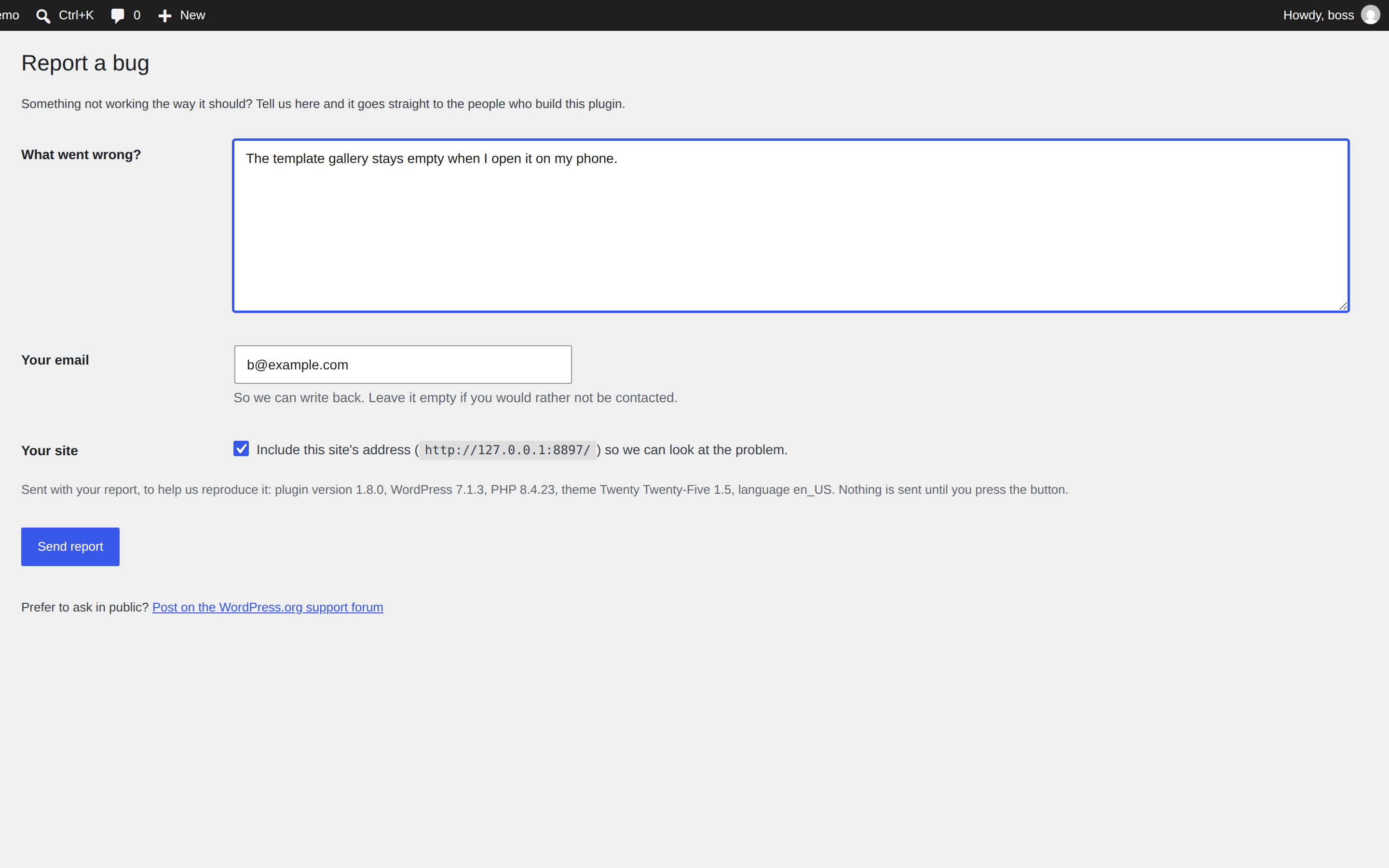
Report a bug (only when you send one). The Image Maker → Report a bug screen
sends what you type straight to the people who build this plugin. Nothing is sent
until you press Send report, and the screen lists what goes with it first:
POST https://burnpedia.app/api/plugin-bug-report— sends your description,
the email address you leave for a reply (optional — leave it empty and we
cannot answer), this plugin’s name and version, your WordPress version, PHP
version, theme name and version, site language, whether this is a multisite
network, and whether an API key is saved (true or false — never the key).
Your site’s address is sent only if you leave “Include this site’s address”
ticked (it starts ticked; untick it and the address is not sent, not even in
the request’s headers). Receives: a reference number for your report. We use a report only
to answer you and to fix the problem. No API key or account is needed.
More plugins (only when you open it). The Image Maker → More plugins screen
lists our other free plugins. When an administrator opens it, WordPress asks
WordPress.org (https://api.wordpress.org/plugins/info/) for that list through
its own plugins_api() — the same request WordPress makes on Plugins → Add
New — and keeps the answer for twelve hours. Installing one uses WordPress’s
own installer and downloads it from WordPress.org. Nothing is installed or
activated unless you press its button, and nothing is sent to Burnpedia.
Installation
- Install and activate the plugin.
- Go to Image Maker → Design a Pin, or use the Design a Pin link on any
post in the Posts list. - Pick a template, adjust anything you like, and press Download.
That is the whole setup. There is nothing to configure and no account to create.
If you also want the plugin to post Pins to Pinterest for you, go to Image
Maker → Connection and press Connect this site. A tab opens on
burnpedia.app where you create a free account and approve the connection; your
site collects its own key, so there is nothing to copy or paste. If you would
rather do it by hand — or your site cannot reach the internet — the same screen
still accepts a key pasted from your Burnpedia dashboard.
FAQ
Do I need an account?
No, not for designing. Choosing templates, editing, cropping, styling text,
exporting, downloading and saving to your Media Library all run in your browser
and on your own site, with no account, no limit and no watermark.
You need a free Burnpedia account for two optional things: posting a Pin to
Pinterest from inside WordPress, and AI help that writes a Pin’s title and
description or makes a background photo, which uses Burnpedia points. Both are
clearly marked, and neither is needed to design, download or save a Pin.
What happens when I hit 3 Pins a day?
The free Burnpedia plan posts up to 3 Pins a day. When today’s allowance is
used, the plugin says so, tells you when it resets, and offers to schedule the
Pin for tomorrow instead. Nothing is lost — the Pin waits, it is not
discarded, and you can still design and download as many Pins as you like.
The allowance resets at midnight UTC, which the plugin translates into your
site’s own timezone so the time it shows is the time on your clock.
Does it come with Pinterest templates?
Yes — 130 Pinterest templates in two families: text over a full-bleed photo, and layouts that hold the photo in a designed frame. The gallery previews every one against your own photo, with 40 colour palettes or your brand colours.
Can I create Pins for my old posts?
Yes. Press the “older posts without a Pin” button above the editor to see every
published post that has no Pin yet. Design one at a time, or tick several: they
are drawn in your current template and brand, and you can download them, save
them to your Media Library, or schedule them one a day. One a day is on purpose:
each Pin is booked for the day after the one before, skipping any day your
Pinterest account already has five Pins planned on, up to 30 days ahead; the
rest stay queued and go out as those days pass.
Can it design a Pin automatically when I publish a post?
Yes, once you have saved a brand kit. Each new post gets a Pin drawn in your
brand and your chosen template, waiting at the top of the editor for you to
approve, edit or discard – nothing is posted on its own. A number on the Image
Maker menu shows when drafts are waiting. You can switch it off in the editor.
How do I see how my Pins did?
Administrators get a “How your Pins did” button in the editor once the site is
connected to Burnpedia. It shows views, saves and visits for the Pins that link
to your site, and which template is winning. New Pins often get only a handful
of views in their first weeks; the screen explains that rather than leaving you
looking at small numbers.
Can my editors and authors use AI help?
Only if an administrator switches it on under Image Maker → Connection. AI help
spends the account’s points, so it is off by default, contributors never get it,
and each person has a daily limit you choose. The price is shown before every
press, and a failed attempt does not count.
Is there a watermark?
No. Never, on any plan, including no plan at all.
Will it change my posts?
Only if you press Insert into post, and it asks you to confirm first. It
appends the image to the end of the post and never rewrites anything that is
already there. Setting a featured image changes only the featured image.
Who can use it?
Anyone who can edit posts can design and download Pins. Saving to the Media
Library needs upload permission. Sending a Pin to Pinterest needs the same
permission as publishing the post itself — it posts to the site owner’s public
Pinterest account, so it is not something a contributor can trigger. Saving the
API key is administrator-only.
Sending and inserting also check the image, not only the post: it has to be an
image you may edit, and one this plugin made for that post. Nobody can point
either action at somebody else’s file in the Media Library.
Which post types work?
Every public post type with an editor screen. Developers can change the list with
the pin_maker_post_types filter.
Does it work on a phone?
Yes. wp-admin gets used on phones, so the editor does too: the canvas takes a
finger, the controls stack, and nothing is smaller than a thumb.
My image will not load into the editor.
The canvas can only read images your own site serves. If your media is offloaded
to a separate CDN domain, download the image and upload it in the editor instead.
The plugin tells you when this happens rather than failing at export time.
Is the JavaScript readable?
Yes. admin/js/editor.js is a build — it turns JSX into React.createElement
calls and concatenates ES modules — but it is shipped completely unminified and
unmangled, with every original comment intact, and admin/js/editor.build.json
lists exactly which source file each part came from. React itself is not bundled:
the plugin uses WordPress’s own wp-element.
How do I report a bug?
Open Image Maker → Report a bug, say what happened and press Send report. It goes straight to the people who build this plugin, with the version numbers we need to reproduce it; leave your email and we will write back. The WordPress.org support forum works too.
Do you make other plugins?
Yes. Image Maker → More plugins lists our other free plugins, and each one installs in one click through WordPress’s own installer.
Screenshots




Changelog
1.8.2
- Fixed: on a computer, the Pin preview stays in view while you scroll the
design settings beside it. It used to scroll away, so each template and
colour was picked a screen below the Pin. - Fixed: on a phone or tablet, a swipe over the preview scrolls the page, even
when the photo is zoomed. Tap the photo first to move it. - New: Fit whole photo under Crop & framing shows a wide photo whole in a
tall Pin, with a blurred copy of the photo or the template’s colour around
it. The zoom now also goes below 1×. - New: a text, badge or sticker tilts with two buttons, 3° a tap, and ↺ puts it
straight. The zoom, the title size, an element’s size and the finish strength
each have a ↺ back to where they started, and “Reset text style” (or badge or
sticker style) puts back its look and keeps its words and place. - The Connection page’s opening sentence now names everything on that page:
the connection that Send to Pinterest and AI help use, who on your team may
use AI help, and the install count question. - The FAQ answer about Pins for older posts now says how the queue spaces them:
each Pin is booked for the day after the one before, skipping any day that
already has five Pins planned, up to 30 days ahead. - Code comments that gave an out-of-date template count, or said the More
plugins page makes only one request, are corrected. Nothing the plugin does
changes with them. - What makes Burnpedia Image Maker different: it starts from the post, inside WordPress, with the post’s featured image, title and permalink already on the canvas.
1.8.1
- Fixed: requests to Burnpedia no longer carry your site’s address in their
User-Agent header. WordPress’s default User-Agent names the site, and until this version
the install count, a bug report, the one-press connection, the AI image
download and every API request used it, although this page said the address
was not sent. Each of those requests now sends its own User-Agent. - Fixed: answering “No, send nothing” to the install count sent one last
“opt-out” report. It now sends nothing at all. - Fixed: the weekly install count could be sent by a logged-out request to
admin-ajax.php or admin-post.php, or while a subscriber was in wp-admin. It is
now sent only while an administrator uses wp-admin. - The install-count panel and this page now name every field the count sends,
and say plainly which requests can happen before an API key is saved. - This page now says that the More plugins list is fetched by WordPress itself,
with WordPress’s own User-Agent, and that the design work calls only your
site’s own REST API. Design a Pin says how this plugin is different, in a
short note under its title. - Uninstall now also removes the Report a bug screen’s short-lived result.
- The parts shared with Burnpedia’s other plugins now load under new names, so
an older copy inside another Burnpedia plugin on the same site can no longer
undo these fixes.
1.8.0
- New: Report a bug in the Image Maker menu. Describe a problem and it reaches us
directly, with the plugin, WordPress and PHP versions we need to reproduce it.
Your site’s address is included only if you leave its box ticked (until 1.8.1
it also went in the request’s User-Agent header), and nothing is sent until
you press Send. - New: More plugins in the Image Maker menu lists our other free plugins, each
installed in one click through WordPress’s own installer from WordPress.org. - The FAQ now answers “Does it come with Pinterest templates?”.
1.7.0
- New: a getting-started checklist – design, download, and (optional) connect
and send. - New: Pins for your older posts – every post without a Pin, with a queue that
schedules them one a day, never on a day that is already full. - New: with a brand kit saved, each new post gets a Pin drafted in your brand,
waiting for you to approve it. Nothing is posted until you do. - New: seasonal and niche template packs – holiday designs appear weeks before
the day, plus recipe, product roundup and quote packs. - New: How your Pins did – views, saves and visits for the Pins from your
site, and which template people save most. - New: an administrator can let editors and authors use AI help, with a daily
limit per person. Off by default. - Fixed: on sites using Plain permalinks, saving to the Media Library and
several other actions failed.
1.6.1
- Listing: says plainly that AI help needs a Burnpedia account and uses
Burnpedia points, and that posting to Pinterest and AI help are the only two
things that can cost anything. Nothing in the plugin itself changed.
1.6.0
- New: once you have made a few Pins, the editor asks one time whether you
would like to leave a review, with the support forum listed first. Answer
it, or press No thanks, and it never appears again.
1.5.0
- New: optional AI help in the editor. Have the title and description written
for you (1 point) or a background photo generated (14 points). The price and
your balance are shown before you press, a failed attempt is never charged,
and a generated photo is saved to your Media Library. Needs a Burnpedia
account; designing, downloading and saving stay free. New: a Pin description
field.
1.4.0
- New: an optional install count under Image Maker → Connection. WordPress.org publishes no
install figure for this plugin, so we genuinely cannot tell how many sites use
it. Switch this on and your site sends a random ID once a week so it can be
counted. Your website address is not in the report (until 1.8.1 it went in
the request’s User-Agent header). It is off unless you turn it on, nothing
depends on it, and turning it off deletes the ID.
1.3.0
- New: draw a whole set of Pins for one post at once – up to six, each on a
different template and using a different one of the post’s photos. Keep the
ones you like and send them with a single press; they go out one a day.
1.2.0
- Your brand kit is now saved for the whole site instead of just your browser,
so every author here gets the same colours. Start one in a click from your
theme’s own palette, and carry it to the other sites you run.
1.1.4
- The plugin page now links to burnpedia.app where it mentions it, instead of
printing the address as plain text.
1.1.3
- Fixed: the template gallery showed blank cards. Every preset drew nothing at
all, in every browser – so the one screen that shows you what the 130 designs
look like was empty. The designs themselves were always fine. - The template thumbnails now use the same code path as the editor, so a design
looks in the gallery exactly like it looks when you open it.
1.1.2
- The preview now wraps your headline exactly where the downloaded image does.
It used to draw the design at preview size, which could break the title onto a
different number of lines than the file you ended up with. - Fixed: the plugin’s internal version number had not been updated, so browsers
could keep serving a cached copy of the older editor after an update.
1.1.1
- Fixed: the “Logo corner” setting had never actually moved the logo – every
image put it in the top left whatever you chose. 1.1.0 shipped with that
still in it. - The drag, the resize and the “Find a clean spot” button announced in 1.1.0
are now really wired into the editor here, not only on the website.
1.1.0
- The logo is now a real object: drag it anywhere on the canvas instead of
choosing one of four corners, resize it with + and -, and it snaps to the
centre lines and to the corners. Undo restores it with the rest of the design. - New “Find a clean spot” button. It measures the finished image – not the
photo underneath it – and moves the logo to the lightest, calmest area that
is clear of the headline. If there is no good spot it says so instead of
putting the logo somewhere bad. - New “Match colours to my logo”. It reads the colours out of your logo and
offers the three closest of the built-in themes. - Fixed: the live preview did not draw your logo at all, so the only way to see
where it had landed was to download the image.
1.0.1
- Connect your site in one press: approve it once on burnpedia.app and your site
collects its own key. Nothing to copy, nothing to paste, and the key is never
shown on screen. Pasting a key by hand still works exactly as before. - Fixed: the “Create a free account” link in the Send panel pointed at a page
that did not exist.
1.0.0
- First release.