


Description
ClearComet Cloak for MCP is an on/off curtain in front of your site’s MCP and Abilities routes.
WordPress sites now have routes that AI assistants and bots use: the MCP Adapter’s mcp routes, the Abilities API, and MCP servers added by other plugins. Those routes are listed in the public /wp-json index unless something removes them.
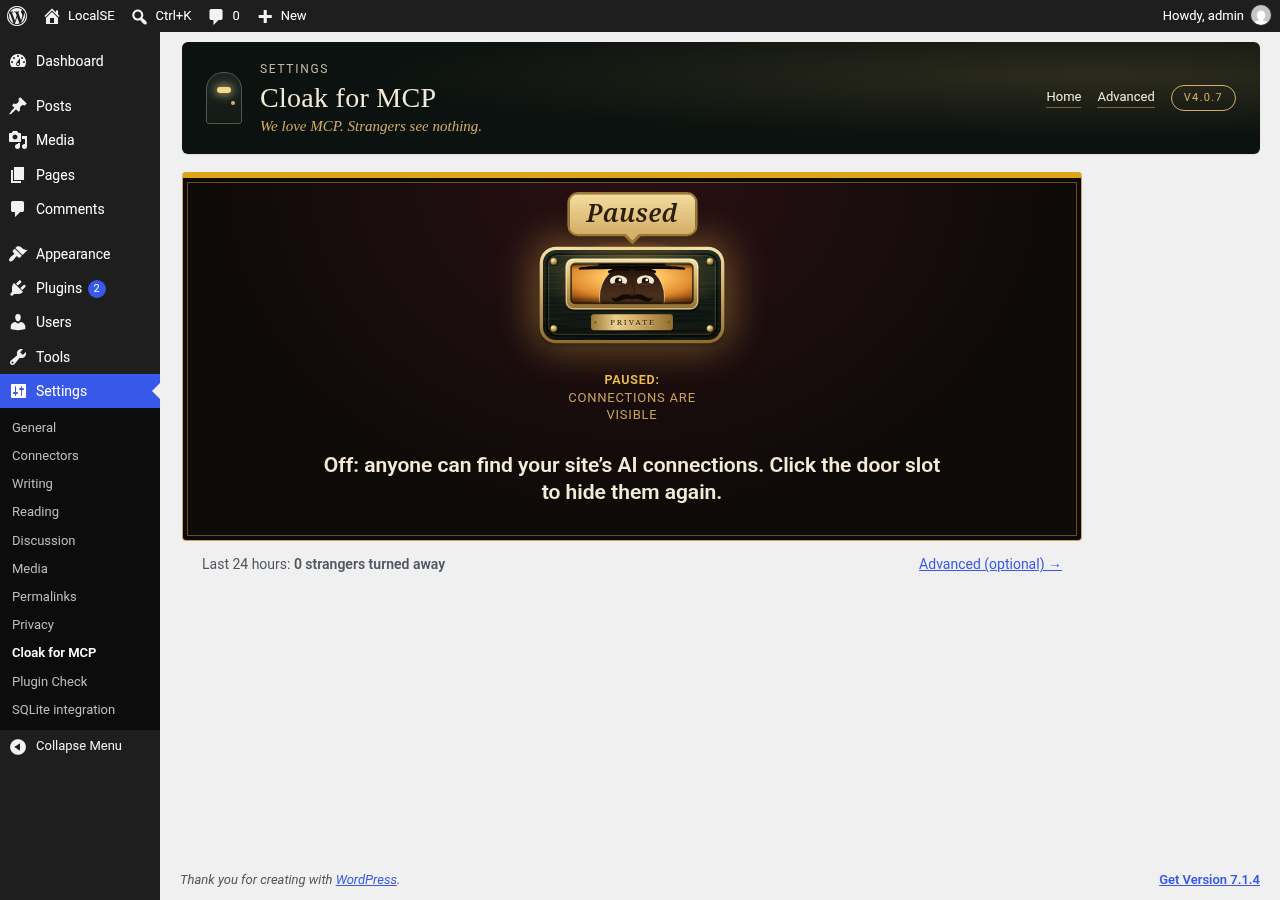
A new install starts paused. Cloak saves that explicitly (on is false) and shows a notice, with Turn on and a link to the settings screen, until you turn it on. The switch on that screen shows Paused. Updating from an older version does not change your on/off choice. A site that was already protected stays protected, including one that never saved a settings row (on those versions, no row meant on).
Once Cloak is on, the default door mode is lights out. A stranger who requests a hidden route gets WordPress’s ordinary not-found answer (rest_no_route, 404), and those routes are left off the public /wp-json index. You do not have to create a key. Who gets in:
- You, in the browser: a logged-in session that sends WordPress’s REST nonce (
X-WP-Nonceor_wpnonce). The block editor does this. A cookie with no nonce does not count. An application password does not count unless you turn that rule on. - AI assistants and bots WordPress has already logged in: if another plugin has accepted the login (for example a checked OAuth token), the hidden route stays in place. Cloak does not read the Authorization header. A missing, wrong, or expired token is still a 404. Sites that want a Cloak key as well can turn this off with the
cloak_allow_authenticated_usersfilter. - Your own scripts: send a secret key in the
X-Cloak-Keyheader (optional, Advanced). The olderX-BlindPig-Keyheader still works. - Guest addresses (optional, Advanced): an IP address or range you add. One preset is offered and stays off until you click it.
-
Unlisted mode (optional, per door): the route stays off the public index, and a request to the address itself is answered by the route. Use this when an assistant must see
401andWWW-Authenticateon its first, still-anonymous request. Anyone who already knows the address can tell the route exists..well-known OAuth files are not hidden.
/.well-known/oauth-protected-resourceand/.well-known/oauth-authorization-server, including path-scoped copies, can name your MCP address. Cloak leaves them up so other OAuth uses on the site keep working. The first anonymous request to the MCP address is still a 404 in the default mode. The follow-up request gets through only after WordPress has accepted the login, or you have allowed a key, an address, or Unlisted mode.
WordPress still checks its own login after Cloak lets a request through. Cloak does not replace application passwords, and an application password alone does not get past Cloak.
Why this matters
People are already scanning the internet for MCP servers:
- A two-week log study of one small web host (one of its sites runs WordPress) saw MCP
initializehandshakes POSTed to/mcpfrom 49 different IP addresses, on a server that runs no MCP at all. SANS Internet Storm Center, diary 33150 - GreyNoise put MCP honeypots online, and every one was found within days. GreyNoise
- Knostic found 1,862 MCP servers exposed to the internet. All 119 it checked by hand listed their tools without any authentication. Knostic
- Bitsight found roughly 1,000 internet-reachable MCP servers with no authorization at all. Bitsight
- On WordPress, CVE-2025-11749 (AI Engine 3.1.3 and earlier, with its “No-Auth URL” option on) leaked an MCP bearer token through the public
/wp-jsonroute list; it is fixed in 3.1.4. Wordfence - A public Metasploit module (also published on Packet Storm) automates that attack against
/wp-json/mcp/v1/. Rapid7 Metasploit, Packet Storm via Vulners
To be honest about it: most of these knocks are reconnaissance, not attacks. GreyNoise saw no MCP-specific exploitation attempts in its honeypots. But being listed is how a site ends up on someone’s target list, and Cloak keeps your MCP doors off that list.
New installs start paused
Activate Cloak and it is not protecting yet. An admin notice stays up until you turn it on. It is not dismissible. It has Turn on and Open settings. After you turn it on, a separate notice explains how AI assistants and bots get in, and that one can be dismissed.
An update keeps the on/off state the site already had. Deactivating and activating again does not pause a site that was already set up. CLOAK_DISABLED in wp-config.php still forces Cloak off.
Everyday use
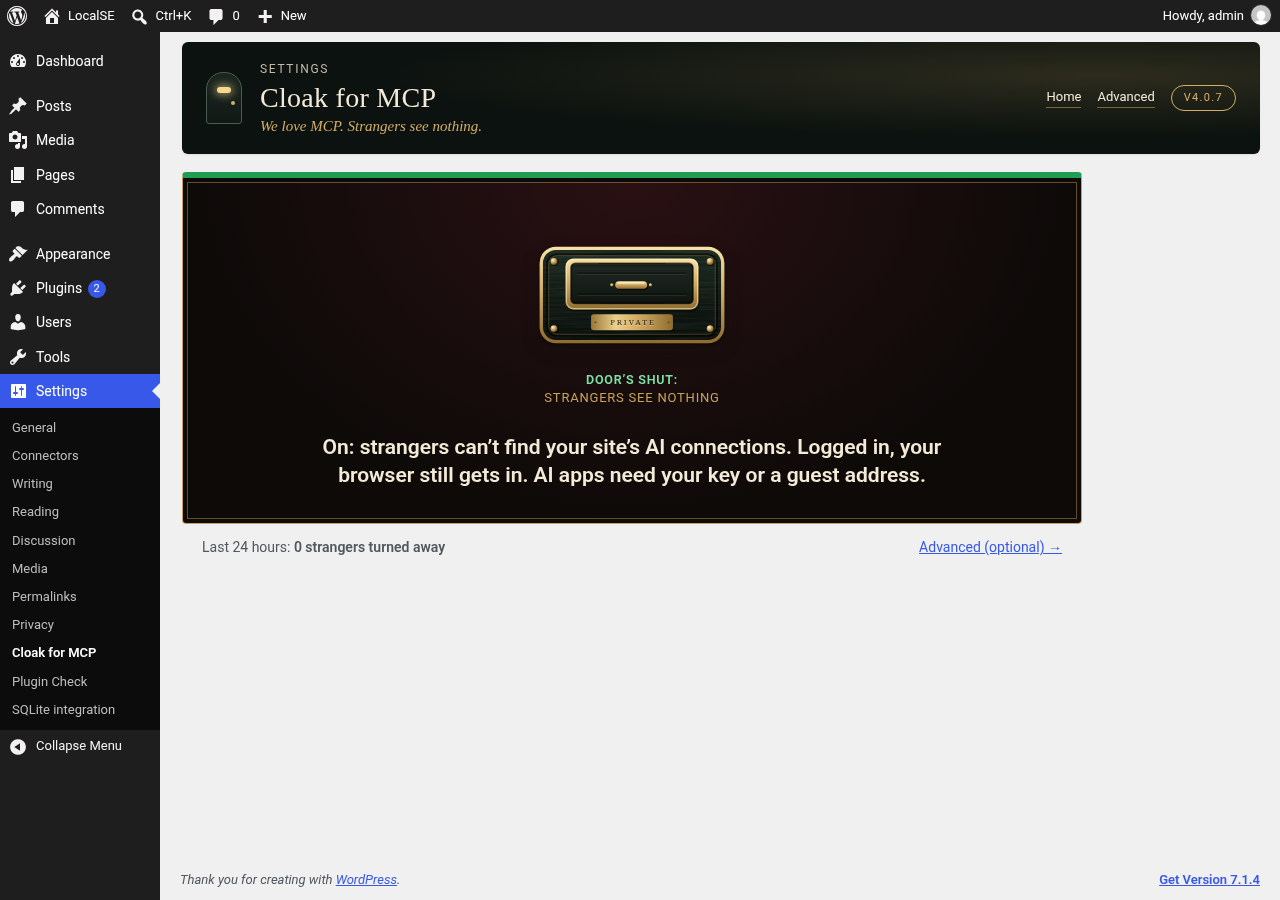
Settings > Cloak for MCP shows one door-slot switch and one line telling you whether you’re protected. Click the slot to pause or resume. Everything else is optional and lives on the Advanced pages: doors, the guest list, a secret key for your own apps, Cloudflare, access rules, an activity log and tools (export/import).
Secret key (optional)
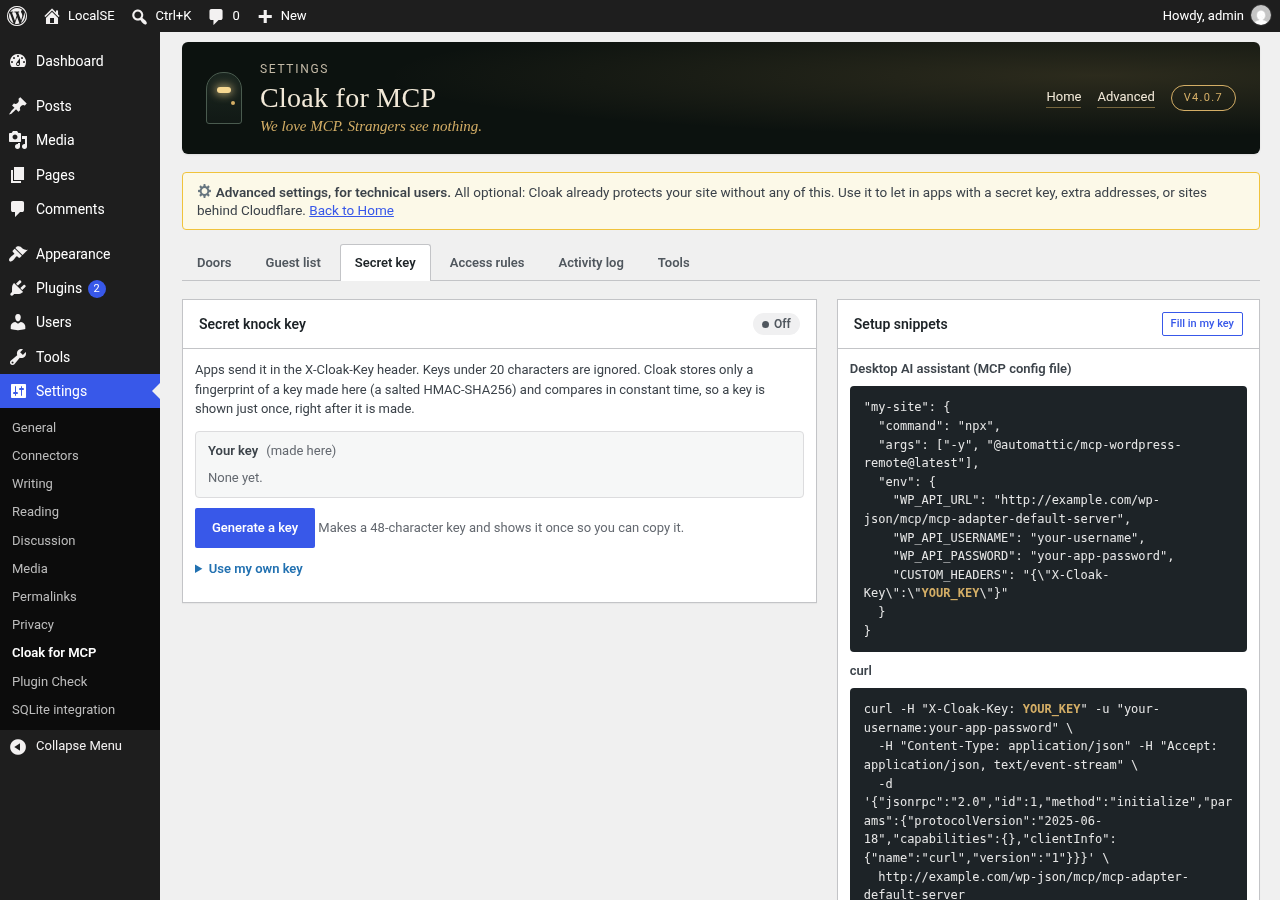
You don’t need a key. It’s only for your own apps or scripts that connect from changing addresses. Generate a key, or paste your own (20+ characters: letters, digits, _ and -). Apps send it in the X-Cloak-Key header. Rotate keeps the old key working for 24 hours so you can update your apps; Turn off stops it. The key page has ready-made snippets for a desktop AI assistant, curl and n8n.
Cloak stores only a fingerprint of the key (a salted HMAC-SHA256), never the key itself, so a new key is shown once, right after it is made. Lost it? Make a new one. Keys are never exported and are compared in constant time.
Cloudflare
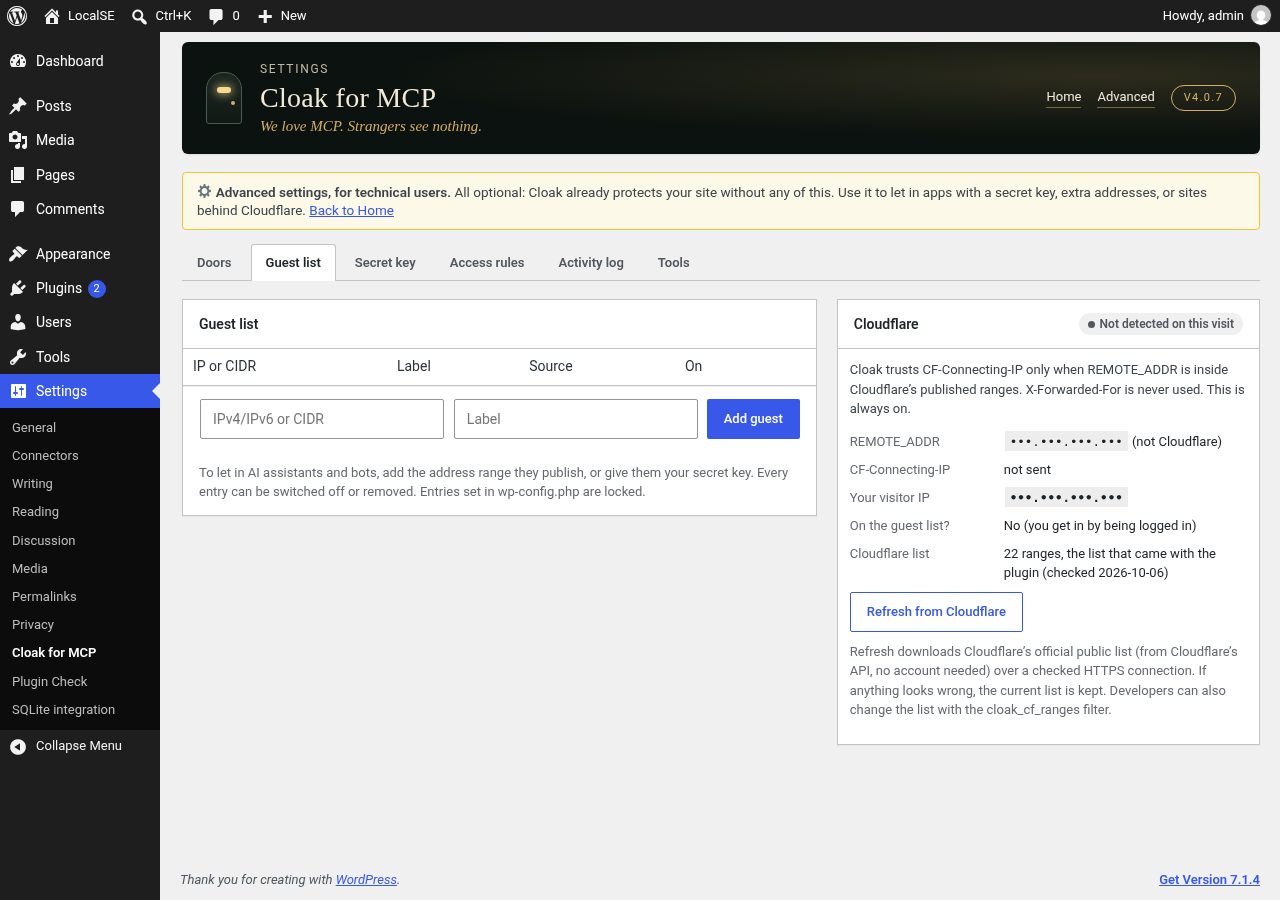
Cloak trusts the CF-Connecting-IP header only when the request really comes from one of Cloudflare’s published ranges. X-Forwarded-For is never used. The plugin ships with Cloudflare’s list (checked 2026-10-06); Refresh from Cloudflare on the Guest list page downloads the current official list from Cloudflare’s public API over a checked HTTPS connection, and keeps the old list if anything looks wrong.
Advanced: wp-config.php overrides
These optional constants pin a setting in code. The matching field shows as locked on the settings screen. They apply once protection is on, except CLOAK_DISABLED, which always switches protection off.
define( 'CLOAK_KEY', 'your-long-random-key' ); (20+ characters; works alongside a key made on the screen)
define( 'CLOAK_GUESTS', array( '203.0.113.7', '198.51.100.0/24' ) );
define( 'CLOAK_MODES', array( '/acme/v1' => 'lights_out' ) ); (modes: `open`, `unlisted`, `lights_out`)

lights_out (the default) answers 404 and hides the route from the index. `unlisted` hides the route from the index and lets the address itself answer, which is what an OAuth client needs in order to see 401. `open` leaves the route unchanged.
define( 'CLOAK_DISABLED', true ); (emergency off switch)
Advanced: filters for developers
cloak_presets: change or add guest presets. Each preset isid => array( 'label' => ..., 'cidrs' => array( ... ) ). A singlecidrstring is still accepted. Presets stay off until an administrator adds them. The olderblindpig_presetsfilter still runs first.cloak_cf_ranges: change the Cloudflare ranges used to trustCF-Connecting-IP.cloak_client_ip: supply the visitor address yourself if your site sits behind another trusted proxy. It must return a valid IP.cloak_allow_authenticated_users: default true. When true, a user WordPress has already logged in for this REST request may use a hidden route, unless that login is an application password or a cookie session (those keep their own rules). Return false to require a Cloak key, a guest address, or a browser nonce as well. Cloak never treats the Authorization header, by itself, as a login. The olderblindpig_allow_authenticated_usersfilter still runs first.
Privacy
Cloak never phones home: no tracking, no analytics, no account, no ads. It makes no outside requests except two optional ones that only run when an administrator clicks a button: the quick check, which asks your own site for one hidden door, and Refresh from Cloudflare (see “External services” below). The activity log keeps the last 200 visits to hidden doors (time, IP address, door, result) on your site only and never records headers or keys. Deleting the plugin deletes all of its data.
Disclaimer
Cloak is one layer of protection, not a guarantee. Keep WordPress, your plugins and your passwords up to date. Cloak is provided as-is, without warranty of any kind, under the GPL (see license.txt).
External services
Cloak connects to one outside service, and only when an administrator asks it to.
Cloudflare IP list (optional, manual). When you click Refresh from Cloudflare on Settings > Cloak for MCP > Guest list, the plugin sends one HTTPS GET request to https://api.cloudflare.com/client/v4/ips to download Cloudflare’s public list of its own server address ranges. The list is used only to decide when the CF-Connecting-IP header can be trusted.
- What is sent: a plain request with no data from your site, no API key and no account. Like any web request, it reveals your server’s IP address and WordPress’s standard user agent (which includes your site address) to Cloudflare.
- When: only when an administrator clicks the button. Never automatically, on a schedule, or on visitor requests.
- If you never click it, the plugin uses the list bundled with it and makes no request.
- Service provider: Cloudflare, Inc. Terms of use and Privacy policy.
The optional quick check sends one request from your site to your own site’s address; nothing goes to a third party.
Installation
- In wp-admin go to Plugins > Add New and search for “ClearComet Cloak for MCP”, or go to Plugins > Add New > Upload Plugin, choose the plugin zip and click Install Now, then Activate.
- A new install is paused until you turn it on. Settings > Cloak for MCP shows the switch. PHP 8.3 or newer is required. An update keeps the setting you already had.
FAQ
What is MCP?
MCP (Model Context Protocol) is the open standard AI assistants and bots use to talk to other software. On WordPress, the MCP Adapter and the Abilities API add web addresses (“doors”) that let an AI assistant read and change your site, if it has a valid login. Those doors are listed publicly by default, so anyone can see they exist and start trying them.
What do strangers see?
On a new install, nothing is hidden until you turn Cloak on. After that, a default (lights out) door returns WordPress’s standard rest_no_route 404, and the route is removed from the public /wp-json index and from that namespace’s listing. Pages, posts, wp-admin, and REST routes that are not hidden doors are left as they are. .well-known OAuth documents are not doors, so they stay public. OPTIONS on a hidden route can still return an empty JSON list with status 200.
Does an update turn Cloak off?
No. A site updated from 4.0.7 or earlier keeps its current on/off state. If that site never saved a settings row, it stays on, because that is what the older plugin did. A brand-new install is the one that starts paused.
What does “logged in” mean?
For the browser rule: a cookie session plus a valid WordPress REST nonce. The block editor sends this. An application password does not count as that browser session. A cookie with no nonce does not count: WordPress treats that request as logged out before Cloak runs. A login some other plugin has already accepted, such as a checked token, is a separate rule and does count unless you filter it off.
How do I let an app in?
Any one of these, and then the app’s normal WordPress login if the route itself requires one:
- Secret key in the
X-Cloak-Keyheader (Advanced > Secret key). The olderX-BlindPig-Keyheader still works. Use this for your own scripts. - A guest IP or range (Advanced > Guest list). One preset is on that screen and does nothing until you add it.
- Set that door to Unlisted. It stays off the public index. A request to the URL is answered by the route, so an OAuth client can get
401andWWW-Authenticateinstead of a 404. People who know the URL can tell the route exists.
Do .well-known files give away the MCP address?
They can. Cloak does not remove /.well-known/oauth-protected-resource or /.well-known/oauth-authorization-server, including path-scoped copies under that prefix. Those files are how some AI assistants and bots discover where to go, and other OAuth software on the same site may need them. The first anonymous request to the MCP address is still a 404. A later request gets through when WordPress has accepted that login. A rejected token stays a 404.
What if I lock myself out?
The browser rule is on by default, so the dashboard and the block editor keep working when they send the REST nonce. If something still goes wrong, any one of these makes every door visible again:
- Click the door slot on Settings > Cloak for MCP (it pauses protection).
- Add
define( 'CLOAK_DISABLED', true );to wp-config.php. This kill switch works even if you can’t reach wp-admin. - Deactivate the plugin, or rename its folder over FTP.
Does it phone home or collect data?
No. There is no tracking, telemetry, account or license check. The only outside request is the optional, manual Cloudflare list refresh described under “External services”. The activity log stays in your own database, never records headers or keys, and is deleted with the plugin.
I use Cloudflare
That works out of the box. Cloak reads the visitor’s real address from CF-Connecting-IP only when the request arrives from Cloudflare’s own ranges, so nobody can fake it. If you use a different proxy or load balancer, use the secret key for your apps rather than address-based helpers.
Why can’t I see my key again?
Cloak stores only a salted fingerprint of a key made on the settings screen, so even someone who can read your database can’t use it. That’s why a key is shown once, right after it is made. If you lose it, make a new one (or Rotate under Advanced, which keeps the old key working for 24 hours).
How private is my key?
- A key made on the settings screen is stored only as a salted HMAC-SHA256 fingerprint and shown once, when it is made.
- Rotate makes a new key and keeps the old one working for 24 hours, so you can update your apps. If a key leaks, rotate it (or turn it off).
- The activity log never records the key or any request headers.
- A key set with
CLOAK_KEYin wp-config.php is plain text in that file. Protect that file as you would your database password. - Cloak doesn’t force HTTPS. A key sent over plain HTTP can be read on the way, so use HTTPS on your site.
Cloak is a curtain in front of MCP, not the lock. After Cloak lets a request through, the route’s own WordPress checks still apply. An application password alone does not get past Cloak. The request needs a browser session with the REST nonce, a login WordPress has already accepted, a key, a guest address, or Unlisted mode (which lets the route answer by itself).
Does this work with the WordPress MCP Adapter?
Cloak’s default doors are the mcp namespace and the Abilities API routes. Other plugins’ MCP routes under /mcp are covered by that same door. Routes outside those prefixes are not hidden. Whether a given assistant can connect depends on the door mode and on how that assistant authenticates. See “How do I let an app in?” above.
Will an OAuth client still connect?
The first anonymous request on the default door is still a 404, with no WWW-Authenticate header. Set the door to Unlisted if the assistant must see that header before it can log in. After WordPress has accepted the token, the same default door lets the request through. Cloak does not inspect the Authorization header: a wrong or expired token, which WordPress does not accept, is still a 404. An application password is not this kind of login. A secret key or a guest IP also lets a request through. Return false from cloak_allow_authenticated_users if you want every assistant to need a Cloak key or a guest address even after WordPress has logged it in.
How do I hide /wp-json routes from the public index?
Activate Cloak. Hidden routes are removed from the public /wp-json index. On the default mode, a direct request gets rest_no_route 404. Other REST routes are left as they are. .well-known OAuth documents are not removed.
Does it replace app passwords?
No. App passwords (or any other authentication) are still checked after the door. Cloak adds a lock; it never removes one.
Screenshots

Changelog
4.0.8
- Requires PHP 8.3. On 11 November 2026, php.net lists 8.3 as security-supported until 31 December 2027.
- New installs start paused. Cloak stores
onas false and a setup-pending marker, and shows a notice with Turn on until you turn it on. That notice is not dismissible. After you turn it on, the dismissible “Cloak is on” notice appears. - Updates keep the on/off state already in effect. A pre-4.0.8 site with no settings row stays on. The check runs on load, so a file update that does not fire the activation hook still migrates. Deactivate and activate again does not pause a configured site.
- A stranger, a missing token, and a rejected token still get a 404. After WordPress has accepted a login that is not an application password and not a cookie session, the hidden route stays available. Cloak does not read the Authorization header.
cloak_allow_authenticated_users(default true) can turn that off. Application passwords stay opt-in. - Readme: “logged in” in the browser means a cookie plus the REST nonce.
.well-knownOAuth files can name the MCP address and are not hidden. Unlisted is how an assistant gets 401 on its first anonymous request. The default for that first request remains a 404. - One guest preset, labelled Anthropic outbound, with ranges 160.79.104.0/21 and 153.61.208.0/20. It stays off until you add it. No other provider preset.
- The hidden wizard no longer switches that preset off.
- Visible Blind Pig names in the plugin link, the plugins-screen status class, the settings script global, and the admin-ajax action are renamed. Saved options, the X-BlindPig-Key header, and the blindpig_* filters are unchanged.
- Upgrades keep keys, guests, and doors.
4.0.7
- Developer constants and filters now use the CLOAK_ / cloak_ prefix; old names keep working.
- Apps can send the key in the X-Cloak-Key header. The previous header keeps working.
4.0.6
- New name on WordPress.org: ClearComet Cloak for MCP (folder and text domain
clearcomet-cloak-for-mcp, settings under Settings > Cloak for MCP). - Notices now appear only on the plugin’s own settings screen and can be dismissed. No activation redirect.
- New installs accept only the new key header.
- Small code clean-ups for the plugin directory. No change to how protection works.
4.0.5
- New tagline: “We love MCP. Strangers see nothing.”
- The door slot badge now reads PRIVATE.
- Simpler guest list: add the address range your AI assistant or bot publishes. Guests you already saved keep working.
- Cleaner wording on the settings screens and in the readme.
4.0.4
- Clearer Home status: your logged-in browser gets in; AI apps need your key or a guest address.
- Readme: key privacy FAQ, “Why this matters” with sources, and a disclaimer.
4.0.3
- New installs start with an empty guest list. Add guests on Advanced > Guest list if you need them.
- Upgrades keep every guest they already had.
4.0.2
- Protection is on as soon as you activate. No wizard, no setup notice, and no keys to set up.
- The Home screen is now just the door slot and one plain status line. The key, guest addresses, Cloudflare and the old header moved to the optional Advanced pages.
- Upgrades keep your keys, guests and doors. Sites that were waiting for setup are now protected. A site you paused on purpose stays paused.
4.0.1
- Refresh from Cloudflare now uses Cloudflare’s official public API (
api.cloudflare.com/client/v4/ips); same validation and fallback. - Readme: External services section, plain-language FAQ.
- Added license.txt.
4.0.0
- Every function, option and hook now uses its own unique prefix.
- New knock header and new wp-config.php constant names.
- Security: the secret key is stored as a salted HMAC-SHA256 fingerprint and shown only once, when it is made (“Reveal” is gone).
- Cloudflare ranges can be refreshed from Cloudflare (certificate checked; the bundled list stays as the fallback), and changed with a filter. Presets can be changed with a filter too.
- The quick check’s loopback visit now uses normal certificate checks.
- Directory readiness: removed the
Update URIheader.
3.0.0
- Public release: no hard-wired access of any kind. The plugin folder no longer contains or reads a config file.
- Safe first install: nothing is hidden until the setup wizard is finished or protection is turned on; an admin notice links to the wizard.
- New 3-step wizard: pick doors, choose guests (you when logged in, a secret key made on the spot, a helper by address), then an honest quick check.
- “Use my own key”: paste an existing key (validated).
- wp-config.php constants remain as optional advanced overrides and are documented on the Tools page.
- Upgrading from 2.x keeps the choices made on the settings screen; protection waits until you review them in the wizard.
2.0.0
- Settings screen with the door-slot master switch, plain-language Home, Advanced pages and a setup wizard.
- Per-door modes, extra doors, guest list with Cloudflare panel, secret key with 24-hour rotation grace, access rules, activity log, quick check, export/import.