

Description
Colchis Cookie Consent shows a cookie banner and blocks analytics, advertising and other trackers until the visitor agrees. It works completely on its own: after you activate it, the plugin does not contact any Colchis server and loads all its files from your own site.
- Automatic blocking of trackers before consent, both on the server (in the page HTML) and in the browser
- Known embeds (YouTube, Google Maps, social widgets) wait for consent too
- Google Consent Mode v2
- The visitor’s choice is remembered in the visitor’s browser, also in Safari for the full period
- Compatible with common caching and optimization plugins (the script is marked so they leave it alone)
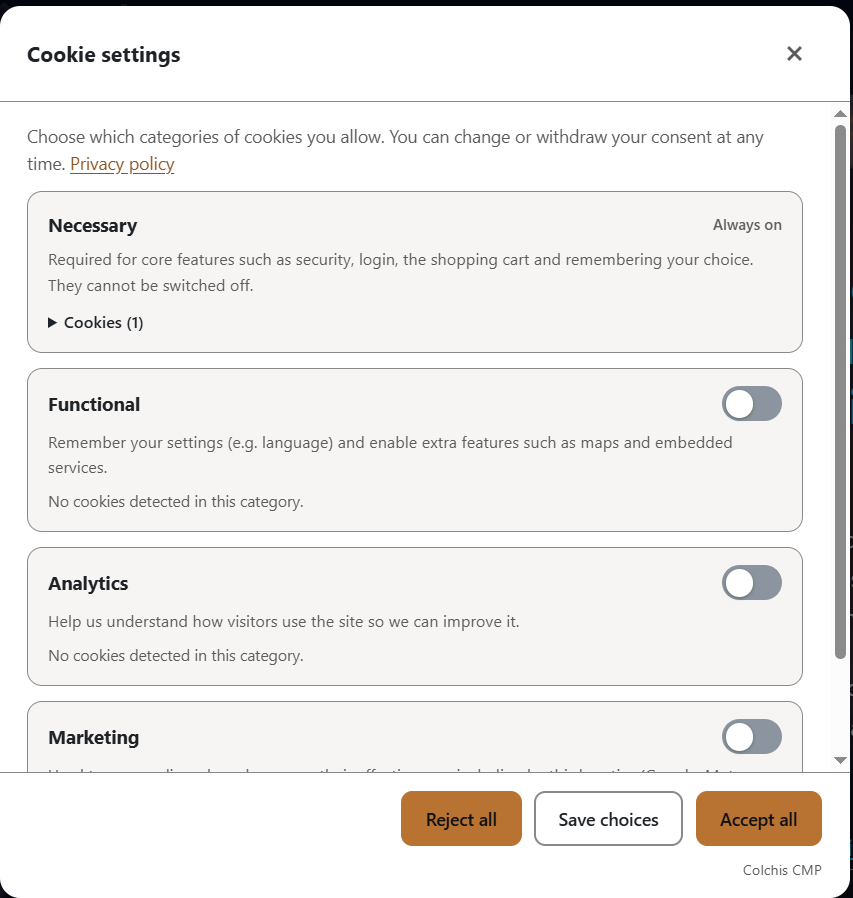
- The banner speaks your site’s language by itself — English, Georgian, Russian, German, French, Spanish, Italian, Polish or Dutch
- Its own place in the WordPress menu, with the banner message in one simple field; the wording of every other text is under “Advanced customization”
- Any other language too: write the banner texts yourself and they are used as they are
- No account and no subscription: blocking, the banner and Consent Mode are free and stay free
Optional: connect to the Colchis service. If you want a dashboard, a scan that lists the cookies your site really uses, banner colours and layout set in the dashboard, a log of consents as proof, or (on the Pro plan) a site in several languages where every page shows the banner in its own language, press Connect to Colchis on the plugin’s page (Colchis Cookies in the left menu of WordPress). You sign in or create a free Colchis account and approve there; the dashboard shows a 6-digit code. You come back to the plugin’s page, type the code and press Link this site: your site is added automatically and there is no DNS record, file or tag to add. The banner on your site then becomes the Colchis service’s own banner: the part that shows it (texts, styles and dialogs) is loaded from the service, while the script that blocks trackers always stays a file of this plugin on your own site. Connecting is the only thing that makes this plugin, or your visitors’ browsers, contact a Colchis server (see “External services” below), and you can disconnect on the same page at any time.
Credit. This plugin never adds a credit or link to your site. On the free plan of the Colchis service, the service’s banner (used only after you connect) shows a small “Powered by ColchisLab” line in the banner and in its cookie settings window, which a paid plan can remove; the plugin’s page says so next to the Connect button and on its Help & data tab.
External services
This plugin works without any external service. Everything below happens only after the site owner presses “Connect to Colchis” on the plugin’s page (Colchis Cookies in the left menu of WordPress). After installation and after every update the site is not connected; until it is, neither the plugin nor the visitor’s browser makes any request to the addresses below. “Disconnect this site” on the same page puts the site back in that state.
The Colchis service is provided by Colchis lab LLC (ColchisLab), Tbilisi, Georgia, on servers in Germany. The addresses cdn.colchislab.com and api.colchislab.com are served through Cloudflare.
Terms of service: https://colchislab.com/terms/
Privacy policy: https://colchislab.com/privacy-policy/
Connecting the site (api.colchislab.com and app.colchislab.com)
What it is for: linking this site to a Colchis account without anything to copy or paste, and making sure that the site is linked to the account of the person who administers it and to nobody else.
What is sent and when:
- When the site owner presses “Connect to Colchis”: from your WordPress server to api.colchislab.com, the site’s address, a one-way fingerprint (SHA-256) of a random secret that stays on your site, the address of the plugin’s page in your WordPress admin (so that the dashboard can send the owner back there) and the plugin version. Then the owner’s browser opens app.colchislab.com, where the owner signs in or creates a free account and approves. The request number is in the part of the address after the # sign, which browsers do not send to a server.
- After the owner approves, the Colchis service checks that the site is the owner’s: its server requests one address of the site,
/?colchis_connect=followed by a code, and the plugin answers it with a short text that only this plugin can give. The plugin answers that address only while a connection that the owner started is waiting for an approval. - While a connection is waiting for an approval (a request runs out after a short time, normally 15 minutes): your WordPress server asks api.colchislab.com whether somebody has approved, sending the request number and the random secret. It does this every few seconds while the plugin’s page is open in the owner’s browser, and from time to time through WP-Cron. The answer, when somebody has approved, contains the email address of the approving Colchis account with part of it hidden (for example g***i@example.com), never the code. The plugin shows it on its page as information and stops asking.
- The administrator then decides on the plugin’s page. The Colchis dashboard showed a 6-digit code to the browser that approved; the administrator types it into the plugin’s page and presses “Link this site”. That sends the request number, the random secret and the typed code to api.colchislab.com once more; only if the code is the right one is the site linked to that account. After five wrong codes the request is deleted. “Cancel” sends the request number and the random secret to api.colchislab.com to delete the request, and nothing is linked. Nothing is linked without this decision and without the code, so a connection link that falls into the wrong hands cannot be used to take a site.
- After the connection, the Colchis service scans the public pages of the site from its own servers to list the cookies they set, and shows the list in the dashboard (the “cookie scan”). It sends nothing from your WordPress server for this.
The owner can also choose “I already added this site in the dashboard” on the Help & data tab, for a site that cannot be connected automatically (for example one without https://). Pressing that button sends one thing: the site’s domain name, to download the banner settings described under “Colchis platform API” below. From then on the site counts as connected and the rest of this section applies.
Colchis banner interface (cdn.colchislab.com)
What it is for: on a connected site the cookie banner is the Colchis service’s own banner, so that its design and texts can be managed in the Colchis dashboard (app.colchislab.com). The interface file of the banner (its texts in nine languages, styles and dialogs) is loaded from the service. The script that blocks trackers is not: it is the file assets/cookie-banner.min.js inside this plugin, served from your own site whether or not the site is connected, so trackers stay blocked even if the service cannot be reached.
What is sent and when: when the banner, its settings window or the notice on a blocked embed has to be shown (for a new visitor that is the first page view), the visitor’s browser downloads that one interface file from cdn.colchislab.com. Like any web server, the CDN receives the visitor’s IP address, the browser name and the address of the page.
Colchis platform API (api.colchislab.com)
What it is for: applying the banner settings made in the Colchis dashboard, and keeping a log of consents as proof of consent.
What is sent and when:
- When a visitor opens a page and the copy of the banner settings in the page is more than ten minutes old, or there is none (a page that came from a page cache, for example): the visitor’s browser requests the banner settings for the site’s domain name, at most once every 10 minutes per visitor (when there is an older copy in the page, after the page has loaded). If “Regional rules” are switched on in the dashboard, the browser also asks the service which region the visitor is in (the country is worked out from the IP address and is not stored).
- When a visitor makes a choice (accept, reject or custom): the site’s domain, a random anonymous visitor ID, the choice and its version, the language, the address of the page (without its query part) and the Global Privacy Control signal. The service also records the browser name and a shortened, one-way hashed form of the IP address; the full IP address is not part of the consent record.
- From your WordPress server, when you open the plugin’s page and once a day: the site’s domain name, to check whether the domain is registered.
- From your WordPress server, through WP-Cron, at most once every ten minutes while the site has visitors: the site’s domain name, to download the banner settings you made in the dashboard (a few kilobytes of public settings: colours, texts, categories, your own blocking rules). The plugin keeps this copy in one option of your WordPress database and writes it into your pages next to the banner script; it is deleted when you disconnect the site or delete the plugin. Nothing about your visitors is sent. A failed request is not repeated for five minutes.
In every case the service’s server logs keep the IP address for a limited time (at most about five weeks) for security and abuse prevention.
Tracker addresses listed in the plugin
The plugin contains a list of addresses of third-party trackers and embeds, such as connect.facebook.net, googletagmanager.com, google-analytics.com, maps.googleapis.com and youtube.com (in includes/trackers.php and assets/src/cookie-banner.js). These are not services the plugin uses: the plugin never contacts them and sends them nothing. It only uses the list to recognise those trackers in your pages and hold them back until the visitor has agreed.
Source code
The files assets/cookie-banner.min.js and assets/cookie-banner-ui-1.min.js are minified. Their readable source ships with the plugin, in assets/src/ (cookie-banner.js and cookie-banner-ui.js), and nothing else is needed to read or change them.
Each minified file is built from the source next to it with one command, and its first line records the SHA-256 of the exact source it was built from, so the two can always be checked against each other:
npx terser assets/src/cookie-banner.js -c -m --comments false -o assets/cookie-banner.min.js

npx terser assets/src/cookie-banner-ui.js -c -m --comments false -o assets/cookie-banner-ui-1.min.js
Installation
- Upload the plugin and activate it. The banner is on straight away.
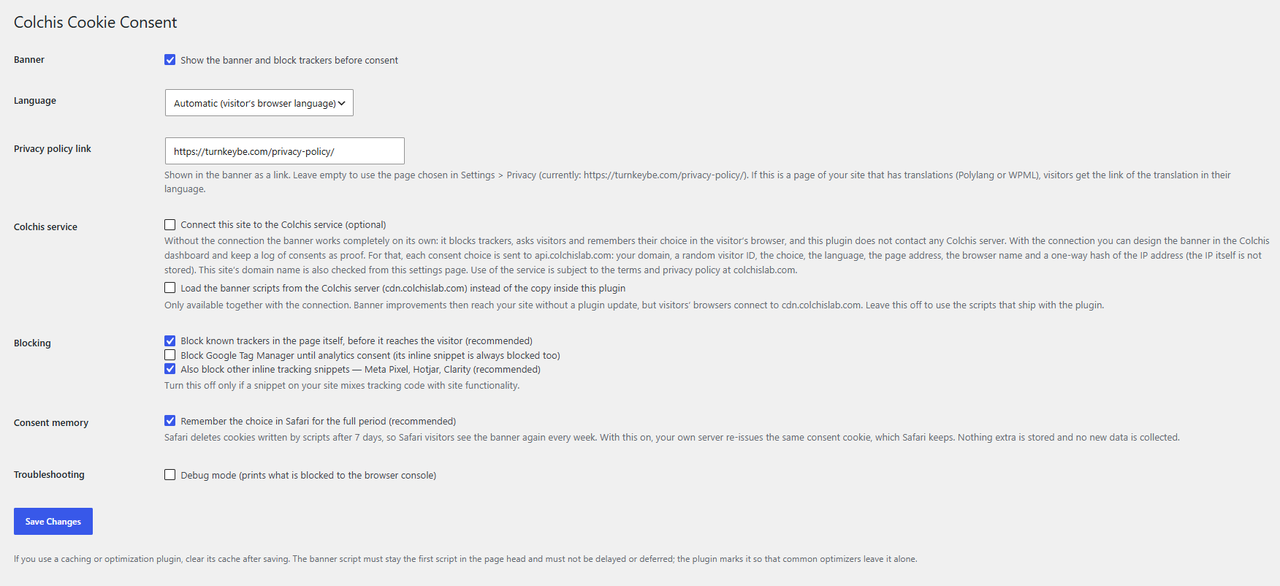
- Open Colchis Cookies in the left menu of WordPress to choose the language, write the banner message and set the blocking options.
- Optional: to get the dashboard, the cookie scan, colours and the consent log, press Connect to Colchis on the Overview tab. A Colchis page opens: sign in or create a free account and press “Connect”. The page shows a 6-digit code. You come back to the plugin’s page, type the code and press Link this site. Your site is added automatically and you land in your dashboard.
- Deactivate any other cookie plugin so visitors do not see two banners.
FAQ
Does the plugin send any data to you?
Not unless you connect the site. See “External services” above for exactly what is sent when you do.
Do I need an account?
No. The banner works without one. An account is only needed for the dashboard, the cookie scan, the colours and the consent log; you create it, free of charge, while you connect.
How do I connect my site, and how do I disconnect it?
Open Colchis Cookies in the left menu of WordPress and press Connect to Colchis. In the Colchis page that opens, sign in or create a free account and press “Connect”; the page shows a 6-digit code. Go back to the plugin’s page, type the code and press “Link this site” (or press “Cancel” if you did not start this connection); the site is then connected and you land in the dashboard. To disconnect, open “Disconnect this site” on the Overview tab and confirm: the banner works on its own again, and your site and its data stay in your Colchis account until you remove them there.
The automatic connection does not work for my site
It needs your site to open over https:// at its main address, not in a sub-folder and not on an unusual port. Otherwise add the site by hand in the Colchis dashboard, then press “I already added this site in the dashboard” on the Help & data tab.
Can I change the colours of the banner?
Yes, once the site is connected: colours and layout are set in the Colchis dashboard, and the Banner tab shows a sample and links there. Without a connection the banner uses the plugin’s own colours.
Can one Colchis account hold several websites?
Yes. Install the plugin on each site and press Connect to Colchis on each one; all of them appear in the same dashboard. A plan is chosen per site.
Do trackers stay blocked if the Colchis service is not reachable?
Yes. The script that blocks trackers is always the plugin’s own file, served from your own site, so it does not depend on any other server. Only the banner’s interface comes from the service on a connected site; if that cannot be loaded, the banner is not shown, but trackers stay blocked.
My site has a strict Content-Security-Policy. Will the banner work?
The blocking script is written into the page (since 0.9.1) and the tag goes through WordPress’s own script-tag functions, so a CSP plugin that adds nonces through the standard WordPress filters covers it. If your policy allows no inline scripts and you have no such plugin, add define( 'COLCHIS_CC_INLINE_CORE', false ); to wp-config.php: the script is then loaded as a file from your own site, as before, and script-src 'self' allows it.
Does the banner lower my PageSpeed score?
A little at most, and these are measured numbers, not a promise. The script that blocks trackers has to run before every other script of the page, so it can never cost exactly nothing; since 0.9.1 it is written into the page, so the browser does not wait for a separate file before it paints. In our tests (Lighthouse, mobile, the same pages with and without the banner, several runs each) a light page kept its score (100 stayed 100) and a heavy page lost about one point. A very large page (thousands of elements) lost up to about two points, and a server that does not compress its pages (gzip or Brotli off) about one. Your own result depends on your theme, plugins and hosting. On a very large page you can compare with the script loaded as a file instead: add define( 'COLCHIS_CC_INLINE_CORE', false ); to wp-config.php and test both in PageSpeed Insights.
The banner does not appear after a change
Clear the cache of your caching plugin and Cloudflare. The banner script must stay the first script in the page head and must not be delayed or deferred.
Does the plugin handle all cookies and trackers automatically?
It blocks the most common trackers and embeds by address and by their inline snippets. A tracker it does not know can be handed over by adding type="text/plain" and data-category="analytics" (or marketing, preferences) to its script tag.
Is this legal advice?
No. The plugin is a tool; what your site needs to do under GDPR, ePrivacy or other laws depends on your situation.
Screenshots

Changelog
0.9.2
- Fix: the request to clear page caches after an update is now made once every plugin has started (
wp_loaded). Before, it came too early for cache plugins that start later, such as Cache Enabler, and their cached pages kept the previous script until they expired. - Fix: Cloudflare’s plugin is cleared through its own purge method; the action used before does not exist in that plugin.
- Each cache plugin is asked on its own, and an error inside one of them can no longer break the page or stop the others.
- Plugin Check: the calls to other cache plugins’ purge actions are marked as such (no change in behaviour).
- readme: a new FAQ entry with measured PageSpeed numbers.
- Nothing else changes: blocking, the consent cookie, the settings copy and what is sent to Colchis are as in 0.9.1.
0.9.1
- The core (blocking) script is written into the page itself instead of being loaded as a separate file. The browser no longer waits for a request before the first paint, which was costing PageSpeed points on real sites (the page stayed unpainted until the file arrived). Every page is about 13 KB larger over the wire; the first visit, the one PageSpeed and search visitors see, is faster.
define( 'COLCHIS_CC_INLINE_CORE', false )or thecolchis_cc_inline_corefilter restores the file. - The server-side blocker leaves the banner’s own inline script alone (it names the trackers it blocks).
- The script tag goes through WordPress’s own
wp_get_inline_script_tag()/wp_get_script_tag(), so a Content-Security-Policy plugin can add its nonce through the standard filters. A site with a strict CSP and no such plugin should setCOLCHIS_CC_INLINE_COREto false and allow the file as before. - After an update the common page caches (WP Rocket, W3 Total Cache, WP Super Cache, LiteSpeed Cache, WP-Optimize, Autoptimize, SiteGround Optimizer, Cloudflare, Breeze, Cache Enabler, Hummingbird) are asked to start afresh, so the new script reaches every page at once.
data-noptimizeon the script tag, the attribute Autoptimize actually reads.- Nothing else changes: blocking, the consent cookie, the settings copy and what is sent to Colchis are as in 0.9.0.
0.9.0
- Speed: the banner no longer asks for its interface file, or (when regional rules are on) for the visitor’s region, while the page is still being painted. Both requests are made once the page has loaded, or after five seconds at the latest; a visitor who opens the cookie settings does not wait. Blocking never depended on the interface file and still does not: until the visitor chooses, every optional tracker stays blocked and Google Consent Mode says “denied” from the first moment.
- Connected sites: your server now keeps a copy of the banner settings made in the Colchis dashboard and writes it into the page next to the banner script, so the script knows your own blocking rules before any other script runs and the visitor’s browser does not have to ask the service for them. The copy is fetched by WordPress itself through WP-Cron (never while a visitor’s page is being built), at most every ten minutes, and is dropped when the site is disconnected or the plugin is deleted. A page that comes from a page cache carries an older copy; the banner script uses only its blocking rules at once (an old copy can add blocking, never switch it off) and gets the current settings after the page has loaded.
- A site that is not connected is unchanged: nothing is stored, written into the page or sent anywhere.
0.8.1
- Accessibility: the banner keeps its colours readable (WCAG 2.2 AA). When a chosen text, link or button colour does not reach a contrast of 4.5 : 1, the banner uses the nearest colour that does and keeps its hue; colours that already read well are not touched. The focus frame, the on/off switches and the small cookie button keep a contrast of at least 3 : 1. Buttons that follow the automatic colour pick the better of dark and white text, also for mid-tone buttons.
- Accessibility: on the plugin’s own page every on/off switch now has one label instead of two, and the page title is no longer announced as a second page header.
- The banner core, tracker blocking, the consent cookie and what is sent to Colchis are unchanged.
0.8.0
- New: a Connect to Colchis button. It links the site to a free Colchis account without any record to add to DNS, no meta tag and no file to upload: you sign in (or sign up) in the dashboard and press “Connect”, then come back, type the 6-digit code the dashboard shows and press “Link this site”, and the site is added and verified automatically. The plugin proves the site is yours by answering one address (
/?colchis_connect=and a code) that only exists while you are connecting. The last step happens in your own WordPress admin and needs the code that only the browser that approved was shown, so a connection link that gets into the wrong hands cannot take a site. The first cookie scan starts by itself. - New: the plugin has its own entry, “Colchis Cookies”, in the left menu of WordPress instead of a page under Settings (the old address forwards to the new one).
- New settings page in the colours of the plugin: Overview, Banner, Blocking and Help & data. The banner message is one simple field; the wording of every other text moved under “Advanced customization”.
- New: a colour sample on the Banner tab. Colours are part of the Colchis dashboard, so choosing one tells you to connect (or, on a connected site, links to the colour settings there). Nothing about colours is stored by the plugin.
- New: after connecting, a short note that one Colchis account can hold several sites. It can be dismissed with “Not now”.
- New: “Disconnect this site” puts the plugin back to working fully on its own.
- The old tick box “Connect this site to the Colchis service” is gone. A site that had it ticked stays connected; a site that had it unticked stays offline: updating never connects a site by itself.
- The banner scripts, tracker blocking and the consent cookie are unchanged.
- “External services” describes the data sent when you connect.
0.7.17
- On a connected site, the script that blocks trackers is now the plugin’s own file, served from your own site, as it already was on a site that is not connected. Before, a connected site loaded it from cdn.colchislab.com: an extra connection that delayed the first paint on slow connections, and trackers were not blocked at all whenever that server could not be reached. Only the banner’s interface (texts, styles and dialogs) still comes from the service on a connected site.
- The “Powered by ColchisLab” line of the service’s free plan, shown on connected sites only, now uses the banner’s own font and size, and the settings page and “External services” say that it appears in the banner and in its settings window.
- “External services” and the privacy policy suggestion describe the two files exactly.
0.7.16
- Connected sites with the language set to “Automatic” now also tell the Colchis service the site’s own language, so plans with one language per site show the banner in it.
- The settings page says plainly that several languages on one site are part of the Colchis Pro plan.
0.7.15
- Updating from a version before 0.7.0 no longer switches the Colchis connection on by itself. The connection is on only when the site owner ticks it.
- The plugin no longer contains any credit. The “Credit” setting is gone; a connected site uses the Colchis service’s own banner, loaded from the service, whose free plan shows a small credit line (explained on the settings page).
- A connected site always loads the banner from the Colchis service; the separate “Load the banner scripts from the Colchis server” option is gone.
- Server-side blocking now uses the page output buffer that WordPress itself manages (WordPress 6.9 and newer). On older versions the banner still blocks trackers in the visitor’s browser.
- Translations come from translate.wordpress.org; the bundled Georgian translation files were removed.
- “External services” in this readme is clearer about what is sent, when, and what the tracker address list is for. The consent log text is precise about IP addresses: only a shortened, hashed form is part of the consent record.
0.7.13
- The “Source code” section now gives the exact build command for each minified file, and points at the readable source that ships inside the plugin.
0.7.12
- New section “Banner texts”: write the heading, the text, the buttons and the category descriptions in your own words. Leave a field empty to keep the built-in text.
- This also covers languages the plugin does not carry: a Turkish or Swedish site writes its own texts and the banner speaks that language.
0.7.11
- The banner now takes your site’s language by itself: a German site gets a German banner, a Georgian site a Georgian one, with nothing to set. You can still pick any of the nine languages by hand.
- A site in several languages, where each page shows the banner in that page’s own language, is part of the Colchis service and the setting says so.
0.7.10
- An opt-in “Credit” setting was added (off by default, plain text, never a link). It was removed again in 0.7.15, see below.
0.7.8
- Translations are now left entirely to WordPress, which loads them for this plugin automatically; the manual call is gone.
- Code comments explain why the raw cookie header is read unchanged (it is validated against a strict pattern before use) and why WPML’s own filter name carries no plugin prefix.
0.7.7
- Fix: with Polylang, the privacy policy link on pages in another language now points to the translated page. The page is found by its path instead of through a query that Polylang adjusts to the visitor’s language.
0.7.6
- More reliable lookup of the translation of the privacy policy page (also when the page address cannot be resolved directly, and with the visitor’s language passed to Polylang).
- With the Debug setting on, an HTML comment in the page source shows how the privacy policy link was chosen.
0.7.5
- The privacy policy link: if it points to a page of the site that has a translation (Polylang, WPML), visitors get the translated page.
0.7.4
- New setting “Privacy policy link” (optional). Empty = the page chosen in Settings > Privacy. Developers can change it with the
colchis_cc_policy_urlfilter.
0.7.3
- Fix: the banner shows a link to the site’s Privacy Policy page (the page chosen in Settings > Privacy) when the plugin works without the Colchis service. Previously the link only appeared for connected sites.
0.7.2
- New default banner colours: copper primary colour with grey borders.
- Button text colour is now chosen by real contrast (dark text on mid-tone colours such as copper).
0.7.1
- Fix: in responsive embeds (the WordPress YouTube block, page builders) the placeholder of a blocked video now fills the video’s place instead of appearing below an empty gap.
0.7.0
- The plugin now contains the banner scripts (minified, with readable source in
assets/src) and no longer downloads code from a server. - New option “Connect this site to the Colchis service”: off for new installations. With it off the plugin and the banner contact no Colchis server at all.
- New option to load the scripts from the Colchis CDN instead (only with the connection on).
- Removed: the daily script download, the “Update script now” button and the release notification endpoint (they are not needed any more).
- Sites updating from an older version: the old downloaded copy in the uploads folder is removed after a week. (Until 0.7.15 such sites were also switched to the connection automatically; that no longer happens.)
0.6.1
- The banner script on your site is now updated right after each Colchis release. Until now the local copy was refreshed by a daily WordPress job, which only runs when somebody visits the site, so quiet sites could keep an old copy for days. The Colchis server now asks your site to fetch the newest script (it can only ever download the official script from the Colchis server).
0.6.0
- Faster page loads: the part of the banner that blocks trackers is now a much smaller file, and the banner’s texts, styles and dialogs load in the background instead of holding up the page.
0.5.2
- The settings screen is now translatable and ships with a Georgian translation. Other languages can be added from the included translation template (languages/colchis-cookie-consent.pot).
0.5.1
- Fix: on a site registered with the platform the server wrote the consent cookie with a slightly different scope than the banner, leaving two cookies of the same name. The server now matches the banner and clears the duplicate.
0.5.0
- Safari: the visitor’s choice is now remembered for the full period. Safari deletes cookies written by scripts after 7 days, so Safari visitors used to see the banner again every week. Your own server now re-issues the same consent cookie, which Safari keeps. No new data is collected and the value itself never changes. Can be switched off under “Consent memory”.
0.4.2
- Google Maps: blocks every embed form (google.com/maps?…output=embed as well as /maps/embed) and the Maps JavaScript API (maps.googleapis.com) until consent.
0.4.1
- YouTube: the IFrame Player API (youtube.com/iframe_api and the player files) is now blocked before consent as well. Page builders such as Elementor load it dynamically, so it used to run even though the video iframe itself was blocked.
0.4.0
- Google Tag Manager: when GTM blocking is on, the inline GTM snippet is blocked too (on the server and in the browser), not only the gtm.js file.
- Inline tracking snippets (Meta Pixel, Hotjar, Clarity) are now blocked by default; the setting can still be switched off.
0.3.0
- Server-side blocking: known trackers (scripts and iframes) are marked in the page HTML before it is sent, so they cannot run before consent. Can be switched off in the settings.
0.2.1
- The banner script is now served from your own domain (daily refresh, automatic fallback to the Colchis server).
- New “Update script now” button.
0.1.0
- First version.