


Description
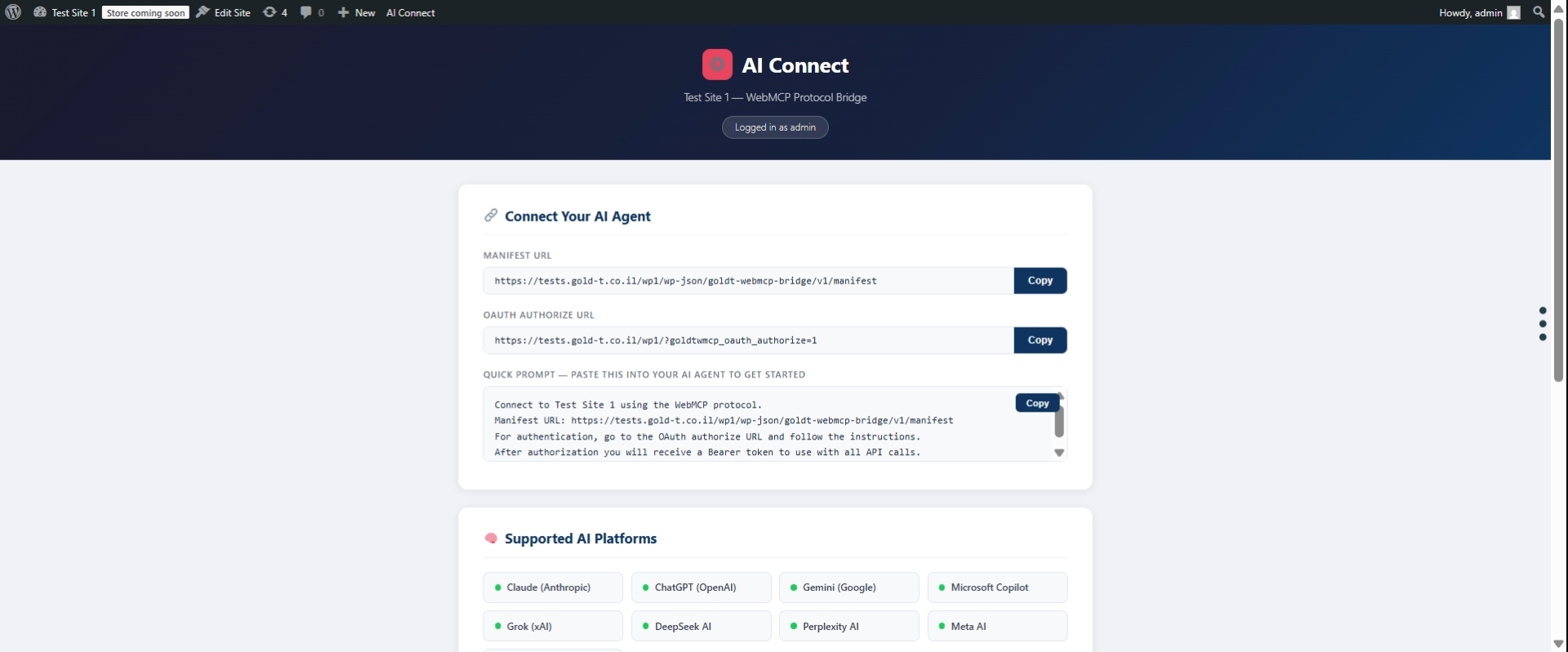
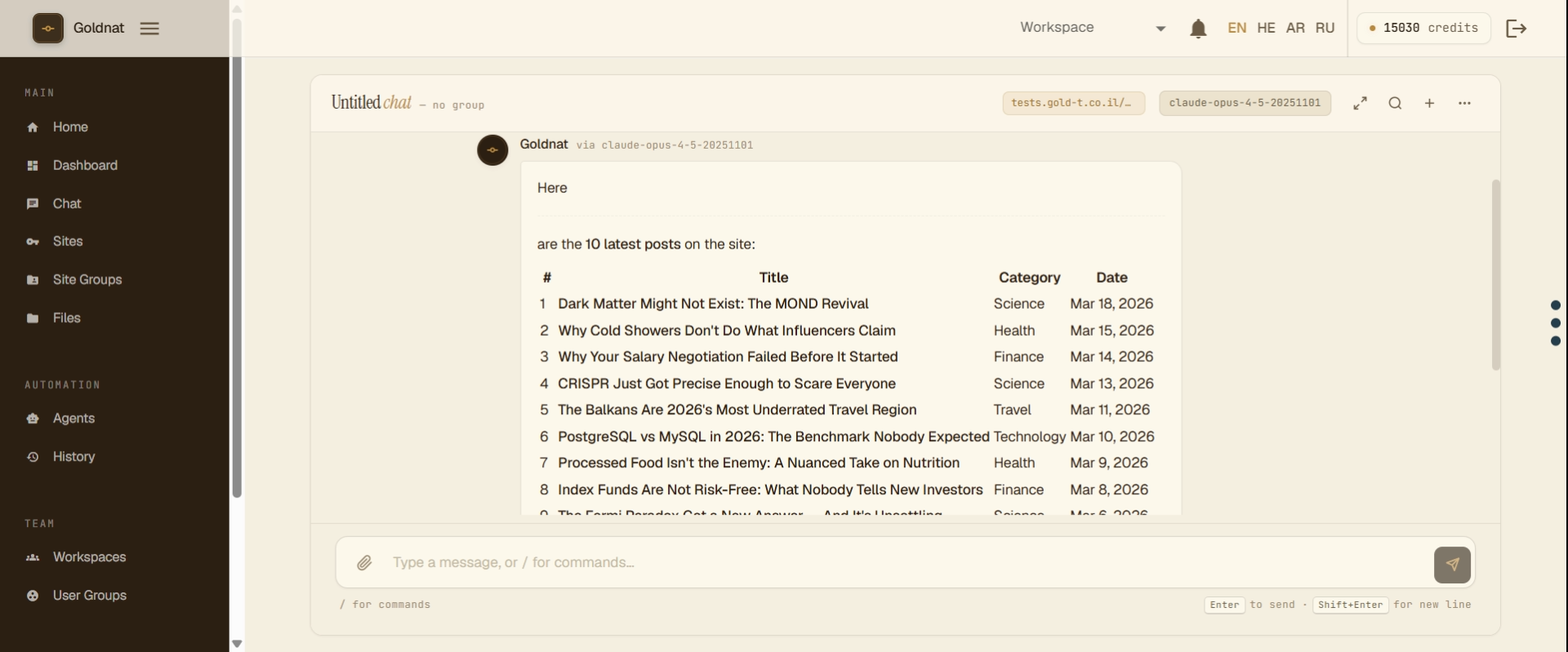
GoldT WebMCP Bridge (also branded as Goldnat AI Connect) enables AI agents to interact with your site through secure OAuth 2.0 authentication using the Servio Protocol.
Perfect for AI-powered customer support, automated content analysis, intelligent search, and custom AI integrations.
✨ Features
- Servio Protocol Support – Industry-standard AI integration
- Secure OAuth 2.0 – Same security standard as Google, Facebook, GitHub – your passwords stay safe
- 8 Pre-registered AI Clients – Claude, ChatGPT, Gemini, Grok, Perplexity, Copilot, Meta AI, DeepSeek
- 7 Tools – WordPress content tools plus optional translation via MyMemory API
- Translation Provider – Choose AI self-translate, MyMemory API, or disabled
- Dynamic Manifest – Instructions adapt to your settings so AI agents don’t invent capabilities
- Rate Limiting – Prevent abuse (50 req/min default)
- Security Controls – Token management, block specific users
- Zero Configuration – Works out of the box
- Extensible – Add custom tools via developer hooks
🎯 Quick Start for AI Users
Using ChatGPT or Claude?
Tell your AI agent:
“I want to connect you to my WordPress site at https://mysite.com using the Goldnat AI Connect for WordPress plugin. The manifest is at /api/aiconnect-manifest. Use OAuth 2.0 with client_id: claude-ai”
The AI will guide you through OAuth authorization – you’ll approve access in your browser.
🤖 Supported AI Agents
Pre-registered and ready to connect:
- Claude AI – Use
client_id: claude-ai(Anthropic) - ChatGPT – Use
client_id: chatgpt(OpenAI) - Gemini – Use
client_id: gemini(Google) - Grok – Use
client_id: grok(xAI) - Perplexity AI – Use
client_id: perplexity - Microsoft Copilot – Use
client_id: copilot - Meta AI – Use
client_id: meta-ai(Facebook) - DeepSeek – Use
client_id: deepseek
All clients use OAuth 2.0 with PKCE and redirect_uri: urn:ietf:wg:oauth:2.0:oob (out-of-band).
🛠️ Available Tools
- wordpress.searchPosts – Search posts with filters
- wordpress.getPost – Get single post by ID or slug
- wordpress.searchPages – Search pages
- wordpress.getPage – Get single page by ID or slug
- wordpress.getCurrentUser – Get authenticated user info
- translation.translate – Translate text via MyMemory API (when Translation Provider = mymemory)
- translation.getSupportedLanguages – List supported language codes (when Translation Provider = mymemory)
🔒 How Authentication Works
Secure OAuth 2.0 Authentication:
Uses the same security standard trusted by Google, Facebook, and GitHub:
- AI agent initiates OAuth flow with code challenge (PKCE)
- User approves in browser (consent screen)
- Agent receives one-time authorization code
- Agent exchanges code for access token using code verifier
- Agent uses token for API calls
The AI agent operates as the user who authorized:
* The agent receives an OAuth token linked to that user’s ID
* All API requests run with that user’s permissions
* The agent respects WordPress user capabilities
Examples:
If Administrator authorizes:
* ✅ Sees all posts (including drafts, private)
* ✅ Full access based on admin capabilities
If Subscriber authorizes:
* ✅ Sees only published content
* ❌ Cannot see drafts or private content
Security: Authorization codes are one-time use (10 min expiry). Access tokens expire after 1 hour. Refresh tokens valid for 30 days. PKCE ensures tokens can’t be stolen.
⚙️ Admin Settings
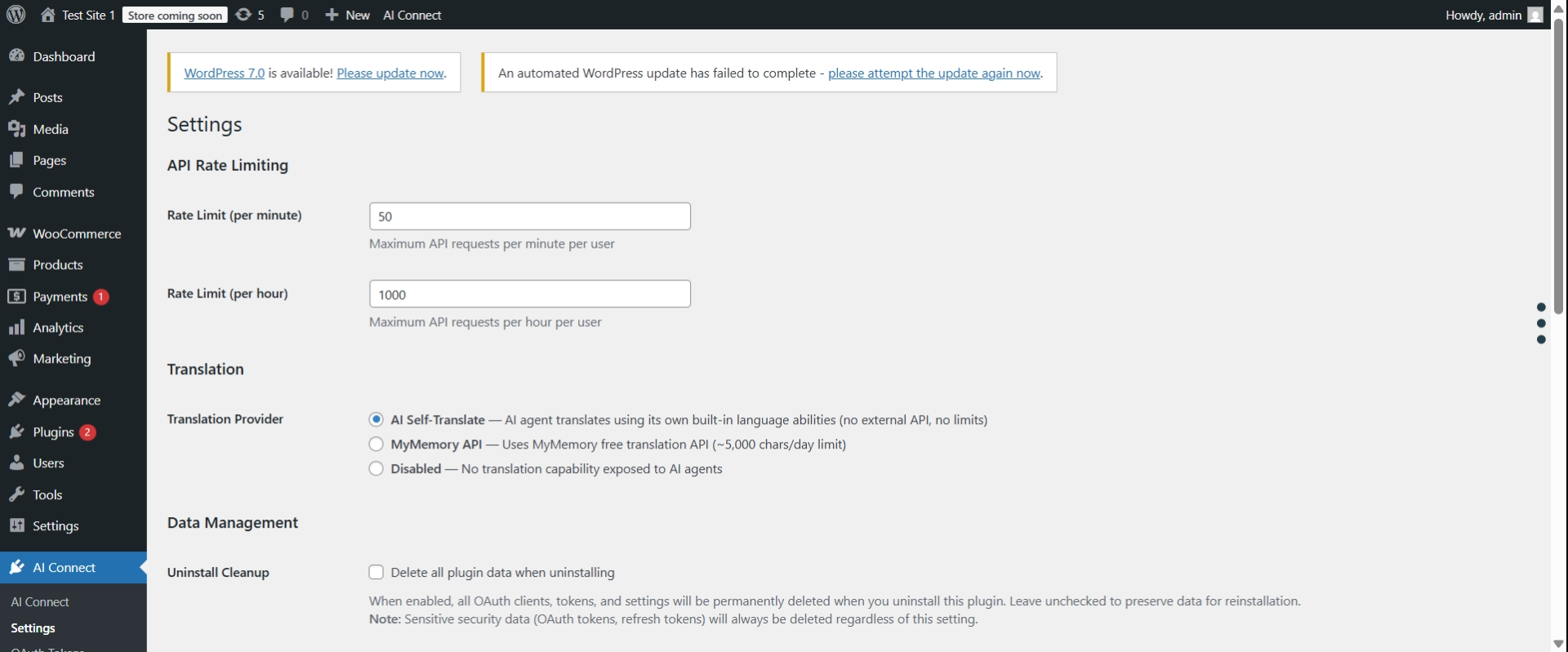
Configure the plugin at AI Connect → Settings:
Translation Provider:
- AI Self-Translate (default) – The AI agent handles translation on its own; no translation tools appear in the manifest
- MyMemory API – Plugin calls MyMemory and returns translated text;
translation.translateandtranslation.getSupportedLanguagestools are added to the manifest - Disabled – Translation tools are hidden from the manifest entirely
Rate Limiting:
- Default: 50 requests per minute, 1,000 per hour (per user)
- Adjust both values in AI Connect → Settings
🔐 Admin Controls
For Site Administrators:
Manage security from the WordPress admin panel:
- Revoke OAuth Tokens – Go to AI Connect → OAuth Tokens to view and revoke active tokens
- Block Users – Go to AI Connect → Settings → scroll to “Manage User Access” section
- Rate Limits – Configure request limits in AI Connect → Settings (default: 50/min, 1000/hour)
💬 We Need Your Feedback!
Help us build what YOU need:
- 💡 What tools would be most useful? Tell us which WordPress features you’d like AI agents to access
- 🐛 Found a bug? Report it so we can fix it quickly
- ⭐ Feature requests – We prioritize based on community feedback
How to provide feedback:
* GitHub: https://github.com/chgold/goldt-wp-webmcp-bridge/issues
* WordPress.org: Support forum
Your feedback directly shapes the future of this plugin!
Troubleshooting
Missing Dependencies Error
Symptoms:
* Red error notice in WordPress admin
* Plugin appears active but doesn’t work
* REST API endpoints return 404
Solutions:
-
Download complete plugin (Recommended)
- Get the full ZIP with dependencies from GitHub Releases
- Delete the incomplete plugin folder
- Upload and activate the complete version
-
Manual composer install (Advanced)
- SSH into your server
- Run:
cd /path/to/wp-content/plugins/goldt-webmcp-bridge && composer install --no-dev
Common causes:
* exec() function disabled on server
* Composer not available on shared hosting
* Plugin directory not writable
How to diagnose:
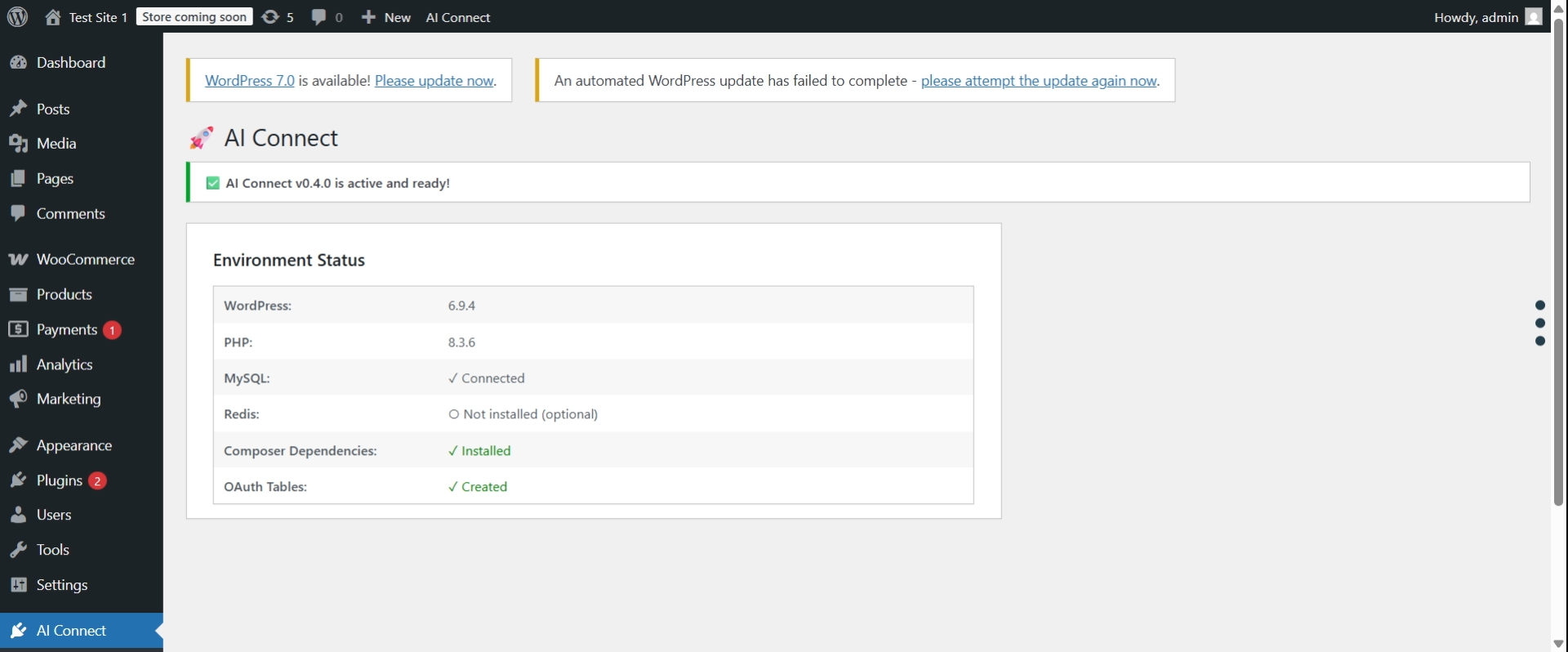
* Go to AI Connect → Settings in WordPress admin
* Check the “Environment Status” table
* Look for red ✗ marks showing the exact issue
Database Tables Missing Error
Symptoms:
* Red error notice: “OAuth database tables were not created”
* OAuth authorization fails
Solution:
1. Deactivate the plugin
2. Reactivate the plugin
3. Check AI Connect → Settings to verify “OAuth Tables: ✓ Created”
If problem persists:
* Your database user may not have CREATE TABLE permissions
* Contact your hosting provider or check wp-config.php
OAuth Authorization Fails
Symptoms:
* Clicking “Authorize” button does nothing
* Redirect loop during OAuth flow
* “invalid_client” or “invalid_request” errors
Solutions:
-
Clear WordPress rewrite rules:
- Go to Settings → Permalinks
- Click “Save Changes” (flushes rewrite rules)
-
Verify OAuth tables exist:
- Go to AI Connect → Settings
- Check “OAuth Tables: ✓ Created”
-
Verify client exists:
- Default clients (claude-ai, chatgpt, etc.) are auto-created
- If missing, deactivate and reactivate plugin
REST API Returns 404
Symptoms:
* /api/aiconnect-manifest returns 404
* Tools API calls fail with 404
Solutions:
-
Flush permalinks:
- Go to Settings → Permalinks
- Click “Save Changes”
-
Reactivate plugin:
- Go to Plugins page
- Deactivate and reactivate “Goldnat AI Connect for WordPress”
-
Check WordPress REST API:
- Visit:
http://yoursite.com/wp-json/ - If this also returns 404, your REST API is disabled or blocked
- Check for conflicting security plugins
- Review .htaccess rules
- Visit:
Still Having Issues?
Before asking for help, gather this information:
- Go to AI Connect → Settings
- Take screenshot of “Environment Status” table
- Check browser console for errors (F12 → Console)
- Check WordPress debug log (if enabled)
Get support:
* GitHub: https://github.com/chgold/goldt-wp-webmcp-bridge/issues
* WordPress.org: Support forum
External Services
This plugin optionally uses the MyMemory Translation API when the “Translation Provider” setting is set to “MyMemory API” in the plugin settings.
MyMemory API
- What it is: A free machine translation service
- When it is used: Only when an AI agent calls the
translation.translatetool AND the plugin settings have “MyMemory API” selected as the translation provider - What data is sent: The text to be translated and the target/source language codes
- Default: Disabled by default. The default provider is “AI Self-Translate” (no external requests)
- Terms of Service: https://mymemory.translated.net/terms-and-conditions
- Privacy Policy: https://mymemory.translated.net/terms-and-conditions
If “MyMemory API” is not selected, no data is sent to any external service.
Privacy Policy
Goldnat AI Connect for WordPress does not collect, store, or transmit any personal data to external services. All API requests are handled locally on your WordPress installation.
Data stored locally:
* OAuth clients (pre-registered: claude-ai, chatgpt, gemini)
* OAuth authorization codes (temporary, 10 min expiry, one-time use)
* OAuth access tokens (temporary, 1 hour expiry)
* Rate limiting counters
* User blacklist (WordPress user IDs only)
No data leaves your WordPress installation. This applies when using the default settings. If you enable the MyMemory API translation provider, text content will be sent to mymemory.translated.net. See “External Services” section for details.
Requirements
Component
Required
Notes
WordPress
✅ 6.0+
Core requirement
PHP
✅ 7.4+
With json, openssl
Composer
✅ Yes
For dependencies
HTTPS
⚠️ Production
Required for security
Redis
⭕ Optional
For high traffic
Credits
- Optional predis/predis support for rate limiting
- Compliant with the Servio Protocol specification
Made with ❤️ for the WordPress & AI community
Installation
Automatic Installation
- Go to Plugins → Add New in WordPress admin
- Search for “Goldnat AI Connect for WordPress”
- Click Install Now and then Activate
Manual Installation
- Download the plugin zip file
- Go to Plugins → Add New → Upload Plugin
- Upload the zip file and click Install Now
- Activate the plugin
Note: All required dependencies are included. No manual setup required!
Setup
No setup required! The plugin works immediately after activation.
Optional: Configure rate limits in AI Connect → Settings
For detailed setup and testing examples, see the plugin documentation on GitHub.
FAQ
What is the Servio Protocol?
The Servio Protocol is a standardized protocol for connecting AI agents to web services. It defines how AI assistants discover, authenticate with, and execute tools on web platforms. Goldnat AI Connect implements Servio across every supported platform (WordPress, XenForo, Drupal, Shopify, and more) so the same AI agent can talk to any of them with identical semantics.
Does this work with ChatGPT and Claude?
Yes! Goldnat AI Connect for WordPress works with any AI platform that supports REST APIs. This includes ChatGPT (OpenAI), Claude (Anthropic), Make.com, Zapier, and custom applications.
Why does reading public content require authentication?
All API calls require authentication for security:
* Rate Limiting – Prevents spam and abuse
* Monitoring – Track who uses your API
* Security – Protects against data scraping and DDoS attacks
This is the industry standard (Twitter, GitHub, Google APIs all require auth).
Exception: The manifest endpoint is public (no auth needed).
How does the AI agent authentication work?
OAuth 2.0 Authorization: The AI agent operates as the WordPress user who authorized it.
When a user approves access through the OAuth consent screen:
* The agent receives an access token linked to that user’s ID
* All API requests run with that user’s permissions
* The agent inherits the user’s capabilities
Security:
* No passwords are transmitted – only authorization codes
* PKCE prevents authorization code interception
* Tokens are time-limited (1 hour) and can be revoked
* The agent respects WordPress user capabilities
Is Redis required?
No, Redis is optional. The plugin works perfectly with WordPress transients. However, Redis is recommended for high-traffic sites (>1,000 requests/day) as it provides better rate limiting performance.
Can I add custom tools?
Yes! Goldnat AI Connect for WordPress is extensible. Use WordPress hooks to add custom tools:
`php
add_action(‘goldtwmcp_register_modules’, function($goldtwmcp_plugin) {
$manifest = $goldtwmcp_plugin->get_manifest_instance();
$manifest->register_tool(‘mysite.getStats’, […]);
});
`
Important: Place your custom tools in your theme’s functions.php or a separate plugin – they will be preserved during plugin updates.
See the plugin documentation for more details.
How long do tokens last?
- Access Token: 1 hour (3600 seconds)
- Refresh Token: 30 days (2,592,000 seconds)
Use the refresh token to get a new access token without re-authentication.
Can I revoke access?
Yes! Multiple options:
Revoke specific OAuth token:
* Go to AI Connect → OAuth Tokens
* Find the token and click “Revoke”
Block specific user:
* Go to AI Connect → Settings
* Enter user ID in “Block User” section
* User cannot authenticate or use existing tokens
How do I troubleshoot authentication errors?
Common issues:
- “invalid_client” – Check client_id (use: claude-ai, chatgpt, or gemini)
- “invalid_grant” – Authorization code expired or already used (codes are one-time, 10 min expiry)
- “access_denied” – User is blocked (check AI Connect → Settings → Manage User Access)
- “Token expired” – Access token expired after 1 hour, use refresh token to get new access token
- “Rate limit exceeded” – Wait for retry period or increase limits in Settings
Enable WordPress debug mode and check wp-content/debug.log for details.
Where can I get support?
- Community: WordPress.org support forums
Screenshots
Changelog
1.2.14 – 2026-11-17
- Fix: an action that waits for the user’s confirmation always carries one plain sentence written for the user –
summary(“Delete 22 old revisions and 5 spam comments”) – anduser_message(the same, plus what to do next). Before, a tool that declared no summary left it empty, and the confirmation card of an AI client showed the instruction meant for the agent (“Not executed… Do NOT call this tool again…”) to the customer. The summary now comes from the tool’s own preview (preview.summary, built from the real names and numbers), from itssummarytemplate (placeholders are filled from the arguments and from the preview), frompreview.what, and as a last resort from a generic sentence – never empty.messagestays an instruction for the agent and says so. - The summary and the preview are built in the user’s own language (
switch_to_user_locale). Hebrew ships with the plugin for the confirmation texts; thelanguages/folder is now registered so bundled translations load. - Users › AI actions: the sentence is the headline of the page, followed by what will happen and what is lost in plain lines; the tool name and the raw data moved under “Technical details”. Risk and status are shown in words.
- Fix: no needless second confirmation request. When the user has just confirmed an action and the agent repeats the same call without
confirmation_id, the bridge returns the stored result (“already executed at …, not run again”) instead of creating a new request – for 2 minutes after the run, or 15 minutes while the agent has not collected the result yet."confirmation_new": trueasks again on purpose; filtergoldtwmcp_confirmation_duplicate_window(0 = off). A request that is still waiting is reused as before, and the answer now says so (reused). - The answer after a confirmed run is unambiguous:
messagestarts with “Already executed”, andconfirmationcarriesalready_executed,executed_at,summaryand a note.GET /confirmations/{id}also returnssummary. - Manifest: the agent instructions and the top-level
confirmationobject describesummary,user_messageand the duplicate rule. - Database:
pending_actions.delivered_at(schema 1.1.0, added automatically). - Tests: tests/confirmation-flow.php (82 checks).
1.2.13 – 2026-11-16
- Security: confirmation flow for destructive and financial tools, enforced in code. A tool registered with
confirmation(for example a refund or a delete) is never run by an agent’s call alone: the call answers HTTP 202confirmation_requiredwith a preview,confirmation_id,confirm_url,status_urlandexpires_at, and nothing happens until the user confirms it on Users › AI actions in their own signed-in browser session (auth cookie + nonce; requests carrying a Bearer token are refused there). The agent’s ownconfirm: trueargument is ignored for these tools and removed from their schema. - A pending action is bound to the user, the tool, the exact arguments (hash) and the client, expires after 15 minutes (filter
goldtwmcp_confirmation_ttl), runs at most once, and a re-submission withconfirmation_idreturns the stored result instead of running again (replay protection). Rejected and expired actions are final. - Autonomy: a user may let one agent run one such tool without asking (“From now on, let … run … without asking me”); the permission is per user, per tool and per client, listed on the same page and removable at any time. Site owners can switch autonomy off with
goldtwmcp_confirmation_autonomy_allowed. - Every request, decision, execution, replay attempt, grant and revoke is written to an audit log (shown on the page; action
goldtwmcp_confirmation_event). - Manifest: gated tools carry
confirmation(required/conditional) andrisk(financial/destructive), their description says what to do, a top-levelconfirmationobject describes the flow and the agent instructions explain it. The same flow applies to the in-process tool gateway (status202,denied_layerconfirmation). - New REST route
GET /wp-json/goldt-webmcp-bridge/v1/confirmations/{id}(Bearer, own actions only) reports pending / executed / rejected / expired and the result. - Fixed:
/api/aiconnect-toolsnow passes the tool’s HTTP status through (it always answered 200). - Security: an AI Connect access token is now accepted only on AI Connect’s own agent routes (tools, confirmation status, and the public manifest / OAuth routes). Before, a token was also accepted elsewhere on the site, so an agent could reach more than the plugin’s tools and scopes allow. On any other REST route the token is now refused with 403
goldtwmcp_token_route_not_allowed. A site owner can allow further routes explicitly with the filtergoldtwmcp_bearer_allowed_routes(default: none). We recommend updating. - Security: the browser-only routes
generate-promptandmy-tokensno longer accept an access token; they work only in the user’s own signed-in browser session. - Security:
getUsersnow shows other users the way the WordPress REST API does: without thelist_userscapability it lists only authors with published posts, without therolefilter (403forbidden_role_filter), without registration dates, and it searches display name and slug only.per_pageis capped at 100. - OAuth: refresh-token rotation now has a 60-second grace window. A client that repeats a refresh with the refresh token it has just used (a lost response, a retry, two workers) gets back the same new token pair instead of being disconnected; no second pair is ever issued. The window ends at once if the new pair is revoked, and only the same client can use it (filter
goldtwmcp_refresh_grace_seconds, 0 = off, at most 300). Database schema 2.0.9 adds two columns for this.
1.2.12 – 2026-11-15
- Security: the
writescope now requires at least one editing capability (posts, pages, media, comments, categories, menus, settings, or a shop’s products / orders —edit_posts,edit_pages,upload_files,moderate_comments,manage_categories,edit_theme_options,manage_options,edit_products,manage_woocommerce,edit_shop_orders,edit_shop_payments; filtergoldtwmcp_scope_capabilities). A subscriber or shop customer who approves a connection now gets a read-only token, as the connection prompt already did, and a write tool called with an older token of such a user is refused with 403insufficient_capability. Every write tool still checks its own WordPress capability on each call. - Security: a tool that does not declare
required_scopeis no longer treated as a read tool. Only a tool named with a read verb (get, list, search, find, count, export, validate, analyze, …) defaults toread; delete / remove / purge / prune tools default todelete; every other undeclared tool defaults towrite, so a read-only token cannot reach it. An undeclared tool fires thegoldtwmcp_undeclared_tool_scopeaction, and with WP_DEBUG_LOG the tools that were closed this way are written to the debug log; add-ons should declare the scope of every tool. Released add-on tools that act only on the shopper’s own cart (WooCommerce AI ConnectaddToCart,applyCouponToCart) keepread(filtergoldtwmcp_legacy_read_tools). - Changed: the connection prompt derives its scopes from the same capability map as the consent screen and every tool call.
1.2.11 – 2026-11-14
- New: in-process tool gateway for other plugins on the same site —
goldtwmcp_tool_gateway()->call_as( $user_id, 'wordpress.getPost', $args, $context ). It runs a registered tool as the given WordPress user with the same access layers as the REST endpoint (blocked users, the WordPress capability behind the tool’s scope, a per-user rate limit in its own bucket) plus an optionalallowed_toolsrestriction; anonymous callers may use read tools only. Content checks stay inside each tool, so a caller can never see more than the user could.check_access()tells whether a call would be allowed without running it; every call firesgoldtwmcp_tool_gateway_call. The REST endpoint is unchanged. - Security: password-protected posts and pages no longer return their content or excerpt (
searchPosts,getPost,searchPages,getPage,listPosts,listPages) to users who cannot edit them — the same rule the WordPress REST API applies. A newprotectedfield says when content was withheld. Comment tools refuse to list the comments of a password-protected post (403password_protected) for users who cannot moderate comments. - Security:
listPostsandlistPageswithstatus=draft|pending|private|future|anylist a non-published entry only to users who may read it (the rulegetPost/getPagealready apply). Before, any user with the read scope could list other authors’ drafts and private posts. - Fixed: the gateway’s tool list reports the definition (input schema) of the tool that actually runs when two modules define the same name.
- Improved:
listComments/getCommentswithpost_idreturn the exacttotalandhas_more, acceptorder(asc= reading order) andoffset(getComments), and give each comment itsurl.
1.2.10 – 2026-11-10
- Security:
listCommentsandgetCommentsshow users who cannot moderate comments only approved comments on posts they can read (as on the public site). Before, any user with the read scope could list pending, spam and trashed comments and comments on private posts. Asking forhold,spamortrashwithout the moderate_comments permission returns 403. - Security: ID parameters must be positive integers. Before, a negative ID was silently turned into a positive one (
absint(-1)= 1), sopost_id: -1read the comments of post 1. A negative or zero required ID, or a negative optional ID (post_id,author,parent), returns 400invalid_param. Optional IDs still accept 0 where 0 means “none”.limit,offsetandper_pagemay not be negative. - Fix:
getPost/getPagewith a numeric identifier that is not a positive whole number (for example -1 or 1.5) return 400invalid_paraminstead of 404. - Fix:
getMediareturns 404not_foundfor a missing media item instead of HTTP 200 withsuccess: false.
1.2.9 – 2026-11-09
- Changed: All AI clients can now be granted every scope the user is entitled to; re-authorize to get new scopes. The eight built-in AI clients (Claude, ChatGPT, Gemini, Grok, Copilot, DeepSeek, Perplexity, Meta AI) may now request
delete,manage_usersandadminlike thegoldnat-masterclient — which AI product connects makes no difference. Fresh installs seed the full scope set for all nine clients; existing installs get it through an automatic DB upgrade (OAuth schema 2.0.8). Custom clients are not changed. - Security: what a token receives is capped by the WordPress user’s own capabilities.
deleterequiresdelete_postsordelete_pages,manage_usersrequireslist_usersoredit_users(filter:goldtwmcp_scope_capabilities), andadminstill requiresmanage_options(filter:goldtwmcp_admin_scope_capability). Scopes the user is not entitled to are dropped at consent, and every tool call re-checks the capability behind its scope (403insufficient_capability). - Improved: the consent screen lists the scopes that will be granted and, separately, any requested scopes that are not granted because the account lacks the permission.
- Note: existing tokens keep the scopes they were issued with. Re-authorize to get new scopes.
1.2.8 – 2026-11-09
- Fixed: new
adminOAuth scope (“Site administration”). Pro and add-on tools that declarerequired_scope: admin(ProcreateUser,updateUser,updateSiteSettings; WooCommerceupdateStoreSettings) could never be called because no client was allowed to request that scope. The scope is now in the scope registry, the consent screen and the manifest (auth.scopes), and the built-ingoldnat-masterclient may request it. Existing installs get it through an automatic DB upgrade (OAuth schema 2.0.7) that addsadminto every client that already had the full scope set; read/write-only clients are unchanged. - Security:
adminis only granted to users who holdmanage_options(filter:goldtwmcp_admin_scope_capability). A non-administrator who approves a consent request asking foradminreceives a token without it, and every call to an admin tool re-checks the capability (403insufficient_capability), on top of each tool’s own WordPress capability checks. - Note: existing tokens keep the scopes they were issued with. To use admin tools, re-authorize (or generate a new connection prompt as an administrator) to get a token that includes
admin. - Added: declarative brief metrics section in the manifest (
manifest.brief.metrics) — goldnat.ai can now collect scalar KPIs on a schedule without an LLM in the loop. Public APIManifest::register_brief_metric()validates keys (^[a-z0-9]+(\.[a-z0-9_]+)+$) and caps the manifest at 50 metrics. Thebriefsection is emitted only when at least one valid metric points at a tool that is present in the manifest. This activates thecontent.published.dailymetric (wordpress.getContentStats) and add-on metrics such as WooCommercesales.revenue.daily/sales.orders.daily.
1.2.7 – 2026-11-09
- Security: RFC 7009 token revocation. The manifest now advertises
auth.revocation_url(/wp-json/goldt-webmcp-bridge/v1/oauth/revoke) next totoken_url, so platforms that hold tokens on a user’s behalf (e.g. goldnat) can kill them on the site when access is cut on their side. - Fixed:
/oauth/revokenow accepts the access token OR the refresh token (optionaltoken_type_hintonly changes lookup order) and revokes the whole pair, including the Token Registry row shown in “Token Registry” and “My AI Tokens”. - Fixed:
/oauth/revokealways answers 200{"success":true}for unknown or already-revoked tokens (no token probing); only a missingtokenreturns 400invalid_request. Accepts form-urlencoded and JSON bodies; no authentication required (public PKCE clients). - Fixed: legacy manifest key
auth.revoke_urlpointed at the token endpoint, which does not revoke; it now points at the revoke endpoint too. - Added:
goldtwmcp_token_revokedaction fires after a pair is revoked (row ID + 16-char prefix only).
1.2.4 – 2026-08-31
- Fixed: reverted plugin display name back to the original GoldT WebMCP Bridge (matches the plugin slug
goldt-webmcp-bridge). 1.2.0 renamed it to a longer form that included the term “WordPress”; the wp.org Plugin Check flags that as a restricted term and it also no longer matched the slug. The Goldnat / Servio Protocol rebrand still lives everywhere it makes sense — description tagline, manifest, admin subtitle, quick-prompt template, OAuth client display — but the Plugin Name header stays stable. - Removed:
includes/core/class-plugin-updater.php. WordPress.org’s Plugin Check rejects custom update systems (Plugin Updater detected), and the Free plugin was already served via wp.org’s built-in updater; the custom checker was only used by external Pro plugins that must ship their own update code from here on. - Fixed: SQL warnings in
upgrade_to_2_0_5andupgrade_to_2_0_6(interpolated table names) suppressed with the samephpcs:disable/enableblock the older migrations use — behaviour unchanged. - Fixed:
parse_url()→wp_parse_url()(only usage was inside the removed updater). - Fixed: 1.2.1 upgrade notice trimmed under the 300-character wp.org limit.
1.2.3 – 2026-08-31
- Rebrand completion (OAuth client identifier): the built-in master OAuth client’s
client_idis renamed fromwebmcp-mastertogoldnat-master, so the plugin no longer exposes any “webmcp” string to AI agents via the OAuth authorize/token flows. New DB schema upgrade2.0.5performs the rename in three tables atomically:oauth_clientsgets a newgoldnat-masterrow (config copied from the legacy row), thenoauth_tokensandaiconnect_token_registryare re-pointed at the new identifier, then the legacywebmcp-masterrow is deleted. Existing agents keep working — their tokens now referencegoldnat-master(which exists), so bearer-auth continues to succeed without any user action. New authorize requests that hard-code the legacy identifier will getinvalid_clientand need to reconnect usinggoldnat-master. Idempotent — re-running the migration is a no-op on already-migrated sites. - Rebrand follow-up (prompt generator UI): the master client’s label in
get_agent_clients()no longer reads “Goldnat (webmcp)”; it now reads “Goldnat Master”, matching the display name in the DB and on the OAuth consent screen.
1.2.2 – 2026-08-31
- Rebrand follow-up (OAuth consent screen): the built-in
webmcp-masterOAuth client hadclient_name = 'WebMCP Master'in the database, which is the name users saw on the “Authorize this application?” consent screen every time they connected an AI agent with full-access scope. New DB schema upgrade2.0.4renames the display name toGoldnat Masteron existing sites. Theclient_iditself stayswebmcp-master— active tokens and integrations reference that identifier and would break if it changed. Fresh installs also get the new display name viainsert_default_clients().
1.2.1 – 2026-08-30
- Fixed: rewrite rules are now auto-flushed on plugin upgrade. WordPress caches compiled rewrite rules in
wp_options.rewrite_rules. The activation hook flushes that cache — but activation doesn’t run on plugin update, wp-cli update, or auto-update, so any new or renamed route (like/api/aiconnect-manifest) returned the homepage instead of the handler until someone manually visited Settings → Permalinks. The plugin now checksgoldtwmcp_versionon every init; when it lagsGOLDTWMCP_VERSIONthe flush is scheduled onwp_loaded(priority 999) and the version option is bumped. Zero-config for site admins — the first request after an upgrade repairs the cache. (See gold-t.co.il thread #700.) - Rebrand follow-up: three user-facing strings that 1.2.0 missed are now updated too. The Servio manifest now advertises “Goldnat AI Connect bridge for WordPress (Servio Protocol)” as its description (was: “WebMCP bridge for WordPress”). The
/ai-connect/info-page subtitle reads “Goldnat AI Connect · Servio Protocol” (was: “WebMCP Protocol Bridge”). The manual quick-prompt template opens with “Connect to using the Servio Protocol” (was: “using the WebMCP protocol”), so users no longer paste stale branding into their AI agent. - Fixed: the “Documentation” link on the
/ai-connect/page pointed tohttps://ai-connect.gold-t.co.il/wordpress, which returns 404. Updated to the live docs athttps://plugins.goldnat.ai/wordpress.
1.2.0 – 2026-08-30
- Rebrand: user-facing name changed from “GoldT WebMCP Bridge” to “Goldnat AI Connect for WordPress” to match the rest of the Goldnat AI Connect plugin family (XenForo, Drupal, Ghost, Moodle, NodeBB, PrestaShop, Shopify, Discourse). The underlying protocol is now called “Servio Protocol” (was: “WebMCP protocol”).
- Rebrand: readme description, features, FAQ, troubleshooting and installation copy updated to reflect the new name and protocol. Plugin URI updated to https://plugins.goldnat.ai/wordpress/goldt-webmcp-bridge.
- Rebrand: admin menu already reads “AI Connect” (since 0.4.0); readme now matches. All documentation references corrected to
/api/aiconnect-manifest,/api/aiconnect-tools,/api/aiconnect-oauth— the old/wp-json/goldt-webmcp-bridge/v1/*paths were removed in 0.5.8 but the readme still showed them. - Compat: plugin folder slug (
goldt-webmcp-bridge), text domain (goldt-webmcp-bridge), PHP namespace (GoldtWebMCP\), option keys (goldtwmcp_*), database tables, PHP constants (GOLDTWMCP_VERSION) and every REST endpoint are UNCHANGED. Existing OAuth tokens, custom tools registered viagoldtwmcp_register_modules, and AI agent integrations continue to work with no reconfiguration.
1.1.0 – 2026-08-21
- New:
wordpress.listCategoriestool — resolve category id from name or slug via case-insensitive substring search. Supportsparent,orderby, andlimitparameters. Fixes the gap where AI agents had to guess category IDs before calling createPost. - New:
wordpress.listTagstool — same interface for post tags. - Compliance: readme headers refreshed (Stable tag + Tested up to 7.1) to satisfy WordPress Plugin Check.
- Version numbering: internal dev branch (0.5.x) resynced to public release track (1.x). No breaking changes vs 1.0.0 — pure additions.
1.0.0 – 2026-06-28
- First public release on WordPress.org (see prior 0.5.x internal changelog entries below).
0.5.8 – 2026-07-02
- Breaking: Servio Protocol alignment — all endpoints moved from
/wp-json/goldt-webmcp-bridge/v1/*to/api/aiconnect-*to match the unified Servio protocol used across all Goldnat plugins (WordPress, XenForo, and future platforms). This enables goldnat.ai’sdetectWebMCPConnectto recognize WordPress prompts the same way it recognizes XenForo prompts. - Breaking: Token prefixes changed from
wpc_/wpr_toxfa_/xfr_(Servio standard). Existing tokens will stop working — users need to generate a new prompt from the/ai-connect/page. - New:
/api/aiconnect-manifest— serves the Servio manifest (was/wp-json/goldt-webmcp-bridge/v1/manifest). - New:
/api/aiconnect-tools— serves tool calls with?name=toolName(was/wp-json/goldt-webmcp-bridge/v1/tools/{toolName}). - New:
/api/aiconnect-oauth— handles token exchange and refresh (was/wp-json/goldt-webmcp-bridge/v1/oauth/token). - New:
Bearer_Auth::authenticate_request()— public method for authenticating requests outside the WP REST infrastructure (used by the Servio/api/handlers). - Changed: Prompt format simplified to match XenForo addon — single MCP section with
webmcp_addSite, no “Option A / Option B”, direct URL fallback for read-only tools only. - Internal: User-facing endpoints (
generate-prompt,my-tokens) remain as WP REST routes with cookie auth — unaffected by this change.
0.5.7 – 2026-07-01
- Security: Fixed dynamic content leak in
wordpress.searchPosts,wordpress.searchPages,wordpress.getPost,wordpress.getPage. Previously the tools ran WordPress’sthe_contentfilter, which executed dynamic blocks and shortcodes — so a Cart page could accidentally return the rendered “New in store” WooCommerce grid (product names, prices, SKUs) even though it was called through a page tool. The four tools now return the rawpost_contentby default, so dynamic blocks stay as<!-- wp:… -->markers. - New:
renderparameter on the four read tools with three modes:raw(default, safe) — returnspost_contentverbatim; no block/shortcode execution.full— runsthe_contentfilter and executes blocks/shortcodes (only for callers that specifically need rendered HTML).excerpt— returns just the post excerpt.
Any unrecognized value falls back toraw. The chosen mode is echoed back in the response as therenderfield so the caller can verify it.
0.5.6 – 2026-07-01
- New:
Module_Base::check_scope()helper method — maps OAuth scopes (read/write/delete/admin/manage_users) to WordPress capabilities and returns whether the current user has the required capability. Used by Pro plugin’s write handlers as a defense-in-depth check on top of the router’s scope validation.
0.5.5 – 2026-07-01
- New: Complete visual redesign of the
/ai-connect/page — Console Hero UI with Space Grotesk, Inter and JetBrains Mono fonts, all styles scoped under.aiconnect-appso they cannot leak into WP admin or other plugins. - New: Simplified prompt generator — single “Generate AI prompt” button. Scopes are derived automatically from the logged-in user’s WordPress capabilities (edit_posts, delete_posts, list_users, etc.), no scope / agent / template pickers.
- New: Universal prompt format — a single prompt body that contains both the MCP block (Claude Desktop / WebMCP-compatible) and the Direct HTTP block (curl / Gemini / Copilot / any REST client). One tool listing per tool, showing MCP name + HTTP path + description side by side.
- New: “My AI tokens” panel (modal) — shows every token you generated with prefix, scope, issued/expires/last-used timestamps and IP. Header pill shows the current active count.
- New: Personal token hard-delete. Delete removes both the registry row AND the underlying OAuth token — the AI agent that held it immediately loses access, and the record disappears from your history.
- New: REST endpoints
GET/DELETE /goldt-webmcp-bridge/v1/my-tokensandDELETE /goldt-webmcp-bridge/v1/my-tokens/{id}, protected by WP cookie + REST nonce. - Changed: Header now shows the user’s WordPress role label (e.g. “Administrator”, “Editor”) instead of the display name.
- Fixed: The Bearer-auth REST filter was returning 401 for user-facing endpoints even when the user was logged in via cookie — now
/generate-promptand/my-tokensbypass the Bearer requirement when the WP session is valid. - Fixed: OAuth Authorize URL field is no longer surfaced on the main info page — it confused end users. It’s now hidden inside a “Manual setup” disclosure at the bottom.
- Fixed: PHPCS compliance across all changed files.
0.5.4 – 2026-06-30
- Fixed: OAuth Authorize URL field restored on /ai-connect/ info page (was defined but not rendered).
- Fixed:
register_module()now supports multiple module instances under the same module_name (was overwriting). Required for Pro plugin compatibility. - Fixed:
getCurrentUser/getSupportedLanguagesinput_schema now uses\stdClassinstead of emptyarray()to ensure JSON Schema 2020-12 compliance (properties: {}notproperties: []). - Fixed: PHPCS compliance — short ternary + Yoda condition in tools endpoint.
- Internal: Capability tester (plugins-manager) rebranded to goldnat.ai.
0.5.3 – 2026-06-01
- Fixed: Admin status page was displaying version 0.4.0 instead of the actual plugin version. Changed hardcoded
$version = '0.4.0'class property to useGOLDTWMCP_VERSIONconstant.
0.5.2 – 2026-06-01
- Fixed: Replaced deprecated
mysql2date()calls withgmdate()in OAuth tokens admin view (deprecated since WordPress 5.3).
0.5.1 – 2026-06-01
- Fixed: Settings link in plugins list pointed to non-existent page slug
goldtwmcp— corrected togoldt-webmcp-bridge. - Fixed: Two unescaped
echocalls in admin status page wrapped withesc_html(). - Removed: Unnecessary WooCommerce recommendation notice (WooCommerce is not required by this plugin).
0.4.6 – 2026-05-20
- Fixed (security): searchPosts and searchPages now hardcode post_status=publish instead of ‘any’. WP_Query with ‘any’ bypasses WordPress capability checks entirely and returns all posts including other users’ drafts — even to subscribers. Reverted to explicit ‘publish’.
0.4.5 – 2026-05-19
- Fixed: Copy Code button on the OAuth authorization code page (OOB) was silently failing — the
copyCode()JavaScript function was missing. Added withnavigator.clipboardAPI andexecCommandfallback. - Added:
webmcp-master.aiadded to the supported platforms list on the/ai-connect/info page.
0.4.4 – 2026-05-19
- Fixed: WordPress.org review — MyMemory external service URLs updated to working addresses.
- Fixed: WordPress.org review —
searchPostsandsearchPagesnow use native WordPress capability filtering (post_status => 'any'): subscribers see only published posts, authors see their own drafts, editors/admins see all. Thestatusparameter has been removed from the tool schema since it is no longer needed. - Fixed: WordPress.org review —
getPostandgetPagenow enforcecurrent_user_can('read_post')for non-published content, preventing unauthorized access to drafts/private pages by ID.
0.4.3 – 2026-05-19
- Fixed:
wp plugin checkwarnings — renamed unprefixed view variables togoldtwmcp_prefix; wrapped$tableinesc_sql()in schema-introspection queries; suppressed false-positivePluginCheck.Security.DirectDBwarnings on whitelisted SQL fragments.
0.4.2 – 2026-05-18
- Fixed: PHPCS WordPress coding standards compliance — resolved 16 errors and 3 warnings across
class-database.php,class-token-registry.php,class-oauth-server.php, andadmin-token-registry.php.
0.4.1 – 2026-05-13
- Added: Manifest now exposes
auth.registered_clients— an object mapping each registered OAuthclient_idto its display name, so AI agents can discover which clients this site accepts without an extra round-trip. - Added: New default OAuth client
webmcp-master(WebMCP Master) with full scopes (read,write,delete,manage_users) — seeded on fresh installs and idempotently inserted on upgrade for existing sites. - Schema: Database upgrade routine 1.4.0 — inserts the
webmcp-masterclient when missing.
0.4.0 – 2026-05-11
- Added: Token Registry — sidecar table (
{prefix}aiconnect_token_registry) records every issued/refreshed token (only the 16-char prefix is stored, not the full secret), tracking issued_at / expires_at / last_used_at / revoked_at / revoked_by / source / ip_address. - Added: Admin REST endpoints
GET /wp-json/goldt-mcp/v1/admin/tokensandDELETE /wp-json/goldt-mcp/v1/admin/tokens/{id}(manage_options only). - Added: WP-Admin sub-page “AI Connect → Token Registry” to view and revoke active tokens with active / revoked / all filters.
- Improved: Bearer-auth lookups now update
last_used_atand reject tokens revoked in the registry (defense in depth). - Improved: Token revocation is now a soft-delete (revoked_at + revoked_by) instead of a hard delete; refresh-token rotation also flows through the registry.
- Schema: Database upgrade routine 1.3.0 — creates the new table on activation and on upgrade, with column-by-column ALTER fallback for partial pre-existing installs.
0.3.3 – 2026-05-06
- Fixed: Removed “Powered by AI Connect” credit link from public-facing info page (WordPress.org compliance)
0.3.2 – 2026-04-12
- Fixed: “Revoke All Tokens” button now actually revokes all active tokens in the database
- Fixed: Tool names now use lowercase module prefix (wordpress.searchPosts) per WebMCP protocol spec
- Improved: CSS/JS extracted to assets/ using wp_enqueue_style/wp_enqueue_script (WordPress.org compliance)
- Improved: Admin settings page cleaned up – removed irrelevant status rows
- Added: External Services disclosure for MyMemory API (WordPress.org compliance)
0.3.0
- Added: Translation Provider setting (AI Self-Translate, MyMemory API, or Disabled)
- Added: TranslationModule with MyMemory API integration (translate, getSupportedLanguages)
- Added: Dynamic manifest instructions to prevent AI agents from inventing capabilities
- Improved: OAuth client_id is now optional (defaults to ‘claude’)
- Improved: Fuzzy client_id matching (recognizes variants like gemini_client, claude_ai)
- Improved: Specific OAuth error messages instead of generic errors
0.2.1 – 2026-03-06
- Security: Added OAuth scope validation – users must explicitly grant permissions for each tool
- WordPress.org Compliance: Fixed inline scripts/styles – moved to wp_enqueue_script/style
- WordPress.org Compliance: Removed /status endpoint per security review
- WordPress.org Compliance: Updated .distignore to exclude vendor development files
- Fixed: Updated Bearer_Auth endpoint paths to current plugin slug
- Improved: 3-layer security architecture (authentication, rate limiting, authorization)
0.2.0 – 2026-02-23
- Security: Migrated to OAuth 2.0 with PKCE for secure authentication
- Added: 8 pre-registered AI clients (Claude, ChatGPT, Gemini, and more)
- Added: Parameter validation and resource limits (prevents abuse)
- Improved: Security hardening – comprehensive input validation
0.1.2 – 2026-02-19
- Added: Translation support for 12 languages
0.1.1 – 2026-02-16
- Improved: Bundled all dependencies – no manual setup required
0.1.0 – 2025-02-13
- Initial public release
- WebMCP protocol support
- 5 WordPress core tools