

Description
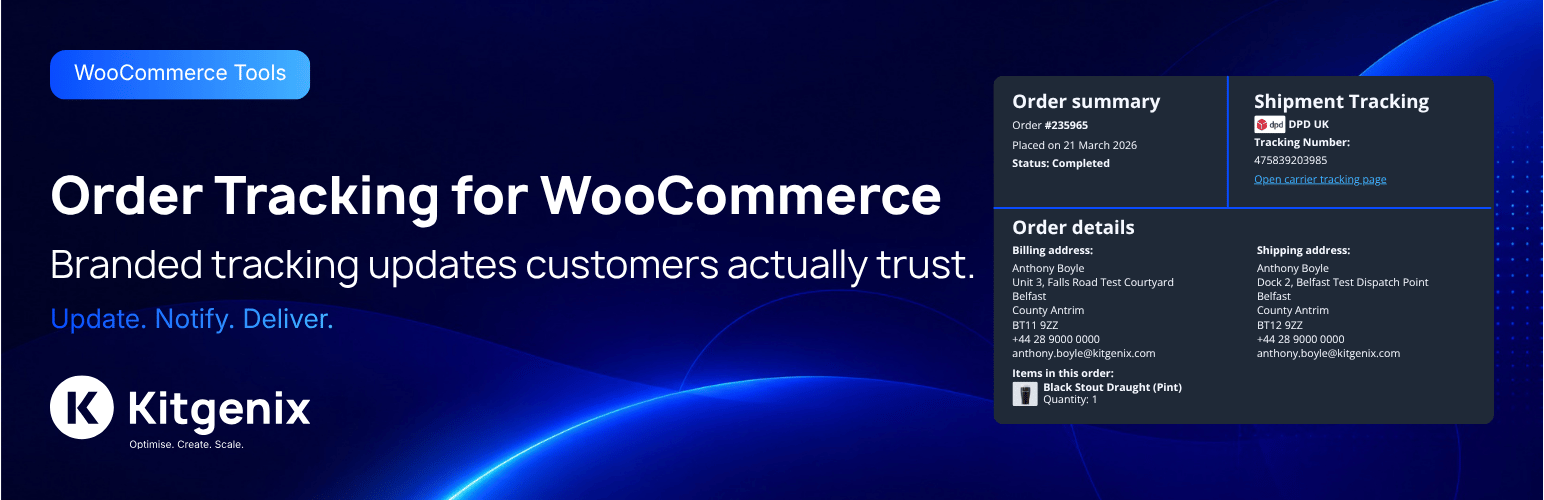
Kitgenix Order Tracking for WooCommerce adds shipment tracking to WooCommerce orders so store staff can record one or more parcels, allocate order items to shipments, include tracking details in customer emails and offer a self-service tracking page.
The plugin is intentionally different from a live carrier-management platform. It stores the tracking number, selected carrier, tracking URL and staff-managed shipment status; it does not call courier APIs to obtain live delivery scans and it does not buy labels or book collections.
That makes it suitable for stores that already fulfil orders through their preferred courier workflow but need a consistent place in WooCommerce to record and communicate tracking information.
Built by Kitgenix.
WooCommerce Shipment Tracking Features
- Add multiple shipments to one WooCommerce order.
- Store a tracking number and carrier for each shipment.
- Allocate specific order items and quantities to a shipment.
- Prevent allocated quantities exceeding what the customer ordered.
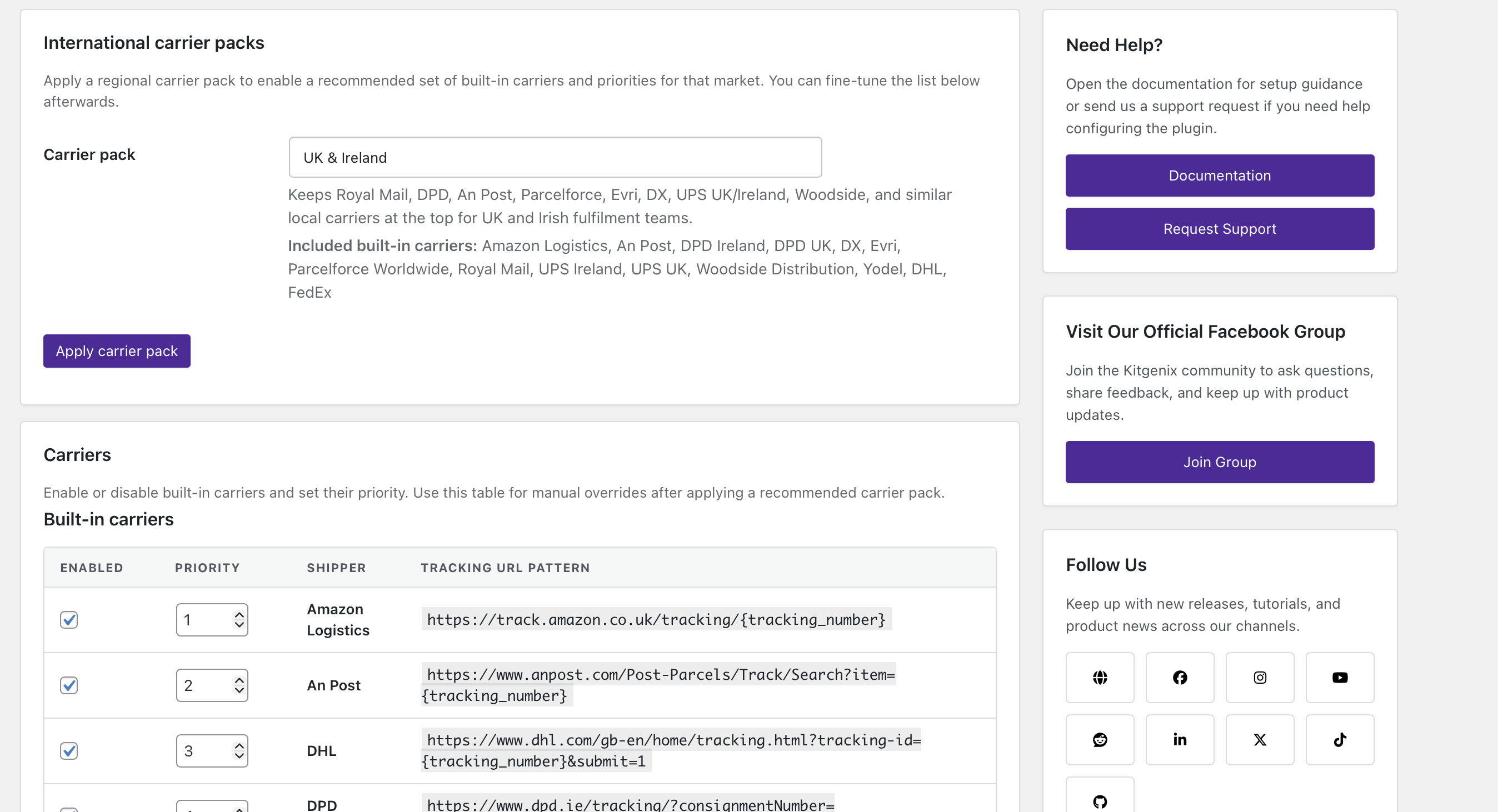
- Use built-in carrier tracking URL patterns.
- Create custom carrier entries for services not included by default.
- Track staff-managed shipment states including shipped, in transit, delivered, exception, returned and cancelled.
- Add tracking information to supported WooCommerce customer emails.
- Provide a dedicated partially-shipped workflow/status/email where configured by the plugin.
- Give customers a self-service order tracking page.
- Support a public tracking form with order-identification checks.
- Show tracking information in My Account for authenticated customers.
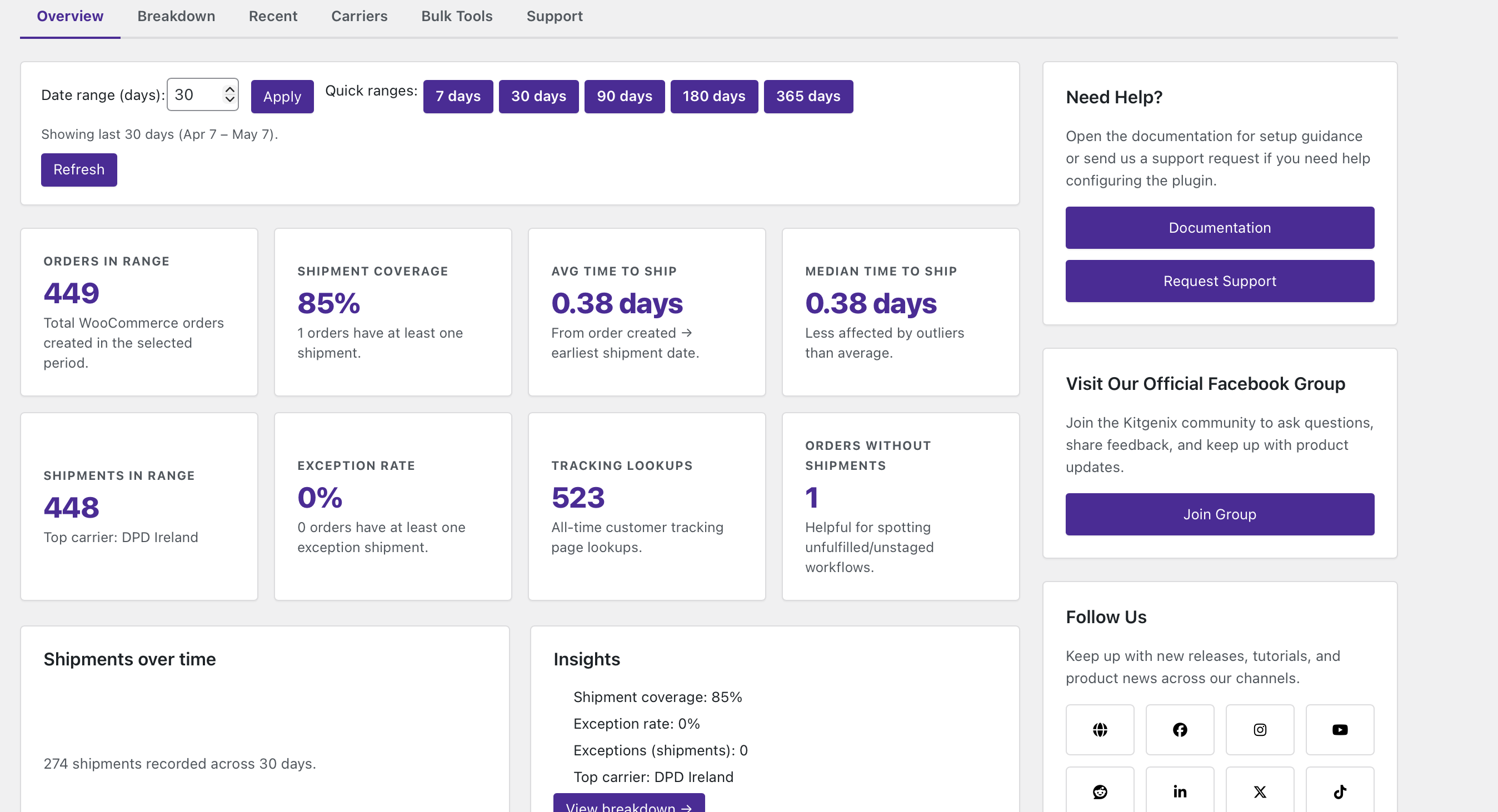
- Provide tracking analytics/reporting in wp-admin.
- Import/export tracking information in supported bulk workflows.
- Optional map presentation using OpenStreetMap tiles and Nominatim geocoding.
- Developer hooks/filters for extending carrier and tracking behaviour.
- Declare WooCommerce HPOS compatibility.
Multiple Shipments and Partial Fulfilment
An order can contain more than one shipment. Each shipment has its own tracking number, carrier and status, making the plugin suitable for split parcels, backordered lines, replacements or orders dispatched from more than one fulfilment location.
Items and quantities can be assigned to an individual shipment. Allocation is bounded by the quantities actually ordered, so the tracking UI cannot legitimately claim that more units were shipped than exist on the order line.
The remaining/unallocated items can continue to represent what has not yet been included in a parcel.
Shipment Statuses
The plugin defines internal tracking states including:
- Shipped.
- In transit.
- Delivered.
- Exception.
- Returned.
- Cancelled.
These values are controlled by store staff or other code that integrates with the plugin. They are not automatically fetched from Royal Mail, DPD, UPS, FedEx or another courier.
That distinction is important: a “Delivered” status in the plugin means the WooCommerce store has set that status, not that Kitgenix independently confirmed delivery with the carrier.
Built-In and Custom Carriers
The carrier manager includes a set of ready-made carriers with tracking URL patterns. The codebase includes services for the UK, Ireland and international markets, including Royal Mail, Parcelforce/related services represented in the carrier set, DPD, An Post, DHL, UPS, FedEx, USPS, Canada Post, Australia Post, NZ Post and others.
A custom/Other carrier option is available where a courier is not built in. A custom tracking URL pattern can contain the tracking-number placeholder so customer links still lead to the relevant courier tracking page.
Customer Email Notifications
Tracking information can be inserted into WooCommerce email flows. The plugin also includes a dedicated email class/workflow for partially shipped orders so customers can be informed when only part of an order has been dispatched.
Because tracking data is stored on the WooCommerce order, customer-facing output can reuse the same shipment records rather than staff copying numbers into several separate systems.
Self-Service Tracking Page
The frontend tracking experience lets a customer look up tracking information using supported order-identification details. Logged-in customers can see order-related tracking through My Account, while the public form validates the supplied order data before showing sensitive order context.
The output intentionally limits customer information rather than exposing a full order record to anyone who guesses an order number.
A shortcode is registered for the tracking form:
[kitgenix_tracking_form]
Tracking Analytics
The plugin includes an admin analytics area for reviewing shipment/tracking activity. Reporting is based on the tracking data stored with WooCommerce orders; it is not a remote courier analytics product and does not profile visitors across websites.
Optional Route Map
Where enabled by the frontend template/settings, the tracking page can display a simple map between the store origin and customer destination. The browser uses the bundled Leaflet library with OpenStreetMap map tiles and can query the public Nominatim geocoding service to translate the displayed addresses into coordinates.
The map is illustrative. The code draws a straight line between geocoded points; it is not a live courier route, vehicle location or turn-by-turn delivery route.
No Google Maps API key is required by this implementation.
Bulk Portability
The plugin includes import/export functionality for tracking records so stores can move or update shipment information in bulk rather than editing every order manually.
Administrators should test bulk imports on a staging copy first when mapping external fulfilment data, especially when orders can have multiple shipments or item allocations.
Privacy and Data
Shipment records are stored with WooCommerce orders. The plugin does not send tracking records to a Kitgenix tracking service. Clicking a courier link takes the customer to that carrier’s own website, which then operates under the carrier’s own privacy terms.
If the optional route map is used, address text is sent from the customer’s browser to the configured Nominatim endpoint for geocoding and map tiles are requested from OpenStreetMap infrastructure. Those services are documented in External Services below.
What This Plugin Does Not Do
- It does not buy or print shipping labels.
- It does not book courier collections.
- It does not pull live tracking scans from carrier APIs.
- It does not automatically know when a parcel is delivered unless another user/integration updates the status.
- It does not replace a warehouse management or fulfilment platform.
Typical Uses
- WooCommerce stores that dispatch with several different couriers.
- Orders split into multiple parcels.
- Partial shipments where customers need to know which items have left.
- Support teams that want tracking visible in the order instead of private notes.
- Stores that want a branded self-service tracking lookup without a hosted Kitgenix account.
Developers
Text domain:
kitgenix-order-tracking-for-woocommerce
Shortcode:
[kitgenix_tracking_form]
Data model (high level):
– Shipments are stored as order meta under _kitgenix_tracking_shipments (array)
– Tracking numbers are indexed for fast lookup via repeated order meta _kitgenix_tracking_number (one meta row per tracking number)
– Each shipment can also store a status value (shipped, in_transit, delivered, exception, returned, cancelled) for admin records and analytics – this is set by staff, not fetched from a carrier
– Admin UI stores the last chosen “update order status” action as order meta kitgenix_order_status_action (values: no_change, partial, completed)
– Carrier settings are stored in the option kitgenix_order_tracking_for_woocommerce_carriers_settings
– Counter option: kitgenix_order_tracking_for_woocommerce_tracking_numbers_added (privacy-safe total)
– Counter option: kitgenix_order_tracking_for_woocommerce_lookup_count (successful tracking-page lookups)
– Event log option: kitgenix_order_tracking_event_log
– Analytics aggregates are cached briefly in transients prefixed kitgenix_order_tracking_for_woocommerce_analytics_...
– Activation redirect uses transient kitgenix_order_tracking_for_woocommerce_do_activation_redirect (about 30 seconds)
– No custom database tables are created
– No custom post types, taxonomies, or REST API routes are registered by this plugin
– Uninstall does not remove order meta or shipment data (to preserve historical tracking) – see Uninstall behaviour below
Nonces / capabilities (summary):
– Order edit tracking save uses nonce action kitgenix_order_tracking_save (kitgenix_order_tracking_nonce) and requires edit_shop_order.
– Order-items modal loads via AJAX action kitgenix_order_tracking_for_woocommerce_get_order_items using nonce action kitgenix_order_tracking.
– Tracking form submissions use nonce action kitgenix_tracking_lookup (kitgenix_tracking_nonce).
– Carriers (Shippers) settings form uses nonce action kitgenix_order_tracking_for_woocommerce_save_carriers (kitgenix_order_tracking_for_woocommerce_carriers_nonce).
– CSV export/import on the Bulk Tools tab use the kitgenix_order_tracking_export_shipments and kitgenix_order_tracking_import_shipments nonce actions and require the plugin’s admin capability (manage_woocommerce, or manage_options if WooCommerce management capabilities aren’t available).
Hooks / filters:
– kitgenix_order_tracking_shipment_created( int $order_id, array $shipment ) (action, fires after a new shipment is saved)
– kitgenix_order_tracking_shipment_updated( int $order_id, array $shipment, array $previous_shipment ) (action, fires after an existing shipment is changed)
– kitgenix_order_tracking_shipment_deleted( int $order_id, array $shipment ) (action, fires after a shipment is removed)
– kitgenix_order_tracking_shipment_notification_sent( int $order_id, string $email_id ) (action, fires after the Partially Shipped email is sent)
– kitgenix_order_tracking_for_woocommerce_debug_save( bool $enabled, int $order_id ): bool (filter, enable a debug order note on save)
– kitgenix_order_tracking_for_woocommerce_nominatim_email( string $email ): string (filter, supply/override the Nominatim contact email param)
– kitgenix_order_tracking_for_woocommerce_nominatim_endpoint( string $endpoint ): string (filter, override the geocoding endpoint)
Templates:
– The custom Partially Shipped email uses standard WooCommerce template override patterns via the files in templates/emails/ and templates/emails/plain/.
Admin AJAX endpoints:
– wp_ajax_kitgenix_order_tracking_for_woocommerce_get_order_items (load order items into the shipment modal)
Uninstall behaviour:
– Removed on uninstall: the carrier settings option, the tracking-numbers-added and lookup-count counter options, the event log option, and all plugin-prefixed transients (including any Kitgenix hub caches described below); the same options are also cleaned up per-site on multisite.
– Not removed on uninstall: order meta (_kitgenix_tracking_shipments, _kitgenix_tracking_number) and the “Partially shipped” order status/history stay on your orders, so historical tracking data and reporting are preserved even after the plugin is removed.
External Services
This plugin may connect to external services in three situations:
1) When customers click courier tracking links
Tracking links open the carrier’s own tracking page (e.g. Amazon Logistics, An Post, DHL, DPD, DX, Evri, FedEx, Parcelforce Worldwide, Royal Mail, UPS, Woodside Distribution, Yodel, or a custom “Other” URL you configure). These links may contain the tracking number. The plugin does not call any carrier API on its own – it never fetches live delivery status from a courier.
2) When the optional route map is enabled
The tracking view may request:
– OpenStreetMap tile images, from https://{s}.tile.openstreetmap.org/{z}/{x}/{y}.png.
– Nominatim geocoding requests, to convert store and customer address details into map coordinates. This defaults to https://nominatim.openstreetmap.org/search and may include the full store and delivery address string in the q parameter. A developer filter lets you override the endpoint and supply a contact email for the request.
Leaflet (the mapping library) is bundled with the plugin – no CDN or external script is loaded to render the map itself.
3) In wp-admin (Kitgenix hub)
This plugin includes a shared “Kitgenix hub” admin page that helps you find and manage other Kitgenix plugins. It uses WordPress core’s plugins_api() function to fetch publicly available plugin listing data from the WordPress.org Plugins API (wordpress.org) – active install counts, ratings, and icon/banner artwork – for a fixed list of Kitgenix plugin slugs. No site content, order data, or personal data is sent as part of these requests; results are cached in transients for up to 24 hours (kitgenix_hub_wporg_active_installs_v1, kitgenix_hub_wporg_ratings_v1, kitgenix_hub_wporg_media_v1) to minimise repeat calls.
No personal data is sold or shared by this plugin. Where external services are used, requests may include data required to perform the function (for example, a tracking number in a carrier link, or address data used for geocoding). Review the relevant provider’s own privacy policy for your use case.
Trademark Notice
All carrier names and logos are trademarks of their respective owners. This plugin is not affiliated with or endorsed by any courier, carrier, OpenStreetMap, or Nominatim service.
Support Development
If this plugin reduces “where is my order?” tickets and helps customers self-serve tracking, you can support ongoing development with a donation via PayPal:
https://www.paypal.com/donate/?hosted_button_id=KALF36K6JJ9B2
Credits
Built with ❤︎ by @kitgenix – https://kitgenix.com
Installation
- Install and activate WooCommerce if you haven’t already – this plugin will not activate without it.
- Install this plugin via Plugins → Add New (search for “Kitgenix Order Tracking for WooCommerce”), or upload the ZIP file to /wp-content/plugins/ and activate it.
- Create a page (e.g. “Track Your Order”) and add the shortcode:
[kitgenix_tracking_form] - Open any WooCommerce order and use the Kitgenix Order Tracking meta box to add a shipment.
- Send a Completed Order email (or use the Partially Shipped status) to confirm tracking appears correctly.
- Optional: visit Kitgenix → Order Tracking → Carriers to apply a regional carrier pack, and → Bulk Tools if your fulfilment team needs CSV import/export.
FAQ
Does this plugin require WooCommerce?
Yes. WooCommerce must be installed and active. If WooCommerce isn’t active, the plugin deactivates itself automatically and shows a notice.
Can I add multiple tracking numbers to one order?
Yes. Add as many shipments as you need per order, including split parcels and partial shipments, each with its own carrier and tracking number.
Does the plugin fetch live tracking status from couriers?
No. It stores the tracking number and links to the carrier’s own tracking page. Any shipment status shown in the admin or analytics (Shipped, In transit, Delivered, etc.) is set manually by your staff – the plugin does not call carrier APIs.
Which couriers are supported?
Built-in carriers include Amazon Logistics, An Post, Australia Post, Bpost, Canada Post, Chronopost, Colissimo/La Poste, Correos, DHL, Deutsche Post/DHL Germany, DPD Ireland, DPD UK, DX, Evri, FedEx, GLS, NZ Post, Parcelforce Worldwide, PostNL, PostNord, Royal Mail, UPS (US, Ireland, UK), USPS, Woodside Distribution, and Yodel, plus an “Other” option for custom links.
Can I use a courier that isn’t listed?
Yes. Use Kitgenix → Order Tracking → Carriers to add a custom carrier with its own tracking URL pattern (using {tracking_number}) and icon, or select “Other” when adding tracking to an order.
Does the plugin guess the carrier for me?
It can suggest one for tracking numbers with a distinctive, unambiguous format (UPS’s “1Z” prefix, Amazon Logistics’ “TBA” prefix, Royal Mail/Parcelforce and USPS formats). This is always shown as an unconfirmed suggestion – it never overwrites a carrier you’ve explicitly chosen, and ambiguous numeric formats are left unmatched rather than guessed.
Can I import or export tracking in bulk?
Yes. The Bulk Tools tab exports all tracked shipments to CSV and lets you re-import edited files, either appending new shipments or replacing all shipments on the matched orders. Per-item quantities round-trip using an item_id:qty|item_id:qty format.
Do customers get tracking in emails automatically?
Yes, once a shipment exists on the order. Tracking appears in the WooCommerce Completed Order email and in the plugin’s Partially Shipped email.
What is the “Partially shipped” order status and email?
The plugin adds a custom order status, “Partially shipped”, and a matching customer email. It’s designed for stores that ship orders in stages and want to notify customers with tracking before the whole order is complete.
Can customers track an order without logging in?
Yes. The [kitgenix_tracking_form] tracking page is public and supports lookup by order number and billing email, or by tracking number alone.
Why can’t a customer see the full address or item details on the tracking page?
For privacy, full addresses, the route map, and item-level shipment detail are only shown after the customer confirms the postcode, ZIP code, or postal code stored on the order. This check uses country-aware matching, not a single fixed postcode format. If an order has no postcode stored, these details are only shown for an order number and billing email lookup, never for a tracking-number-only lookup.
Can someone guess order numbers, emails or postcodes on the tracking page?
No. The form shows the same message whether an order doesn’t exist or the email doesn’t match, so it can’t be used to find valid order numbers. Failed lookups are also rate-limited: 20 per IP address every 15 minutes, and an individual order is locked for 15 minutes after 5 wrong email or postcode attempts. Developers can change these limits with the kitgenix_order_tracking_for_woocommerce_max_failed_lookups_per_ip and kitgenix_order_tracking_for_woocommerce_max_failed_lookups_per_order filters.
Does the plugin work with WooCommerce High-Performance Order Storage (HPOS)?
Yes. The plugin declares HPOS compatibility and its order meta box and save logic work on both the classic and HPOS order-edit screens.
Do I need a Google Maps API key for the route map?
No. The optional map uses Leaflet (bundled with the plugin) and OpenStreetMap tiles, with no API key or CDN required.
The route map isn’t showing – what should I check?
Check for a strict Content Security Policy or aggressive script/asset optimisation that might block the bundled Leaflet script or the OpenStreetMap tile and geocoding requests.
Does this plugin create shipping labels or replace a fulfilment system?
No. It records tracking numbers you already have and displays them to customers; it doesn’t generate labels, rates, or replace a fulfilment/shipping suite.
Is this plugin GDPR-friendly?
It doesn’t set tracking cookies and uses WooCommerce’s existing order data for lookups. Carrier tracking links and the optional map’s tile/geocoding requests are external services – review their own privacy policies for your needs.
Does this plugin talk to any other Kitgenix plugins or a remote Kitgenix server?
No customer or store data is sent to Kitgenix. The plugin adds an optional “Kitgenix” admin page that can look up publicly available plugin listing information (install counts, ratings, icons) from WordPress.org for other Kitgenix plugins, to help you find and manage them – see External Services below.
Screenshots


Changelog
2.2.0 (30 October 2026)
- Fix: The order number and email lookup now works for stores using a sequential or custom order-number plugin (for example WebToffee/Skyverge Sequential Order Numbers, Algoritmika Custom Order Numbers, or Kitgenix MultiStore Sync’s own network order numbers). The lookup previously called
wc_get_order()directly on the submitted number, which only accepts the order’s internal ID, so a customer entering the order number actually shown to them could never find their order. The submitted number is now resolved the same way WooCommerce’s own order-tracking shortcode does, through thewoocommerce_shortcode_order_tracking_order_idfilter, with a fallback to a short list of known order-number meta keys (filterable viakitgenix_order_tracking_for_woocommerce_order_number_meta_keys) before falling back to the raw internal ID. - New: Branded My Account Tracking Panel. Display shipments and status details directly within WooCommerce My Account order views. Each shipment shows its carrier, a status badge, the tracking number, a shipment timeline, the items it contains and a “Track with carrier” button. The panel can be turned off with the
kitgenix_order_tracking_for_woocommerce_show_my_account_panelfilter, and its accent colour changed with thekitgenix_order_tracking_for_woocommerce_my_account_accent_colorfilter. - Improved: The My Account shipment timeline no longer shows a permanently greyed-out “In transit” step for shipments staff never manually advance. Any shipment that hasn’t reached a final status (delivered, exception, returned or cancelled) now ends in a single open “On its way”/”In transit” step with a subtle pulsing indicator, so it reads as active progress instead of a stalled tracker. The “Track with carrier” button is also more prominent, since the carrier’s own site remains the source of live scan updates.
- Security: Fixed an issue where, for an order with no postcode stored, a lookup using only a tracking number could show the order’s full billing and shipping addresses. These details are now only shown after an order number and billing email lookup, or once the postcode is confirmed.
- Security: Added rate limiting to the tracking form. Failed lookups are limited per IP address (20 every 15 minutes), and an individual order is temporarily locked after 5 incorrect email or postcode attempts, so the postcode check cannot be brute-forced. Both limits can be changed with the
kitgenix_order_tracking_for_woocommerce_max_failed_lookups_per_ipandkitgenix_order_tracking_for_woocommerce_max_failed_lookups_per_orderfilters. - Security: The tracking form now shows the same message when an order does not exist and when the email does not match, so it can no longer be used to discover which order numbers exist.
- Security: Shipment CSV exports now neutralise spreadsheet formula injection by prefixing values that start with
=,+,-,@, a tab or a carriage return with an apostrophe. Shipment CSV imports remove it again automatically, so exported files import back unchanged. - Improved: Raised the minimum PHP version to 8.2 (
Requires PHP: 8.2). - Improved: Tested up to WordPress 7.4 and WooCommerce 11.2.1, and reviewed for compatibility with PHP 8.2 to 8.5. The full codebase passes syntax checks on PHP 8.5 and a PHPCompatibility scan for PHP 8.2–8.5, and uses no dynamic properties or functions deprecated in PHP 8.2–8.5.
- Improved: Declared compatibility with the WooCommerce Cart and Checkout blocks (
cart_checkout_blocks), so WooCommerce no longer lists the plugin as possibly incompatible in the Checkout block editor. - Fix: The CSV
$escapeargument is now passed explicitly in the shipment CSV export and bulk tracking CSV import, preventing “the $escape parameter must be provided” deprecation notices on PHP 8.4 and later. The CSV format is unchanged. - Dev: Removed the PluginScore verification code from the readme, as Kitgenix Plugin Score has been discontinued.
- Dev: Bumped the version to 2.2.0 across the plugin.
- Documentation: Regenerated the
.pottranslation template for 2.2.0. - Documentation: The readme changelog now lists only the current release. The full release history is in
CHANGELOG.md.
Full release history is available in the plugin’s CHANGELOG.md file.