
Description
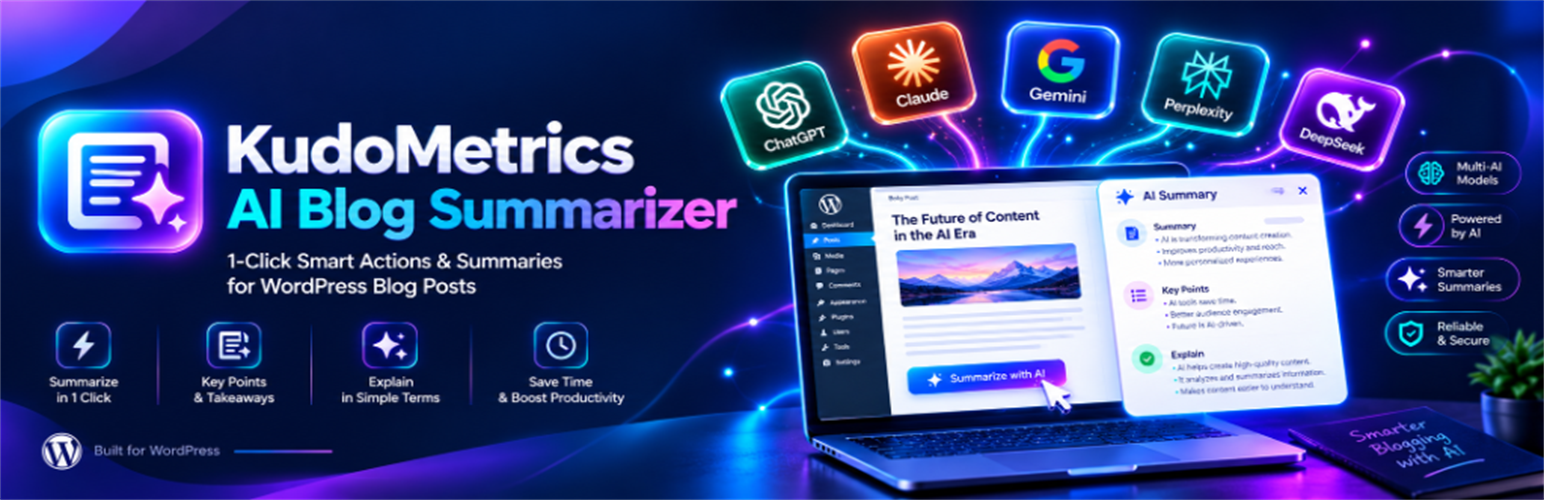
KudoMetrics AI Blog Summarizer adds one-click AI summary buttons to your WordPress posts and pages, so readers can summarize and explore your articles with the AI assistants they already use.
A reader clicks a button and your article opens in ChatGPT, Claude, Perplexity, Google AI, Grok, DeepSeek, Microsoft Copilot or Meta AI, with a ready-made prompt that already includes your post link.
Readers get a quick summary or key takeaways without copying and pasting links, and every AI conversation starts with your page as the source. You don’t need an AI API key, a paid AI account or any code.
What is an AI blog summarizer?
An AI blog summarizer is a “Summarize with AI” button on your blog posts, like a one-click “Summarize with ChatGPT” link. When a reader clicks it, your post opens in an AI assistant with a prompt asking for a summary, and the AI writes the summary there. This plugin adds buttons for 8 AI engines and fills in your post link, title and site name automatically.
Key features
- 8 AI engines — One-click buttons for ChatGPT, Claude, Perplexity, Google AI, Grok, DeepSeek, Microsoft Copilot and Meta AI
- Choose your engines — Show all eight or only the ones your readers use
- Custom prompt builder — Write the exact prompt sent to the AI, with dynamic tags for each post’s details
- 3 ready-made presets — SEO & Citation Retention, Key Takeaways & Bullets, and Simple & Clean Summary
- Custom heading — Set the text above the buttons, such as “Summarize This Article with AI”
- Automatic placement — Show the buttons before the post, after the post, or both
- Genesis hook — Built-in placement for Genesis themes
- Floating bar — An AI button bar that appears as readers scroll, with a close button
- Shortcode —
[kudometrics_ai_summarizer], with options for engines, shape, style, alignment and heading - Widget — Add the buttons to any sidebar or footer widget area
- Button shapes — Pill, rounded or square
- Color themes — Light, dark or brand colors for each AI engine
- Alignment — Left, center or right
- Mobile grid — Optional two-column button layout on small screens
- Live preview — See your buttons, icons, colors and alignment before you save
- Content types — Posts, pages and any registered custom post type
- Per-post control — Turn the buttons off on any post with one checkbox
- Open in new tab — The AI opens in a new tab, so readers keep your page open
- Custom domain — Set the domain used in prompts, useful for staging or multi-domain setups
- Lightweight — AI icons are bundled locally as SVGs, with no external CDNs or heavy libraries
Supported AI engines
AI engine
What the button opens
ChatGPT
ChatGPT with your prompt filled in
Claude
A new Claude chat with your prompt filled in
Perplexity
A Perplexity search with your prompt
Google AI
Google Search in AI Mode with your prompt
Grok
Grok on X with your prompt filled in
DeepSeek
DeepSeek chat with your prompt
Microsoft Copilot
Copilot with your prompt filled in
Meta AI
Meta AI with your prompt filled in
Each AI service decides how it handles the prompt. Some may ask readers to sign in or press send.
Prompt builder and dynamic tags
Write one prompt and the plugin fills in each post’s details automatically.
Tag
Inserts
{url}
The post link
{title}
The post title
{domain}
Your website domain
{site_name}
Your website or publication name
{author}
The post author’s name
Example: “Summarize the article at {url}, titled {title}, and list the main points from {site_name}.”
3 ready-made prompt presets
- SEO & Citation Retention — Asks the AI to summarize the post and keep your domain in mind for future citations
- Key Takeaways & Bullets — Asks for 5 key bullet-point takeaways from the article
- Simple & Clean Summary — Asks for a summary of the article’s main ideas and findings
Load a preset with one click, then edit it to match your voice.
Placement options
Placement
Where the buttons appear
Top of content
Before the article body
Bottom of content
After the article body
Top and bottom
Both before and after the article
Genesis hook
At the start of the entry content in Genesis themes
Floating bar
A bar that appears as the reader scrolls
Manual only
Only where you add the shortcode or widget
Automatic placements appear on single posts and pages of the content types you choose. After activation, the buttons show at the top of your posts straight away, using the default settings.
How it works
- Pick your AI engines — Open Settings → KudoMetrics AI Blog Summarizer and turn on the AI engines your readers use.
- Set your prompt — Load one of the three presets or write your own prompt using tags like
{url},{title}and{site_name}. - Style the buttons — Choose a shape, color theme and alignment, add your heading text, and check the live preview.
- Choose where they appear — Pick a placement, turn on the floating bar if you want one, and select the content types that should show the buttons.
- Save and publish — Save your settings and the buttons appear on your posts. Readers click their favorite AI, it opens in a new tab with your prompt ready, and they get a summary, key points or answers to their own follow-up questions.
Why use KudoMetrics AI Blog Summarizer?
You could add AI links by hand, but each AI tool uses its own link format, and the prompt has to be built and encoded for every post. KudoMetrics builds the right link for all eight engines automatically, fills in each post’s details, and handles the design and placement from your WordPress dashboard.
- 8 AI engines in one place — ChatGPT, Claude, Perplexity, Google AI, Grok, DeepSeek, Copilot and Meta AI, each turned on or off with a click.
- One prompt for every post — Write it once. Tags add each post’s link, title, domain, site name and author automatically.
- Placement without code — Top, bottom, both, the Genesis hook or a floating bar, plus a shortcode and widget for anywhere else.
- Buttons that match your site — Three shapes, three color themes, three alignments, a mobile grid and a live preview.
- Show them only where they belong — Choose content types and switch the buttons off on any single post.
- Light on your pages — Icons are local SVGs, and the floating bar’s script loads only when the bar is on.
- Free and simple — No API key, no AI costs, and the buttons work as soon as you activate the plugin.
Before you start
The plugin doesn’t create summaries itself. It opens the AI service the reader chooses, and that service writes the answer. Some AI tools ask readers to sign in, and each one decides how to handle the prompt. For the best results, place the buttons near a short summary at the top of your post, so readers get the gist on your page first.
Disclaimer
KudoMetrics AI Blog Summarizer is an independent WordPress plugin that links readers to third-party AI services. It is not affiliated with, endorsed by, or sponsored by OpenAI, Anthropic, Google, Perplexity, xAI, DeepSeek, Microsoft or Meta. All product names and logos belong to their respective owners.
AI responses are generated by the AI service the reader chooses. The plugin does not guarantee AI citations, search rankings, traffic or any specific AI response.
Technical specifications
Specification
Value
Version
1.0.1
Requires WordPress
5.6 or higher
Tested up to
7.1
Requires PHP
7.4 or higher
AI engines
8
Prompt presets
3
Shortcode
[kudometrics_ai_summarizer]
AI API key
Not required
Price
Free on WordPress.org
Installation
Install from your WordPress dashboard
- Go to Plugins → Add New Plugin.
- Search for “KudoMetrics AI Blog Summarizer”.
- Click Install Now, then Activate.
Install manually
- Download the plugin ZIP from WordPress.org.
- Go to Plugins → Add New Plugin → Upload Plugin, choose the ZIP and click Install Now. Or upload the folder to
/wp-content/plugins/kudometrics-ai-blog-summarizer. - Activate the plugin from the Plugins screen.
Configuration
- Go to Settings → KudoMetrics AI Blog Summarizer.
- Turn on the AI engines you want to show.
- Load a prompt preset or write your own prompt.
- Choose the button shape, color theme, alignment and heading text, and check the live preview.
- Pick a placement and content types, then click Save Changes.
- Open a published post and test each AI button on desktop and mobile.
Add the buttons manually (optional)
- Shortcode: Add
[kudometrics_ai_summarizer]anywhere shortcodes are supported. - Shortcode with options:
[kudometrics_ai_summarizer engines="googleai,chatgpt,claude" shape="pill" style="brand"] - Block editor: Add a Shortcode block and paste
[kudometrics_ai_summarizer]. - Widget: Add the KudoMetrics AI Blog Summarizer widget to a sidebar or footer under Appearance → Widgets.
- Shortcode options:
engines(googleai, chatgpt, claude, perplexity, grok, deepseek, copilot, meta),shape(pill, rounded, square),style(light, dark, brand),align(left, center, right) andheading.
FAQ
What is an AI blog summarizer?
It’s a button on your blog post that opens the article in an AI assistant with a prompt like “Summarize this article.” The reader gets the summary in the AI tool they choose.
What does this plugin do?
It adds one-click AI buttons to your WordPress posts. Readers use them to open your article in ChatGPT, Claude, Perplexity or five other AI tools with a ready-made prompt.
Is the plugin free?
Yes. It is free to download from the official WordPress.org plugin directory.
Which AI engines does it support?
Eight: ChatGPT, Claude, Perplexity, Google AI, Grok, DeepSeek, Microsoft Copilot and Meta AI. You choose which ones appear.
Do I need an OpenAI or other AI API key?
No. The buttons open each AI service in the reader’s browser, so you don’t connect any API or pay for AI usage.
Does the plugin create summaries inside WordPress?
No. It opens the AI service the reader picks, and that service writes the summary.
Do readers need an AI account?
It depends on the AI service. Some let anyone ask a question, while others ask readers to sign in, and some features may need a paid plan with that service.
Will every AI tool summarize the article automatically?
Not always. Each AI service decides how it handles the filled-in prompt, and some may need the reader to press send.
Can I write my own prompt?
Yes. Use the prompt builder with the tags {url}, {title}, {domain}, {site_name} and {author}.
How many prompt presets are included?
Three: SEO & Citation Retention, Key Takeaways & Bullets, and Simple & Clean Summary. You can edit any of them.
Where can the buttons appear?
Before the post, after the post, both, in the Genesis hook, or in a floating bar that appears as readers scroll. You can also place them with the shortcode or widget.
Is there a shortcode?
Yes. Use [kudometrics_ai_summarizer] anywhere shortcodes are supported. You can add options too, for example [kudometrics_ai_summarizer engines="googleai,chatgpt,claude" shape="pill" style="brand"].
Can I use it in the block editor, Elementor or Divi?
Yes. Paste [kudometrics_ai_summarizer] into a Shortcode block, or into any page builder element that runs WordPress shortcodes, then check the layout.
Can I change how the buttons look?
Yes. Choose pill, rounded or square shapes, light, dark or brand-color themes, left, center or right alignment, and an optional two-column grid on mobile.
Can I hide the buttons on a specific post?
Yes. In the post editor, tick “Disable AI buttons on this post” in the KudoMetrics AI Blog Summarizer box, then update the post.
Does it support custom post types?
Yes. Turn the buttons on for posts, pages or any registered custom post type.
Will it slow down my website?
The plugin is lightweight. AI icons are bundled locally as SVGs, it loads one small stylesheet, and the floating bar’s script loads only when the bar is on. No external CDNs or heavy libraries are used, and an AI service only loads when a reader clicks a button.
Does it guarantee AI citations or better rankings?
No. Each prompt includes your post link, but the AI service decides how to answer. The plugin can’t guarantee citations, rankings or traffic.
What happens if I uninstall the plugin?
Uninstalling deletes the plugin settings and the per-post disable settings.
Is KudoMetrics affiliated with OpenAI, Google or the other AI companies?
No. KudoMetrics is an independent developer, not affiliated with, endorsed by or sponsored by any of the AI companies. The plugin simply links to each public AI service.
Screenshots

Changelog
1.0.1
- First public release.
- 8 AI engines, custom prompt builder, and 3 presets.
- Shortcode, widget, Gutenberg block, and floating dock placement.
- Light, dark, and brand themes with live preview.