

Description
Most captchas stop spam by making your visitors do the work. Tick the box, then pick out every traffic light anyway. Free Captcha Protection hands that job to the visitor’s browser, so people just fill in your form and press send.
As soon as someone starts using a protected form, their browser works through a small proof-of-work calculation in the background. On most devices it takes about a second, usually while the person is still typing. Bots that post straight to your forms never run it, so they arrive without a valid answer and get turned away.
All of it happens on your own server. The plugin never talks to Google, Cloudflare or anyone else, and it sets no cookies. There’s no account to create and no API key to paste in. It’s free.
We made it for the client sites we build and look after at MJ Studios. Now you can use it on yours.
Replaces Google reCAPTCHA, Cloudflare Turnstile and hCaptcha
Google reCAPTCHA, Cloudflare Turnstile, hCaptcha and Friendly Captcha all ask you for an account and a site key, and each loads its script from the provider’s servers. This plugin does the same job from your own server. It’s free, and there’s nothing to sign up for.
Switch the old captcha off, activate this one, and the forms below are protected straight away. You don’t have to edit a single form.
Works with the forms you already have
The plugin sees which form plugins are active and protects their forms by itself. Each one has a switch under Captcha Protection > Settings, so you can leave any of them out.
- WordPress login, registration, lost password and comments
- WooCommerce lost password, plus login, registration and the classic checkout once you switch them on
- Fluent Forms (its conversational forms aren’t covered yet)
- Contact Form 7
- WPForms
- Gravity Forms
- Ninja Forms
- Formidable Forms
- Forminator
- WS Form
- Everest Forms
- Elementor Pro forms
- Kadence Blocks forms
- MetForm
- HappyForms
- Jetpack Forms
- Bricks forms
- Any other form, using the
[mjscp_captcha]shortcode andmjscp_verify()
Forms built with Divi, Beaver Builder, Otter Blocks, Spectra and Brizy are protected as well, but we call those experimental for now because they haven’t run on many real sites yet. If one of them gives you trouble, switch it off in Settings and tell us in the support forum.
Protection is on with sensible defaults from the moment you activate it.
What your visitors notice
Ideally, nothing.
- Nothing loads until someone interacts with a form, so your page speed stays where it was.
- The widget stays hidden. If a submission is turned away, the message shows up where the form puts its other errors.
- If someone presses submit before the answer is ready, the form waits a moment and then sends itself.
- Each answer works once. The widget then fetches a fresh challenge, so AJAX forms can be sent again without a page reload.
- Forms that send without reloading the page work, and so do forms in popups and pages with more than one form.
- The work runs in Web Workers using the browser’s built-in crypto, with a pure JavaScript fallback for older browsers and sites on plain HTTP.
- Page caching is fine, because challenges are fetched fresh when a form is used.
When the check can’t run
Now and then the check can’t finish in someone’s browser. A privacy extension might block the script, or a strict network might block the request for a challenge. Rather than turn a real person away, the plugin sends the form anyway and leans on its other checks: the honeypot, the time spent on the form and the spam score.
These submissions show up as “Let through” on the Activity screen. Each IP address gets three an hour and the whole site gets 50, so bots can’t use this as a way around the proof of work. A fault in the plugin is handled the same way. If the check hits an error on your server, the message still goes through and the error lands in the log.
Plugins that handle their own spam
Contact Form 7, Formidable Forms, Gravity Forms and Jetpack Forms each deal with spam in their own way. For these four, a failed check hands the submission to that plugin as spam by default, and the plugin treats it like any other spam. If you’d rather turn failed submissions away with an error message, pick Reject for that plugin in Settings.
Extra checks behind the scenes
- A hidden honeypot field that only bots fill in
- A minimum time on the form, because nobody writes a message in half a second
- A spam score that counts links in messages and notices requests with missing browser headers
- Automatic IP blocking after repeated failures (by default, 5 failures in an hour earns a 24 hour block)
- An allowlist for single IPs and IPv4 ranges
- Support for Cloudflare and other proxies, so blocks land on the real visitor IP
You can’t lock yourself out. Login forms ignore IP blocks, and an IP an administrator has used is never blocked automatically.
See what it stopped
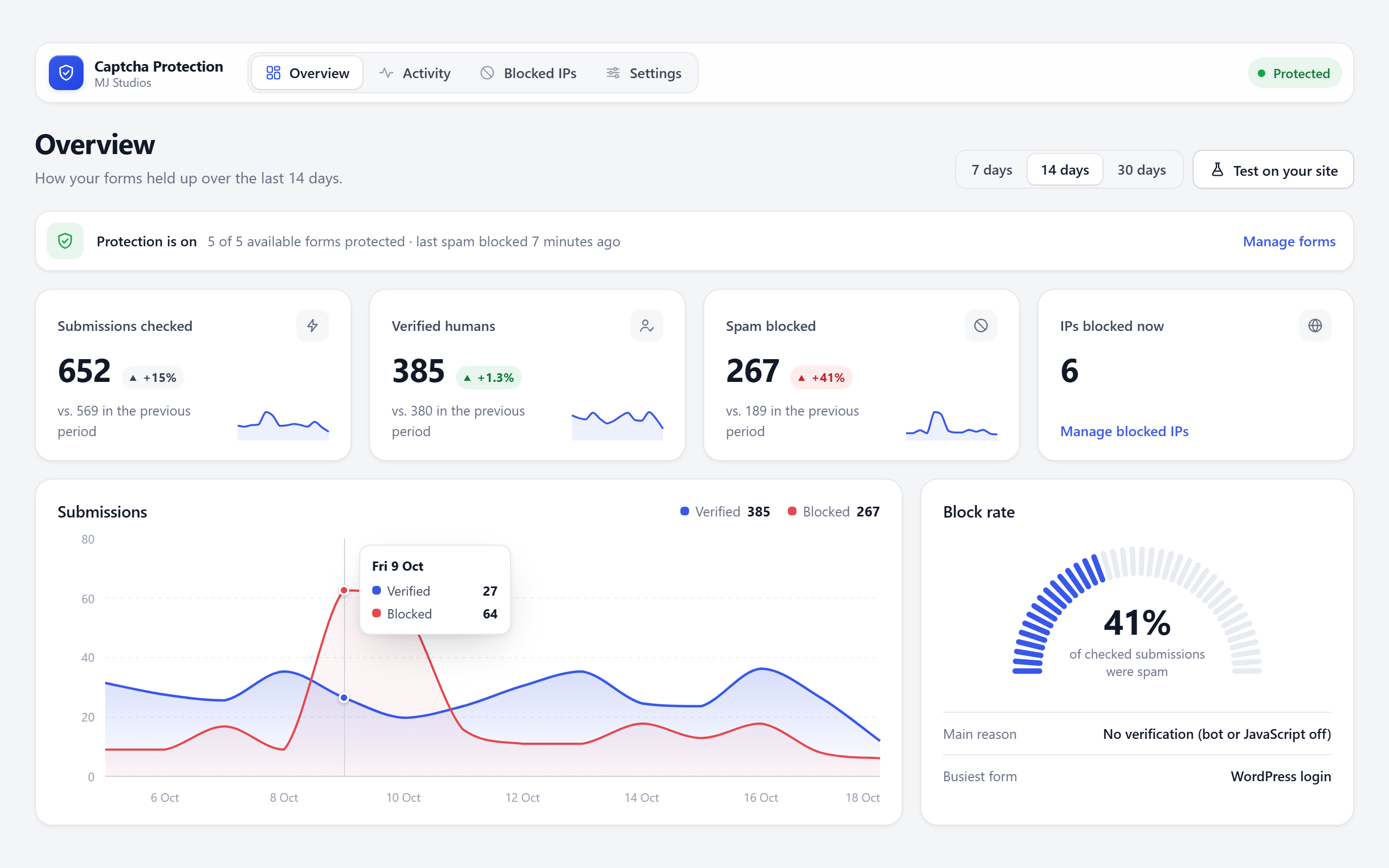
The Overview screen shows how your forms held up over the last 7, 14 or 30 days. You get totals compared with the period before, a daily chart you can hover for each day’s numbers, the block rate, the IPs that failed most and a breakdown by form and by reason.
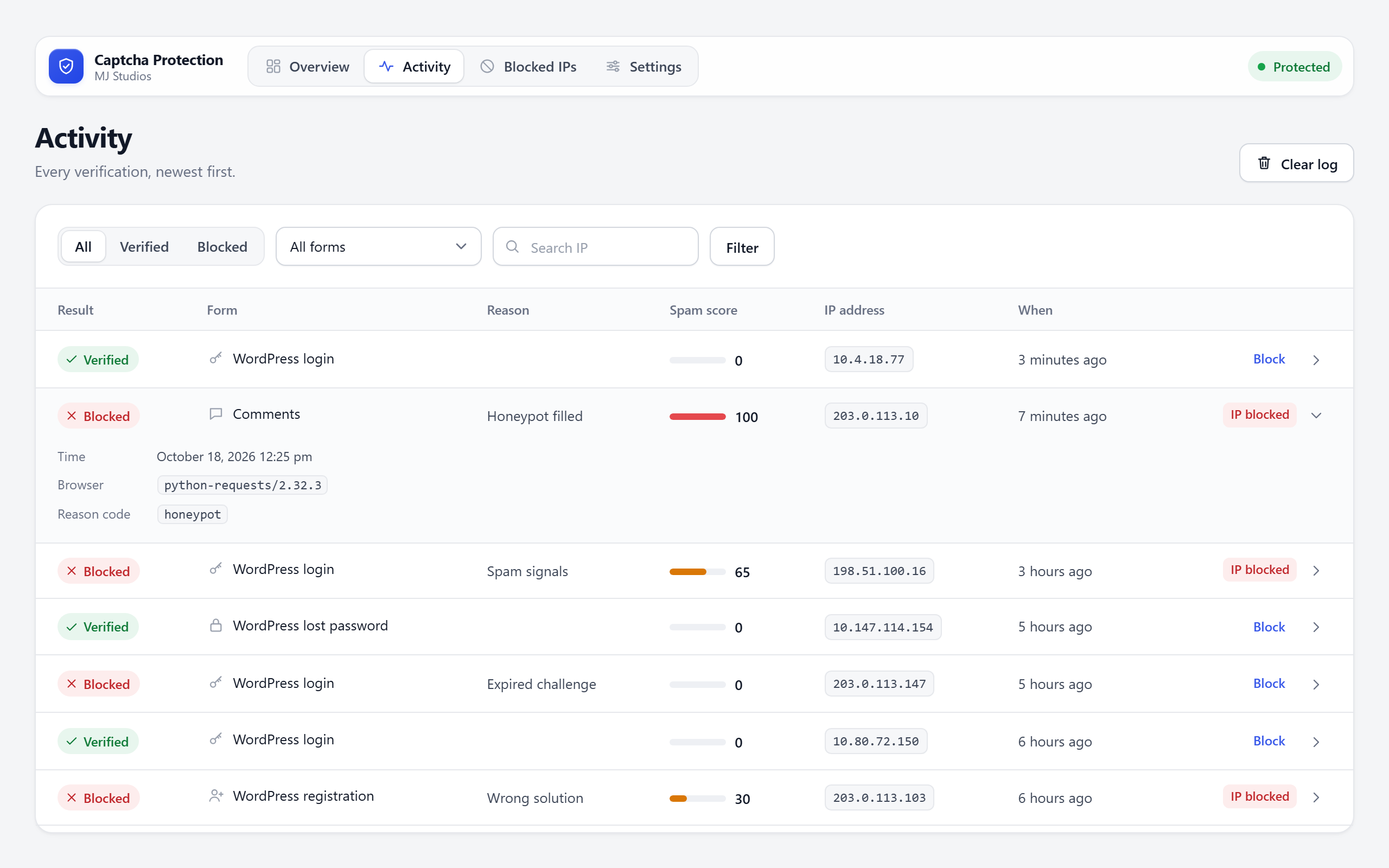
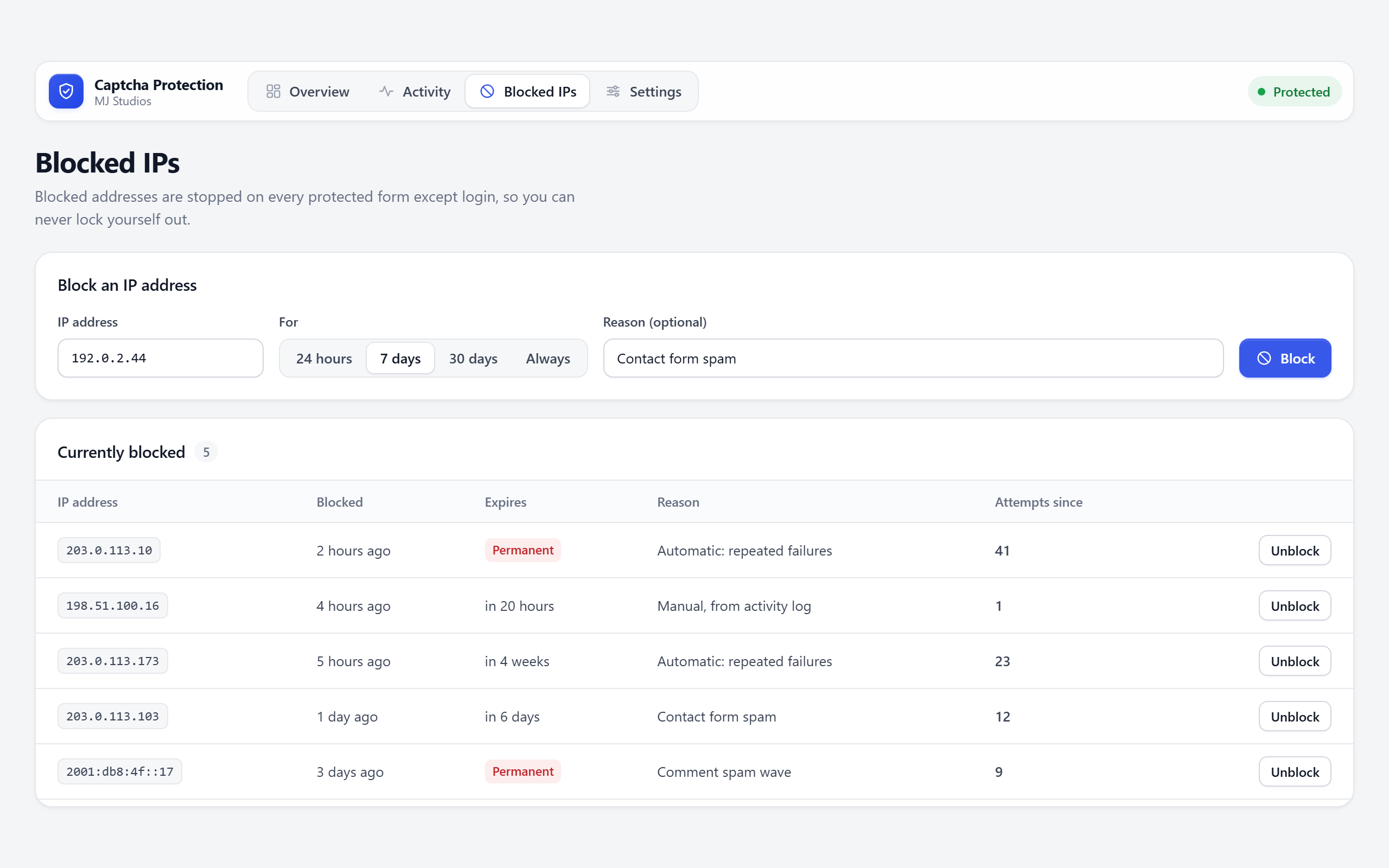
The Activity screen lists every check, newest first, and you can filter it by result, form or IP. Blocked IPs have their own screen, where you can block an address for a day, a week, a month or for good, and lift a block again.
The admin screens are part of the plugin and load nothing from outside your site, so they open quickly. They work with JavaScript switched off too.
Privacy
The plugin was designed with privacy laws such as the GDPR in mind.
- It sets no cookies and stores nothing in the visitor’s browser.
- It makes no requests to outside services, so visitor data stays on your server.
- The verification log keeps the IP address, browser user agent, form name, form ID and result for 30 days by default. You can shorten that to one day or switch the log off.
- It remembers the last 20 IP addresses your administrators used, only so it never blocks them.
- It adds suggested wording for your privacy policy under Settings > Privacy.
- Deleting the plugin removes its tables and settings, unless you choose to keep them.
Whether your site meets the GDPR depends on far more than one plugin, so that part is still yours to check. This plugin’s share of it is small and easy to explain in your privacy policy.
External services
None. This plugin does not connect to any third-party service.
Trademarks
Google reCAPTCHA, Cloudflare Turnstile, hCaptcha, Friendly Captcha, Akismet, CleanTalk, WooCommerce, Elementor, Contact Form 7, WPForms and the other form plugins named on this page are trademarks of their owners. This plugin is not affiliated with or endorsed by any of them.
Developer hooks
mjscp_form_enabled(filter): enable or disable a form key.mjscp_pre_check(filter): short-circuit verification. Gets the form key and an array with the form plugin’s form ID.mjscp_score(filter): adjust the spam score.mjscp_error_message(filter): change the message shown on failure.mjscp_is_allowlisted(filter): allowlist an IP programmatically.mjscp_auto_attach_selectors(filter): attach the widget to extra forms by CSS selector.mjscp_max_number(filter): fine-tune difficulty.mjscp_degraded_limits(filter): how many submissions an hour may pass when the check can’t run, per IP (per_ip, default 3) and for the whole site (site, default 50).mjscp_native_{slug}(filter): true when this plugin protects that form plugin on the current request, for examplemjscp_native_fluentforms.MJSCP_Plugin::has_native( 'fluentforms' )gives the same answer. Code that connected a form plugin by hand can check it and switch itself off.mjscp_checked(action): runs after each verification, with the result, form key, IP, status (pass,blockordegraded) and form ID.
Installation
- In your WordPress admin, go to Plugins > Add New Plugin, search for “Free Captcha Protection” and click Install Now. You can also upload the zip under Plugins > Add New Plugin > Upload Plugin.
- Activate it.
- Go to Captcha Protection > Settings and choose which forms to protect. The defaults suit most sites.
If your site sits behind Cloudflare or another proxy, set “Visitor IP source” so blocking uses the real visitor IP.
FAQ
Can it replace Google reCAPTCHA?
Yes, for the forms listed above. reCAPTCHA needs a Google account and site keys, and every check goes through Google. Turn your reCAPTCHA plugin off, activate this one, and those forms are protected. Leaving both on means your visitors still get the reCAPTCHA check, which defeats the point.
Can it replace Cloudflare Turnstile?
Yes. Turnstile is free as well, but it needs a Cloudflare account and a site key, and each check is sent to Cloudflare. This plugin checks visitors on your own server instead. Turn your Turnstile plugin off before you activate this one.
Can it replace hCaptcha?
Yes. hCaptcha needs an account and a site key, and visitors can still be asked to solve an image puzzle. This plugin never shows a puzzle, and nothing is sent to hCaptcha or anyone else.
Is it an invisible captcha?
Yes. Visitors see nothing while it works. If a submission is turned away, they get a short message where the form shows its other errors, and they can send it again straight away.
Do I have to set anything up for my form plugin?
No. If your form plugin is in the list above, its forms are protected as soon as both plugins are active. Settings shows which form plugins it found, with a switch for each.
What does “Let through” mean on the Activity screen?
The check couldn’t run in that visitor’s browser, so the submission was judged on the honeypot, the time on the form and the spam score alone, and it passed those. A few now and then are normal. If you see a lot of them, something on your site may be blocking the plugin’s script or its REST route, and the Overview screen will tell you.
Do I still need Akismet?
Often not. This plugin stops automated submissions before they are saved. Spam typed in by real people can still get through, and that’s the kind Akismet and CleanTalk look for. You can run either of them alongside this plugin.
Is it really free?
Yes. Every feature on this page is included, with no limit on forms or submissions and no sign-up.
Does it help with the GDPR?
It’s built to collect as little as possible. Nothing leaves your server, and the only log is a short one you can cut down further or switch off. Many site owners rely on legitimate interest for this kind of security log (Recital 49 of the GDPR mentions network security). Your own setup decides that, so check with whoever handles privacy for your site.
Does it work with page caching?
Yes. Challenges come fresh from a REST endpoint when a visitor uses a form, so cached pages are fine.
My site is behind Cloudflare. Do I need to change anything?
One setting. Set “Visitor IP source” to CF-Connecting-IP. Otherwise every visitor looks like a Cloudflare server, and blocking would hit Cloudflare’s IPs instead of the spammer’s.
What if a visitor has JavaScript turned off?
Protected forms need JavaScript to produce an answer, so submissions without one are rejected. A browser that runs JavaScript but can’t finish the check, for example because an extension blocks it, is a different case. Those submissions go through on the other checks, as described under “When the check can’t run”.
How can I see it working?
Add ?mjscp_debug=1 to any page URL to show the widget and its status. Every verification also shows up on the Activity screen.
How do I protect my own custom form?
Place [mjscp_captcha] inside the form, or echo mjscp_widget(); in PHP. When you process the form, call mjscp_verify(). It returns true or a WP_Error.
Can I lock myself out?
No. Login forms ignore IP blocks, and IPs that administrators have used are never blocked automatically. You still need a valid answer and the right password to log in.
What happens to blocking if I switch the log off?
Automatic blocking counts failures from the log, so it stops too. Manual blocks and the allowlist keep working.
Does it support the WooCommerce block checkout?
Not yet. The classic checkout is supported and is off by default.
Will it slow down older phones?
On medium difficulty most devices finish in about a second, usually while the visitor is still typing. Choose Low difficulty for the lightest load.
Screenshots

Changelog
1.3.0
- New welcome tour. When you activate the plugin, it opens the Overview and walks you through it in about thirty seconds. If you already use the plugin, click “Take the tour” at the bottom of any of its screens.
- Switches, buttons, the save bar and notices in the admin now move with a light spring. If your device is set to reduce motion, they don’t animate at all.
- Visitors see no difference. All of this runs only in the admin.
1.2.0
- Many more form plugins are protected on their own, with nothing to set up: Fluent Forms, Gravity Forms, Ninja Forms, Formidable Forms, Forminator, WS Form, Everest Forms, Kadence Blocks, MetForm, HappyForms, Jetpack Forms and Bricks. Contact Form 7, WPForms and Elementor Pro were already covered.
- Divi, Beaver Builder, Otter Blocks, Spectra and Brizy forms are supported too, marked as experimental for now.
- Settings lists the form plugins it found on your site, each with its own switch.
- Fixed: AJAX forms, Fluent Forms and WPForms among them, could turn real visitors away because the answer was cleared before the form was sent.
- If the check can’t run in a visitor’s browser, the form is sent anyway on the other spam checks instead of failing. These show as “Let through” on the Activity screen.
- Contact Form 7, Formidable Forms, Gravity Forms and Jetpack Forms hand failed submissions to their own spam handling by default. You can switch any of them to Reject.
- New installs leave WooCommerce login and registration off until you switch them on. Existing sites keep their settings.
- For developers: the
mjscp_native_{slug}andmjscp_degraded_limitsfilters, and more details passed tomjscp_pre_checkandmjscp_checked.
1.1.6
- New name: Free Captcha Protection by MJ Studios. Nothing else changes, and your settings stay as they are.
- The plugin now links to its home page, captcha.mjstudios.tech.
- A small link in the plugin’s footer to rate it on WordPress.org.
- The readme explains how to switch from another captcha service.
1.1.5
- Settings: forms from plugins that aren’t active now show as off and locked, with a note that they start once you activate the plugin. Your choice is kept until then.
- The test view you get with ?mjscp_debug=1 now says what visitors actually see, so Invisible mode no longer looks like a visible status line.
1.1.4
- Removed the Plugin URI header, which pointed to the same page as Author URI.
1.1.3
- Corrected the contributor username in the readme.
1.1.2
- Activity now marks rows from an IP you’ve already blocked with “IP blocked” instead of offering to block it again.
- Fixed the missing space between the two cards on the Blocked IPs screen.
1.1.1
- Rewrote the database queries behind the Overview and Activity screens and the uninstall routine, so Plugin Check now reports no warnings.
- The screens show the same data as before, and uninstalling still removes data only when Clean uninstall is on.
1.1.0
- New admin design with four screens: Overview, Activity, Blocked IPs and Settings.
- Overview compares totals with the previous period and adds a daily chart you can hover, the block rate and the IPs that failed most.
- New Activity screen with filters, pages and the full details of each check.
- Settings show whether each form’s plugin is active, and a save bar appears when you change something.
- Block an IP for 24 hours, 7 days, 30 days or permanently.
- One-click fix for sites behind Cloudflare.
- Tested with WordPress 7.1 and PHP 7.4 to 8.5.
1.0.0
- First public release.