

Description
ModuleFest Media Library Manager shows you exactly where every file in your Media Library is used, finds the files nothing uses any more, and lets you clean them up safely. Nothing is deleted straight away: files go to a Recycle Bin first, and you can restore them at any time until the retention period you choose runs out.
Everything here is free
Every feature described on this page is included in this plugin. Nothing is hidden or held back, and the plugin never asks you to register.
Video guides
Seven short narrated videos show each part of Media Library Manager: an overview, getting started, the deep scan, the recycle bin, image tools, duplicates, folders and cleanup rules, and the audit log. Each Media Library Manager screen and help topic links to its own video, and the About page and Help Centre list them all. They open on YouTube in a new tab; nothing is loaded from YouTube inside your WordPress admin. Watch them all in order in the Media Library Manager playlist.
More from ModuleFest
Media Library Manager is made by ModuleFest. Our other free plugins are listed on our WordPress.org profile, for example ModuleFest Pet Groomer and ModuleFest Pet Walker, and on Media Library Manager’s About ModuleFest screen. Nothing is installed unless you choose to install it yourself from WordPress.org.
If you’d like Media Library Manager tips and update notes by email, the About ModuleFest screen has an optional Get news for Media Library Manager sign-up. Nothing is sent unless you tick its box and press Subscribe, and no part of the plugin depends on it. Full guides: modulefest.com/help/modulefest-media-library-manager.
Features
- Media usage map – every file shows where it is used: posts, pages, blocks, featured images, galleries, page builders and theme settings.
- Unused media scanner – a batched, resumable deep scan finds files nothing references, with a live progress bar and time estimate. Filter results by type, date, size, folder or tag.
- Recycle Bin – move files to the bin instead of deleting them. Choose how long they stay (7, 30, 90 days or your own period), restore them individually or in bulk, and export the bin to CSV or a printable report.
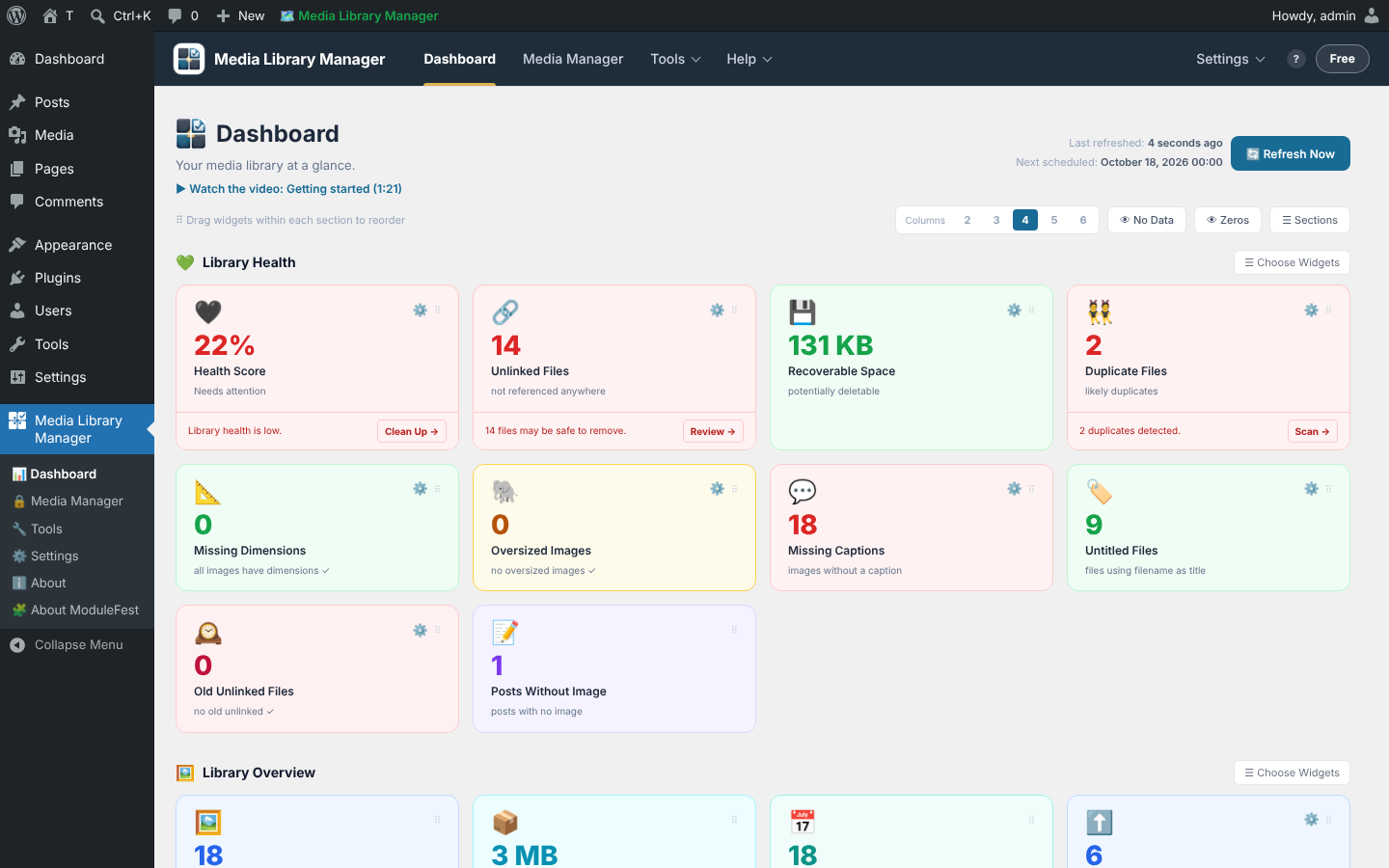
- KPI Dashboard – 30+ library health metrics in five sections, with a health score, threshold alerts, drag-to-reorder cards and a scheduled refresh.
- Library over time – weekly charts of library size, file count and health score on the Dashboard, and the change since last week in the weekly digest email. Kept on your site only.
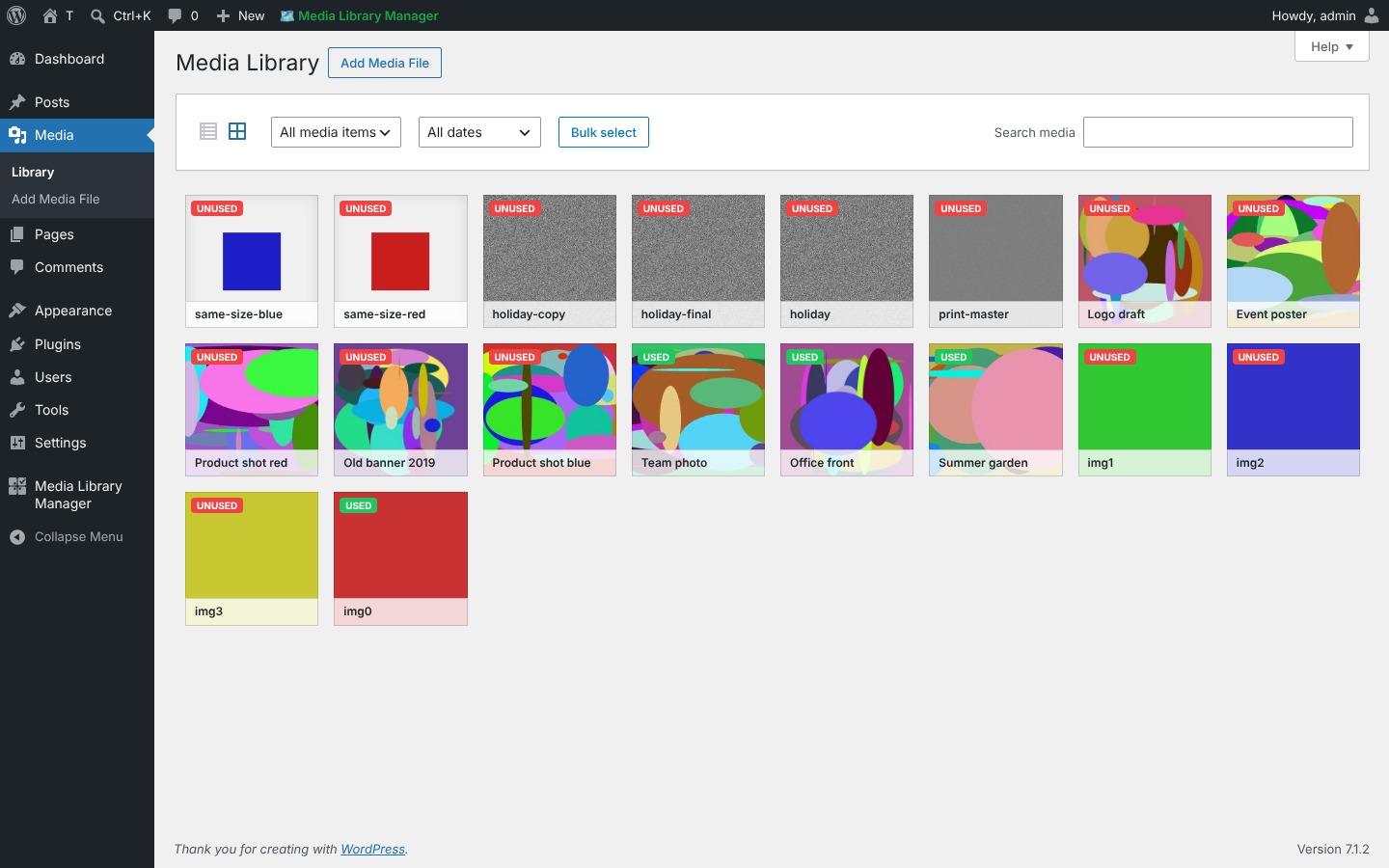
- Grid overlays – 14 styles mark used and unused files on every Media Library thumbnail, in colours you choose.
- Virtual folders and tags – organise media into folders and tags without moving files on disk, and filter the Media Library by tag.
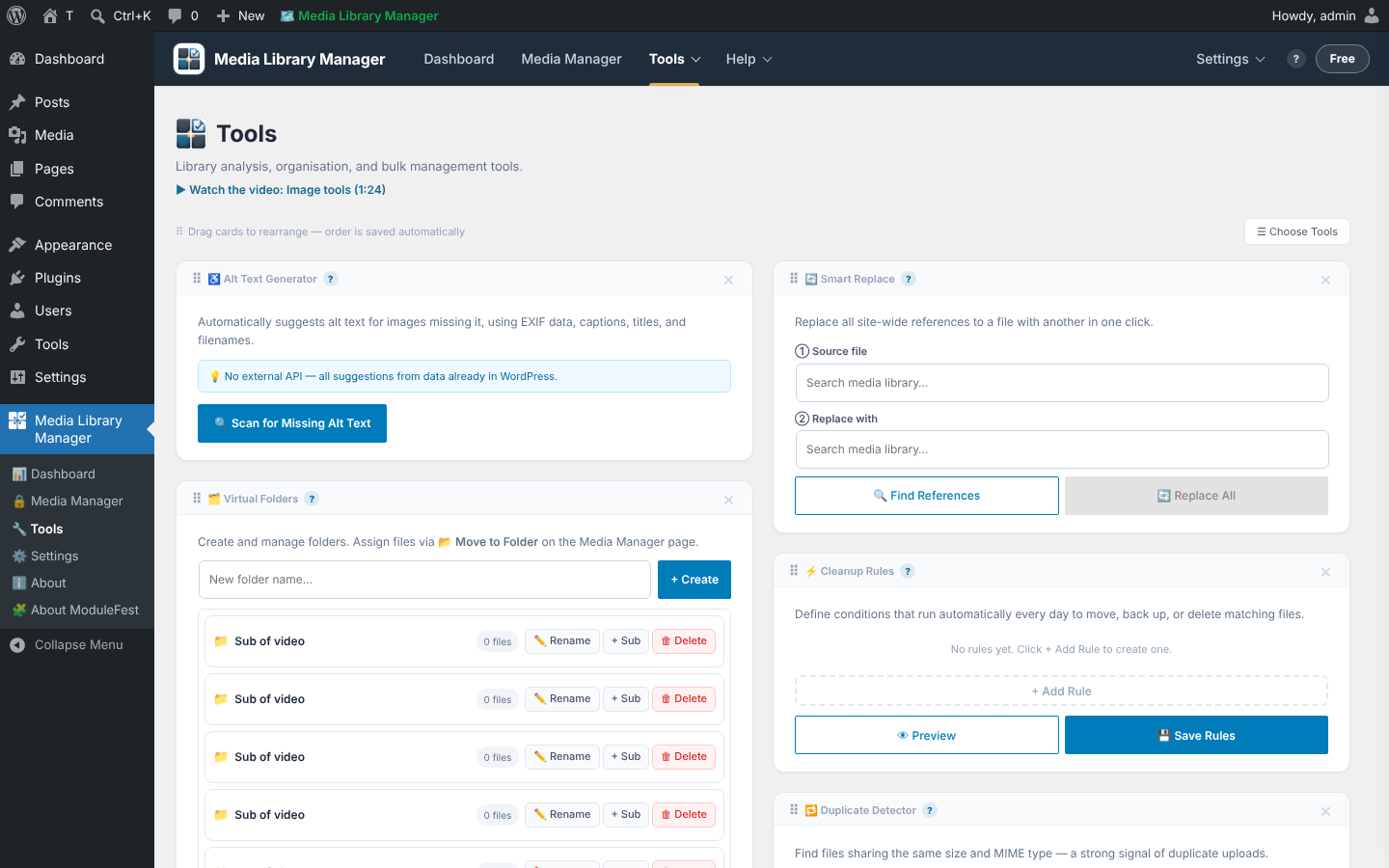
- Cleanup rules – rules that run on your schedule (every hour, twice a day, daily or weekly, at the time you choose), such as “move unused PDFs older than a year to the Recycle Bin”, with a preview before they run.
- Optimise new uploads – optional: large pictures are scaled down to the width and height you choose and saved at your quality as they are uploaded. Off by default, existing pictures are never changed, and the space saved is logged.
- Image tools – resize and compress images (one at a time, in bulk, or by right-clicking in the Media Library). The original is backed up first and can be restored.
- Convert to WebP or AVIF – see the expected saving first, then convert one image or a selection. Links in your pages are updated and the original is kept for your retention period, with Restore. Formats your server cannot create are shown as unavailable, with the reason.
- Smart Replace – swap one image for another everywhere it is used.
- Alt text generator – finds images with no alt text, very short alt text or alt text that looks like a file name, suggests better text from the file name, title and caption, and saves many at once. Mark decorative images so they are not counted. The count is on the Dashboard and in the weekly digest.
- Unused image sizes – finds resized copies left behind by themes and plugins you no longer use, keeps any copy your content still points at, and moves the rest to a bin you can restore from.
- Dead Link Scanner – finds published pages and posts that point at an image or file that no longer exists, with an Edit button for each and a CSV export. Resumable, so large sites can be scanned in steps.
- Finders – duplicate files, broken file records and a compression advisor.
- Cloud backup and import – connect your own Google Drive, Dropbox, OneDrive, Amazon S3 (or S3-compatible storage), FTP/SFTP or WebDAV, back files up before they are deleted, and import files into the Media Library.
- Weekly digest email – a summary of your library sent to the address you choose.
- Audit trail – every Media Library Manager action is logged, with filters and CSV export.
- Built-in help – a help drawer on every screen, step-by-step How-To scenarios and a searchable Help Centre.
Privacy and external services
Media Library Manager sends no analytics, usage data or site details anywhere, and never contacts our servers on its own. The only time it contacts ModuleFest is when you ask for our newsletter (see “ModuleFest newsletter sign-up” below).
Otherwise it only connects to an outside service when you set that service up yourself, using your own account and your own API keys. Each one is listed below.
Google Drive (Google LLC)
Used for cloud backup and cloud import, only after you add your own Google OAuth client ID and secret and click Connect. When you sign in, your browser is sent to Google to approve access; Media Library Manager then exchanges the returned code for an access token at oauth2.googleapis.com. After that, when you back up, browse, import or create a folder, Media Library Manager sends the file (its contents, name and type) or the folder request to www.googleapis.com. Nothing is sent until you connect, and nothing is sent after you disconnect.
Terms: https://policies.google.com/terms – Privacy: https://policies.google.com/privacy
Dropbox (Dropbox, Inc.)
Used for cloud backup and cloud import, only after you add your own Dropbox app key and secret and click Connect. Sign-in happens on www.dropbox.com; tokens are exchanged at api.dropboxapi.com. When you back up, browse, import or create a folder, the file contents, name and folder path are sent to api.dropboxapi.com and content.dropboxapi.com.
Terms: https://www.dropbox.com/terms – Privacy: https://www.dropbox.com/privacy
Microsoft OneDrive (Microsoft Corporation)
Used for cloud backup and cloud import, only after you add your own Microsoft app client ID and secret and click Connect. Sign-in happens on login.microsoftonline.com. When you back up, browse, import or create a folder, the file contents, name and folder path are sent to graph.microsoft.com.
Terms: https://www.microsoft.com/en-us/servicesagreement – Privacy: https://www.microsoft.com/en-us/privacy/privacystatement
Amazon S3 and S3-compatible storage (Amazon Web Services, Cloudflare R2, Backblaze B2, Wasabi, DigitalOcean Spaces)
Used for cloud backup, only after you enter your own access key, secret, bucket and region. When a file is backed up, its contents and name are sent to the bucket endpoint you entered (for AWS, s3..amazonaws.com). Requests are signed locally with your keys.
AWS terms: https://aws.amazon.com/service-terms/ – AWS privacy: https://aws.amazon.com/privacy/
Cloudflare: https://www.cloudflare.com/terms/ and https://www.cloudflare.com/privacypolicy/ – Backblaze: https://www.backblaze.com/company/policy/terms-of-service and https://www.backblaze.com/company/policy/privacy – Wasabi: https://wasabi.com/legal/terms-of-use and https://wasabi.com/legal/privacy-policy – DigitalOcean: https://www.digitalocean.com/legal/terms-of-service-agreement and https://www.digitalocean.com/legal/privacy-policy
FTP / SFTP and WebDAV servers
Used for cloud backup and import, only after you enter the address and login of a server you control (for example your own host, a Nextcloud instance or a Hetzner Storage Box). Files are sent to and read from that server only. Its terms and privacy policy are those of whoever runs it.
WordPress.org plugin details (About ModuleFest screen)
The “More free plugins from ModuleFest” box on Media Library Manager’s About ModuleFest screen links to our other plugins. “View details” opens WordPress’s own plugin details window, which WordPress loads from WordPress.org (api.wordpress.org) only when you click it. Nothing is sent by Media Library Manager itself. WordPress.org privacy policy: https://wordpress.org/about/privacy/
ModuleFest newsletter sign-up (support.modulefest.com)
What it is: ModuleFest’s newsletter for Media Library Manager (tips, new features and update notes).
What is sent: your name, your email address, this site’s address (home URL), the plugin name and version, and the wording of the consent box you ticked.
When: only when you tick the consent box and press Subscribe on the “Get news for Media Library Manager” card (Media Library Manager → About ModuleFest). Nothing is sent on activation, on a schedule, when you dismiss the card, or in the background, and Media Library Manager does not keep your email address.
Why: to send you the newsletter you asked for. ModuleFest emails you a confirmation link first; you can unsubscribe at any time from any newsletter or at https://modulefest.com/newsletter/?leave=1
Privacy policy: https://modulefest.com/privacy/ – Terms: https://modulefest.com/terms/
YouTube (video guide links only)
The “Watch the video” links and the Video guides list open videos on youtube.com in a new browser tab, only when you click one. Media Library Manager does not embed a player, load thumbnails or contact YouTube itself. YouTube terms: https://www.youtube.com/static?template=terms – Google privacy policy: https://policies.google.com/privacy
Dead link scanner (optional external check)
The Dead Link Scanner checks links inside your own posts and pages. Links to files on your own site are checked on your server. Links to other websites are only checked when you tick “Check external links” before a scan; Media Library Manager then sends a HEAD request (no data, just the address) to each linked website to see whether the page still exists. Each site’s own terms and privacy policy apply.
The plugin stores your cloud tokens and keys in your WordPress database. Deleting the plugin removes them, along with all other Media Library Manager settings and its audit table.
Source code
There is no build step. Every PHP, JavaScript and CSS file in the plugin is the readable source, with its comments, exactly as it is maintained.
Third-party code
None. Media Library Manager bundles no third-party libraries; it uses jQuery and the image editor that ship with WordPress.
Installation
- In WordPress, go to Plugins → Add New, search for “ModuleFest Media Library Manager” and click Install Now, then Activate. (Or upload the
modulefest-media-library-managerfolder to/wp-content/plugins/and activate it.) - Open Media Library Manager → Dashboard and click Refresh Now to build your first set of metrics.
- Open Media Library Manager → Media Manager and click Run Full Scan to find unused files.
- Review the results. Nothing changes until you choose to move files to the Recycle Bin.
FAQ
Will Media Library Manager delete my files?
Not without you asking. Files you choose are moved to the Recycle Bin first. They are only deleted permanently when the retention period you set runs out, or when you empty them from the bin yourself. You can restore them at any time before that.
How does it decide a file is unused?
It looks for the file’s ID and file name in post and page content of every type (including blocks, shortcodes, drafts and revisions), featured images, WooCommerce galleries, widgets, theme Customizer settings, and Elementor (page and template data, Theme Builder headers and footers, Site Settings and page settings). A file that is not found anywhere is listed as unused. It cannot see a file used only in theme or plugin code, another plugin’s own tables, or a link from outside the site such as an email. Always review the list before moving anything; you can mark files you want to keep so they are never flagged.
Does it work on multisite?
Yes, site by site. Each site keeps its own media, folders, scans and Recycle Bin, and is scanned on its own. Before a file is listed as unused, the other sites on the network are checked too, so an image another site shows from this site’s uploads counts as used. Network Admin › Media Library Manager lists every site with its last scan and upload space, so you can see where to clean up next and open each site’s screen. With the plugin network-activated, it can also scan every site in turn every day or week, copy and lock settings across every site, and send one weekly summary email for the whole network.
Does it work with WP Offload Media and Amazon S3?
Yes. The usage scan reads the WordPress database, so it finds where a file is used wherever the file is stored. Files kept only in cloud storage show the size recorded for them, and the Dead Link Scanner does not report them as missing. Tools that change the file itself (resizing, compressing, converting, finding duplicates by content, backup before delete) need a copy on the server, so they skip files kept only in cloud storage and say so.
Does it slow my site down?
No. Media Library Manager only runs in the WordPress admin. Scans run in small batches in the background, and nothing is added to your site’s front end.
Does it send my data anywhere?
No, not unless you ask. See “Privacy and external services” above: the only outside connections are the cloud services you connect yourself, the optional external link check, and the newsletter sign-up if you choose to subscribe.
Can I edit alt text for many images at once?
Yes. Tools › Bulk Edit lists your media as rows to edit titles, alt text, captions, descriptions and folders together. You can also export a CSV, edit it in a spreadsheet and import it back; every change is shown before it is saved.
Can it tell me which images slow my pages down?
Yes. Tools › Page Image Audit checks your published pages as visitors see them and lists images served much bigger than shown, without width and height, over 300 KB or not lazy-loaded. It only visits your own site.
Can I keep track of image rights?
Yes. Record the rights, source, credit and expiry date in each image’s details. Expired and expiring image rights are listed on Tools and the Dashboard and in the weekly digest, and the shortcode [modulefest_image_credits] shows credits on a page.
Can I move media to another site?
Yes. Download a folder or chosen files as a ZIP with their details, then import the ZIP on the other site. Titles, alt text, captions, folders and image rights are kept.
Can I organise files into folders?
Yes. Folders appear beside the Media Library grid and in every media window. Click a folder to filter, drag files onto it, or choose a folder in a file’s details. Folders only group files in WordPress; no file moves on the server, so no address changes.
Can I rename image files?
Yes, one at a time from the Media Library or in bulk from Tools › Rename Files. Names can come from the title or alt text. The file and all its sizes are renamed, links in your pages and custom fields are updated, and each rename can be undone.
Can I replace a file without changing its address?
Yes. Click Replace file… in a file’s details and upload the new version. With the same file type the address stays the same. The old file is kept for your retention period so you can undo.
Can I use it from the command line (WP-CLI)?
Yes. With WP-CLI, wp mlm status, wp mlm scan, wp mlm unused, wp mlm cleanup --dry-run and wp mlm report check, scan, list, clean up and report on the media library. Clean-up only moves files to the Recycle Bin and is recorded in the audit log. Most commands take --format=json. The same commands also work as wp media-library-manager.
Is everything included?
Yes. Everything described on this page is in this plugin and free.
Do you make other plugins?
Yes. ModuleFest’s other free plugins are listed at https://wordpress.org/plugins/author/modulefest/ and on Media Library Manager’s About ModuleFest screen. You can also visit https://modulefest.com/.
Is there a newsletter?
Yes, and it is optional. Use the “Get news for Media Library Manager” card on the About ModuleFest screen, or https://modulefest.com/newsletter/. Nothing is sent from your site unless you tick the box and press Subscribe.
Are there video guides?
Yes: seven short narrated videos, from an overview to the audit log. Watch them all in the Media Library Manager playlist on YouTube, or use the “Watch the video” links on each screen and help topic.
Where do I get help?
Every Media Library Manager screen has a help (?) button, and Settings → Help Centre has step-by-step guides. For anything else, please post in this plugin’s support forum on WordPress.org.
Screenshots


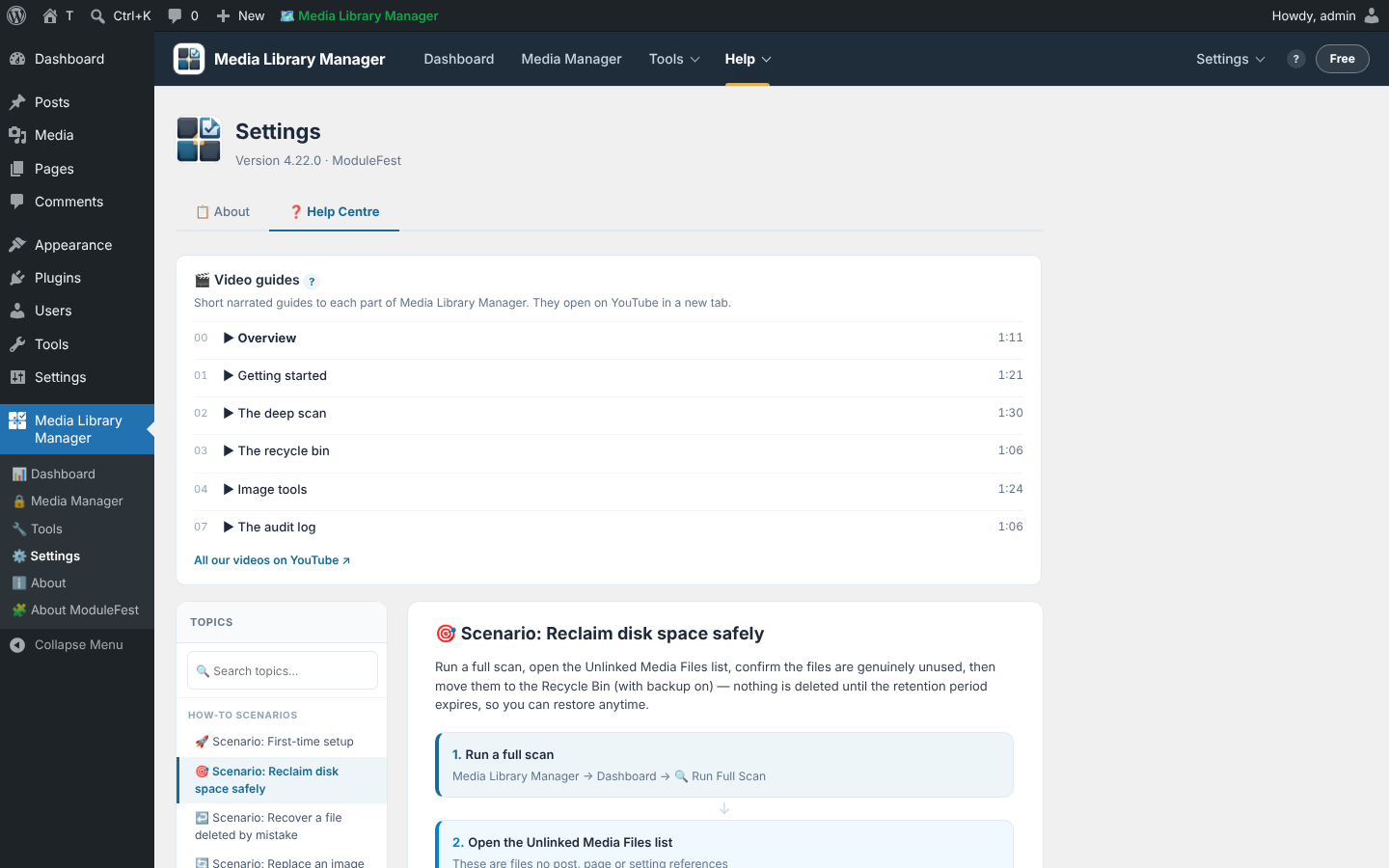
Changelog
4.32.2
- Fix: Bulk Edit: file names have room again instead of wrapping one letter per line; Page Image Audit says 1 image, not 1 images.
4.32.1
- Fix: Image Rights: the Tools card now opens on Expired when any image rights have expired, and the help wording is corrected.
4.32.0
- New: Bulk Edit: edit titles, alt text, captions, descriptions and folders for many files on one screen, filtered by folder, type or missing details, with CSV export and an import that previews every change first.
- New: Page Image Audit: checks your published pages as visitors see them for images served much bigger than shown, without width and height, over 300 KB or not lazy-loaded, heaviest pages first, with CSV export.
- New: Image rights and credits: record each image’s rights, source, credit and expiry date, see expired and expiring image rights on Tools and the Dashboard and in the weekly digest, and show credits on a page with [modulefest_image_credits].
- New: Download a folder or chosen files as a ZIP with their details, and import that ZIP on another site with titles, alt text, folders and image rights kept.
4.31.2
- Fix: Plugin Check: the folder counts call WordPress’s own media-window filter on purpose; this is now marked in the code as WordPress.org requires.
4.31.1
- Fix: Folders panel: sits beside the media grid without moving the page heading, and its counts match what the grid shows (including files other plugins hide).
- Fix: Undoing a replace or restoring a WebP/AVIF conversion now always puts links to the main file back on the main file.
- Fix: Replace file: clearer message when the address stays the same but resized copies change shape. Rename: underscores become hyphens.
4.31.0
- New: Folders in the Media Library: a folder panel beside the grid (click to filter, drag files onto a folder, add, rename and delete folders), a folder filter in every media window, and a Folder choice in each file’s details.
- New: Rename files for search engines, one at a time or in bulk, from the title, the alt text or a name you type. Every link to the old name is updated, and each rename can be undone.
- New: Replace a file but keep its address: upload a new version and every page shows it. Another image type updates the links. The old file is kept for the retention period, so it can be undone.
- New: Regenerate Thumbnails: rebuild image sizes for all images, only missing sizes, or chosen images, in resumable steps with a report. One image can be done from the Media Library.
4.30.12
- Fix: Multisite bulk clean-up: Preview and Move now check the security code of the form themselves, as WordPress.org requires.
4.30.11
- New: WP-CLI commands: wp mlm status, scan, unused, cleanup (with –dry-run) and report, with JSON output for scripts. Clean-up only moves files to the Recycle Bin and writes the audit log.
- New: Multisite: clean up unused files on several sites at once from Network Admin, with a preview per site. Files go to each site’s own Recycle Bin.
- Fix: Multisite: with permanent deletion turned off for site administrators, they can again move a single file to the Recycle Bin from the Media Manager; deleting a broken file record now respects the setting.
4.30.10
- Fix: Readme: the 4.30.8 notice is now within the WordPress.org limit of 300 characters.
4.30.9
- New: Help Centre: new Multisite networks topic and a How-to for looking after every site on a network, with ? help links on the Network Admin page. Dashboard, cloud storage and unused-file help brought up to date.
- Fix: Client report: space saved now reads 0 B (not 0.0 B) in the CSV when nothing was saved.
4.30.8
- New: Client report on the Dashboard: a month’s work on the media library as a printable page (save as PDF) or CSV, with your agency name and logo.
4.30.7
- New: Multisite: copy settings from one site to every site, lock them, and stop site administrators deleting files permanently. New sites get them too.
- New: Multisite: one weekly summary email for the whole network.
4.30.6
- New: Multisite: Network Admin › Media Library Manager can scan every site in turn every day or week, or now (with the plugin network-activated).
- New: Multisite: each site’s upload space and limit on the network overview, with sites near their limit highlighted.
4.30.5
- New: Multisite: before a file is listed as unused, the other sites on the network are checked too, so an image another site shows from this site’s uploads counts as used.
4.30.4
- New: Files kept only in cloud storage are skipped with a clear message by resize, compress, convert and backup before delete; the Duplicate Detector says how many it could not compare.
- Fix: Unused scan: images used in a gallery widget are now found.
- Fix: Multisite network page: page links now carry a security check.
4.30.3
- New: Multisite: Network Admin › Media Library Manager lists every site with its last scan, files, unused files and health, most unused first, with a link to each site’s screen.
- New: Works with WP Offload Media: files kept only in Amazon S3 (or other cloud storage) show their real size, and the Dead Link Scanner no longer reports them as missing.
- Fix: Unused scan: files used in widgets (image, gallery, text, custom HTML and block widgets) are now found.
- Fix: Unused scan: files used in Elementor Site Settings (site logo, backgrounds) and page settings are now found.
4.30.2
- Fix: Dashboard: the WordPress footer line no longer sits over the cards.
4.30.1
- Fix: Dashboard: a tidier top. Refresh Now sits at the end of the toolbar row, after Sections, at the same height as the other buttons, and the refresh times are shown in one line on the left.
4.30.0
- New: a shorter WordPress side menu. Media Library Manager now has just Dashboard there, and every other screen is on the menu bar across the top of its screens.
- New: Menu bar › Settings › Plugin & system info opens the page with the plugin version, your WordPress and PHP versions and the active features.
- Fix: Tools: the “Watch the video” links wrap on a narrow phone (also in 4.29.3).
4.29.3
- Fix: Tools: the “Watch the video” links now wrap on a narrow phone instead of pushing the page sideways (this fix missed the 4.29.2 directory release).
4.29.2
- Fix: Settings → About: the information cards now stack on a phone instead of running off the side of the screen.
- Fix: Tools: the “Watch the video” links now wrap on a narrow phone instead of pushing the page sideways.
4.29.1
- First release on WordPress.org.
- Every feature is included and free.
- The plugin never contacts our servers: no update checks, no support-desk link and no usage statistics.
- Scripts and styles now load as separate, readable files through WordPress’ standard loader, with no inline code in the page.
- Security hardening throughout: every request that changes data checks a nonce and the user’s permissions, every input is sanitised and every output is escaped.
- Safer file handling: files are removed with WordPress’ own functions, and the dead link scanner refuses to probe private network addresses.