


Description
Plaxswap Crypto Payments adds a crypto payment gateway to WooCommerce. Customers can pay with Bitcoin (BTC), Ethereum (ETH), USDT, USDC, Solana (SOL), Tron (TRX), BNB, Litecoin (LTC), Dogecoin (DOGE), Bitcoin Cash (BCH), XRP, Avalanche (AVAX), Polygon (POL), DAI, Dash and GRAM: 16 coins, with 29 coin and network choices on 15 networks. USDT can be paid on Tron (TRC-20), Ethereum (ERC-20), BNB Chain (BEP-20), Solana, Arbitrum, Polygon and TON.
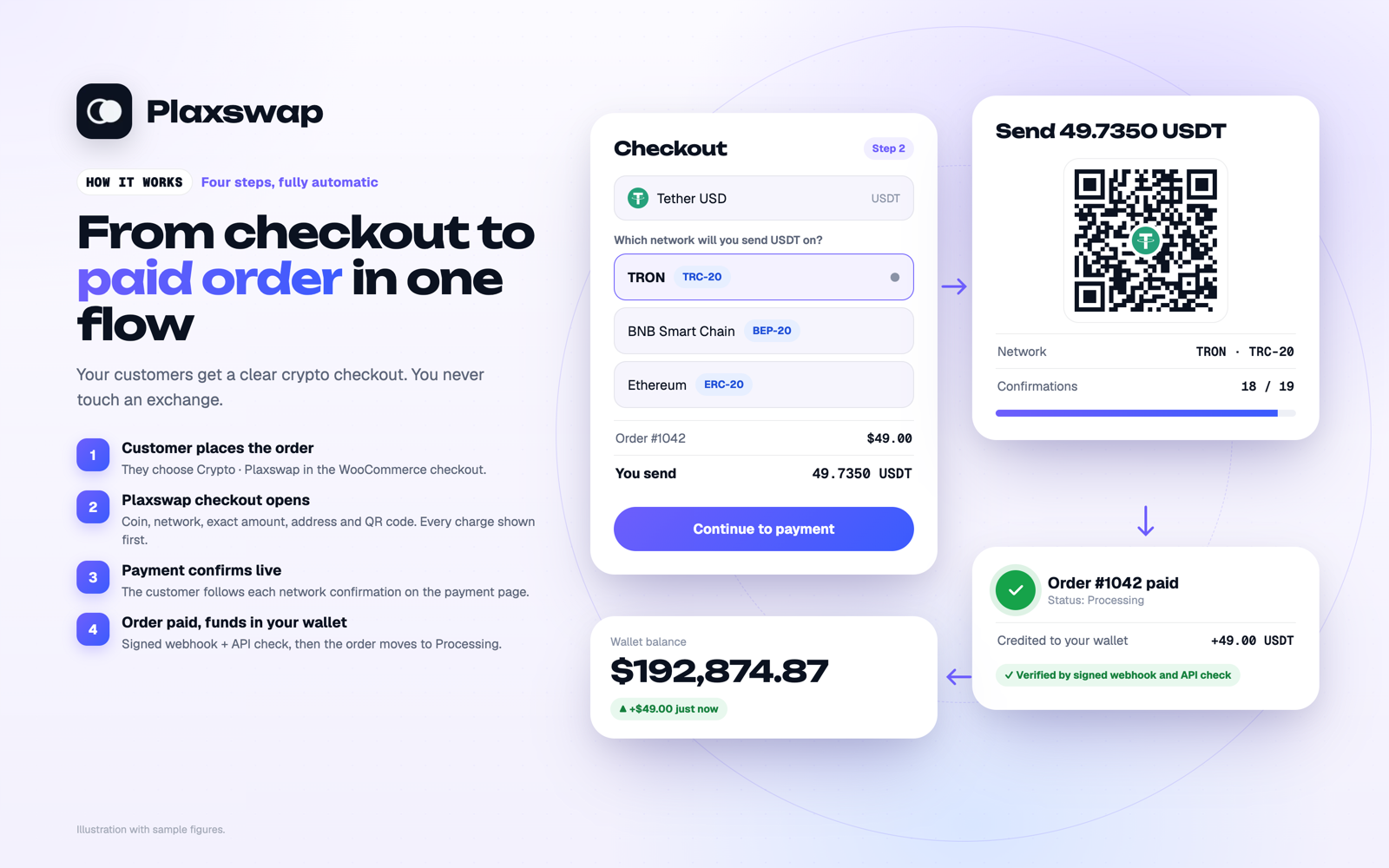
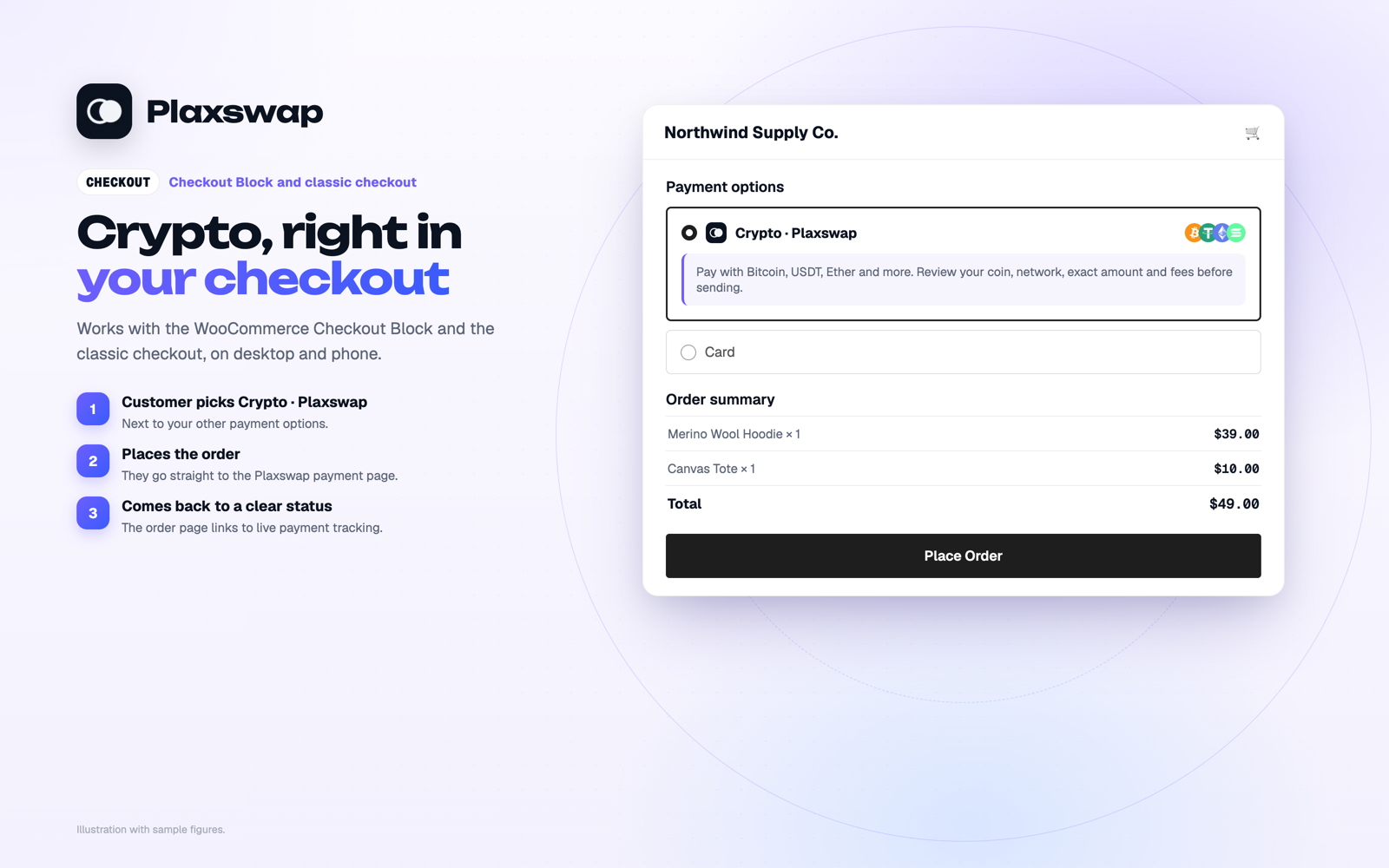
The customer chooses Crypto · Plaxswap at checkout, picks a coin and network on the Plaxswap hosted checkout, and sees the exact amount, address and QR code before sending anything. The order stays Pending payment until the coins arrive and moves to Processing only after the plugin has checked the payment with the Plaxswap API.
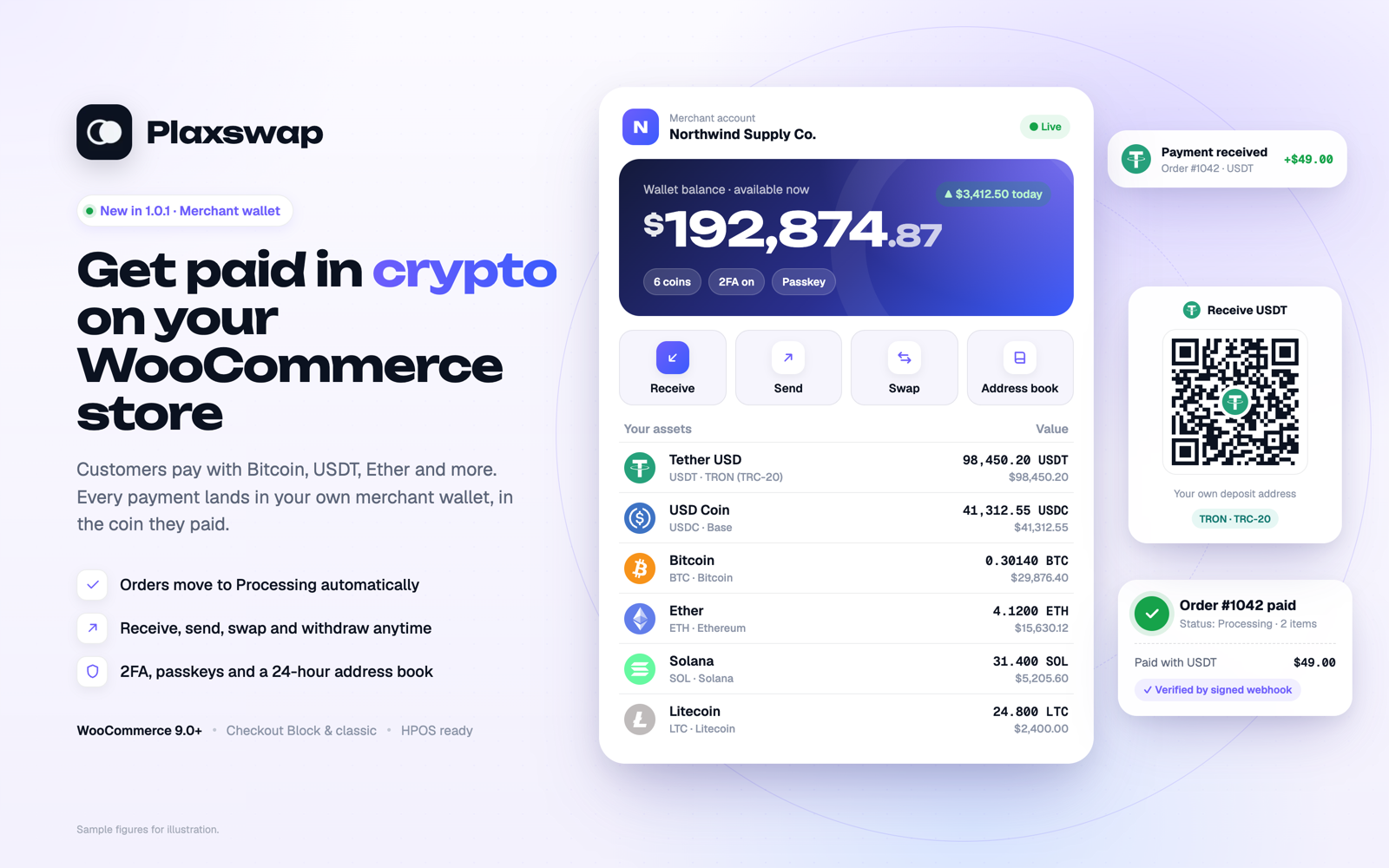
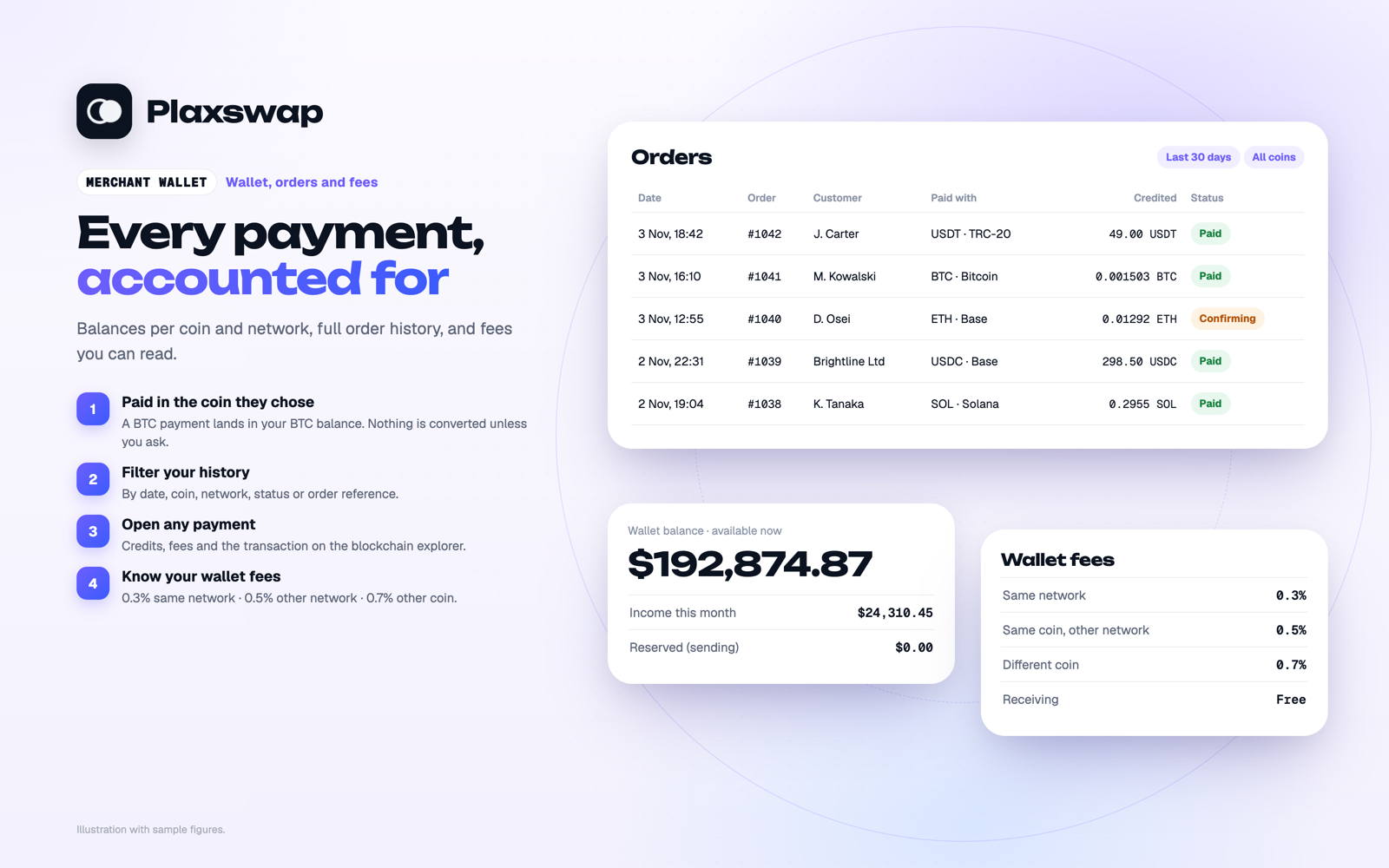
Payments are credited to your Plaxswap merchant balance in the coin and network the customer used. Plaxswap holds the coins until you withdraw them to your own wallet or swap them to another coin.
Setup guide with screenshots: plaxswap.com/integrations/woocommerce.
Features
- Built for WooCommerce. Works with the Checkout Block and the classic checkout, on desktop and phone, and with High-Performance Order Storage (HPOS).
- A clear checkout. Customers search for a coin (for example “usdt trc20”), pick the network, see the exact amount, address and QR code, and follow each confirmation live.
- Verified orders. A signed webhook and a separate API check confirm the payment before the order is marked paid. A scheduled check catches anything delayed. A customer coming back to your store is never treated as proof of payment.
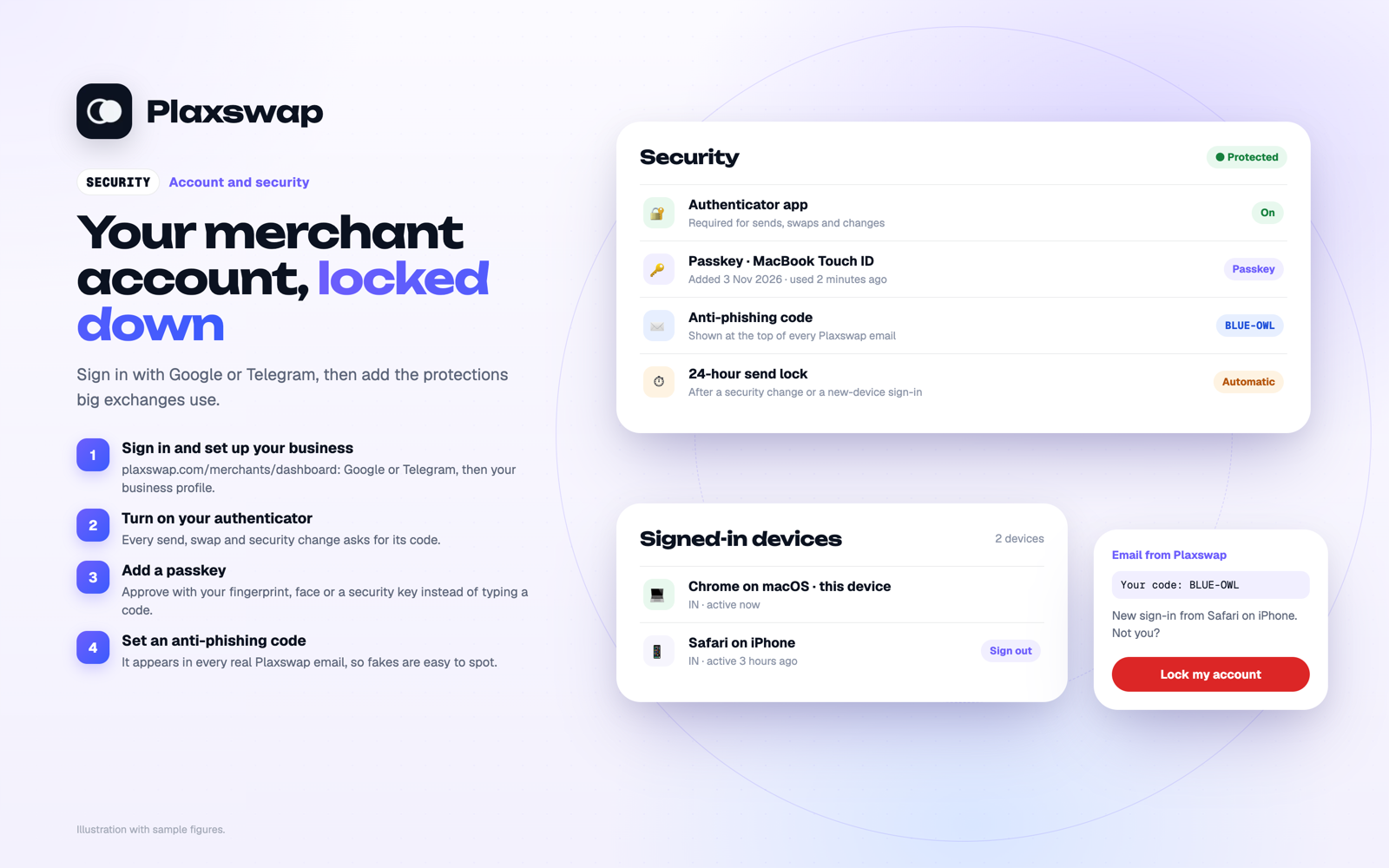
- Withdrawals need a fresh code. Every withdrawal from your merchant balance needs an authenticator code or a passkey.
- Test mode. Store administrators and shop managers can place test orders and act out paid and expired payments with no real funds before going live.
New in 1.0.3: steadier orders
- Unpaid orders stay Pending payment. Stock is reduced and on-hold emails are sent only once coins arrive.
- A customer whose payment expired or failed can pay again from the order; a late payment to the earlier payment is still matched and reported to you.
- Customers go straight to the Plaxswap checkout page, and see a clear reason when a payment cannot open (for example an order below the minimum of about US$1).
- Background checks slow down over time and stop once a payment is final.
- Cancelling an unpaid order also cancels its Plaxswap payment.
- The settings page warns when your Plaxswap webhook URL is missing or points somewhere else, and when the store has no HTTPS.
Your Plaxswap merchant balance
The gateway is custodial: Plaxswap holds the coins from confirmed payments until you withdraw them. In your merchant dashboard you can:
- Withdraw to any address on the coin’s network. The payout starts as soon as you approve it with your authenticator code or a passkey.
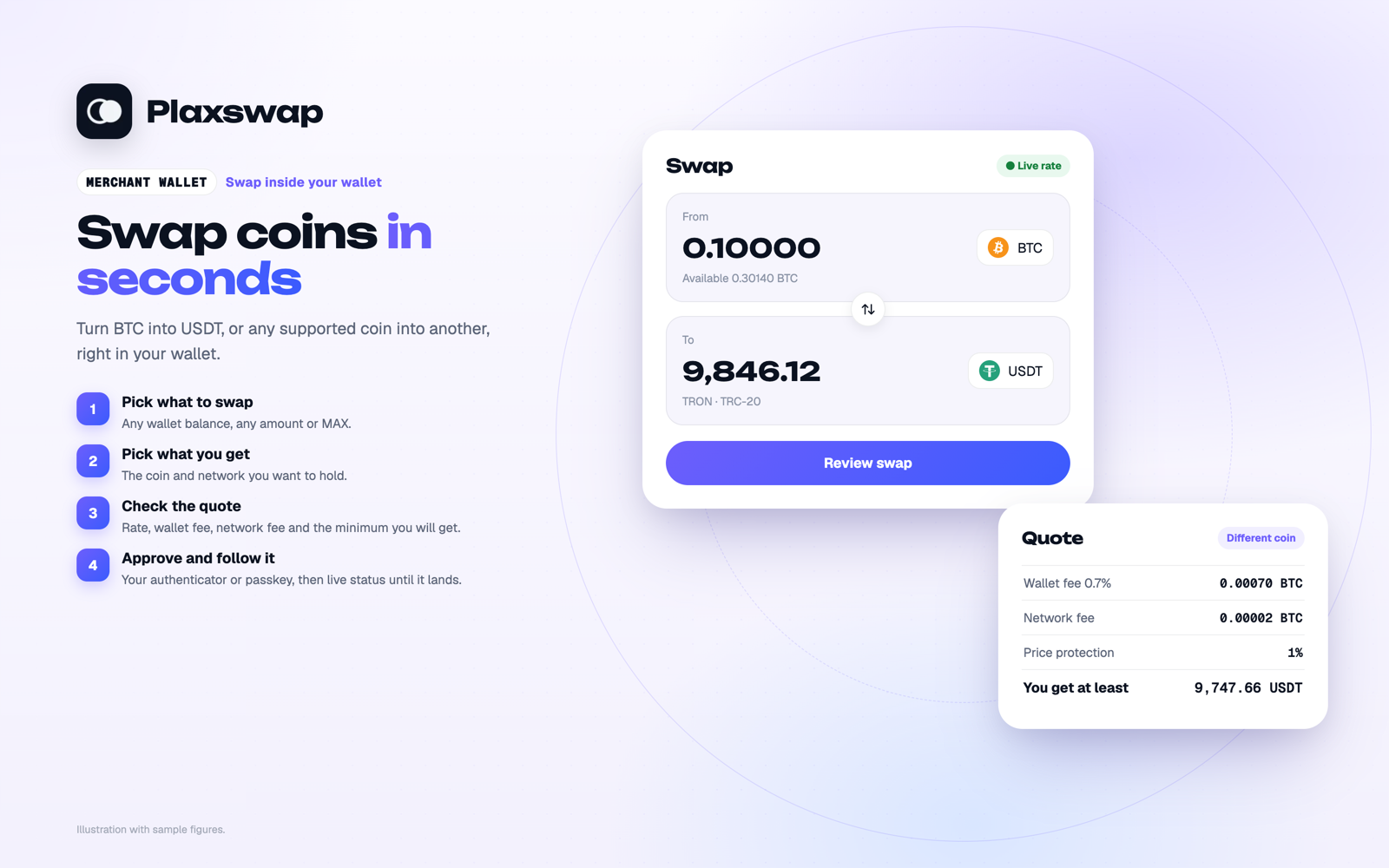
- Swap between coins, with the rate and every fee shown before you approve.
- Receive coins to a deposit address for your merchant balance, with a QR code.
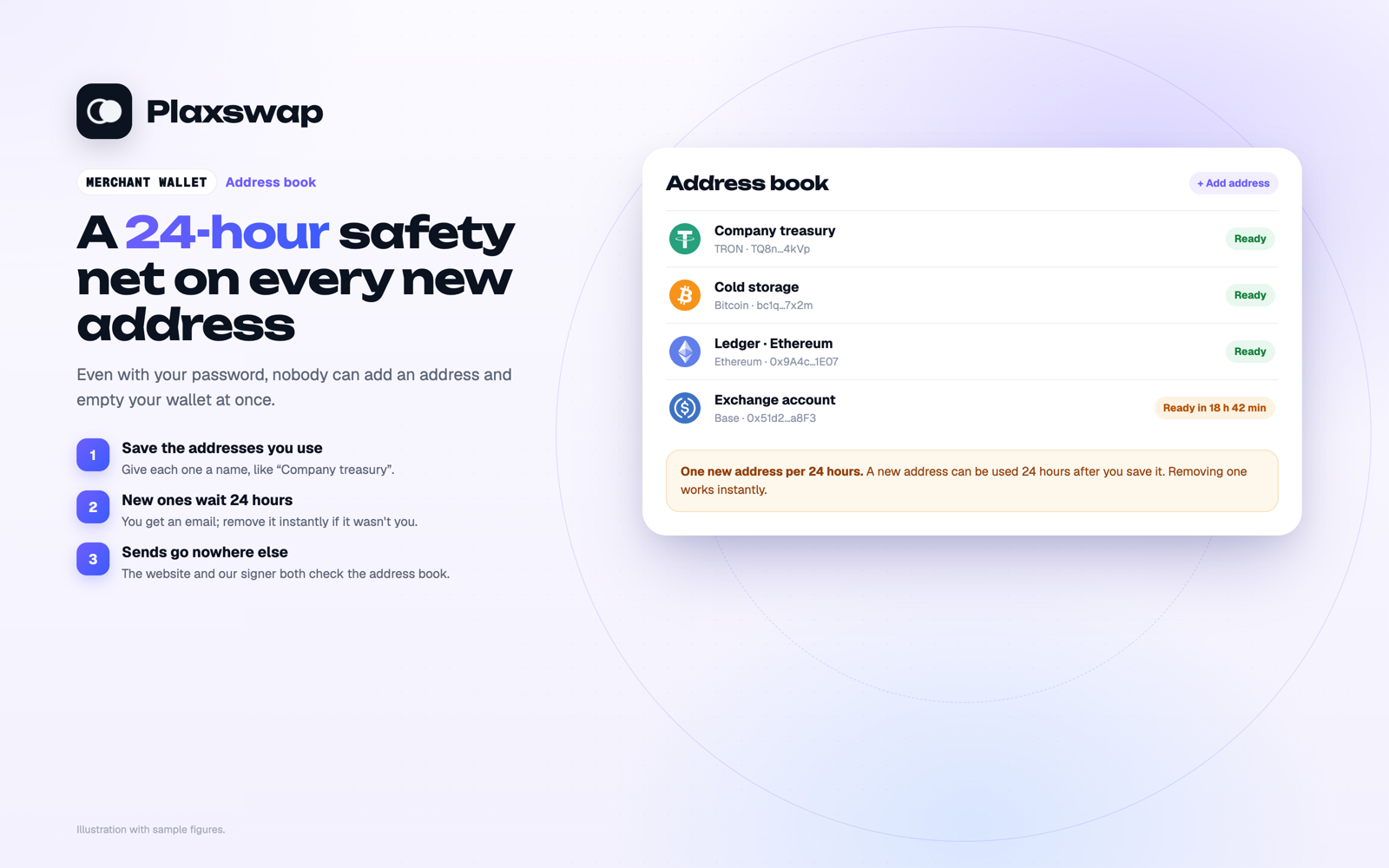
- Protect the account: your anti-phishing word appears in every Plaxswap email, and every security email has a link to lock your account, which freezes withdrawals and signs every device out. Withdrawals wait 24 hours only after the authenticator is moved with a recovery code.
How it works
- Your customer chooses Crypto · Plaxswap at checkout and places the order.
- Plaxswap checkout shows the coin, network, exact amount, address and QR code.
- The customer pays from any wallet or exchange and follows the confirmations live.
- The payment is verified, the order moves to Processing, and the payment is credited to your merchant balance.
Order statuses
- Pending payment: the order is waiting for the customer to pay. Stock is not reduced yet.
- On hold: coins arrived and are being confirmed, or only part of the amount arrived. WooCommerce reduces stock at this point.
- Processing: the payment is verified and credited (Completed for virtual, downloadable products, as WooCommerce decides).
- Cancelled: the payment expired with nothing paid. Plaxswap still accepts coins for 24 hours after expiry; a late payment is flagged for your review and emailed to you.
- Failed: the payment failed and any coins went back to the customer. The customer can pay again from the order.
Fees
- Payment fee: a 1.5% platform fee (or the fee set for your merchant account), paid by the customer. The checkout shows the customer every charge before they pay. The plugin adds no surcharge of its own.
- Withdrawals: 0.3% plus the network fee. Both are shown before you approve.
- Swaps in your merchant account: 0.3% on the same network, 0.5% for the same coin on another network and 0.7% for another coin on another network, plus the network fee.
Current fees for every coin and network: plaxswap.com/fees.
What it doesn’t do
- Subscriptions and automatic renewals. Each order is paid once at checkout.
- Automatic refunds. Marking an order Refunded in WooCommerce doesn’t send coins back; send them from your merchant balance.
- One payout coin. You receive the coin and network the customer paid with, and can swap it afterwards.
- Webhooks to localhost. A live store needs a public HTTPS address.
- Withdrawals. The plugin holds only an API key and a webhook signing secret, and cannot move your funds.
Orders, history and tracking
- WooCommerce order screen: Plaxswap payment status, coin and network, credited amount, payment reference, and a Refresh Plaxswap payment order action.
- Merchant dashboard: payments and balance activity with date, coin, network, status and reference filters.
- A unique payment and tracking link for each order.
Coin and network availability, minimum amounts and fees come from Plaxswap checkout. They are not fixed in the plugin.
Requirements
- WordPress 6.8 or newer and WooCommerce 9.0 or newer, in a version combination supported by WooCommerce.
- PHP 7.4 or newer with OpenSSL.
- A Plaxswap merchant account with an integration API key and webhook signing secret.
- HTTPS on your public store, outbound HTTPS access to plaxswap.com, and a publicly reachable payment callback.
- Working WordPress scheduled tasks for payment reconciliation.
Local testing is supported with isolated simulated payments. Public Plaxswap webhooks cannot reach a private localhost store without a separately configured, secure test route.
External Service and Privacy
This plugin connects to Plaxswap at plaxswap.com to create, verify and (when you cancel an unpaid order) cancel crypto payments. It transmits the order amount, currency, an opaque order reference, verification metadata, a description, and store return/cancel URLs (https only). A customer billing email is sent only when the store enables the optional email-sharing setting.
The hosted checkout receives the customer’s own web request. The plugin’s API integration credentials are encrypted on the WordPress server using its security salts; they are not included in the customer’s checkout page. Preserve the WordPress salts when restoring a backup, or re-enter the credentials afterward. Order payment references and a limited payment summary are stored in WooCommerce for reconciliation.
Plaxswap is operated by SAMZAL LLC. Review its terms and privacy policy. Service availability information is at plaxswap.com/compliance.
Installation
- In WordPress, open Plugins → Add New Plugin and search for “Plaxswap”.
- Choose Install Now on Plaxswap Crypto Payments for WooCommerce, then Activate. WooCommerce must be active.
- Open WooCommerce → Settings → Payments → Plaxswap.
- Sign in at plaxswap.com/merchants/dashboard, finish the business setup and turn on your authenticator app. Then open Developers → API keys and create a test key.
- Save the key and your webhook signing secret (Developers → Webhooks) in the plugin settings. One signing secret per merchant account covers test and live payments. Leave test mode enabled.
- Copy the callback URL shown by the plugin. In your merchant dashboard, open Developers → Webhooks and add that exact URL. Plaxswap sends every payment event to it.
- Choose Save changes. Saving checks the merchant connection and warns you if the webhook URL saved at Plaxswap is empty or different.
- Place a test order while signed in as a store administrator or shop manager. Verify checkout, the paid order status and payment details before switching to live credentials.
The full setup guide with screenshots and a troubleshooting table is at plaxswap.com/integrations/woocommerce.
FAQ
Where do I get an API key?
Sign in at plaxswap.com/merchants/dashboard. Complete your business and authenticator setup, then open Developers → API keys. Create a test integration key for testing or a live integration key for customer payments. The webhook signing secret is under Developers → Webhooks; one secret per merchant account works with both test and live keys.
What is a webhook?
A webhook is a payment notification Plaxswap sends to your store. The plugin shows your store’s callback URL. Add it under Developers → Webhooks in your merchant dashboard. The plugin checks its signature and then retrieves the authoritative payment before updating an order.
Which coins and networks can customers use?
Customers choose at Plaxswap checkout. Today they can pay with 16 coins: 29 coin and network choices on 15 networks. Availability for a specific payment depends on the current gateway configuration, network readiness, amount and applicable service rules, so the plugin does not keep its own coin list and needs no update when the list changes.
Can customers pay USDT on Tron (TRC-20)?
Yes. USDT can be paid on Tron (TRC-20), Ethereum (ERC-20), BNB Chain (BEP-20), Solana, Arbitrum, Polygon and TON. The customer picks the network at checkout, and your merchant balance is credited in USDT on that network.
Who holds the funds?
Plaxswap does, until you withdraw. The gateway is custodial: confirmed payments are credited to your Plaxswap merchant balance in the coin and network the customer paid. You withdraw to your own wallet from plaxswap.com/merchants/dashboard, approving each withdrawal with an authenticator code or a passkey. A withdrawal costs 0.3% plus the network fee, both shown before you approve. The plugin itself holds only an API key and a signing secret and cannot withdraw anything.
Can I receive everything in USDT?
Not automatically. The plugin has no setting for one payout coin: your balance is credited in the coin and network the customer used. You can swap to USDT inside your merchant account afterwards.
How long does a customer have to pay, and how much can they pay?
60 minutes from when the payment opens. Orders start at about US$1, and the checkout shows the limits for each coin. A payment counts as paid when at least 99.5% of the amount arrives (the default short-payment allowance).
Where can’t I use it?
Payments are closed in 15 countries that are under sanctions or that Plaxswap treats as high risk. See the country list in the compliance policy. The merchant terms also bar gambling, adult content and financial services unless you are licensed for them where you operate.
Does returning to the store mark an order paid?
No. The plugin only marks an order paid after a signed notification or reconciliation triggers an independent Plaxswap API verification of the matching payment. A pending, incomplete or unverified payment remains unpaid.
What happens if a payment notification is delayed?
The plugin also checks unsettled payments in the background while your WordPress scheduled tasks are running: after about 2, 5, 10 and 30 minutes, then hourly, and once just after the payment expires. Checks stop once the payment is paid, or 25 hours after an expired, cancelled, failed or partly paid payment expired (Plaxswap passes on coins that arrive up to 24 hours late), and never run longer than 30 days. Store managers can use Refresh Plaxswap payment in the order actions to request an API check at any time. Signed webhooks and manual checks still verify the authoritative payment; these limits are not a refund deadline.
What if a payment expires, fails or is only partly paid?
An expired payment with nothing paid cancels the order. A failed payment marks the order Failed, and the customer can pay again from the order: the plugin opens a new Plaxswap payment and keeps the earlier one on the order, so a late payment to it is still matched. Late payments never complete an order on their own; you get an order note and an email to review them. If a payment expires after only part of the amount arrived, the order stays On hold and you get a note and an email: refund the amount from your merchant balance or complete the order manually.
Can I test on a staging site without HTTPS?
Yes, in test mode. Plaxswap only links buyers back to https addresses and only sends webhooks to https, so on a plain-http staging site the payment page has no “back to shop” link and orders update through the background checks instead. Live payments need HTTPS.
Does this plugin support automatic renewals or refunds?
No. This version supports individual checkout payments. Automatic recurring billing and automatic WooCommerce refunds are not supported. Changing a WooCommerce order to Refunded does not send crypto to the customer: send the refund from your merchant balance or your own wallet, or ask Plaxswap support.
What happens if I delete the plugin?
Deleting or deactivating this plugin retains its WordPress settings, encrypted integration credentials and order payment history. Reinstalling can reuse those records with the same WordPress security salts. Deletion does not close your Plaxswap merchant account or delete remote payment records. Revoke an integration key in your merchant dashboard if you no longer want this store to have access.
Does the plugin store a wallet recovery phrase?
No. The plugin uses a merchant integration key and webhook signing secret. It does not request or store a wallet key, wallet recovery phrase or merchant authenticator secret, and it does not start merchant withdrawals.
How are fees shown?
Plaxswap checkout presents the quote and applicable platform, exchange and network charges before payment. The plugin does not silently add another store-side crypto surcharge.
The order details label Platform fee · invoice basis shows the API’s fee amount calculated from the invoice total. Final checkout charges and network or exchange costs are separate; this invoice-based figure is not a report of realized platform profit.
How do I get support?
Post in this plugin’s support forum. For questions about your merchant account, use plaxswap.com/support. Include your plugin version, WooCommerce version and the public payment reference. Never post or send an API key, signing secret, wallet recovery phrase or authenticator code.
Screenshots





Changelog
1.0.3
- Unpaid orders stay Pending payment. On hold is used only while coins confirm or after a partial payment, so stock and on-hold emails no longer start before the customer pays. An expired payment cancels the order; a failed one marks it Failed and returns any reduced stock (also on WooCommerce 9 and 10).
- A customer can pay again for a failed or expired order: a new Plaxswap payment is opened, and late payments to the earlier one are still matched, noted and emailed.
- Customers go to the Plaxswap checkout page (checkoutUrl) instead of the tracking page.
- Background checks back off (2, 5, 10, 30 minutes, then hourly) and stop once a payment is final. A create request refused with a 4xx error is never sent again automatically.
- Clear checkout messages for an order below the minimum, paused payments, missing exchange rates and store setup problems. Creation errors are always logged and explained in an order note.
- Plain-http staging stores can open test payments (return links are left out) and the settings page explains why.
- Cancelling an unpaid order cancels its Plaxswap payment.
- A partial payment that expires, and a late payment to a closed order, now send the store an email as well as an order note.
- Paid-with-shortfall (inside your allowance) and overpaid payments get an order note; shortfall and allowance are kept with the order.
- Settings save compares your Plaxswap webhook URL with this store’s callback URL.
- Works on WordPress with SQLite: a database row lock is used when MySQL GET_LOCK is not available.
- Text updates: one signing secret covers test and live; no events to enable; order statuses, fees and coin counts described correctly.
1.0.2
- Setup texts follow the new Plaxswap merchant dashboard: API keys and Webhooks are under Developers.
- The description covers the new merchant wallet: 133 coins on 17 networks, a page per coin, an Activity page and search.
- No change to checkout, payment verification or stored data. Update in place.
1.0.1
- The settings page and installation guide now describe the Plaxswap merchant wallet: receive with a QR code, send to saved addresses, swap between coins, and the 0.3% / 0.5% / 0.7% wallet fees.
- New plugin description, banner and screenshots.
- No change to checkout, payment verification or stored data. Update in place.
1.0.0
- Initial WooCommerce gateway with guided merchant setup, hosted crypto checkout, signed payment notifications, verified order updates, test mode and Checkout Block integration.