

Description
Help visitors choose which optional technologies your site may use. Set up a clear cookie banner and preference center, then configure the services you want to manage.
Features
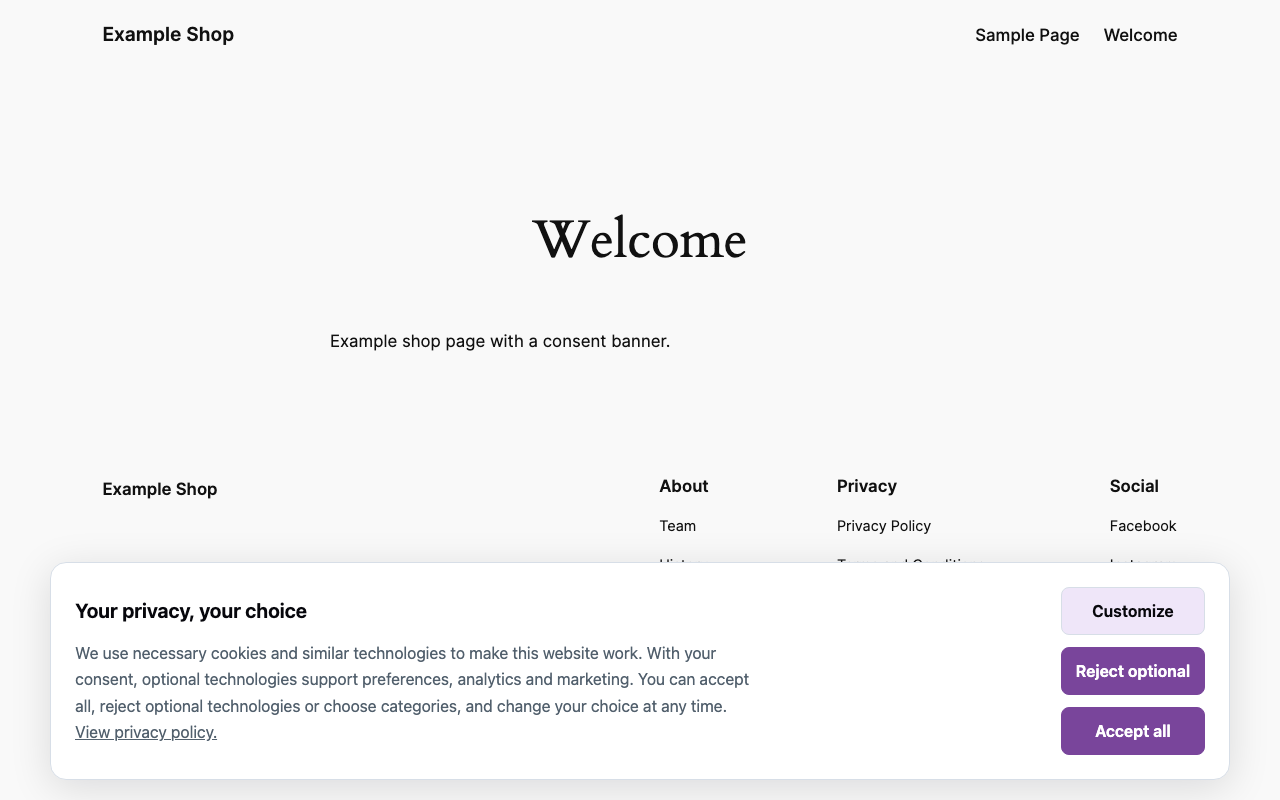
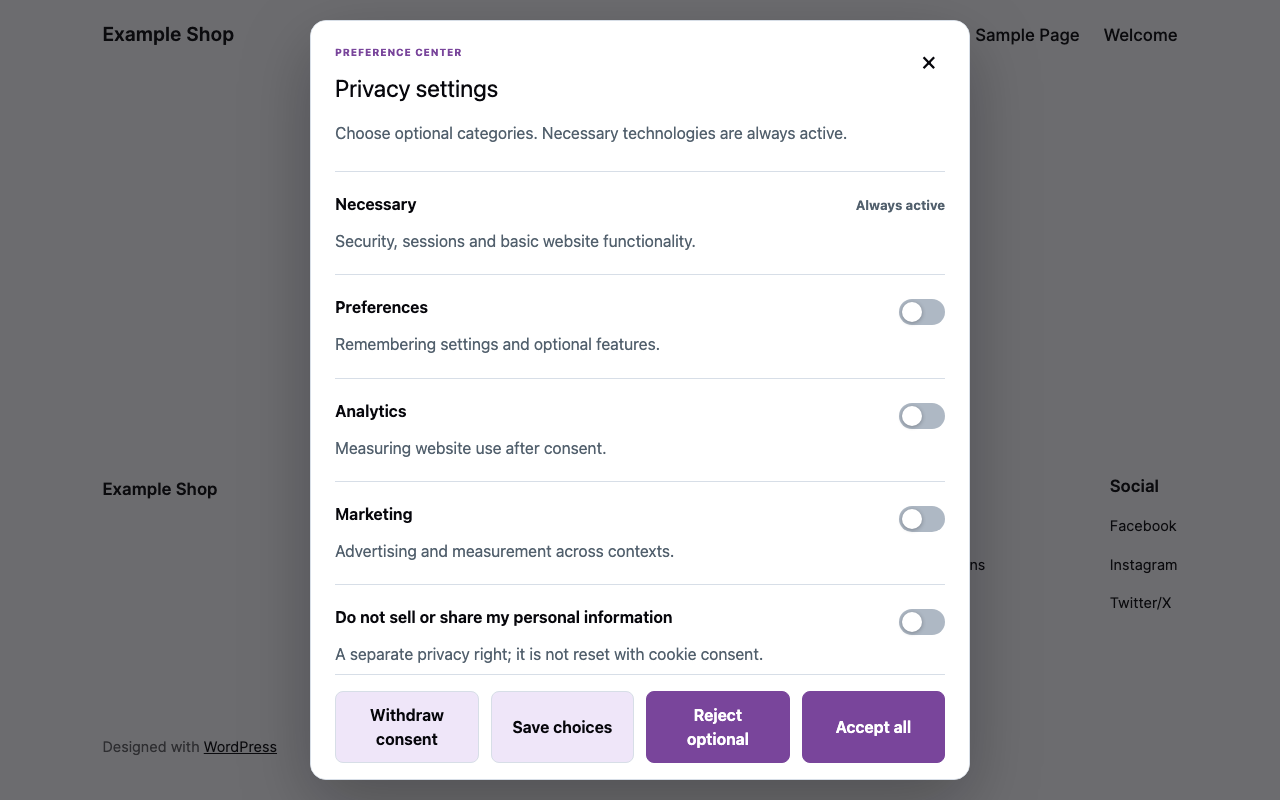
- Accept, reject, customize and withdraw optional consent.
- Consent-based loading for configured scripts and supported embeds.
- Google Consent Mode v2: Basic or Advanced mode, setup steps and an on-site check.
- Microsoft UET (Bing Ads) and Clarity consent signals follow each visitor’s choice.
- Visitors choose again after 6, 12 or 13 months, or when you click “Ask visitors again”.
- Global Privacy Control and separate sale/sharing privacy choices.
- Cookie inventory with HTML and browser runtime scanning.
- Consent logs, privacy requests and dashboard statistics.
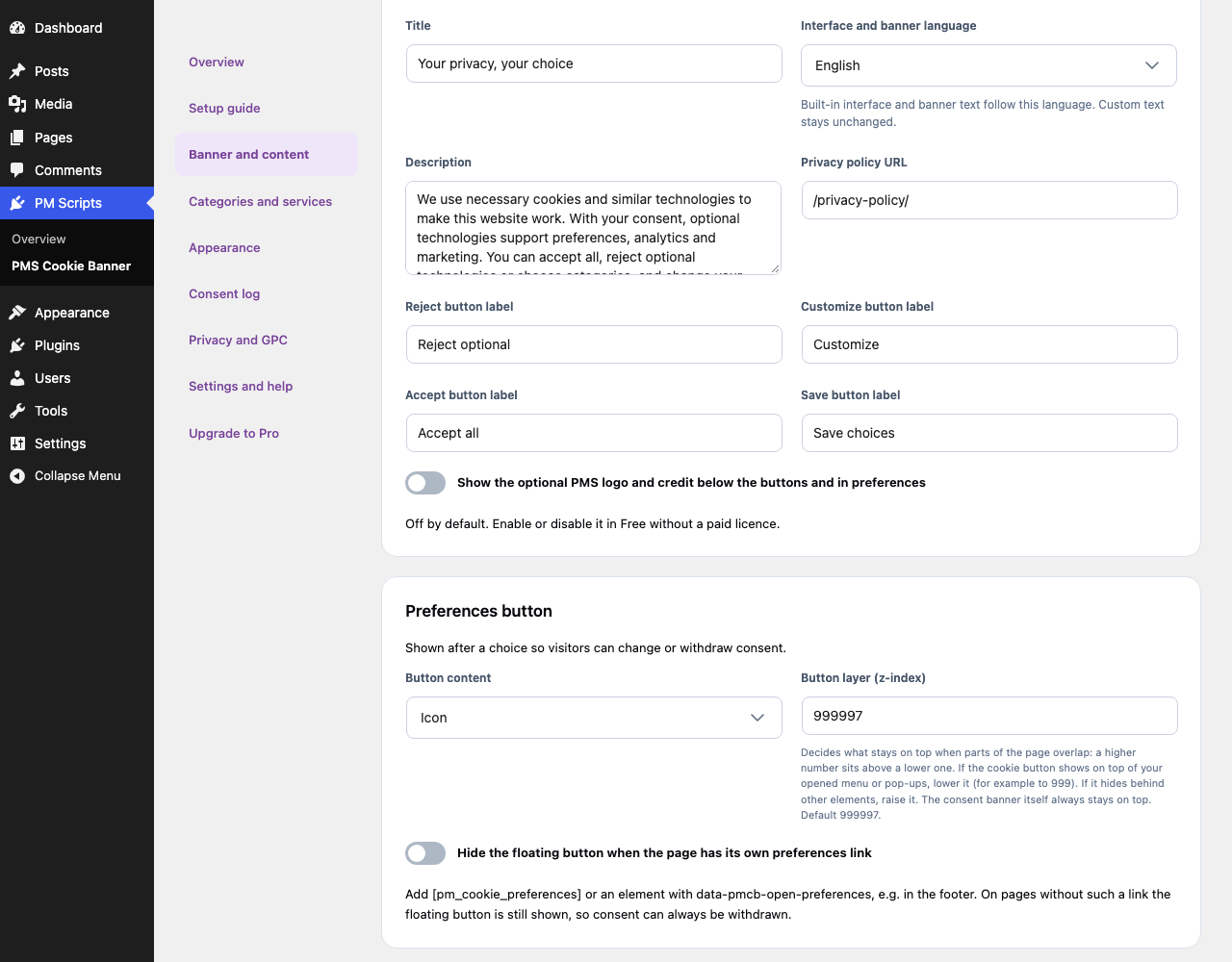
- Floating preferences button with a layer (z-index) setting, so it never covers your site menu.
- Configuration-specific text to copy into your privacy policy.
- English, Polish, French, German, Spanish and Swedish interfaces.
- Optional: banner texts follow the language of the page on multilingual sites.
Why PMS Cookie Banner Lite?
The included local features are free and do not expire. No PMS account or paid licence is required. Settings and visitor records remain under your control in WordPress.
Need more tools?
PMS Cookie Banner Pro adds banner layouts, custom colors and typography, a local Media Library logo, custom preferences-button icons and placement, and higher-capacity, path-aware classification.
The paid implementation is not included in Lite. Pro replaces Lite in the same plugin folder; do not install both together. See features and plans.
Privacy
This WordPress.org edition updates through WordPress.org and contains no external updater or licence manager. Public PMS branding is optional and off by default.
Automatic cookie descriptions (PMS classification) are off in this edition until an administrator turns them on with one click in the setup guide, the plugin notice or Settings. Each request to https://pmscripts.com/licenses/v1/classification/register and /v1/classification/classify then contains at most 50 cookie names and 50 resource origins, with an installation ID and pseudonymous credential. Before sending, the plugin removes numbers and long codes from cookie names and addresses (for example wp-settings-1 is sent as wp-settings-0), so user numbers and session codes do not leave the site. PMS receives the server IP and technical headers. Cookie values, page content, URL queries and visitor consent records are never sent.
Unfamiliar names and resource origins, and for Pro also WordPress plugin or theme folder names (not full paths), may be sent to OpenAI. Unknown cookies are researched in the background; results arrive with the next automatic retry. No OpenAI key is required in the plugin. Disabling classification stops new requests and retries while preserving the local inventory.
First frame for videos that wait for consent: when a page contains a YouTube or Vimeo video, the website’s server downloads that video’s preview image once (from i.ytimg.com for YouTube, or through vimeo.com and vimeocdn.com for Vimeo) and stores it in wp-content/uploads/pmcb-posters/. Only the public video ID is sent, by the server; visitors’ browsers do not contact YouTube or Vimeo before consent. YouTube: https://www.youtube.com/t/terms and https://policies.google.com/privacy. Vimeo: https://vimeo.com/terms and https://vimeo.com/privacy.
PMS privacy policy and service terms.
OpenAI privacy policy and service terms.
Before using it on a live site
This is a technical consent tool, not legal certification. Scanning and consent signals do not prove that every tracker is blocked. Verify your actual integrations, including third-party and server-side behavior, and adapt your privacy policy to the whole website. Visitor tags are supplied by the site administrator, not installed automatically by this plugin.
Technical Details
- Managed scripts use WordPress’s native template enhancement lifecycle, without a separate response buffer.
- A one-time WP-Cron HTML baseline runs in bounded batches. It covers the home page, regular pages, shop and supported landing pages, excluding individual posts/products, archives and technical templates.
- The administrator’s runtime scan executes page JavaScript. Keep its tab open and finish the representative queue; closing or reloading it interrupts the run.
- Accepted signed classifications are imported automatically after a completed scan, including AI-assisted results. Unresolved identities/categories remain private. Unknown retention periods or provider privacy URLs remain marked unknown. Importing a result does not create blanket domain-blocking rules.
- Policy review metadata stays in WordPress. Relevant configuration, inventory and linked local policy changes require a new review; external policy changes need manual checking. Missing or unpublished local pages cannot be marked reviewed.
- Decision logs are eligible for deletion after 180 days or the consent period, whichever is longer. Privacy requests use the saved 730–3650-day setting, with a minimum of 24 calendar months. Cleanup depends on WordPress scheduling. Consent expiry does not physically erase localStorage; separate privacy restrictions have no automatic browser expiry.
- Scan and policy notices stay on Cookie Banner screens. Appearance fields and browser observations are validated before storage or extension callbacks.
- The preferences button uses the inline “cookie” icon from Lucide (https://lucide.dev), ISC License, Copyright (c) Lucide Contributors. No external request or library is loaded.
Installation
- Install and activate on WordPress 6.9 or later with PHP 7.4 or later.
- Open PM Scripts > PMS Cookie Banner and follow the setup guide.
- Review your banner, categories, services and privacy policy. Copy and adapt the policy draft in your own editor, then confirm your review.
- Test rejection, acceptance, custom choices, reopening and withdrawal as an anonymous visitor. Enable classification only if you choose the disclosed service connection.
FAQ
Does Google Consent Mode stop all pre-consent data?
Not by itself. Consent signals and script blocking are separate controls. Check your installed tags and supported integrations.
Does the scanner cover every visitor interaction?
No. It scans representative pages, not every possible interaction. Review the inventory and test the services that matter on your site.
Can it edit or certify my privacy policy?
No. It provides a draft and records your review; it never replaces the published policy.
How do I check consent in theme or plugin code?
In JavaScript call PMCookieBanner.hasConsent('analytics'); it already ignores choices made for an older consent version. In PHP, pmcb_get_consent_version() returns the effective version stored with visitor choices. It differs from the “policy version” setting because it also covers the banner text and disclosed services:
$current = function_exists( 'pmcb_get_consent_version' ) ? pmcb_get_consent_version() : '';

PMCookieBanner.policyVersion exposes the same value in the browser, and `PMCookieBanner.diagnostics()` lists blocked, failed and unmanaged resources.
The banner reads its settings asynchronously. To read stored consent reliably, also on slow pages, wait for it: window.pmcbWhenReady(api => api.hasConsent('analytics')), the pmcb:ready event, or, in code that may run before the banner script, (window.pmcbQueue = window.pmcbQueue || []).push(api => { ... }). If the settings cannot load, pmcb:unavailable fires and pmcbWhenReady() rejects. PMCookieBanner.getServiceState('youtube') returns whether a service runs and why not (consent, gpc, opt_out, sensitive, reload).
Do videos play when a visitor sends Global Privacy Control?
Yes, after a click. GPC blocks sale or sharing for services whose status is not “no”. A YouTube or Vimeo video then shows “Play video” in its place; the click is the visitor’s own request for that video, so it loads right there (YouTube in its privacy-enhanced domain). The request is not stored, and other restricted services stay blocked.
Can a service remove localStorage or sessionStorage after withdrawal?
Yes. Add keys in the service settings (local:key, session:prefix*) or pass storage: [{type: 'local', key: 'prefix*'}] to PMCookieBanner.registerService(). Declared keys are removed when the service is no longer allowed.
How do I set up Google Consent Mode v2?
Open Settings and help, choose a mode and follow the four steps shown there:
- Basic (recommended) holds recognised Google tags (GA4, Ads, Tag Manager) until consent. Advanced loads them at once with every signal denied, so Google may receive cookieless pings; that choice is yours. Off sends no signals and is only for sites where Tag Manager or another tool owns consent.
- GA4 or Ads through gtag or a plugin needs no extra code; run the scanner so the tags are recognised.
- In Google Tag Manager keep the built-in consent checks for Google tags and require additional consent for other vendors. Use only one consent tool.
- Click “Check Consent Mode on the site” and confirm in Google Tag Assistant that “Consent default: denied” comes before the tags and “Consent update” follows a choice.
Consent Mode alone does not make a site compliant and does not control non-Google tags.
Does it send consent to Microsoft Ads (UET) and Clarity?
Yes, on by default (Settings and help → Microsoft UET and Clarity). Before any UET tag, PMS sets ad_storage to denied and updates it after each choice; Marketing grants it. Clarity receives consentv2 with ad_Storage (Marketing) and analytics_Storage (Analytics), also when consent is withdrawn. These are signals only: tags still wait for consent and nothing is sent to Microsoft by the plugin itself.
When are visitors asked again?
After the period set in Settings and help (6, 12 or 13 months; 12 for new installs), when you add or remove services or change the banner text, and when you click “Ask visitors again”. A shorter period also applies to choices already given. Each logged decision records the consent version it was given for.
Does it work with PixelYourSite and Pixel Cat?
Yes. When either plugin is active, their browser pixels and server-side events (Meta Conversions API and the other server APIs they send) follow the visitor’s categories. A necessary first-party cookie, pmcb_state, gives the server the category choices; it contains no identifier and expires with the consent. Remove other consent integrations in those plugins, such as ConsentMagic. With page caching, enable “Enable AJAX filter values update” in PixelYourSite → Consent. After a visitor accepts, the plugins start on the next page view.
Which embeds are blocked?
YouTube, Vimeo, Google Maps, Spotify, SoundCloud, Calendly, Instagram, X and TikTok, including players created later by page builders such as Elementor. Visitors see a notice with “Allow and load”. A provider is disclosed only after your pages show it. Other scripts and iframes added after page load wait for consent when their domain belongs to a configured service.
Can the banner follow the page language on a multilingual site?
Yes. In Banner and content turn on “Follow the page language”. Built-in banner and preference texts then use the language of the page being viewed when it is English, Polish, French, German, Spanish or Swedish; other pages use the language selected above. The page language comes from PMS Translations when it is active, otherwise from the WordPress locale of the request (set by most multilingual plugins). Your own texts apply to the selected language. The language is printed into each page, so page caching cannot mix languages, and a visitor’s consent stays valid in every language.
Developers can choose the language with the pmcb_visitor_language filter (return a language code), translate custom texts with pmcb_visitor_content (texts array, language) and set the privacy policy link with pmcb_visitor_privacy_url (URL, language).
Screenshots
Changelog
1.0.108
- Maintenance release.