

Description
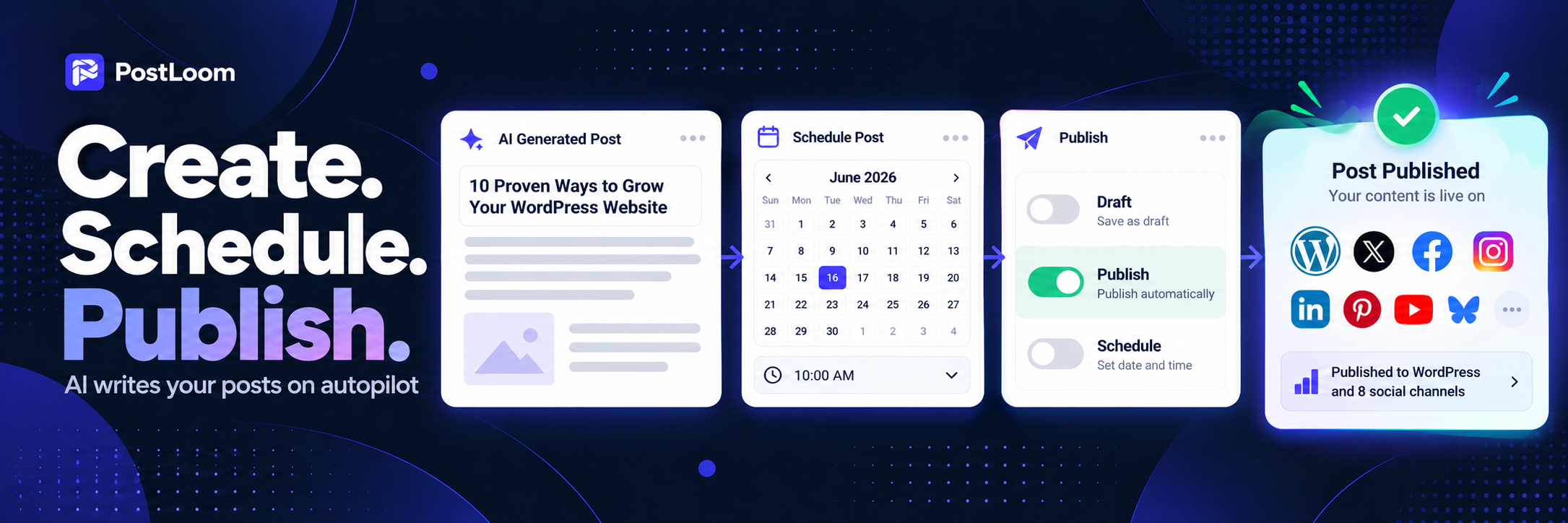
Postloom is an auto post creator and auto post publish plugin for WordPress. Give it a keyword, a topic list or a product document, and it researches the subject, writes the article with your own AI key, fills in the SEO fields, adds a featured image, and then saves the post as a draft, publishes it immediately or schedules it on a visual calendar. When the post goes live, Postloom shares it to your connected social accounts.
Most auto post plugins start after the post already exists. Schedule Press, Social Post Flow schedule or share finished posts. AI writers AutoPost AI create drafts and leave the publishing to you. Postloom covers both halves in one plugin: it creates the post, then handles the auto post publish side with an editorial calendar, a weekly slot scheduler and a missed schedule watchdog. You bring your own API key from Google Gemini, OpenAI, Anthropic Claude, DeepSeek, X.AI Grok or OpenRouter, so there are no article credits and no monthly content subscription.
The includes AI post creation, the Instant Creator Studio, the editorial calendar, the review queue, the weekly slot scheduler, the missed schedule watchdog, SEO field filling, AI and stock images, and auto publishing to X (Twitter), Facebook with eight more social networks, custom platform templates, instant multi channel sharing and editable AI skills.
Auto Post Creator: Write WordPress Posts With AI
Postloom turns a keyword or a rough note into a finished article without leaving the WordPress dashboard.
- Instant Creator Studio: type a focus keyword, a headline or raw notes and generate a full article. The topic is optional. Leave it empty and Postloom proposes topics from your product knowledge.
- Topic strategies: new angle, comparison, refresh stale content and long tail. Postloom checks your published posts so it does not repeat a focus keyword or a URL slug.
- Native Gutenberg output: headings, lists and paragraphs are saved as real blocks, with an automatic table of contents built from your H2 and H3 headings.
- Content length options: choose short, medium or long output per post or as a default.
- Instant AI Post Editor: refine a generated article with a formatting toolbar and switch between the Gutenberg view and visual HTML without losing the markup.
- Knowledge base grounding: upload PDF, DOCX, Markdown or TXT files so drafts are written from your own documentation instead of guesses.
- Product and link relations: store your product name, features, documentation link, blog link and support link once, and Postloom works them into each article.
- Competitor research: when Gemini or OpenAI is connected, Postloom can run live research. With only Claude connected it builds the comparison from your own product data and marks it as not live verified.
- Skills: two bundled skills, an SEO blog creator and an image prompt generator, control tone, structure and image direction.
Auto Post Publish: Schedule, Publish and Rescue Missed Posts
The auto post publish side is where most AI writers stop. Postloom keeps going.
- Three output modes: save as draft for review, publish immediately, or schedule for an exact date and time.
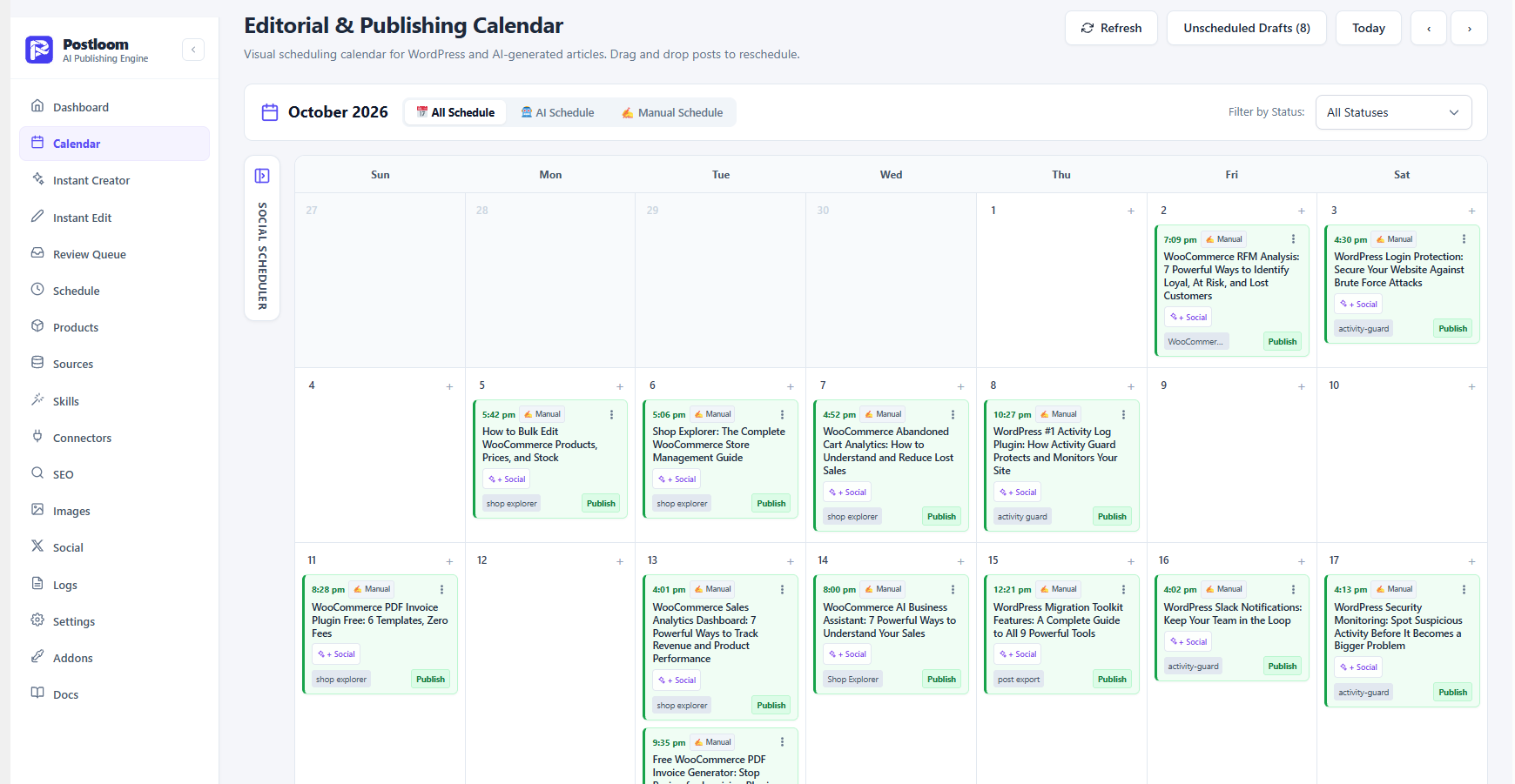
- Editorial calendar: a monthly grid of published, scheduled, draft and queued posts. Drag a post to a new date to change its publication time, open the unscheduled drafts drawer, or click the plus icon on any day to create a post.
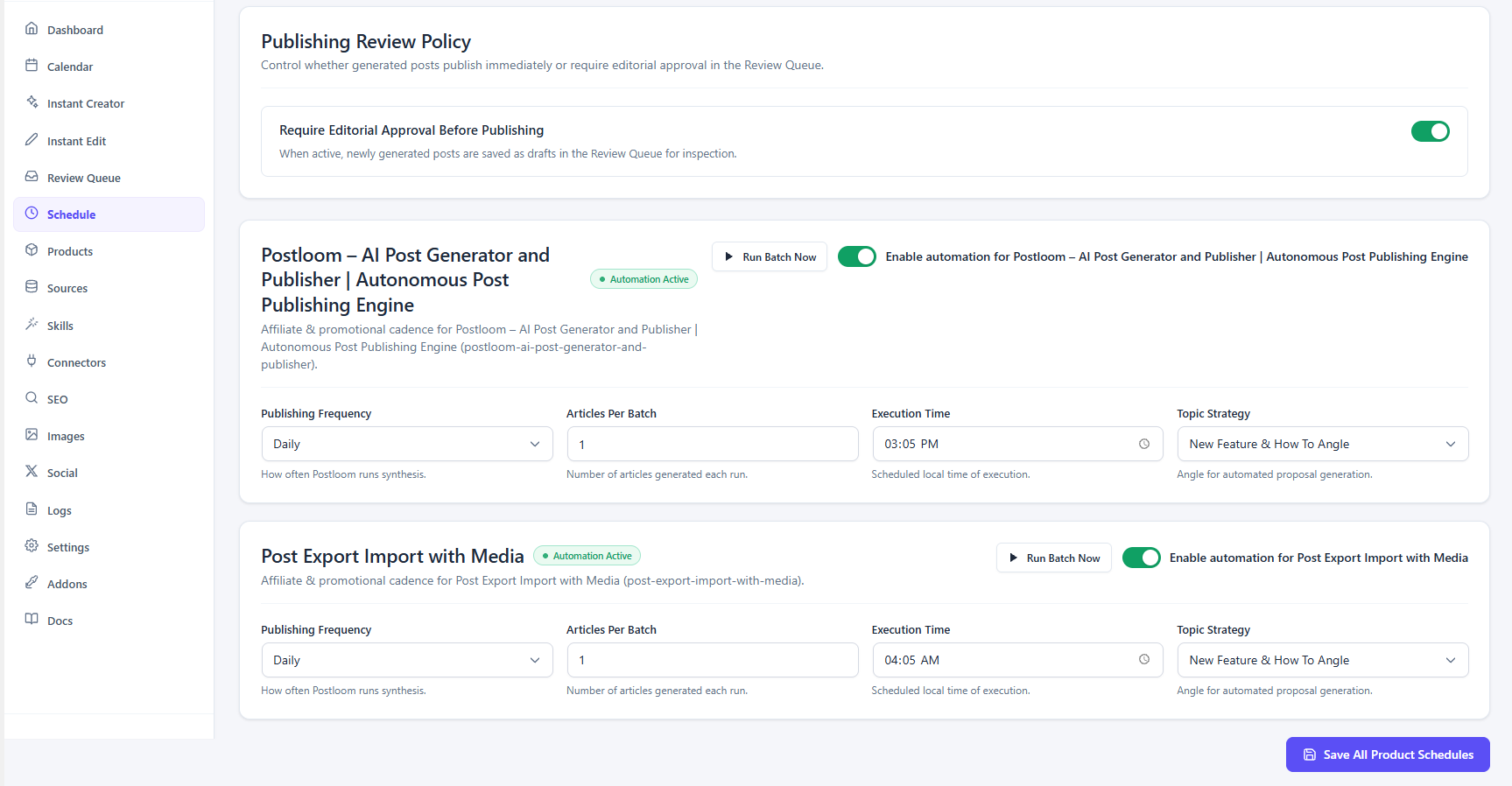
- Weekly slot auto scheduler: set publishing slots for each day of the week and a daily limit per product, and Postloom fills them without manual work.
- Missed schedule watchdog: a background check finds scheduled posts that WordPress missed and publishes them. A one click rescue button is available on the Schedule screen.
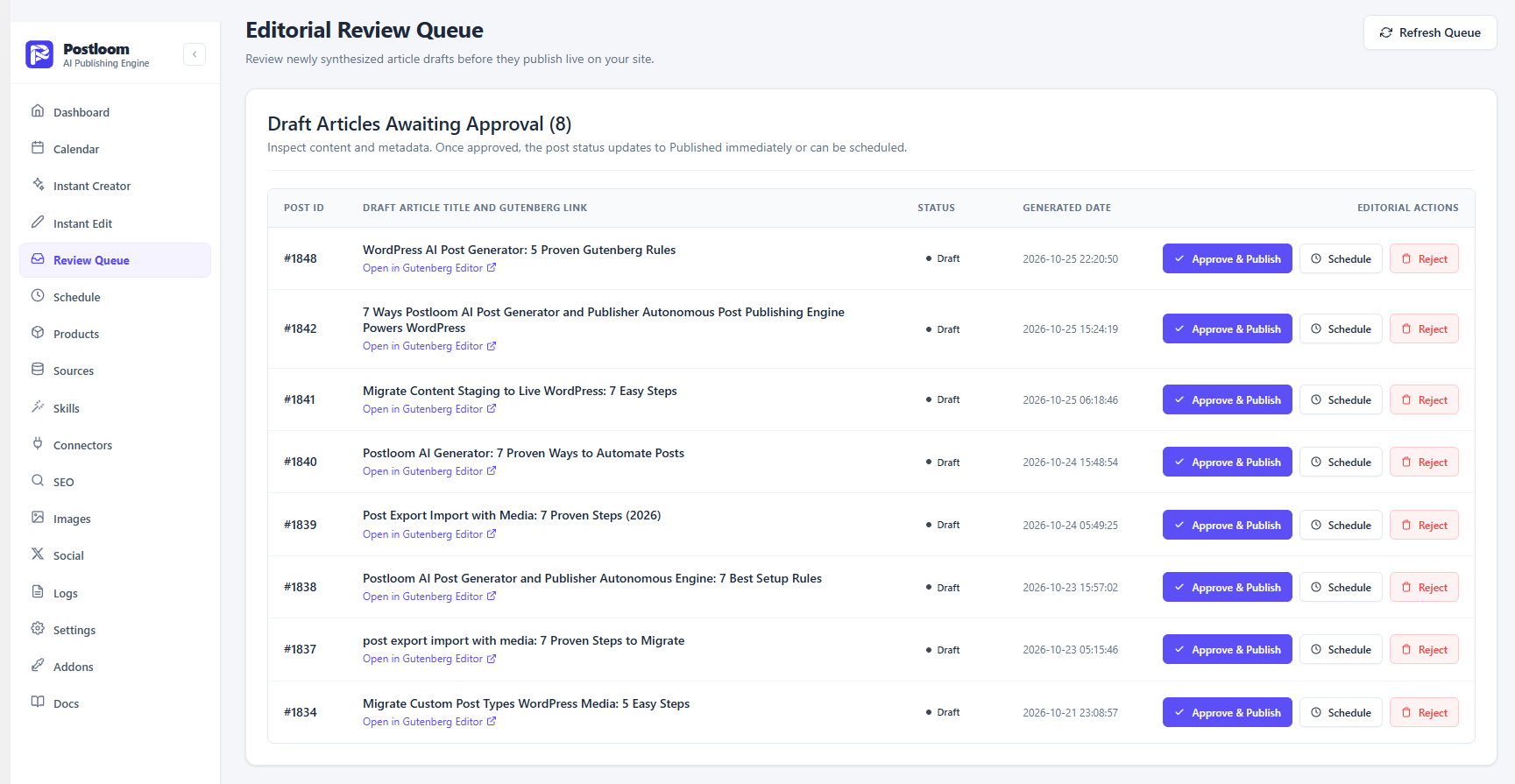
- Editorial review queue: open any draft in Gutenberg, approve and publish it, schedule it on the calendar or reject it.
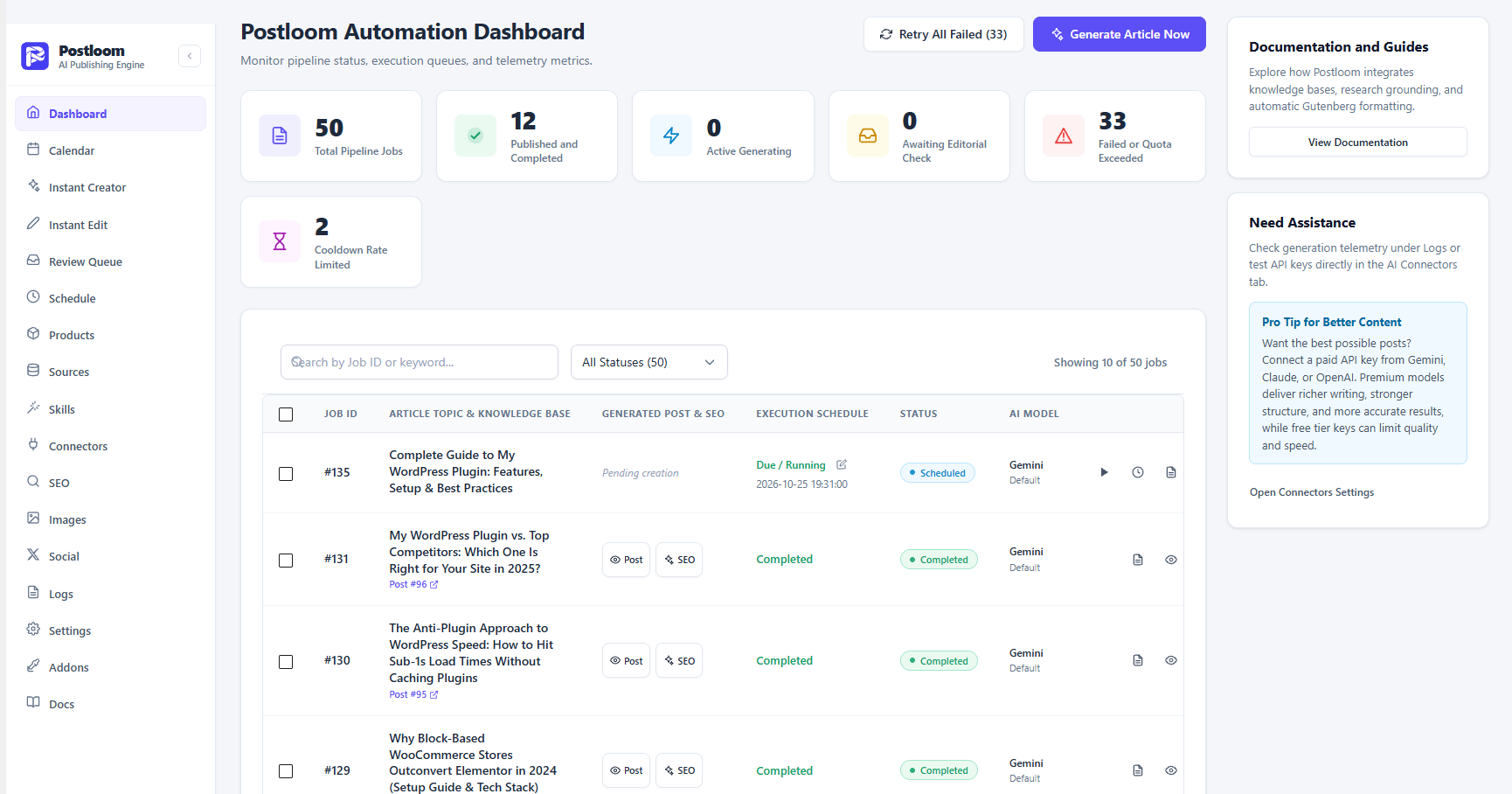
- Dashboard controls: live countdown timers, start a job now, reschedule it, retry a failed job and apply bulk actions to several jobs at once.
- WordPress dashboard widget and an admin bar counter show how many posts are scheduled.
- Email notifications tell authors and editors when a post is scheduled, published or changes status.
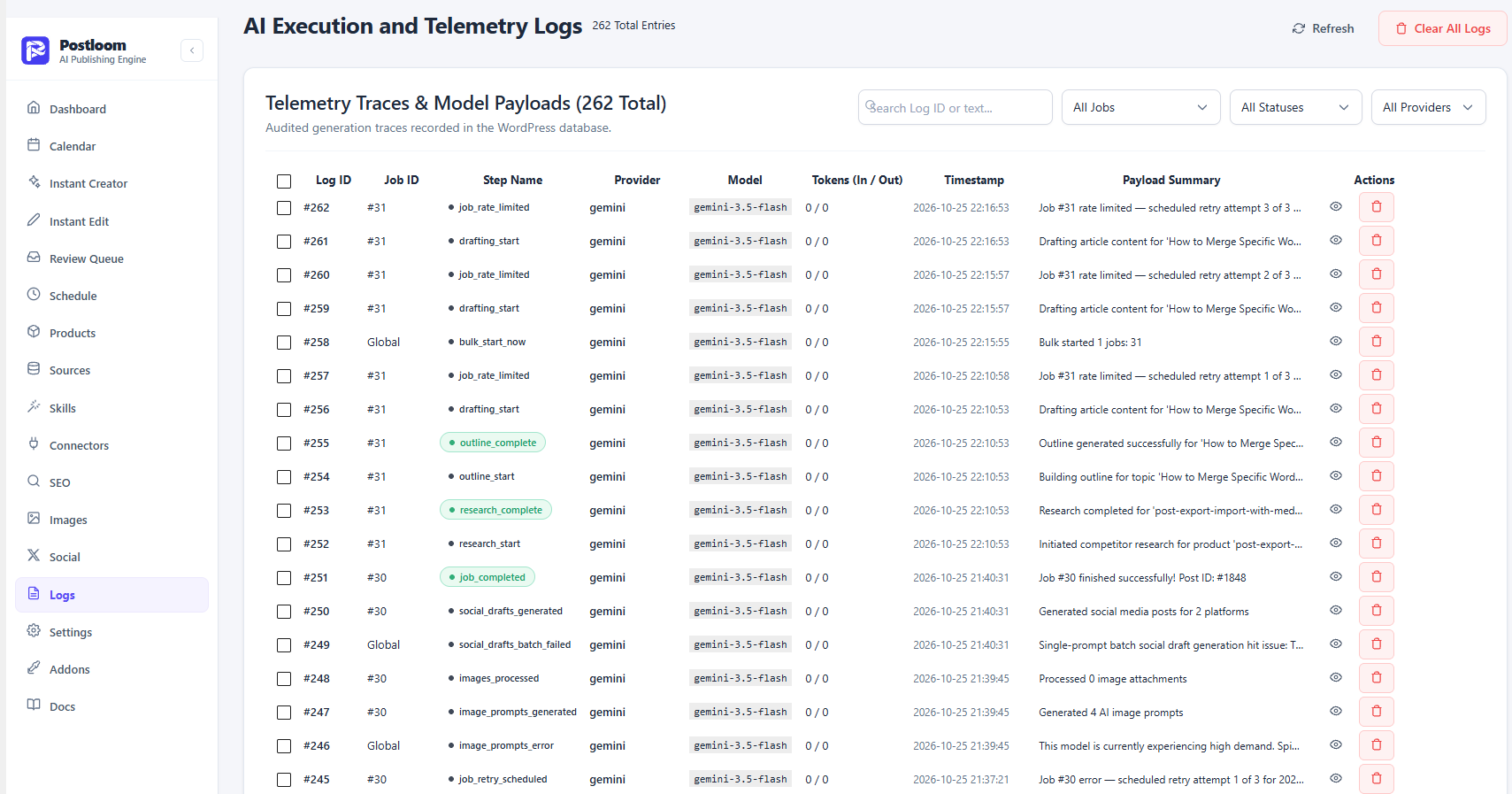
- Logs: step by step records for research, drafting, block conversion, image generation and social publishing, with search and filters.
Auto Post to Social Media
When a post is published, or when a scheduled post reaches its time, Postloom sends it to the social accounts you connected.
- Auto publish to X (Twitter) and Facebook Pages. It supported Instagram Business, LinkedIn, Bluesky, Mastodon, Pinterest, Meta Threads, Medium and Google Business Profile.
- AI social drafts: Postloom writes a draft for each network that respects its character limit, for example 280 characters for X and 300 for Bluesky.
- Hashtags: post tags become hashtags, trimmed to the limit of each platform.
- Social publish queue: see what was sent, the platform post ID and URL, and retry failures. Failed posts are retried automatically up to three times.
- Post editor box: choose which connected profiles receive a specific post from the edit screen.
- Calendar scheduler: schedule social shares for an existing post from the Editorial Calendar sidebar.
AI Providers, Images and SEO
- Providers: Google Gemini, OpenAI, Anthropic Claude, DeepSeek, X.AI Grok and OpenRouter. On WordPress 7.0 and later, Claude, OpenAI and Gemini can run through the core AI Connectors, and a direct key remains available as an override.
- Key handling: API keys are stored encrypted in the plugin vault, masked in the interface and tested with a latency check before you use them.
- Images: generate a featured image with OpenAI DALL·E or Google Imagen, pull a royalty free photo from Pexels or Pixabay, or choose prompt only mode to save image prompts for Midjourney or DALL·E. If only Claude is connected, images fall back to prompts.
- SEO fields: Postloom writes the focus keyphrase, secondary keywords, SEO title and meta description for Yoast SEO and Rank Math, and keeps a native set of fields for sites without an SEO plugin. The Instant Editor also reads All in One SEO titles and descriptions.
- Heading control: a clean H2 and H3 structure, bulleted lists and FAQ items are part of the generated article.
Competitor Analysis
Search the WordPress.org directory for an auto post creator or an auto post publish plugin and the results fall into three groups: social auto posters, scheduling tools and AI blog writers. Postloom is the only one in this comparison that does the writing and the publishing in the same plugin.
SchedulePress is the closest match on the publishing side. Its free version has a drag and drop calendar, a dashboard widget and social sharing to Facebook, Twitter, LinkedIn, Pinterest, Instagram, Medium, Threads and more, one profile per network. Its Auto Scheduler, Missed Schedule Handler, Manual Scheduler and Advanced Schedule are Pro features, and it does not write articles. Postloom includes the weekly slot scheduler and the missed schedule watchdog in the free plugin and adds the article generation SchedulePress leaves to you.
WP2Social Auto Publish sends posts to Facebook only, with category and post type filters and message formats. Social Media Auto Poster for Buffer and for Hootsuite, both from WP Zinc, add posts to a Buffer or Hootsuite queue and need an account with that service, and Instagram and Pinterest need their Pro versions. Social Post Flow supports many networks but needs a paid Social Post Flow subscription. Bit Social connects a wide range of networks, though its free version covers Facebook and LinkedIn profiles, and the calendar, WooCommerce sharing and AI prompts are Pro. None of these plugins creates the post itself. Postloom writes the article first, then publishes and shares it with your own accounts and your own AI key.
Auto Post Publisher solves a narrower problem: it publishes scheduled posts that missed their time and checks when someone visits the site. Postloom includes a missed schedule watchdog as one part of a larger publishing workflow.
On the AI side, AutoPost AI creates scheduled drafts but, according to its own FAQ, does not publish them for you. Postomatic starts with a small set of free credits, and AutoArticle works on a monthly credit plan. Postloom has no credit system. You pay your AI provider directly, and you can use a free tier key such as Google Gemini.
So if you want a free auto post creator and auto post publish engine that writes, schedules, publishes and shares from one dashboard, Postloom is built for that job. If you only need to push existing posts to a single network, the focused plugins above may be enough.
Benefits of Postloom
- For bloggers and content creators: keep a steady publishing rhythm without writing every article by hand.
- For agencies and site owners: use one set of AI connectors, saved skills and a shared editorial calendar across clients.
- For SaaS and product companies: upload documentation and release notes so feature announcements are written from your own material.
- For ecommerce stores: publish buying guides, comparison posts and seasonal roundups on a schedule.
Privacy and Security
Scheduled jobs, drafts, logs and knowledge base files are stored in your own WordPress database and uploads folder. AI providers receive data only when you add a key and run a generation. Social networks receive data only for accounts you connect. A setting called delete data on uninstall removes the plugin tables, options and uploaded files when you choose it, and leaves them in place otherwise.
External Services
This plugin connects to external services only for the features you configure. Nothing is sent to a service you do not use.
When the WordPress AI Client is available (WordPress 7.0 and later), Claude, OpenAI and Gemini can run through WordPress Connectors under Settings, Connectors. A direct API key is used only when the AI Client is not detected or when you choose to enter your own key. DeepSeek, Grok and OpenRouter are always direct integrations.
Google Gemini
* Purpose: writes article content and image prompts, and generates images with Imagen, when Gemini is the active provider.
* Data sent: topic keyword, knowledge base context, prompt parameters and your API key for authentication.
* When it connects: when you run a generation, a connection test or an image request.
* Service URL: https://generativelanguage.googleapis.com/
* Terms of Service: https://policies.google.com/terms
* Privacy Policy: https://policies.google.com/privacy
OpenAI
* Purpose: writes article content and generates images with DALL·E when OpenAI is the active provider.
* Data sent: topic keyword, prompt parameters and your API key for authentication.
* When it connects: when you run a generation, a connection test or an image request.
* Service URL: https://api.openai.com/v1/
* Terms of Service: https://openai.com/policies/terms-of-use/
* Privacy Policy: https://openai.com/privacy/
Anthropic Claude
* Purpose: writes article content when Claude is the active provider.
* Data sent: topic keyword, prompt parameters and your API key for authentication.
* When it connects: when you run a generation or a connection test.
* Service URL: https://api.anthropic.com/
* Privacy Policy: https://www.anthropic.com/legal/privacy
DeepSeek
* Purpose: writes article content when DeepSeek is the active provider.
* Data sent: topic keyword, prompt parameters and your API key for authentication.
* When it connects: when you run a generation or a connection test.
* Service URL: https://api.deepseek.com/v1/
* Privacy Policy: https://cdn.deepseek.com/policies/en-US/deepseek-privacy-policy.html
X.AI Grok
* Purpose: writes article content when Grok is the active provider.
* Data sent: topic keyword, prompt parameters and your API key for authentication.
* When it connects: when you run a generation or a connection test.
* Service URL: https://api.x.ai/
* Privacy Policy: https://x.ai/legal/privacy-policy
OpenRouter
* Purpose: routes text generation requests to the model you select.
* Data sent: topic keyword, prompt parameters and your API key for authentication.
* When it connects: when you run a generation or a connection test.
* Service URL: https://openrouter.ai/api/
* Privacy Policy: https://openrouter.ai/privacy
Pexels
* Purpose: finds royalty free stock photos for generated posts when Pexels is selected.
* Data sent: search keywords and your API key.
* When it connects: when a post needs a featured image.
* Service URL: https://www.pexels.com/api/
* Terms of Service: https://www.pexels.com/terms-of-service/
* Privacy Policy: https://www.pexels.com/privacy-policy/
Pixabay
* Purpose: finds royalty free stock photos for generated posts when Pixabay is selected.
* Data sent: search keywords and your API key.
* When it connects: when a post needs a featured image.
* Service URL: https://pixabay.com/api/docs/
* Terms of Service: https://pixabay.com/service/terms/
* Privacy Policy: https://pixabay.com/service/privacy/
Social networks
* Purpose: connects your accounts and publishes posts, text and the featured image to the networks you turned on.
* Data sent: your access token, account or page identifiers, the post text built from your template, the post link, hashtags and the featured image.
* When it connects: when you connect or refresh an account, and when a post is published, scheduled or retried from the queue.
* X (Twitter), api.twitter.com. Terms: https://x.com/en/tos Privacy: https://x.com/en/privacy
* Facebook, Instagram and Threads by Meta, graph.facebook.com, graph.instagram.com and graph.threads.net. Terms: https://www.facebook.com/terms.php Privacy: https://www.facebook.com/privacy/policy/
* LinkedIn, api.linkedin.com and www.linkedin.com. Terms: https://www.linkedin.com/legal/user-agreement Privacy: https://www.linkedin.com/legal/privacy-policy
* Pinterest, api.pinterest.com. Terms: https://policy.pinterest.com/en/terms-of-service Privacy: https://policy.pinterest.com/en/privacy-policy
* Medium, api.medium.com. Terms: https://policy.medium.com/medium-terms-of-service-9db0094a1e0f Privacy: https://policy.medium.com/medium-privacy-policy-f03bf92035c9
* Bluesky, bsky.social or the personal data server you enter. Terms: https://bsky.social/about/support/tos Privacy: https://bsky.social/about/support/privacy-policy
* Mastodon, the server you enter, mastodon.social by default. The terms and privacy policy of that server apply.
* Google Business Profile, mybusinessaccountmanagement.googleapis.com, mybusinessbusinessinformation.googleapis.com, mybusiness.googleapis.com and oauth2.googleapis.com. Terms: https://policies.google.com/terms Privacy: https://policies.google.com/privacy
Freemius
* Purpose: license checks, the account and upgrade screens, and optional usage data if you opt in.
* Data sent: nothing until you opt in or open the upgrade or account screens. After you opt in, the SDK shares your site URL, WordPress and PHP versions, plugin version and admin email.
* When it connects: when you opt in, activate a license, or open the upgrade checkout.
* Service URL: https://freemius.com/
* Terms of Service: https://freemius.com/terms/
* Privacy Policy: https://freemius.com/privacy/
Links to wpazleen.com in the plugin are plain links to documentation and support. No data is sent to wpazleen.com.
Note on third party libraries: the admin panel uses React Router, which contains documentation URLs in its source code. No requests are made to those addresses at runtime.
Source Code
The admin panel is a React application compiled with the standard WordPress build tool. All source files are included in the plugin and are public.
- The compiled file build/index.js is built from the admin source folder, which holds the React components, pages and hooks.
- Build tool: @wordpress/scripts.
- To rebuild, run npm install and then npm run build from the plugin root.
The full source is also on GitHub: https://github.com/wpazleen/postloom-ai-post-generator-and-publisher
Installation
Automatic installation
- In your WordPress admin, go to Plugins, then Add New.
- Search for “Postloom AI Post Generator and Publisher”.
- Click Install Now, then Activate.
Manual installation
- Upload the plugin folder to the /wp-content/plugins/ directory.
- Activate Postloom from the Plugins screen.
Requirements
- WordPress 6.9 or higher
- PHP 8.0 or higher
- An API key from at least one supported AI provider, or the WordPress 7.0 AI Connectors
First setup
- Open Postloom and go to AI Connectors. Add a key for Gemini, OpenAI, Claude, DeepSeek, Grok or OpenRouter, then run the connection test.
- Open Products and add your product or site details and any documents you want the AI to use.
- Open Instant Creator, enter a keyword and choose Save as Draft, Publish Immediately or Schedule on Calendar.
- To publish on a rhythm, open Schedule and set your weekly time slots.
- To share to social media, open Social and connect X (Twitter) or Facebook. The interactive guide lists the credentials each network needs.
FAQ
What is Postloom and what does it do?
Postloom is an auto post creator and auto post publish plugin for WordPress. It uses your own AI provider key to write articles, fill in SEO fields, add images, schedule or publish the post, and share it to social media. It runs from a dashboard, a calendar and a review queue inside your WordPress admin.
How does Postloom work as an auto post creator?
You enter a focus keyword, a topic or notes in the Instant Creator Studio, or let Postloom propose topics from your product knowledge. The plugin researches the subject, writes the article as Gutenberg blocks, adds a table of contents and SEO fields, and attaches an image. You choose whether it becomes a draft, a live post or a scheduled post.
How does auto post publish work in Postloom?
Posts can publish immediately or at a date and time you set on the Editorial Calendar. The weekly slot scheduler fills your chosen days and times automatically, and the missed schedule watchdog publishes any post that WordPress failed to publish on time. When a post goes live, Postloom shares it to your connected social accounts.
How do I create and schedule a post automatically?
Open Instant Creator, enter your keyword, pick Schedule on Calendar and choose the date and time. The button changes to Instant Generate and Schedule Post, and the job appears on the Editorial Calendar. For a repeating rhythm, set weekly slots on the Schedule screen instead.
Can I review posts before they go live?
Yes. Set the output mode to Draft and every generated article waits in the Editorial Review Queue. From there you can open it in Gutenberg, approve and publish it, schedule it or reject it.
What happens if WP Cron misses a scheduled post?
Postloom runs a missed schedule watchdog that looks for future posts whose time has passed and publishes them. You can also press Rescue Missed Schedules Now on the Schedule screen. This is included in the free plugin.
How does the weekly slot auto scheduler work?
You pick publishing times for each day of the week and set a daily limit per product, for example Monday at 9:00 AM and Wednesday at 2:00 PM. Postloom uses those slots for recurring article generation, so your site publishes on a predictable rhythm without you choosing a date for each post.
Which AI providers can I use with Postloom?
You can use Google Gemini, OpenAI, Anthropic Claude, DeepSeek, X.AI Grok and OpenRouter. On WordPress 7.0 and later, Claude, OpenAI and Gemini can run through the core AI Connectors. You can still enter a direct key as an override.
Do I need a paid API key?
Not always. A free tier key, such as the Google Gemini free tier, works for light use. Heavier use is billed by your provider based on your own volume. Postloom itself does not charge per article.
Does Postloom create images for posts?
Yes. It can generate featured images with OpenAI DALL·E or Google Imagen, or pull royalty free photos from Pexels or Pixabay. In prompt only mode it saves image prompts to the post so you can use them in Midjourney or another tool.
Does Postloom work with Yoast SEO and Rank Math?
Yes. It writes the focus keyphrase, secondary keywords, SEO title and meta description into Yoast SEO and Rank Math fields. If you use neither, Postloom keeps its own SEO fields for the post.
Which social networks can Postloom auto post to?
The free plugin auto publishes to X (Twitter) and Facebook Pages. Postloom Pro adds Instagram Business, LinkedIn, Bluesky, Mastodon, Pinterest, Meta Threads, Medium and Google Business Profile. Scheduled posts are shared when they publish, not when you create them.
Do scheduled posts share to social media automatically?
Yes. When a scheduled post publishes on its date, Postloom detects it and sends it to every active connected account. Failed shares stay in the social queue and are retried up to three times.
Is Postloom free? What does Pro add?
The core plugin is free, including AI post creation, the calendar, the review queue, the weekly slot scheduler, the missed schedule watchdog, SEO fields, images, and auto publishing to X (Twitter) and Facebook Pages. Pro adds the other eight social networks, custom platform templates, instant multi channel sharing and editable AI skills. You pay your AI provider separately for API use.
Can I make Postloom write from my own documents?
Yes. Upload PDF, DOCX, Markdown or TXT files in Products, and the plugin uses them as source material when it writes. This keeps feature names, steps and details close to your real documentation, but you should still read each draft before publishing.
How is Postloom different from SchedulePress?
SchedulePress is a strong scheduling and social sharing plugin with a calendar, a dashboard widget and many networks, but it does not write posts, and its Auto Scheduler and Missed Schedule Handler are Pro features. Postloom writes the article with AI and includes the weekly slot scheduler and the missed schedule watchdog in the free plugin.
Is Postloom a good alternative to WP2Social Auto Publish?
WP2Social Auto Publish sends your posts to Facebook with filters and message formats, and it is a fair choice if Facebook is all you need. Postloom also auto publishes to Facebook Pages and X, and adds AI article creation, a calendar, scheduling and a review queue.
How does Postloom compare with Social Media Auto Poster for Buffer?
The Buffer plugin from WP Zinc adds your posts to a Buffer queue and needs a Buffer account, and Buffer’s own free plan limits how many channels you can connect. Postloom connects to the social networks directly with your own credentials, and it also writes and schedules the posts.
How does Postloom compare with Social Post Flow?
Social Post Flow reaches many networks through its own service, and it requires a paid Social Post Flow subscription. Postloom has no subscription for its core features, uses your own accounts and AI key, and creates the article as well as sharing it.
Is Postloom different from Auto Post Publisher?
Auto Post Publisher publishes scheduled posts that missed their time, and nothing more. Postloom includes the same kind of missed schedule rescue, then adds AI post creation, an editorial calendar, weekly slots and social sharing.
How is Postloom different from Bit Social?
Bit Social shares posts to social networks, but its free version covers Facebook and LinkedIn profiles, and its calendar, WooCommerce sharing and AI prompts are Pro. Postloom writes the whole post with AI, includes the calendar in the free plugin and auto publishes to X and Facebook Pages.
Is Postloom an alternative to Social Media Auto Poster for Hootsuite?
The Hootsuite plugin from WP Zinc posts to social networks through a Hootsuite account and does not create content. Postloom does not need a third party dashboard, and it generates the article before it publishes and shares it.
Is Postloom better than AI blog writers like AutoPost AI?
AutoPost AI creates scheduled drafts, and its FAQ says it does not publish them automatically. Postloom creates the post and can publish it on a schedule, with a missed schedule watchdog and social sharing, or hold it in a review queue if you prefer.
Does Postloom overwrite my existing posts?
No. Postloom creates new posts as drafts, scheduled posts or published posts. It does not change your existing posts unless you open one in the Instant Editor and save your own changes.
Which post types does Postloom create?
Postloom creates standard WordPress posts with your chosen categories, tags and author. It does not create WooCommerce products or custom post types.
Does Postloom collect any personal data?
Postloom stores jobs, logs and settings in your own WordPress database. It sends data only to the AI, image and social services you connect, and to Freemius if you opt in. See the External Services section for the exact list.
Is Postloom GDPR compliant?
Postloom keeps its data on your site and does not send it to wpazleen.com. You decide which AI and social services to connect, and each has its own privacy policy that you should review for your own compliance needs. The delete data on uninstall setting removes the plugin data when you remove the plugin.
Will Postloom slow down my website?
No. Generation and publishing run in the WordPress admin and in background jobs, and Postloom does not load its scripts on your public pages.
My posts are not generating. What should I check?
First run the connection test in AI Connectors and confirm your key is valid and has quota. Then open the Logs screen and read the raw error for the failed step. Some hosts also block outbound HTTPS requests, which stops calls to the AI provider.
Where can I get support or report a bug?
Use the support forum for Postloom on WordPress.org and include the error from the Logs screen. Documentation and priority support are available at https://wpazleen.com/support
Screenshots


Changelog
1.3.1
- Enhancement: Posts not following the product
- Enhancement: Social auto-share
- Fix: X didn’t always include the link, and character counts were wrong.
- Fix: Bluesky links weren’t clickable and had no link card.
- Fix: Threads and Instagram often failed with “Media ID is not available”.
- Fix: Google Business sent the wrong location format.
- Fix: Editing a profile wiped its stored keys.
1.3.0
- New: Postloom MCP Server Support for AI Agents.
1.2.2
- Enhancement: Prevention of Duplicate Focus Keywords & URL Slugs.
- Enhancement: Add filters and search to Logs tab.
- Enhancement: Add Clear Filters button to Logs tab.
- Enhancement: Prompt & Skill Hardening
- Enhancement: Instant AI Editor & Preview
1.2.1
- Fix: Multi-select checkboxes and bulk action toolbar to the Dashboard
- Fix: Resolved missing Schema class import in JobRunner preventing scheduler fatal errors.
- Fix: Refined batch deduplication so manual “Run Batch Now” executes immediately without blocking scheduled daily runs.
- Fix: Dynamic AI provider resolution in SourceEngine eliminating hardcoded provider exceptions and static fallbacks.
- Fix: Resolved 503 timeouts and 15 RPM rate limits by consolidating social media drafts into single-call batch prompts.
- Fix: Made Article Topic optional in Instant Creator and Generate Now modal with automatic product-grounded topic ideation.
- Fix: Persisted and connected Content Sources toggles to the topic generation engine.
- Fix: Added live searchable post selection by title or ID for Instant Social Media Sharing.
- Fix: Respected global telemetry logging toggle and added missing lifecycle audit logs.
- Fix: Updated uninstall.php to cleanly drop all 11 plugin database tables upon complete wipe.
1.2.0
- New: Instant AI Post Editor Studio” with Pagination with Batch Mode
- New: Full WYSIWYG Formatting Toolbar
- New: Gutenberg ⇄ Visual HTML Bidirectional Sync
- New: Simplified All Social Connection Modal
- Enhancement: Upgraded Developer Portals & Token Directory
- Enhancement: Backend Driver Verifications & Resilience Enhancements
1.1.1
- Enhancement: Gutenberg Post Preview & Live SEO Editor in Dashboard Table
- Enhancement: Added content length options for generated posts
1.1.0
- New: Added Social Media Auto Schedule & Multi-Platform Publishing with target platform selection.
- New: Built-in Social Scheduler sidebar on the Editorial Calendar for scheduling posts to 10+ social networks.
- New: Added an interactive step-by-step user guide with checkbox progress tracking for complete operational mastery.
- New: Added platform credential setup guides for all supported social networks.
- Fix: Fixed missing social queue events and enhanced queue audit logs.
- Fix: Improved feature functionality and ensured complete operational coverage.
- Fix: Improved the auto scheduler’s date, product, and category selection.
1.0.1
- Fix: Calendar data now auto refreshes while the calendar is open.
- Fix: Fixed optimistic update issues when rescheduling generation jobs.
- Fix: Quick created calendar posts now correctly include platform selection.
- Fix: Added social visibility and channel controls to the calendar.
- Fix: Fixed social publishing for scheduled posts and restored the dead rescue hook.
- Fix: SocialEngine API failures are now properly surfaced.
- Fix: Fixed silent failures during social profile validation.
1.0.0
- Initial public release of Postloom – AI Post Generator and Publisher.