


Description
Presswell Alt Text Generator helps teams reduce accessibility backlog by generating descriptive alt text for new and existing images. Connect a provider, choose a model, and run generation workflows directly inside wp-admin.
Features
- Supports OpenAI, Anthropic Claude, and Google Gemini through WordPress AI Connectors (recommended, WordPress 7.0+) or, deprecated, with API keys stored by the plugin
- On WordPress 7.0+, can send requests through the WordPress AI Client, so the plugin stores no key
- Generates alt text for individual images in the Media Library, the media modal, and the Image block
- Generates alt text for new uploads automatically (optional)
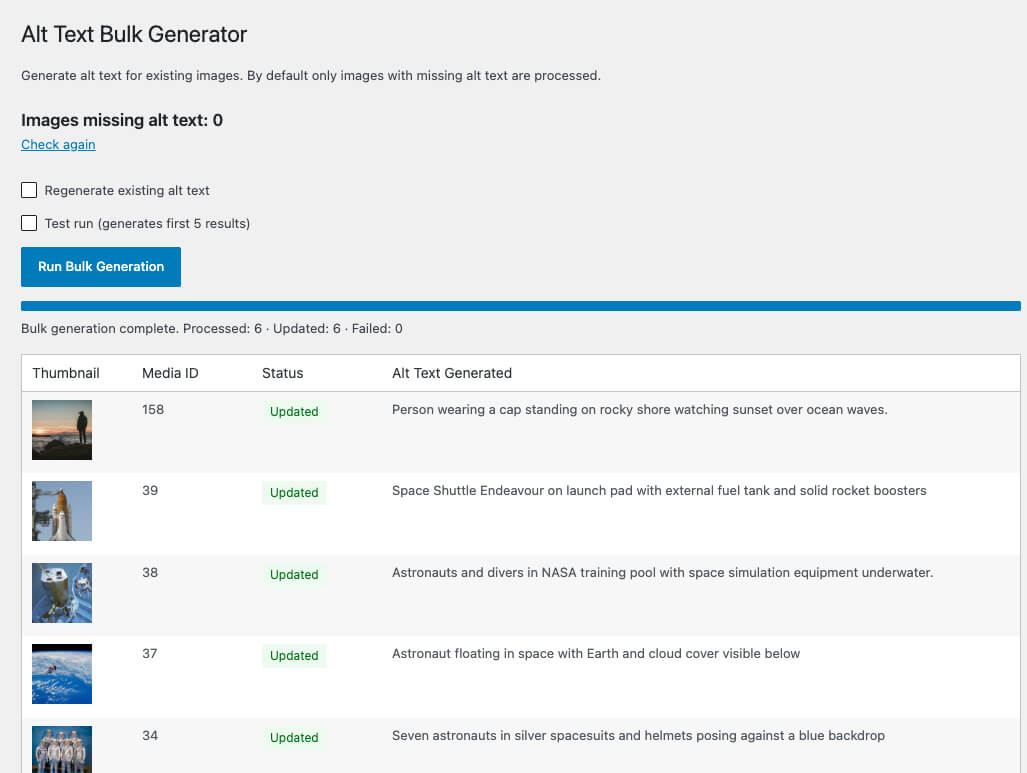
- Processes missing-alt backlogs in batches with a dedicated bulk queue
- Writes alt text in your site’s language
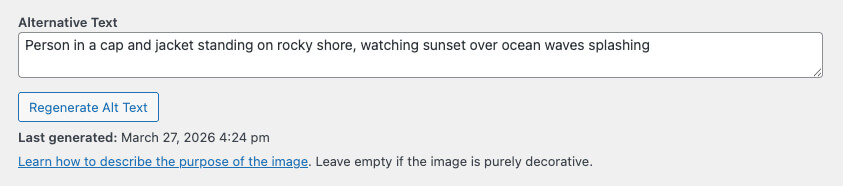
- Keeps the previous alt text when regenerating, so you can restore it with one click if you prefer it
- Handles provider rate limits and quota errors with automatic pauses
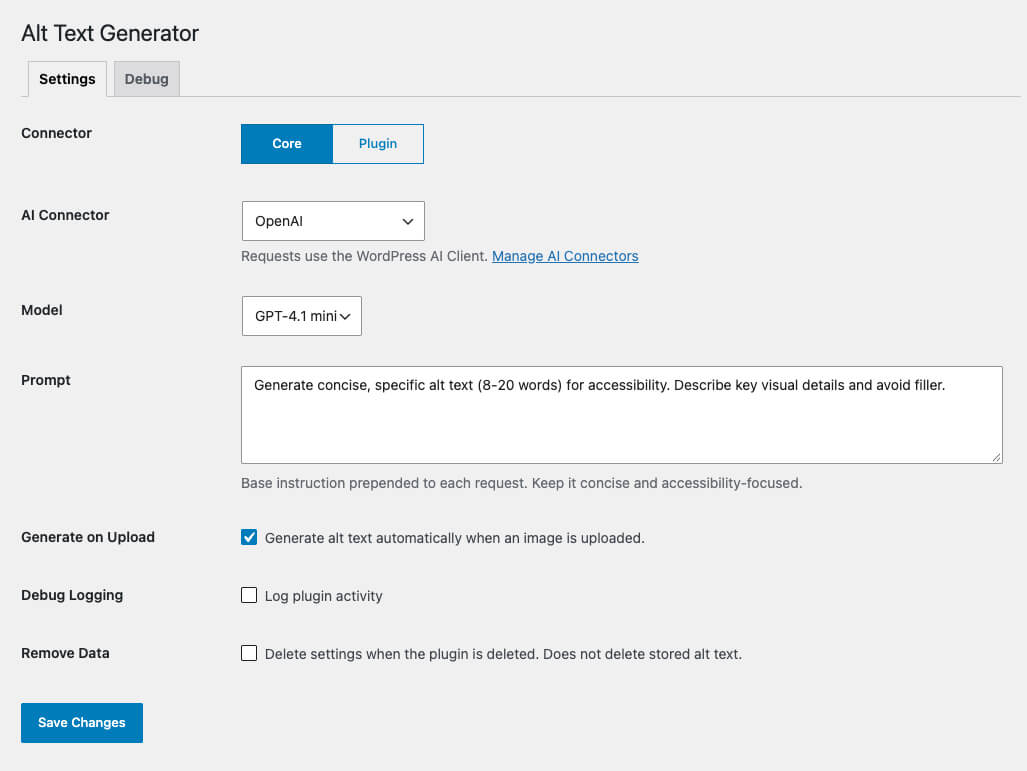
- Provides a customizable prompt seed for output consistency
Media Library Tools
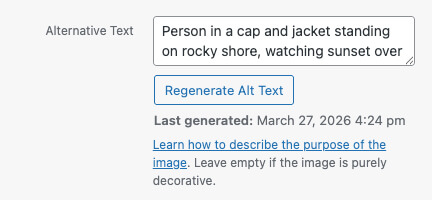
An Alt Text column shows each image’s alt text, and a “Generate Alt Text” or “Regenerate Alt Text” row action updates it in place. The same button appears in the media modal and on the attachment edit screen, along with “Restore previous alt text” after a regeneration.
Block Editor
Select an Image block to find an Alt Text Generator panel in its sidebar. It fills in the block’s alt text and updates the image in the Media Library.
Bulk Generator
The Bulk page counts images missing alt text, can regenerate existing alt text or do a test run on the first five images missing it, and runs batches while surfacing progress, failures, and rate-limit pauses.
Debug Tab
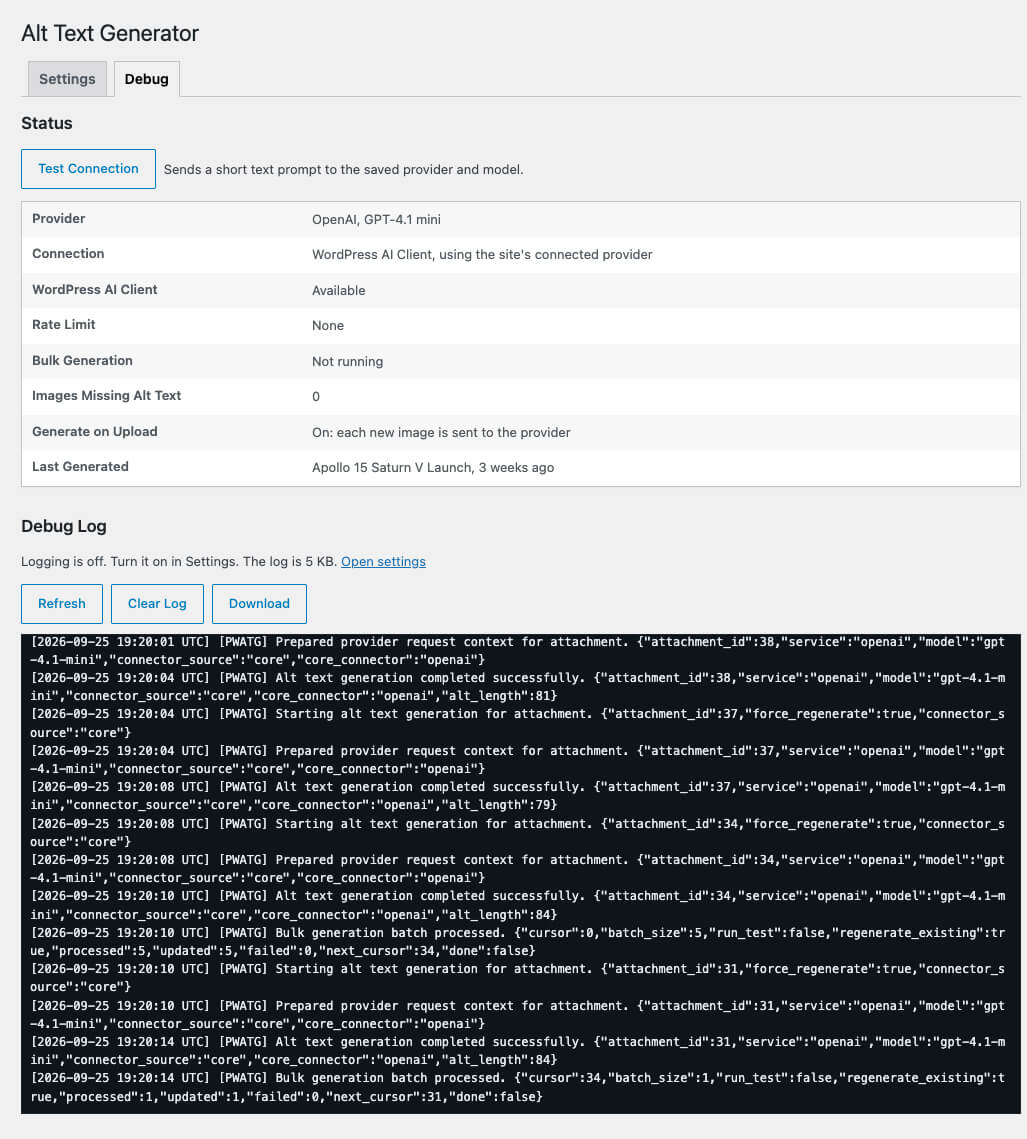
Settings -> Alt Text Generator -> Debug shows how requests are sent and what can stop them (API key, rate limits, bulk runs, images missing alt text), a Test Connection button, and the private debug log.
Connector Source
WordPress AI Connectors (Settings -> Connectors, WordPress 7.0+) are the recommended setup and the default for new installs. The Plugin connector source, which stores API keys in this plugin’s settings, is deprecated and will be removed in a future release; the settings screen shows a warning while it is selected. On WordPress versions without AI Connectors, the plugin keeps using its own keys.
Documentation
Filters
pwatg_available_services— Modify the available AI providerspwatg_available_models— Modify the available models for a provider (receives the models and the provider slug; the first model is the default; providers added withpwatg_provider_registryhave no models until you list them here)pwatg_provider_registry— Map provider slugs to custom service classes (each slug is listed in the settings, with its own API key field)pwatg_generate_on_upload— Return false to skip generating alt text for a new upload (receives the attachment ID)pwatg_debug_log_max_bytes— Size at which the debug log rotates (default 5 MB)pwatg_image_max_dimension— Long edge, in pixels, of the image copy sent to the provider (default 1024, minimum 256)pwatg_alt_text_language— Language the alt text is written in (defaults to the site language; return an empty string to leave it to the model)pwatg_include_filename_in_prompt— Return false to leave the image’s filename out of the prompt (receives the attachment ID)pwatg_use_wp_ai_client— Return false to call the provider directly instead of through the WordPress AI Client in Core mode (receives the provider ID)pwatg_core_connector_service_map— Map WordPress AI Connector IDs to this plugin’s provider slugspwatg_service_connector_candidates— Connector IDs checked for each provider’s API keypwatg_debug_log_filename— Filename of the private debug logpwatg_status_rows— Rows of the Debug tab’s status table (each an array with stringlabelandvalue, andstatusofok,warning, or an empty string; rows without a string label and value are dropped)pwatg_should_generate— Return false to skip an image on every path: uploads, the Media Library and Image block, bulk runs, WP-CLI, andpwatg_generate_alt_text()(receives the attachment ID and the context:upload,single,bulk,cli, orapi)pwatg_prompt— The full prompt sent to the provider (receives the attachment ID, the provider slug, and the context; an empty or non-string value keeps the original)pwatg_alt_text— Generated alt text before it’s saved (receives the attachment ID, the current alt text, and the context; returning an empty string fails the generation and saves nothing)
Actions
pwatg_alt_text_generated— After generated alt text is saved (receives the attachment ID, the new alt text, the alt text it replaced, and the context)pwatg_generation_failed— When generation fails, not when it’s skipped (receives the attachment ID, theWP_Error, and the context)
Functions
pwatg_generate_alt_text( $attachment_id, $args = [] )— Generate and save alt text for an image with the saved settings. Pass[ 'force' => true ]to replace existing alt text. Returns true when saved, false when skipped, or aWP_Error. It doesn’t check the current user’s capabilities.
WP-CLI
If WP-CLI is available, you can run single-image generation, bulk generation, and missing-alt counts from the command line:
wp pwatg generate <attachment-id>wp pwatg bulk-generatewp pwatg count-missingwp pwatg network-bulk-generate
Optional CLI flags:
wp pwatg generate <attachment-id> --forcewp pwatg bulk-generate --force— reports how many images would be overwritten; add--dry-run=falseto generatewp pwatg bulk-generate --dry-runwp pwatg bulk-generate --limit=<int>wp pwatg bulk-generate --missing-onlywp pwatg network-bulk-generate --force— a dry run unless--dry-run=falseis givenwp pwatg network-bulk-generate --limit=<int>wp pwatg network-bulk-generate --missing-onlywp pwatg network-bulk-generate --sites=<id,id,...>
Privacy
This plugin sends images to the AI provider you choose when generating alt text (OpenAI, Anthropic, or Google Gemini). Generation happens when you ask for it, and for new uploads when Generate on Upload is on. In the deprecated Plugin mode, API keys are stored in WordPress options on your site (or your network, when network-activated on Multisite) and used only for requests your server sends to that provider.
External Services
This plugin connects to an external AI service only when alt text is generated (on request, or for new uploads when Generate on Upload is on) or when you use Test Connection. Only the provider selected in the plugin settings is contacted. In Core mode on WordPress 7.0+, the request is sent through the WordPress AI Client using the connection set up in Settings -> Connectors. This plugin sends the following data:
- The API key, in the provider’s authentication header (in Core mode, the WordPress AI Client sends it)
- The selected model name
- The prompt: your prompt seed, the site language, and a short plain-text version of the image’s filename when it describes something (camera and screenshot names are left out; leave it out entirely with the
pwatg_include_filename_in_promptfilter) - For alt text generation: a copy of the image, resized to about 1024 pixels and converted to JPEG when the provider doesn’t accept its format or the file is over 5 MB, encoded as base64
- For Test Connection: a short text prompt (“Reply with: OK”)
OpenAI API
- Terms: https://openai.com/policies/terms-of-use
- Privacy: https://openai.com/policies/privacy-policy
Anthropic API
- Terms: https://www.anthropic.com/legal/commercial-terms
- Privacy: https://www.anthropic.com/privacy
Google Gemini API
- Terms: https://ai.google.dev/terms
- Privacy: https://policies.google.com/privacy
Installation
Install via the WordPress plugin installer, or manually upload the plugin directory to wp-content/plugins/.
Configuration
- Activate the plugin.
- Visit Settings -> Alt Text Generator. Choose Core to use a provider set up in Settings -> Connectors (WordPress 7.0+), or Plugin to enter an API key and choose a model.
- Use Test Connection on the Debug tab to confirm the provider responds.
- (Optional) Turn Generate on Upload on or off.
- Use the bulk tool under Media -> Alt Text Generator, or the Media Library and Image block actions.
FAQ
Which providers are supported?
OpenAI (GPT-4.1 and GPT-4o, including the mini models), Anthropic Claude (Haiku 4.5, Sonnet 5, Opus 5.5), and Google Gemini (2.5 Flash, Flash-Lite, and Pro). In Core mode on WordPress 7.0+, the OpenAI, Anthropic, and Google connectors in Settings -> Connectors can be used; other connectors are offered only once the pwatg_core_connector_service_map filter maps them to one of the plugin’s providers. The pwatg_available_models filter changes the model list, and the pwatg_provider_registry filter adds provider classes.
Where are API keys stored?
In Core mode (recommended), keys are managed by WordPress in Settings -> Connectors. In the deprecated Plugin mode, keys are stored in the site’s options (the network’s, when the plugin is network-activated on Multisite) and sent only to the selected provider, from your server. Saved keys are never printed in the settings page, and they are removed when the plugin is deleted. Plugin mode will be removed in a future release, so switch to WordPress AI Connectors when you can.
Can I regenerate specific images without affecting others?
Yes. Use the inline “Regenerate Alt Text” link in the Media Library or media modal to update a single attachment without affecting the rest of the queue, or run wp pwatg generate <attachment-id> --force.
Can I run generation from WP-CLI?
Yes. Use wp pwatg generate <attachment-id> for one image, wp pwatg bulk-generate for a batch run, and wp pwatg count-missing to check remaining backlog.
How does it work on Multisite?
It depends on how the plugin is activated.
- Network-activated (recommended for managing settings once): the AI provider, API keys, model, and prompt are set once for the whole network, in Network Admin -> Settings -> Alt Text Generator, so only Super Admins manage keys and costs. Each site can choose whether new uploads get alt text automatically (or follow the network’s choice), and has its own Bulk screen and Debug tab. Test Connection on a site’s Debug tab is available to Super Admins. Settings saved on the main site by earlier versions move to the network automatically.
- Activated on individual sites: each site has its own settings page, API keys, and Test Connection, just like a single-site install.
Can I run bulk generation network-wide on Multisite?
Yes. Use wp pwatg network-bulk-generate to process all sites in the network, or pass --sites=<id,id,...> to target specific site IDs.
What is removed when I delete the plugin?
Deleting the plugin (not deactivating it) always removes saved API keys, debug logs, rate-limit pauses, and bulk run state. With Remove Data on, it also removes the settings and generation history (when each image was last generated, and the alt text kept for Restore previous alt text). Alt text itself is never removed.
How does rate limiting work?
When a provider reports a rate limit, the plugin pauses requests to that provider for the time it asks for, between 1 and 30 minutes (5 minutes when it doesn’t say). An out-of-credit or quota error pauses it for an hour. Bulk runs stop and say why, and the image that hit the limit is retried when you continue.
Screenshots
Changelog
1.3.1
- Now requires WordPress 6.9 and PHP 8.2.
- Added public helpers and developer hooks.
- Fixed custom providers display.
- Fixed issue in admin scripts.
1.3.0
- Added Multisite network settings managed by Super Admins, with a per-site Generate on Upload choice.
- Added a status table and Test Connection to the Debug tab.
- Changed the default connection to WordPress AI Connectors. API keys stored by this plugin are deprecated and will be removed in a future release.
- Fixed Gemini rate limits pausing generation for an hour.
- Fixed image conversion, bulk generation, and various security and reliability issues.
1.2.0
- Fixed various performance and security issues.
- Added site language support and filter.
- Added debug functionality and improved logging.
1.1.0
- Added WordPress 7.0 Core AI Connector support with connector mode setting.
1.0.0
- First public release with provider integrations, Media Library tools, and bulk generator.