

Description
Stablevoy is a non-custodial crypto payment gateway for WooCommerce. It lets your store accept USDT (Tether) and USDC (USD Coin), the two biggest stablecoins, so every price stays in US dollars and there is no volatility to worry about. Customers pay from their own crypto wallet, and the money goes straight to your wallet, not to an exchange or a payment processor account.
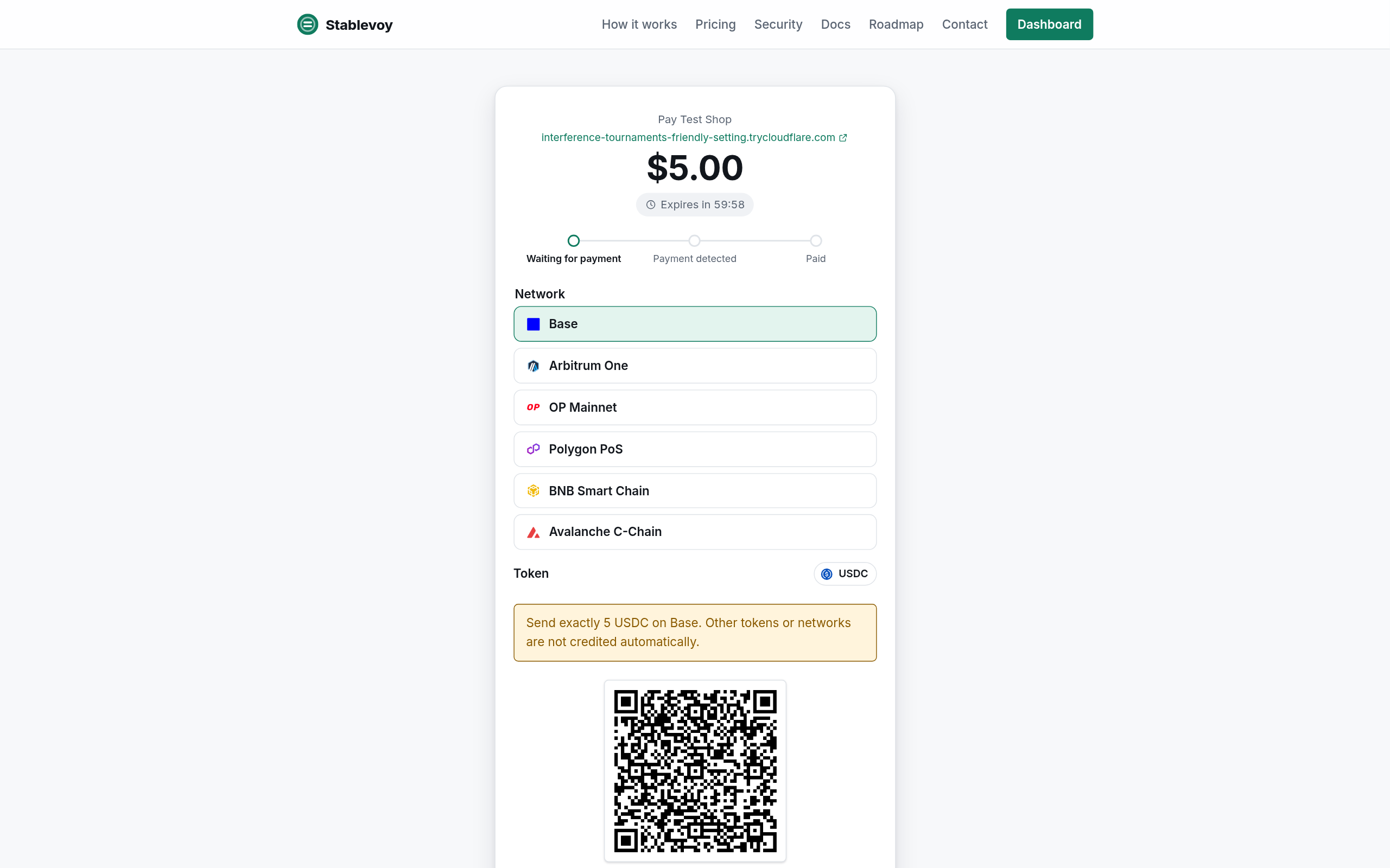
Accept USDT TRC20 on Tron with no fee, USDT BEP20 and USDC on BNB Chain (BSC), and USDT and USDC on Base, Arbitrum, Optimism, Avalanche and Polygon, where network fees are cents. Customers pay with MetaMask, Trust Wallet, TronLink, Rabby or any other wallet, or by scanning a QR code from an exchange app.
Features
- Connect in one click: sign in to Stablevoy with your wallet, choose or create a store, and come back with the API key and webhook secret saved and tested.
- Money goes straight to your own wallet. Stablevoy never holds it.
- USDT and USDC on Base, Arbitrum, Optimism, Avalanche, Polygon and BNB Chain, and USDT on Tron.
- Every order gets its own deposit address, checked in the customer’s browser before payment.
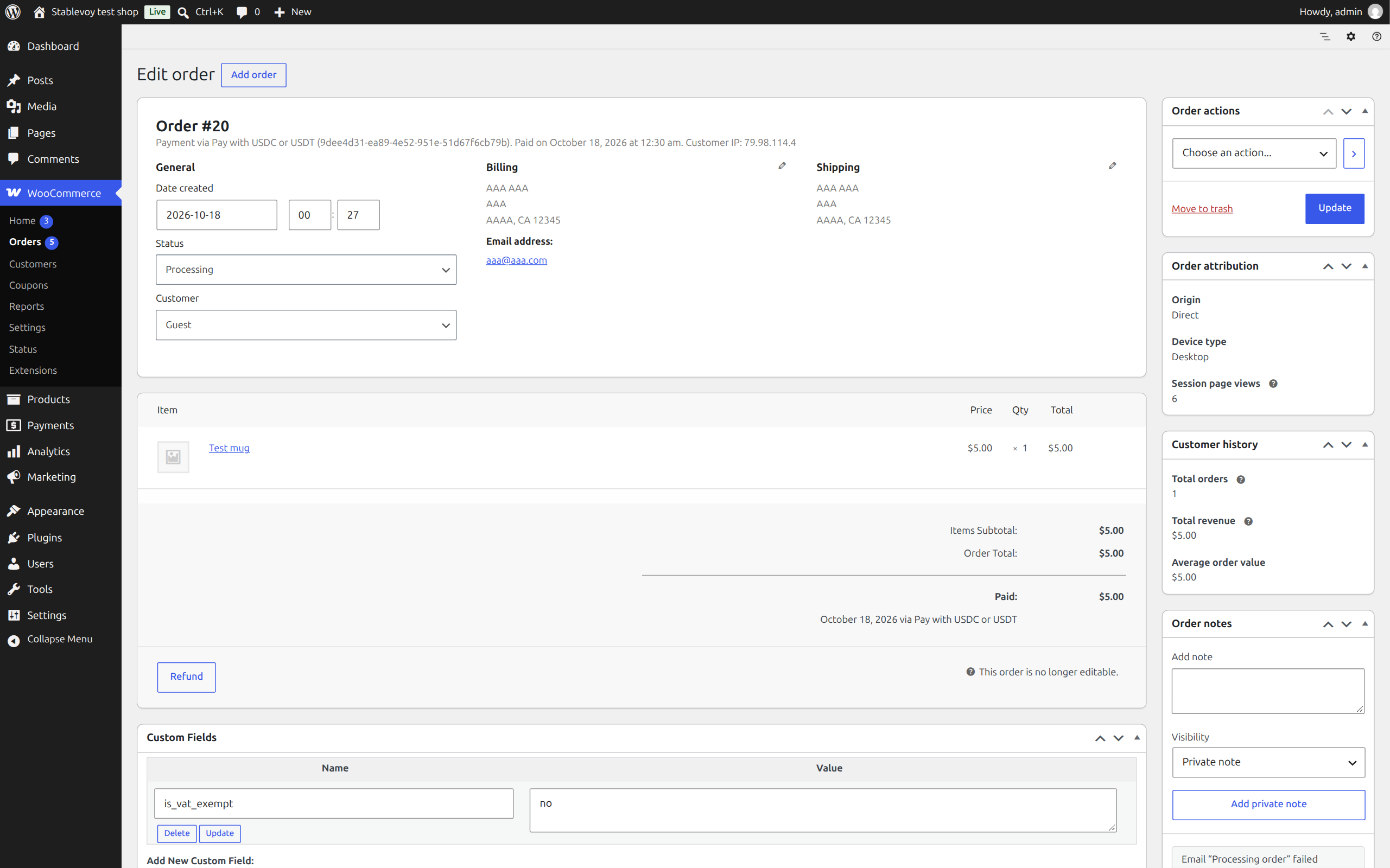
- Orders move to Processing on their own once the payment is confirmed on chain; status changes arrive as signed webhooks.
- Underpaid, overpaid and late payments are recognised and noted on the order.
- Sender addresses are screened against the OFAC sanctions list.
- Pay on the Stablevoy payment page, or in a window on your own order page (the payment widget).
- Cancelling an unpaid order cancels its invoice, so the customer is told not to pay it.
- Works with the block checkout and the classic checkout, and with High-Performance Order Storage.
Pricing
No monthly fee and no setup fee. The first $1,000 of payments is free, once per payout wallet. After that the fee is 0.5% per payment, taken on chain when the funds are forwarded to you, and the contract caps it at 2% forever. USDT on Tron has no fee from Stablevoy.
How it works
Each order gets its own deposit address, backed by an immutable contract that can only forward funds to your payout wallet (minus a fixed fee). Stablevoy never holds your money.
On Tron (USDT TRC20, also written TRC-20) there is no contract at all: the customer pays your own wallet directly, an exact amount identifies the order, and Stablevoy takes no fee. A payment that arrives with another amount, for example from an exchange that took its withdrawal fee out of it, is listed in your Stablevoy dashboard for you to match to the order.
On the payment page the customer can pay on Tron with TronLink in the browser or from a mobile wallet that supports Tron, such as Trust Wallet, over WalletConnect: the page prepares the transfer of the exact amount and the customer confirms it in the wallet.
External service
This plugin connects to the Stablevoy API (https://api.stablevoy.com, or the URL you configure) to create an invoice for each order and to read your invoice limits and which of the store’s networks have a payout address. It sends the order total, the order id and the order return URL. When you click Connect to Stablevoy, your browser opens https://stablevoy.com/app/connect/ with this shop’s address, settings page address and webhook address; after you confirm there, the plugin sends a one-time code back to the Stablevoy API to receive the shop’s API key and webhook secret. Disconnect asks the Stablevoy API to revoke that key. When an unpaid order is cancelled, the plugin asks the Stablevoy API to cancel its invoice. Stablevoy sends signed webhooks back to your site when a payment is confirmed or an invoice is cancelled. If you choose the payment widget (“How the customer pays”, “On this site (widget)”), the order pay page loads the script https://stablevoy.com/js/v1/stablevoy.js, which shows the payment page https://stablevoy.com/pay/embed/ in a window; the browser sends it the invoice id and the address of your shop, nothing else, and nothing is used for tracking. With the default setting the customer is sent to the Stablevoy payment page instead and no script is loaded on your site. Terms of service: https://stablevoy.com/terms/ Privacy policy: https://stablevoy.com/privacy/
Installation
- Install and activate the plugin. Your store currency must be USD.
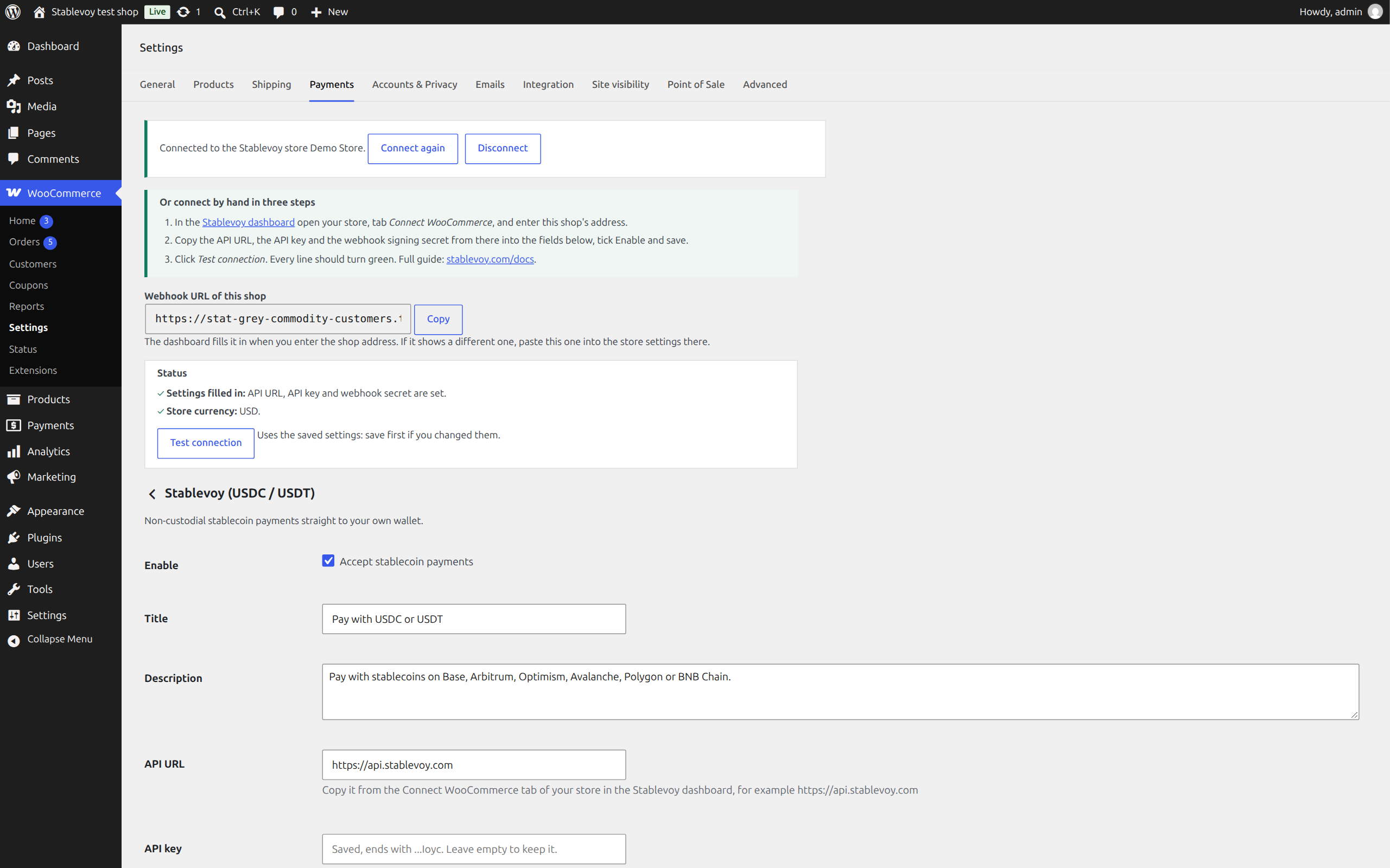
- In WooCommerce, Settings, Payments, Stablevoy click Connect to Stablevoy.
- Sign in to Stablevoy with your wallet, choose or create a store and confirm. You come back to the settings with everything saved and tested; click Turn on payments.
Manual setup still works: in the Stablevoy dashboard create a store and an API key, set the webhook URL shown on the gateway settings page, and paste the API URL, API key and webhook signing secret into the fields.
FAQ
How do I accept USDT and USDC payments in WooCommerce?
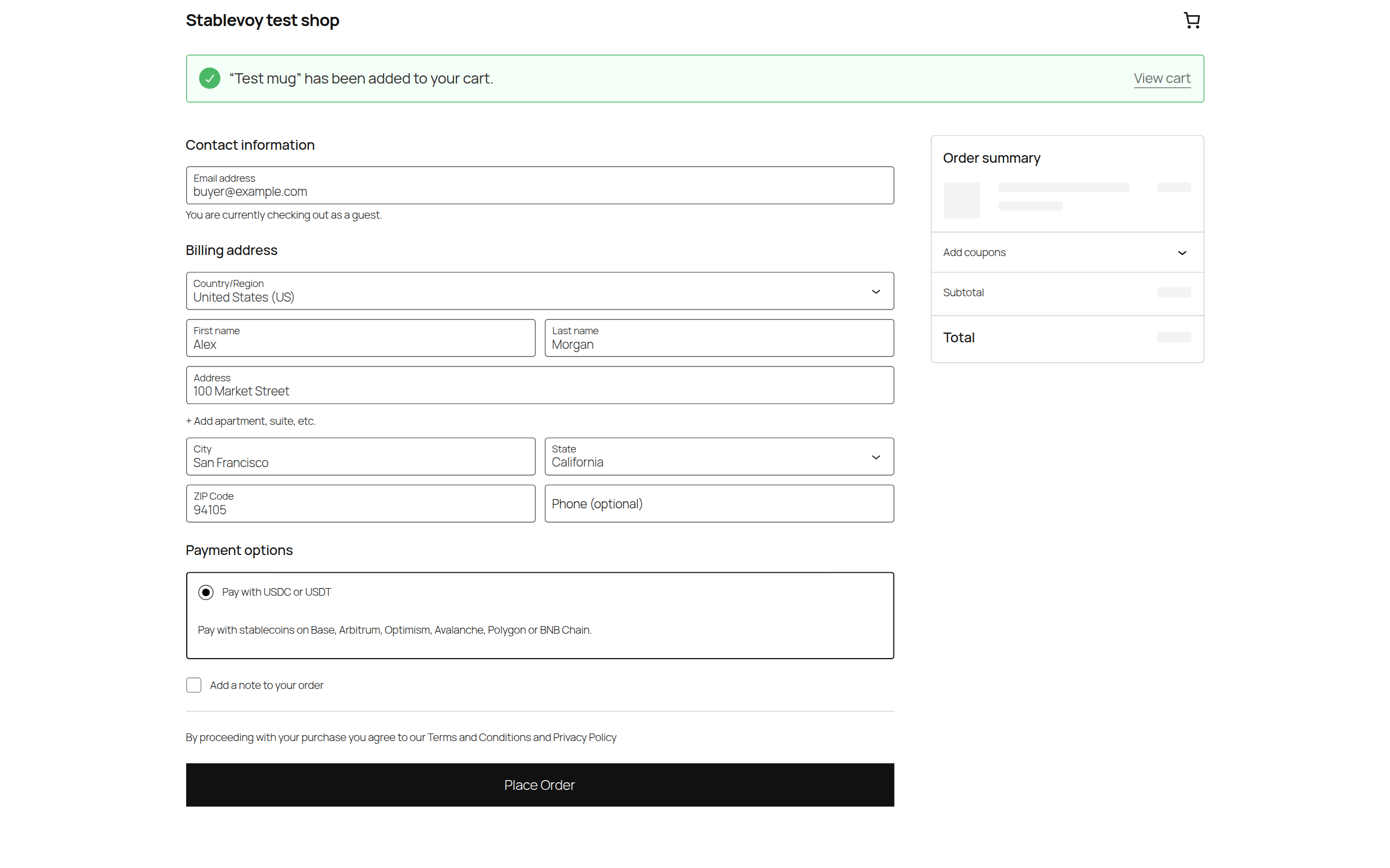
Install this plugin, click Connect to Stablevoy in WooCommerce, Settings, Payments, sign in with your wallet and confirm. Then turn payments on: customers see “Pay with USDT or USDC” at checkout and pay in crypto, and the order is marked paid on its own.
Does Stablevoy ever hold my money?
No. Every order gets its own deposit address, a small contract that can only send the funds to your payout wallet and the fee to Stablevoy. There is no owner key and no way to change where the funds go. On Tron the customer pays your own wallet directly.
What happens if Stablevoy goes offline?
Your money is not stuck. Forwarding from a deposit address is permissionless: anyone, including you, can call one function of the public factory contract on a block explorer and the funds move to your wallet. The Stablevoy docs have a step-by-step recovery guide.
Which wallets can customers pay with?
Any wallet that can send USDT or USDC on the chosen network: browser extensions such as MetaMask or Rabby, mobile wallets over WalletConnect, or a plain transfer by scanning the QR code or copying the address. On Tron, TronLink or a mobile wallet such as Trust Wallet.
What if the customer sends the wrong amount?
Partial payments add up until the invoice expires; if it is still short, the order goes on hold with a note. A top-up within seven days after expiry marks the order paid, with a note to check stock before shipping. Overpayments are forwarded to you like any payment, so you can refund the difference.
Is there a fee on Tron?
No. On Tron there are no contracts and nothing to forward: the customer pays your own wallet directly and Stablevoy takes no fee. The customer pays only their own wallet or exchange fee.
Does my store currency have to be USD?
Yes. Invoices are in US dollars, so the WooCommerce store currency must be USD.
Can customers pay without leaving my shop?
Yes. Set “How the customer pays” to “On this site (widget)”: after placing the order the customer pays in a window on your order page. Set the store website in the Stablevoy dashboard to your shop’s address first; Test connection checks it. A link to the full payment page is always there for a wallet that does not work inside the window.
How long does the customer have to pay?
As long as the payment window of your store in the Stablevoy dashboard (store Settings), 60 minutes unless you change it, from 15 minutes up to 7 days. Test connection shows the current value.
Can one Stablevoy store be connected to several sites?
No, a Stablevoy store serves one site. For another site, create another store; you can do it right on the Connect to Stablevoy screen.
Do I need to know crypto?
You need a wallet to receive the money, that is all. Sign in to Stablevoy with it, set the payout address, connect the plugin, and customers pay from their own wallets.
Screenshots
Changelog
1.10.0
- When GitHub finds this shop’s Stablevoy API key or webhook signing secret in public code, the plugin now accepts the Stablevoy notice about it, logs it and shows what to do in the admin until the key or secret is replaced. Before, it refused these notices, and their retries could count against the webhook endpoint.
- The admin shows when webhook deliveries to this shop are failing, with the time they will be paused, and when they are paused, so paid orders do not stay unconfirmed unnoticed.
- Stablevoy PHP SDK 1.10.0.
1.9.0
- A store can now pay out to its own address instead of the one of your Stablevoy account. Test connection says which address each network family of the store uses, and the payout messages point to both places where an address can be set.
- Stablevoy PHP SDK 1.9.0.
- Tested with WooCommerce 11.3.
1.8.0
- Accepts Stablevoy’s own key format: API keys starting with svk_live_ (svk_test_ on testnets) and webhook signing secrets starting with svwhsec_, each ending in a checksum. Keys and secrets starting with sk_live_, sk_test_ and whsec_ keep working.
- A pasted key or secret with a wrong or missing character is named as such in the settings check, instead of failing later at the API.
- Uses the Stablevoy PHP SDK 1.8.
1.7.0
- Payment widget: with “How the customer pays” set to “On this site (widget)”, the customer pays in a Stablevoy window on your order page instead of leaving the shop. The default stays the Stablevoy payment page. Test connection checks that the store website in Stablevoy is this shop, which the widget needs.
- Cancelling an unpaid order now cancels its Stablevoy invoice, so the payment page tells the customer not to pay. If the invoice is no longer waiting for payment, the order notes say so.
- An invoice cancelled in the Stablevoy dashboard cancels its pending order, with a note.
- Test connection shows how long customers have to pay (the payment window of the store, set in the Stablevoy dashboard).
- The pay button takes your theme’s button style, and closing the payment window tells the customer how to open it again.
- Test connection marks networks left out for lack of a payout address with a warning instead of a check mark.
- Messages that pointed to the API keys tab of the Stablevoy dashboard now point to the WooCommerce card on the Integrations tab, where keys and the webhook live now.
- Uses the Stablevoy PHP SDK 1.6.
1.6.0
- When your EVM payout address is a smart contract wallet or an EIP-7702 delegation that is not confirmed in the Stablevoy dashboard, or it changed since you confirmed it, the WooCommerce admin now says so and names the networks buyers are not offered until you review it. Test connection says it too, and the payment method is hidden when no other network is left.
- Stablevoy tells the shop at once when this status changes, so the notice appears and goes away without waiting for the ten-minute cache. Before, the shop answered that event with an error.
- Uses the Stablevoy PHP SDK 1.5.
1.5.1
- Connecting in one click and disconnecting now go through the Stablevoy PHP SDK, like every other call of the plugin.
- Declares the WooCommerce version it is tested with (11.2), so WooCommerce no longer lists the plugin as untested.
1.5.0
- The plugin checks that your Stablevoy account has a payout address for the networks of the store. Without one for any network the payment method is hidden and the admin notice says why, instead of failing when the buyer places the order. Networks without a payout address are named in a warning.
- “Test connection” shows a Payout address line.
- Talks to Stablevoy through the official Stablevoy PHP SDK, bundled under the plugin’s own namespace so it never clashes with other plugins.
1.4.1
- The setup hints point to the new Integrations tab of the Stablevoy dashboard.
- The connect link names the platform, so the Stablevoy dashboard can tell this shop apart from other plugins on the same site.
1.4.0
- Connect to Stablevoy in one click: sign in, choose or create a store and come back with the key and webhook secret saved and tested. No more copying values between tabs.
- Disconnect revokes the shop’s key on Stablevoy and clears it here.
- After connecting, a button turns payments on; the plugin never turns them on by itself.
1.3.1
- Clearer plugin name, tags and description in the plugin directory. No change in how the plugin works.
1.3.0
- USDT on Tron: the customer pays your own wallet directly, with no fee from Stablevoy. The order note says so.
- On Tron the customer can pay with TronLink or from a mobile wallet such as Trust Wallet over WalletConnect.
1.2.1
- Taking over a stale webhook lock is now atomic, so two deliveries can no longer both process the same order.
- Admin notices appear only on the Plugins screen and the WooCommerce settings screens.
1.2.0
- Paying again for an order after its invoice expired creates a new invoice instead of reopening the expired one.
- A late underpayment or hold notice no longer moves an already paid order back to on hold.
- Checkout stays fast when the Stablevoy API cannot be reached: the failed lookup is remembered for a minute and uses a short timeout.
- Buyers see a neutral message when a payment cannot be started; the details go to the order notes.
- Webhook deliveries for the same order are handled one at a time.
- The saved API key and webhook secret are never printed back into the settings page.
- Deleting the plugin removes its settings, including the API key and the webhook secret.
- All texts are translatable. The plugin folder and text domain are now stablevoy-for-woocommerce.
1.1.0
- Setup help on the settings screen, the shop’s webhook URL with a copy button, and a Test connection button that checks the key, the webhook URL and the invoice range.
1.0.0
- First release.