

Description
ONE REMINDER ISN’T A REPEAT-PURCHASE STRATEGY.
A customer buys today. You send one reminder months later—but what if they still don’t reorder? A single follow-up can be missed. Tom Volz Repeat Purchase Reminders for WooCommerce lets you go further: Free gives you unlimited reminder campaigns, while Pro lets you build recurring follow-ups instead of stopping after one email.
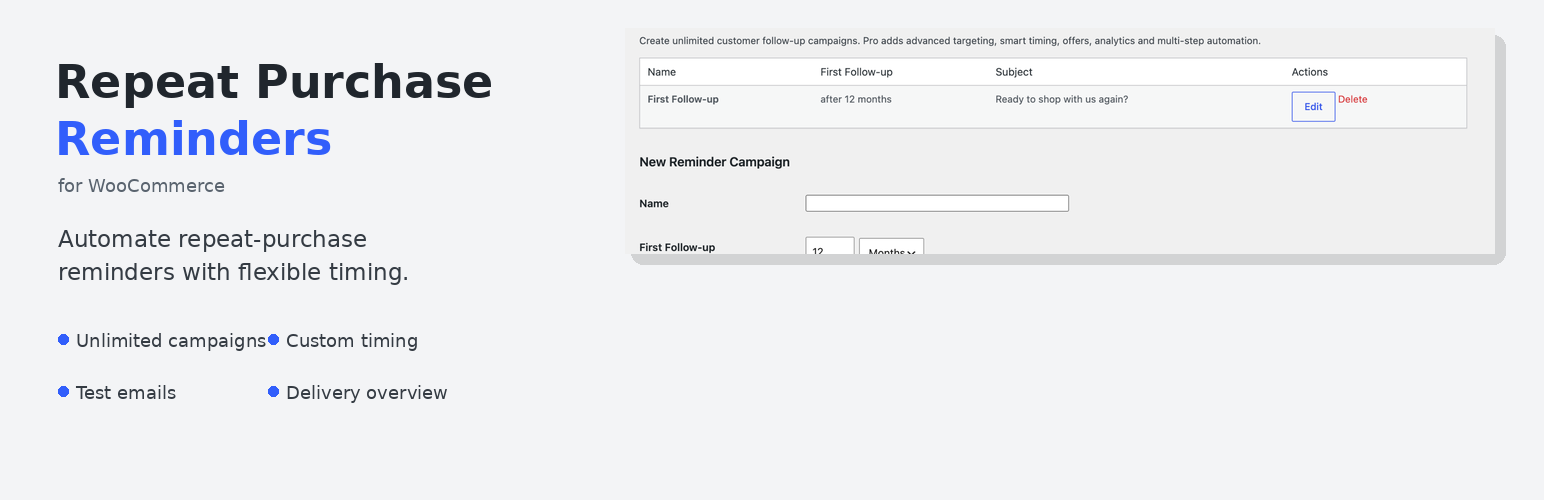
FREE: Start bringing customers back. Create unlimited campaigns, choose a delay in days or months after a completed order, customize your email, and let WordPress schedule the reminder automatically.
PRO: Keep the follow-up going—and learn what works. Schedule recurring reminders at defined intervals, build multi-step campaigns, test email variations with A/B testing, and measure clicks, conversions, and attributed revenue. Product targeting and customer segmentation help make follow-ups more relevant.
The difference: don’t rely on one chance to win the next order. Build a repeat-purchase process you can test and improve.
- Start without a campaign cap: Free includes unlimited reminder campaigns, so you can build reminders around your products and reorder cycles.
- Control the timing and message: Choose when a reminder should go out and customize its subject and content.
- Check before customers see it: Send a test email before activating your campaign.
- Know what happened: Review scheduled, sent, and failed reminders in WordPress.
- Scale beyond a single follow-up: Pro adds recurring reminders and multi-step campaigns.
- Improve instead of guessing: Pro adds A/B testing, click/conversion tracking, and revenue attribution.
If your main goal is to bring existing WooCommerce customers back—not to run every kind of newsletter, popup, or abandoned-cart campaign—this focused workflow keeps the job clear and manageable.
Start free — no campaign limit
The free version includes the core reminder workflow:
- Unlimited customer reminder campaigns.
- Custom delay in days or months after a completed order.
- Custom email subject and content.
- Automatic reminder scheduling after completed orders.
- Test emails before sending to customers.
- Synchronization of existing completed orders.
- Overview of scheduled, sent, and failed reminder emails.
- Customer unsubscribe link.
- Customizable email placeholders, including {first_name}, {order_number}, {order_date}, {site_name}, and {unsubscribe_url}.
You can start with straightforward reminders and keep using the free version for as many campaigns as your store needs.
Pro: go beyond the first reminder
Move from one reminder to a repeat-purchase process you can refine. Pro is for stores that want more follow-up opportunities and clearer evidence of what works.
- Recurring reminders: Schedule additional reminders at defined intervals instead of stopping after one email.
- A/B testing: Compare email variations to learn which subject lines or messages perform better.
- Product targeting: Focus reminders on relevant products customers have purchased.
- Customer segmentation: Adapt follow-ups for different customer groups.
- Smart timing: Use advanced timing options to make follow-ups more relevant.
- Multi-step campaigns: Build a sequence of follow-ups rather than relying on a single message.
- Cross-selling: Introduce relevant additional products in follow-up emails.
- Coupons and offers: Add incentives to selected campaigns.
- Click and conversion tracking: Measure how customers respond to your reminders.
- Revenue attribution: Track revenue attributed to reminder campaigns.
Free removes the campaign-count barrier. Pro adds the repeat sequence, audience controls, testing, and measurement to develop that workflow further.
Explore Repeat Purchase Reminders Pro
Features
- Unlimited reminder campaigns in Free.
- Custom reminder delay in days or months.
- Custom email subject and content.
- Automatic scheduling after completed WooCommerce orders.
- Test email function.
- Synchronization of existing completed orders.
- Overview of scheduled, sent, and failed emails.
- Customer unsubscribe link.
- Customizable email placeholders.
- Email delivery through WordPress wp_mail() and scheduling through WordPress Cron.
How it works
- Create a reminder campaign.
- Choose how long after a completed order the reminder should be sent.
- Customize the email subject and message.
- Send a test email to check the content.
- Save the campaign. WordPress schedules the reminder automatically.
- Review scheduled, sent, and failed emails in the delivery overview.
Privacy
The plugin stores reminder-related information in the WordPress database, including order ID, customer ID, email address, scheduled time, and delivery status. Email delivery uses WordPress wp_mail() and your site’s mail configuration.
Installation
- Install and activate WooCommerce.
- Go to Plugins > Add New Plugin and upload the plugin ZIP, or install the plugin through the WordPress Plugins screen.
- Activate Tom Volz Repeat Purchase Reminders for WooCommerce.
- Open Repeat Purchase Reminders in the WordPress admin.
- Create a campaign, customize the email, and save it.
FAQ
Does it require WooCommerce?
Yes. WooCommerce must be installed and active.
Are there limits on the number of free campaigns?
No. The free version supports unlimited reminder campaigns.
When are reminders scheduled?
Reminders are scheduled automatically when an order reaches the completed status. Existing completed orders can be synchronized manually.
Can I test an email before sending it to customers?
Yes. Use the test email function to check your message before relying on a live campaign.
Can I send recurring reminders?
Recurring reminders are a Pro feature. They allow follow-ups to continue at defined intervals instead of ending after one reminder.
Does Pro include A/B testing?
Yes. Pro includes A/B testing to compare email variations and identify which messages perform better.
How are emails sent?
Emails are sent through WordPress wp_mail(). Actual delivery depends on your site’s mail configuration. A correctly configured SMTP or transactional email service can improve deliverability.
Does the plugin send customer data to an external service?
The plugin stores reminder-related data in the WordPress database and uses WordPress mail delivery. Your site’s mail configuration determines how emails are delivered.
Screenshots


Changelog
1.3.1
- Current WordPress.org release.
1.3.0
- Renamed the plugin to Tom Volz Repeat Purchase Reminders for WooCommerce.
- Updated the plugin slug and text domain for the new directory name.
- Removed the built-in campaign limit so the free plugin remains fully functional.
- Replaced the plugin prefix with a distinct RPRWC prefix.
- Refined the Free and Pro positioning around advanced retention features.
1.2.6
- Refined Free edition messaging around customer retention and repeat purchases.
- Clarified the Free vs. Pro positioning in the admin and documentation.
- Updated onboarding copy without changing Free edition functionality.
1.2.5
- Improved Plugin Check compatibility for admin request handling and custom database queries.
- Shortened the plugin directory short description.
- Kept deleted source orders from being treated as send failures.
1.2.3
- Improved WordPress.org Plugin Check compatibility.
- Aligned the plugin slug and text domain with WordPress.org requirements.
- Added Donate link and Tested up to metadata.
- Cancelled scheduled reminders when the source WooCommerce order no longer exists.
1.2.0
- Refreshed the Free edition to align with the current Pro feature set.
- Added clearer Free vs. Pro upgrade messaging in the admin.
- Standardized remaining backend messages to English.
- Updated version metadata and documentation.
1.1.1
- Set English as the default backend language.
- Updated the translation text domain.
- Updated default email text to English.