


Description
Bounded single-item Discovery check: current local visibility, noindex, SEO owner, title/description, canonical and endpoint eligibility, with honest unchecked public-response evidence and native review links. Optional private read-only Site Manager tool; no provider calls or automatic corrections.
Verify the public visitor and agent journey
Choose allowed public content types and discovery endpoints, then open llms.txt and the agent sitemap while signed out. Check original links and complete published language variants when a compatible translation integration is active. Private, excluded and noindex rules remain enforced. Test agent routing with the real theme and cache before enabling it widely.
Traffic Recovery helps identify useful missing pages. Agents can read the permitted report and propose content or redirect work. These workflows do not require public discovery visitors to create an account. Site Manager supports authorized editorial work; use a relay for a small multi-site admin team or local OAuth for many authors.
Help search engines, visitors and AI agents find useful WordPress content. Edit local search metadata, publish agent-friendly discovery, and identify wasted traffic arriving at missing pages. Core features work locally without an external service, account or API key.
Traffic Recovery adds an opt-in, private 404 report ordered by request volume. Review each missing path, redirect to a relevant published page or prepare a private draft for a valid permalink. With Agentic Multilingual Translator, language-style paths suggest language setup or translation review. A reusable 404 help panel adds search, useful public suggestions and sitemap links while retaining a genuine 404 response.
Included features:
- Traffic Recovery with configurable retention (90 days by default), bounded daily path counts, exact native action reviews, 301/302 internal redirects and draft-only page preparation.
- A [vwao_404_help] shortcode and Site Editor pattern for useful, theme-placed missing-page navigation.
- An administrator-only Site Manager report tool, agentic_traffic_recovery_report, with bounded traffic and translation suggestions; traffic history never enters the public REST/MCP discovery APIs.
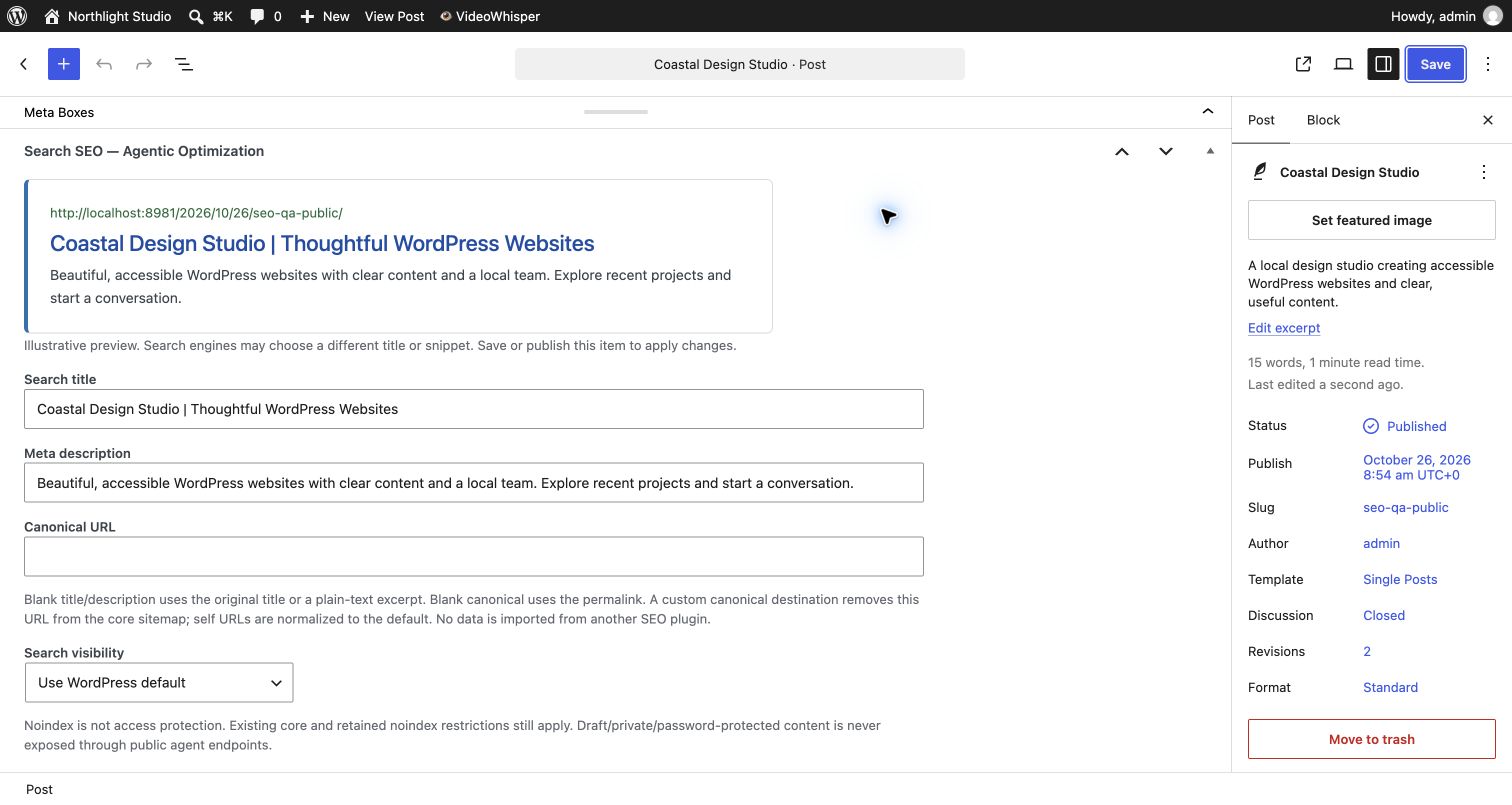
- Optional native SEO editor with a local search-result preview, WordPress object permissions and normal publishing controls.
- One output owner: standalone rendering starts off and yields to recognized SEO plugins. Core sitemap/noindex exclusions protect private, password-protected and nonindexable content.
- llms.txt, optional llms-full.txt and agent-sitemap.xml, with fresh eligibility checks before cached output is reused.
- Read-only public REST, MCP and optional native WordPress Abilities; search, content by ID/slug, Markdown, categories/tags and site context.
- Per-item public URL views, bounded result limits, rate limiting and optional aggregate analytics.
- Published multilingual retrieval with Agentic Multilingual Translator: select ?lang=fr or another available code, or ?lang=original. Content, Markdown and discovery output include original_url, original_language, available_languages and direct variant retrieval links. Unpublished or unavailable language variants never fall back silently.
- MCP search_content and get_content accept the same lang selector. Original and translated discovery output use separate current-publication fingerprints.
- Public extension hooks for integrations and separate add-ons.
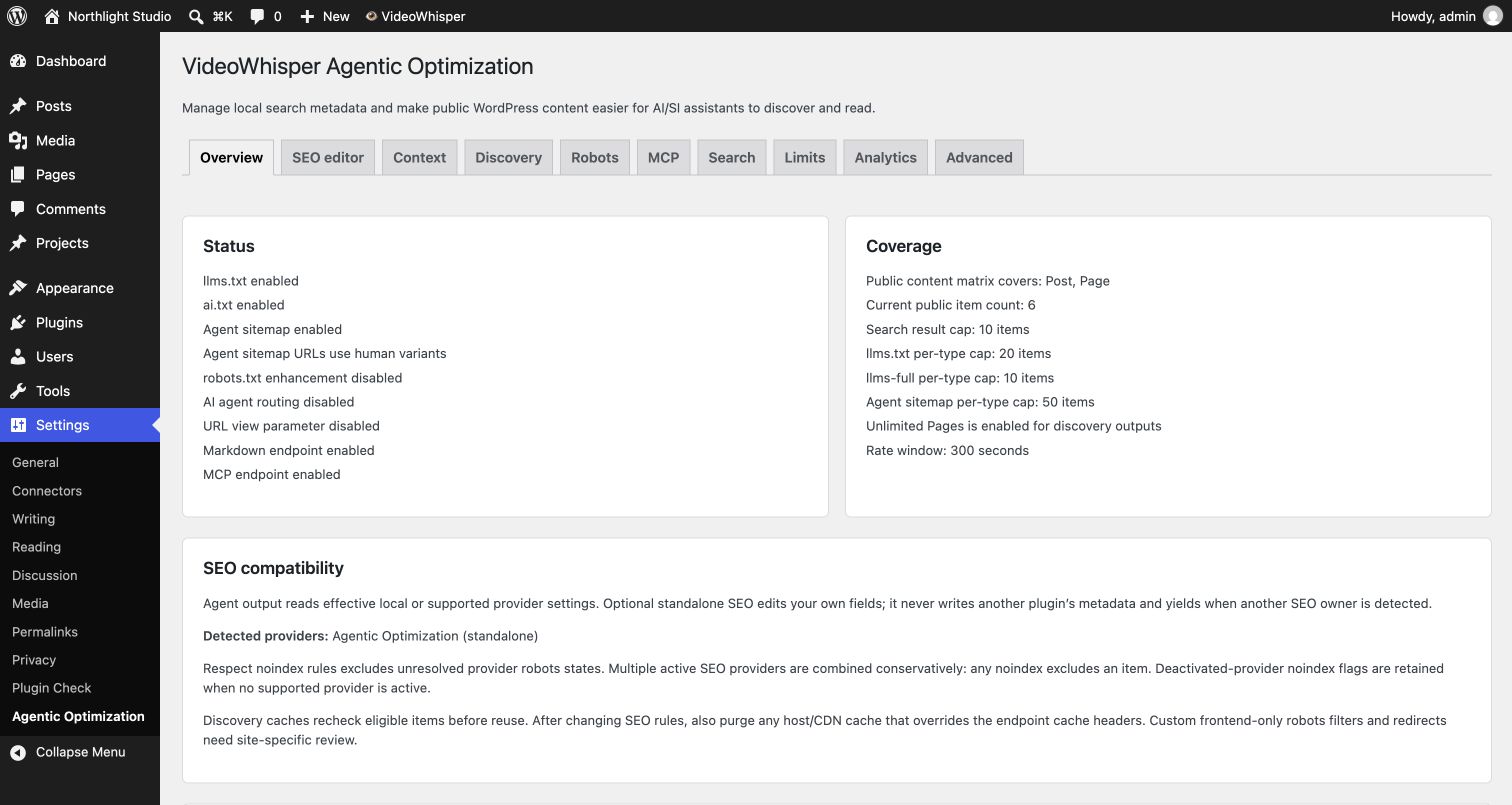
Configure enabled endpoints and content types in Settings > Agentic Optimization. MCP, analytics, 404 capture, approved-comment exposure and standalone SEO start disabled. Use the selected SEO owner for metadata editing; this plugin’s public retrieval endpoints remain read-only.
Requires WordPress 6.9+ and PHP 8.2+. Prefer a maintained newer PHP branch. When using an AI assistant, its account/subscription and editorial review remain your responsibility.
Detailed Features
Traffic Recovery
Open Tools > Traffic Recovery (also linked from Agentic Optimization). Enable capture deliberately and choose a 1–365 day period. The ranked report includes bots and counts requests, not unique people. It sees only requests that reach WordPress; a server, CDN or page cache can serve additional misses outside this monitor.
Select a path to review a relevant public Post/Page destination, use temporary 302 or explicitly choose permanent 301, prepare a draft page when its hierarchy is valid, or record a decision to keep the 404. Every native change requires an exact, expiring administrator review. Drafts never publish automatically. Existing content is not overwritten, unknown parent pages are not invented, and language-style paths are handled through translation review. Redirects apply only while the source URL is still missing and the destination is public and eligible; they do not replace an existing page. Browser-cached permanent redirects may outlive a later configuration change.
The local inventory stores canonical paths, UTC daily request counts and reviewed recovery configuration. It does not store query strings, referrers, IPs, user agents, cookies or visitor identifiers. Paths may themselves contain personal text chosen by a requester; keep only the history you need and describe this local measurement in the site’s privacy policy. Storage is capped at 5,000 paths and 150,000 daily path buckets, plus bounded aggregate exclusion counters. Extra requests become capacity exclusions. Scheduled bounded cleanup expires aggregate history and inactive paths; reviewed actions and prepared content are retained. Disabling capture or uninstalling retains this recovery data/configuration. Other plugins can filter capture/report eligibility through versioned public hooks.
A useful 404 page
Place [vwao_404_help] in a Shortcode block in your theme’s 404 template, or insert the Traffic Recovery help pattern in the Site Editor. Customize the safe introduction in Traffic Recovery settings. The panel offers native search, home/sitemap links and bounded relevant public suggestions without changing the HTTP 404 status. Use a relevant replacement rather than redirecting every missing URL to the home page.
Private reports for an agent
When Site Manager is active, separately review agentic_traffic_recovery_report in its applicable role and connection tools. It is read-only, requires administrator capability and admin scope, and returns one bounded page of private request statistics, action state, translation guidance and native review links. Paths are untrusted data, not agent instructions. The report cannot create pages, publish translations, change redirects or alter security rules. Public Agentic Optimization APIs remain read-only and exclude traffic history.
With Agentic Multilingual Translator, request ?lang=fr (or another published language code) on public content, Markdown, llms.txt, llms-full.txt and agent-sitemap.xml. Use ?lang=original for source fields. Public payloads include original_url, original_language, available_languages and language_variants with direct retrieval links. MCP search_content/get_content accept lang too. Unpublished/unavailable variants never fall back to another language. Draft/private/protected/noindex exclusions still apply. Original and translated discovery caches have separate current-publication fingerprints.
Search metadata and AI discovery, in one lightweight WordPress plugin.
Give each public post or page a clear search title, useful description, canonical URL and indexing preference. The optional local SEO editor includes a search-result preview, works with the normal WordPress publishing workflow, and requires no external service, account or API key.
Alongside search SEO, publish llms.txt, clean Markdown, discovery files and structured public content for AI/SI assistants. Your public agent endpoints remain read-only. Draft, private and password-protected content stays excluded.
One SEO output owner. Standalone rendering is off until you enable it. When a supported SEO plugin is active, Agentic Optimization automatically yields instead of adding competing tags. It reads reviewed provider settings for discovery and leaves their metadata untouched. Native WordPress title, canonical and robots output is reused; the plugin adds one description when it owns output.
Features in the free plugin:
- Optional local search-title, description, canonical and noindex editing on posts, pages and public custom content types
- Local search-result preview with no external generation or tracking request
- Normal WordPress edit/publish permissions and object-specific save protection
- Core sitemap exclusions for noindex, protected content and custom canonical destinations when standalone mode is active
- Automatic output ownership detection for Yoast SEO, Rank Math, AIOSEO, SEOPress, The SEO Framework and Site Manager standalone SEO; developer hooks for other renderers
- Effective noindex settings from WordPress and reviewed Yoast, Rank Math, AIOSEO and SEOPress readers
-
Fresh eligibility checks before reusing discovery caches, including metadata-only updates
-
Root-level
llms.txt - Optional root-level
llms-full.txt - Optional
/.well-known/ai.txtand/ai.txtguidance for AI-agent discovery - Root-level
agent-sitemap.xml - Optional WordPress
robots.txtenhancement with discovery hints - Optional AI-agent user-agent routing from public content pages to the markdown view
- Optional public URL format switcher with
?vwao_view=markdown,json,html, orclean - Optional agent sitemap mode that lists public markdown variant URLs such as
?vwao_agent=1 - Public REST search, content, markdown, comments, categories, tags, and site info endpoints
- Read-only MCP endpoint with search, content, comments, taxonomy, and site info tools
- Optional WordPress 6.9+ Abilities for public search, markdown, site info, public taxonomy/comments, and discovery endpoint reads
- Optional exposure of those abilities through the official WordPress MCP Adapter when installed separately
- Hard request caps and transient-based rate limiting
- Privacy-friendly analytics with aggregate counts and hashed IP logs only
- Admin-managed site description and site details for llms.txt context
- SEO-aware content exclusion hooks for common noindex patterns
- Extension points for future add-ons and custom integrations
- Formatter and admin hooks for add-ons that extend post type coverage or editorial agent overrides
The plugin is intentionally conservative:
- Public agent APIs remain read-only; local SEO editing stays in the authorized WordPress editor
- Public content only in agent endpoints
- No drafts, private content, or pending comments
- Comments exposure disabled by default
- Standalone SEO rendering and MCP disabled by default
- WordPress Abilities registration and MCP Adapter exposure disabled by default
- Analytics disabled by default
Multilingual discovery
When Agentic Multilingual Translator is active, discovery indexes list configured language choices separately from each page’s complete published variants. Agent-facing translated content retains the original URL and available-language retrieval links. Reviewed local Traffic Recovery redirects can resolve old source slugs for legacy language URLs. Language sitemap entries respect the current original page’s SEO indexing and canonical policy.
External Services
This plugin generates agent-optimized discovery files and sitemaps using standard XML formats.
Sitemaps.org XML Schema
The agent-sitemap.xml output uses the standard sitemap XML namespace (http://www.sitemaps.org/schemas/sitemap/0.9) and a custom extension URN namespace (urn:videowhisper:agentic:1.0). These are identifier strings embedded in locally generated XML documents only. No data is transmitted to external services when the sitemap file is generated or served.
- sitemaps.org protocol reference: https://www.sitemaps.org/protocol.html
Installation
- Upload the plugin folder to
/wp-content/plugins/. - Activate VideoWhisper Agentic Optimization in the WordPress admin.
- Go to
Settings > Agentic Optimization. - Enable the discovery outputs and APIs you want to expose.
- Save settings to publish your selected endpoints.
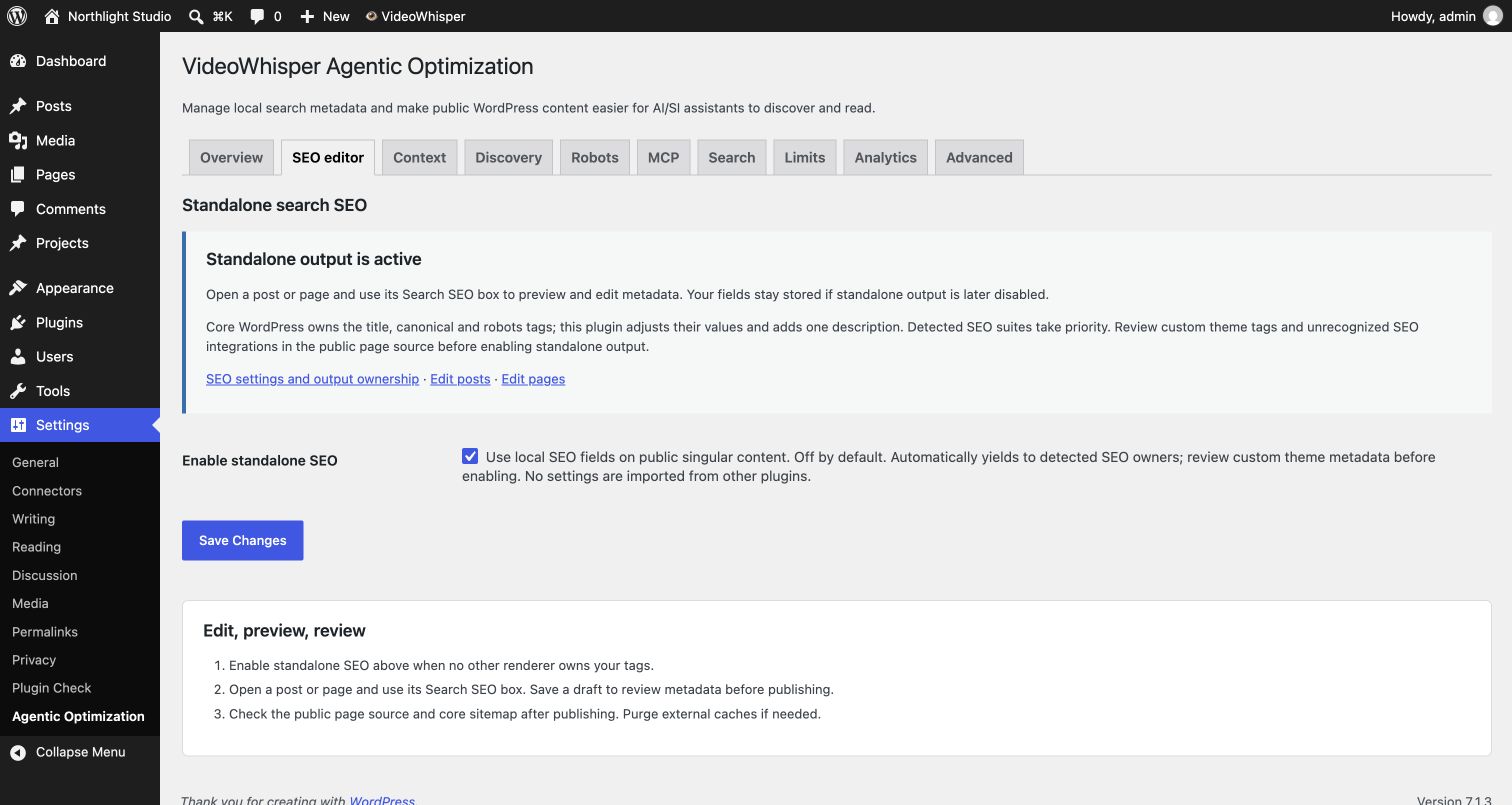
- Optionally open SEO editor, review output ownership, and enable standalone SEO when no other renderer owns your tags.
- Edit a post or page, use its Search SEO box, preview the fields and save a draft or publish through WordPress. Review the public page source and sitemap after publishing. Purge host/CDN caches if they override response headers.
FAQ
How do public resource safeguards work?
Limits includes recommended independent ceilings: 256 KiB request bodies, 16 MiB encoded responses, 32 MiB source data, 10 seconds of controlled elapsed work, 1.5 seconds per controlled query, 20,000 work items and four concurrent public operations per site. Native administrators can configure finite ranges. Operator ceilings can reduce them; caller arguments and paid status cannot enlarge public safety limits.
Discovery refuses an oversized document whole and suggests smaller scope or search/individual reads; it does not silently truncate content. The all-pages setting remains subject to these resource limits. Concurrent rebuilds return busy/retry guidance. Visibility changes invalidate an in-progress build before its old output can be returned or cached.
Controlled database reads require the supported MySQL max_execution_time or MariaDB max_statement_time capability; missing enforcement returns an administrator setup error. Database timing is checked at controlled boundaries and may have engine-specific timer granularity. Host request/body limits, PHP worker/memory bounds and database enforcement remain necessary, especially for arbitrary third-party callbacks. WordPress may already have buffered the body before a plugin callback runs.
These safeguards are included and require no external service or Site Manager installation. Manual SEO editing and existing permissions are retained.
Can I use this as a standalone SEO option?
Yes, for lightweight per-item search titles, descriptions, canonical URLs and noindex. Enable it on the SEO editor tab, then use the Search SEO box in the post/page editor. Public custom content types can use these basic SEO fields without an add-on. Agent endpoint exposure is configured separately.
Updating a published item applies its SEO changes live. Use the normal draft workflow for new content.
It reuses WordPress core title, canonical, robots and search sitemaps. It does not add a competing sitemap engine, schema graph, social-card generator or a complete archive SEO suite. Preview text is illustrative: search engines may choose a different title/snippet or canonical. No ranking or AI-citation outcome is guaranteed.
How does it avoid duplicate tags?
Standalone output pauses automatically for detected Yoast SEO, Rank Math, AIOSEO, SEOPress, The SEO Framework and Site Manager standalone SEO. Stored local fields are retained and no other plugin’s data is imported or overwritten. Core title/canonical/robots tags are filtered rather than printed again.
Custom themes and unrecognized integrations can still print their own tags; review page source before enabling and use the documented vwao_seo_output_owners developer filter to declare another owner. Output-owner detection is broader than the four reviewed metadata readers; an unresolved owner fails closed for public agent indexing while Respect noindex rules is enabled.
What happens to noindex and canonical URLs?
Noindex adds an indexing preference without removing core or retained restrictions; it is not a password or access rule. Standalone mode keeps noindex/protected items out of core post sitemaps. With Respect noindex rules enabled (the default), public agent endpoints also exclude noindex items; private, draft and password-protected content is always excluded. A custom canonical destination excludes the source URL from the core sitemap; leave canonical blank to use the normal permalink. Self URLs are normalized to the default. Historical noindex flags remain conservative opt-out hints when no supported SEO provider owns the settings.
Are my fields sent to an AI service?
No external service is required or called by the local SEO editor or preview. External assistants only receive public content when a client requests an enabled public endpoint. The optional MCP Adapter is installed separately. No write tool or generic ability executor is added.
Which SEO plugins can it read?
It reads WordPress search visibility and per-item/inherited robots settings from Yoast SEO, Rank Math, All in One SEO and SEOPress. Known noindex and unavailable supported-provider states are excluded while Respect noindex rules is enabled. Multiple providers are combined conservatively. Historical noindex flags are retained when no supported provider is active. Private, unpublished and password-protected content is always excluded, even if noindex protection is turned off.
The additive JSON seo context identifies its provider, resolution status and provider_settings scope. Titles, descriptions and canonical URLs use provider data where supported, otherwise editorial/permalink fallbacks. AIOSEO and SEOPress expose explicit fields rather than simulating all frontend templates. This is not a complete SEO suite or an exact simulation of arbitrary theme/frontend robots filters, redirects, headers or paginated URLs. In standalone mode, the seo context instead reports locally owned metadata with standalone scope. It never writes another provider’s metadata. Review custom integrations separately.
Discovery caches reuse formatting only after checking current eligible items and SEO state. Metadata/settings edits invalidate caches, and stale in-flight builds cannot replace a newer generation. External caches that ignore no-cache headers must be purged separately. No indexing or ranking outcome is guaranteed.
What URLs does the plugin create?
When enabled, the plugin publishes:
/llms.txt/llms-full.txt/.well-known/ai.txt/ai.txt/agent-sitemap.xml/robots.txt(enhanced virtual output when enabled)/wp-json/videowhisper-agentic-optimization/v1/search/wp-json/videowhisper-agentic-optimization/v1/content/wp-json/videowhisper-agentic-optimization/v1/markdown/<id>/wp-json/videowhisper-agentic-optimization/v1/comments/<post_id>/wp-json/videowhisper-agentic-optimization/v1/site-info/wp-json/videowhisper-agentic-optimization/v1/mcp
Can a connected agent write SEO fields through this plugin?
No. Public REST/MCP and optional native Abilities remain read-only. Authorized WordPress users can manually edit local SEO fields in the native editor after standalone mode is enabled. This does not add remote write permissions or change another connector’s grants.
Does this replace the REST or MCP endpoints?
No. WordPress Abilities are optional and additive. Existing REST, MCP, discovery, and OpenAPI-style integration surfaces remain available for clients that use them.
Does the plugin include the WordPress MCP Adapter?
No. If you want WordPress Abilities exposed to MCP clients through the official adapter, install and configure the WordPress MCP Adapter separately, then enable the Abilities settings in this plugin.
How can I test AI-agent routing?
Enable AI-agent routing on the Robots tab, then open any public post or page with ?vwao_agent=1 appended to the URL. The parameter name can be changed in settings.
Can agents access the normal human page?
Yes. Markdown responses include a human page URL with ?vwao_human=1, which bypasses AI-agent redirects and returns the normal theme-rendered page.
What does the URL view parameter do?
When enabled, public single content URLs can render alternate views with ?vwao_view=markdown, ?vwao_view=json, ?vwao_view=html, or ?vwao_view=clean. Explicit view requests bypass AI-agent redirects.
Does it track visitors?
Analytics are disabled by default. When enabled, the plugin stores aggregate counters and recent event logs with hashed IP values only.
Where do I report security bugs found in this plugin?
Please report security bugs found in the source code of Agentic Optimization through the Patchstack Vulnerability Disclosure Program. The Patchstack team will assist you with verification, CVE assignment, and notify the developers of this plugin.
Screenshots


Changelog
1.12.0
- Bounded single-item Discovery check: current local visibility, noindex, SEO owner, title/description, canonical and endpoint eligibility, with honest unchecked public-response evidence and native review links. Optional private read-only Site Manager tool; no provider calls or automatic corrections.
1.11.0
- Added configurable public request, source, encoded response, elapsed work, query and concurrent-operation safeguards under Limits.
- Bounded discovery rebuilds with atomic nonblocking leases; interrupted or visibility-invalidated rebuilds return actionable refusals instead of stale or partial documents.
- Preserved public-only content checks, SEO ownership, existing endpoint settings and independent operation without a hosted account.
1.10.0
- Add a clear public discovery verification workflow and generic administration workflow links.
1.9.1
- Correct configured-language discovery links to use the public API language parameter.
1.9.0
- Keep core sitemaps responsive on metadata-heavy builder pages with indexed SEO exclusions. Retain unpublished drafts when reviewing a missing-URL redirect.
- Discovery indexes list configured languages separately from complete published variants.
- Reviewed traffic recovery targets can resolve legacy translated permalinks; sitemap entries respect current source SEO policy.
1.8.0
- Add opt-in, bounded Traffic Recovery reports, configurable retention and private Site Manager reporting.
- Add exact native single-path redirect, draft-page and review actions, retaining existing content and permissions.
- Suggest Free Translator language/translation review for recognized language-style paths.
- Add a theme-placed 404 help shortcode/pattern with search, public suggestions and sitemap links, preserving HTTP404.
- Document local path privacy, quotas, retention and cache coverage limits.
1.7.0
- Use the selected published language URL in Markdown headers and human-view links.
- Expose supported source-owned WPBakery text and labels in agent output without wrapper tags or REST shortcode execution.
1.6.0
- Retrieve translated search titles and descriptions only from complete published variants; retain original content links, language availability and inherited indexing restrictions.
- Feed locale values into the existing optional standalone SEO renderer without emitting duplicate descriptions or exposing private drafts, plans, notes or provenance.
1.5.0
- Apply published language selection before pagination so later translated pages remain discoverable under configured list limits.
- Skip incomplete third-party endpoint catalog entries without PHP warnings.
- Published language selection for content, Markdown, discovery indexes and MCP, with original URLs and retrievable language alternatives.
1.4.1
- Setup links optional standalone SEO and, when installed, Site Manager connection approvals and native proposal review.
- Public capability-checked, versioned PHP editor contract for integration with Site Manager’s human SEO review workflow. Agentic Optimization retains ownership of metadata and output; no public write endpoint is added.
1.4.0
- Add an optional local SEO editor and search-result preview for posts, pages and public custom types.
- Reuse core title/canonical/robots output and add a description only when standalone mode owns rendering.
- Automatically yield to detected SEO suites and Site Manager standalone output; preserve stored fields and public read-only permissions.
- Align core post sitemaps with noindex, protected content and custom canonical destinations.
- Keep new rendering off on fresh installs and upgrades; retain SEO data with source content on uninstall.
- Update benefits, setup and screenshots for standalone SEO and AI discovery.
1.3.0
- Read supported SEO provider robots settings, including inherited noindex rules, and WordPress search visibility.
- Add bounded read-only SEO context to public JSON summaries and content, preserving editorial titles and URLs.
- Recheck discovery eligibility before cache reuse; invalidate metadata/settings changes and reject stale cache writers.
- Require WordPress 6.9+ and PHP 8.2+; optional Abilities/MCP and public-only defaults remain unchanged.
1.2.1
- Remove legacy/current public caches on uninstall for each network site.
- Security: exclude password-protected content from public responses and shared caches even when the requester has unlocked it.
1.2.0
- Added optional WordPress 6.9+ Abilities for read-only public content, markdown, site info, taxonomy/comment, and agentic discovery endpoint access.
- Added settings to register WordPress Abilities and mark them public for the official WordPress MCP Adapter without replacing existing REST or MCP endpoints.
1.1.2
- Synchronized plugin version metadata and updated WordPress.org support requirements.
1.0.8
- Added optional
/.well-known/ai.txtand/ai.txtdiscovery guidance for AI agents. - Added configurable AI-agent user-agent routing from public single content pages to the markdown view.
- Added configurable
vwao_agentandvwao_humanURL parameters for agent markdown and human page variants. - Added optional
vwao_view=markdown|json|html|cleanpublic URL view switching. - Added optional agent sitemap mode that lists agent-view markdown URLs.
- Improved robots.txt recommendations with agent API allow lines when related endpoints are enabled.
1.0.4
- Added endpoint-specific public content matrices with per-endpoint discovery exposure and per-type discovery limits.
- Added grouped discovery output for
llms.txt,llms-full.txt, andagent-sitemap.xmlwith improved page, post, and custom post type ordering. - Improved agent markup conversion and fixed plain-text discovery output so markdown blockquotes and other characters are not HTML-escaped.
- Improved admin Discovery reporting and external integration hooks.
1.0.3
- Added:
vwao_post_summaryandvwao_admin_tab_labelhooks so add-ons can extend summaries and admin navigation safely. - Changed: the built-in post type chooser now focuses on posts and pages, while extensions can add custom post type exposure through hooks.
- Bumped stable tag to 1.0.3.
1.0.2
- Changed: REST namespace is now plugin-prefixed as
/wp-json/videowhisper-agentic-optimization/v1/...for WordPress.org compliance. - Bumped stable tag to 1.0.2.
1.0.1
- Fixed: Active settings tab now passed through the Settings API
$inputarray, removing direct POST reads inside the sanitize callback. - Added:
== External Services ==section in readme.txt documenting XML namespace usage foragent-sitemap.xml. - Changed: Custom
agent-sitemap.xmlextension namespace from URL form to URN (urn:videowhisper:agentic:1.0) to avoid implying any external service call. - Bumped stable tag to 1.0.1.
1.0.0
- Initial release.
- Added root-level
llms.txt,llms-full.txt, andagent-sitemap.xml. - Added admin-managed llms.txt context fields and optional robots.txt enhancement.
- Added public REST endpoints for search, content, markdown, comments, terms, and site info.
- Added a read-only HTTP JSON-RPC MCP endpoint.
- Added rate limiting, analytics, settings UI, and extension hooks for future add-ons.