


Description
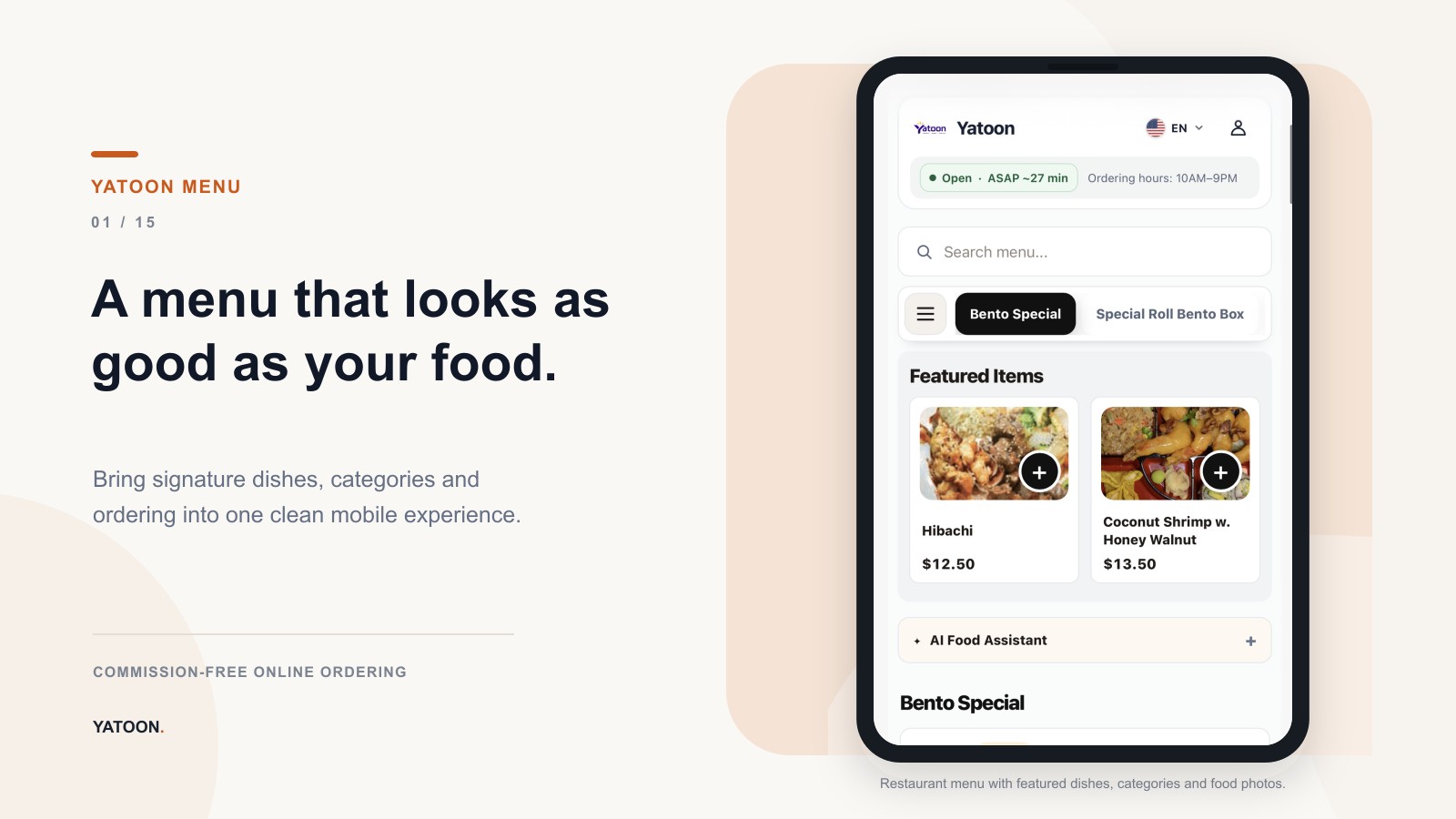
Take commission-free pickup and delivery orders on your own restaurant website. Customers browse a photo menu, pay by card with Stripe or pay in person, and the money goes straight to you. No WooCommerce, no per-order fees.
Live in three steps
- Activate the plugin. The setup guide opens on its own.
- Upload a photo or PDF of your menu and AI fills in dishes, prices and categories for you to check. You can also type dishes in or import a CSV.
- Click “Save & create my pages”, then place a test order from your phone.
Moving from GloriaFood? Oracle is retiring GloriaFood in 2027. Import your GloriaFood menu with a Fetch Menu key or JSON file, and your customer and order history from GloriaFood report CSVs, under Yatoon Menu > Import & migration. Menus exported from Orderable, WPCafe, WooCommerce and RestroPress import too. Imported dishes stay hidden until you review them.
Included free
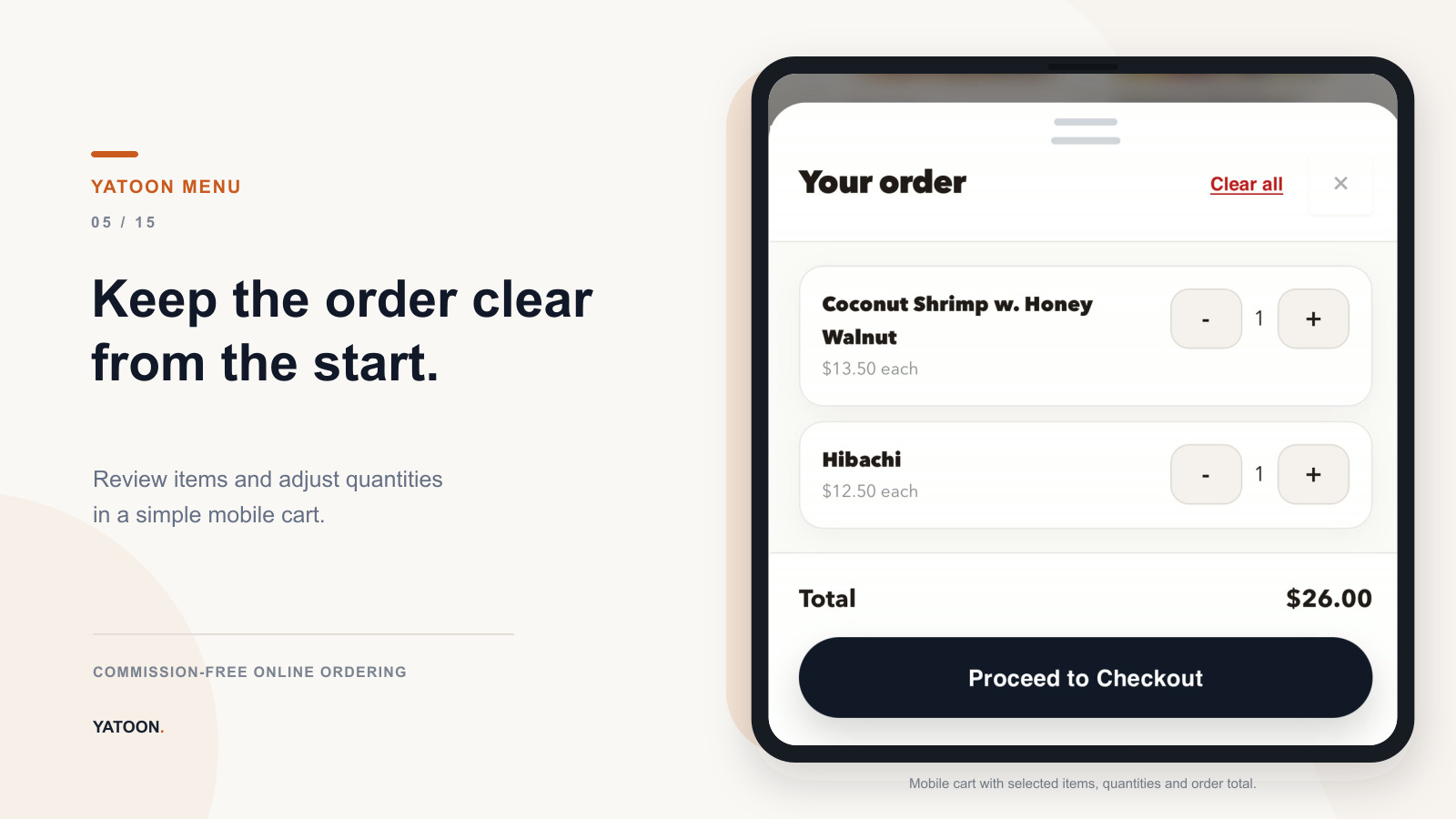
- Photo menu with categories, options, allergen notes, stock limits and sold-out marks
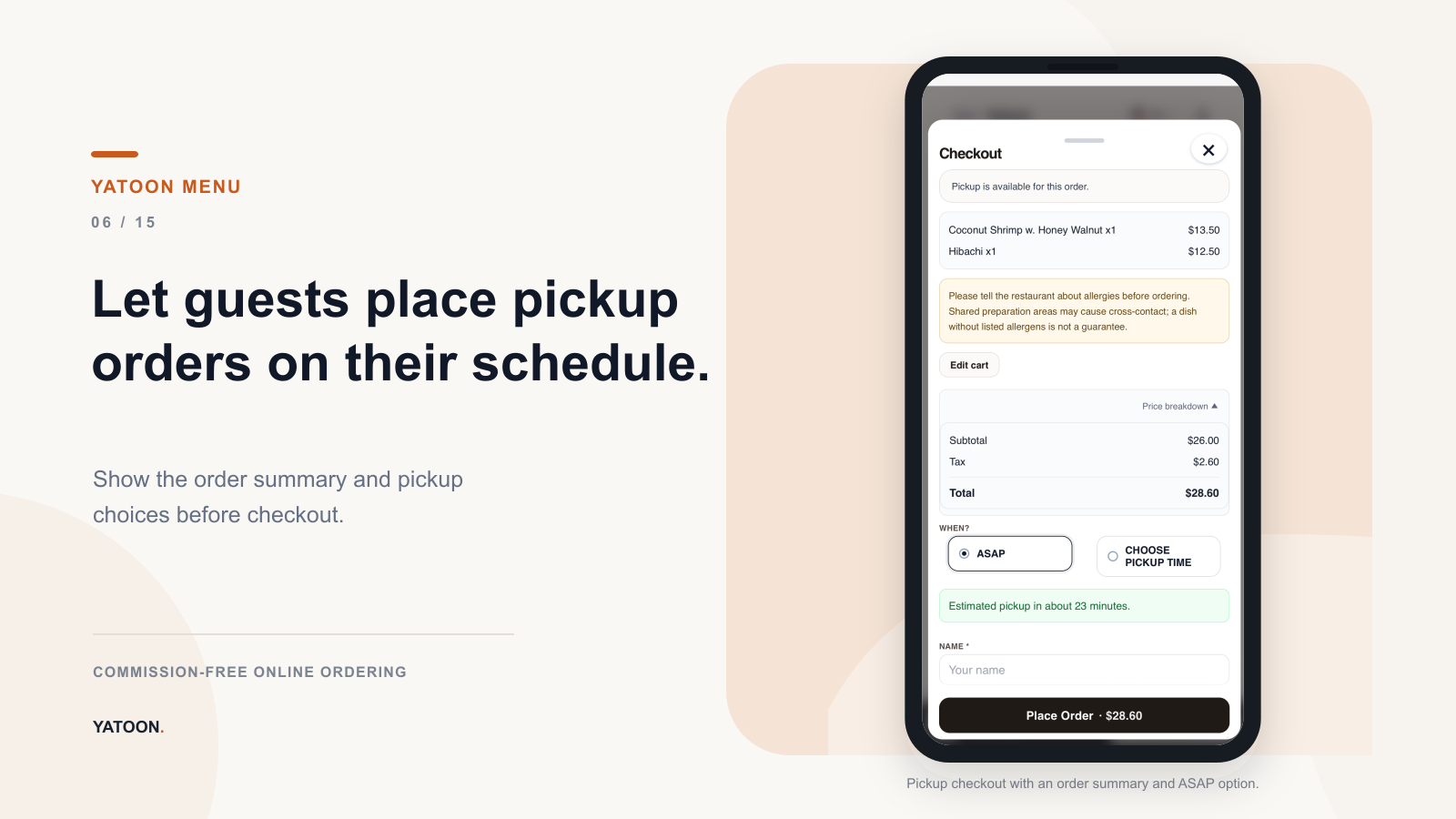
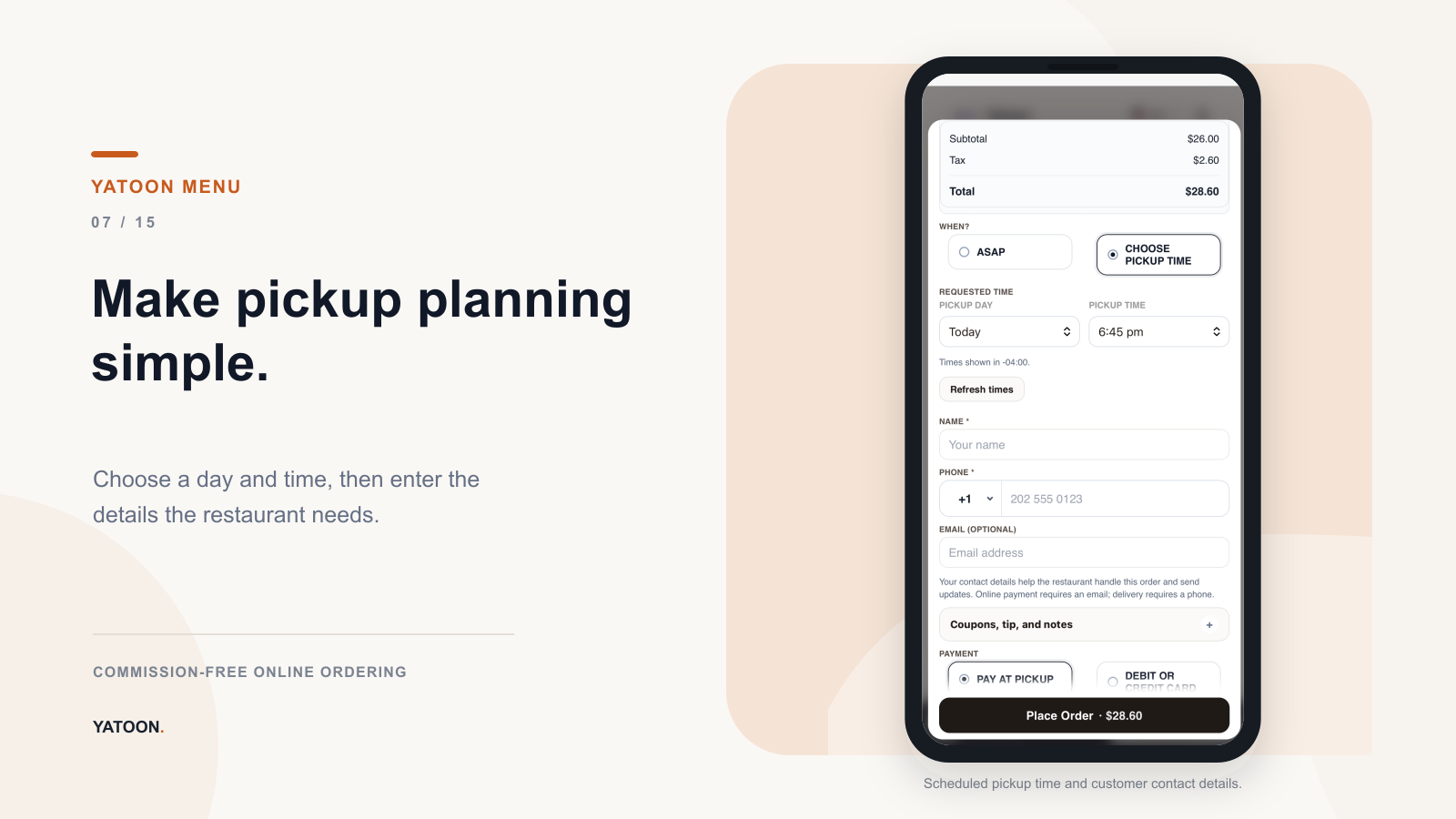
- Pickup with ASAP or scheduled times, opening hours, holidays and kitchen capacity
- Delivery with a flat fee, minimum order and postal-code list
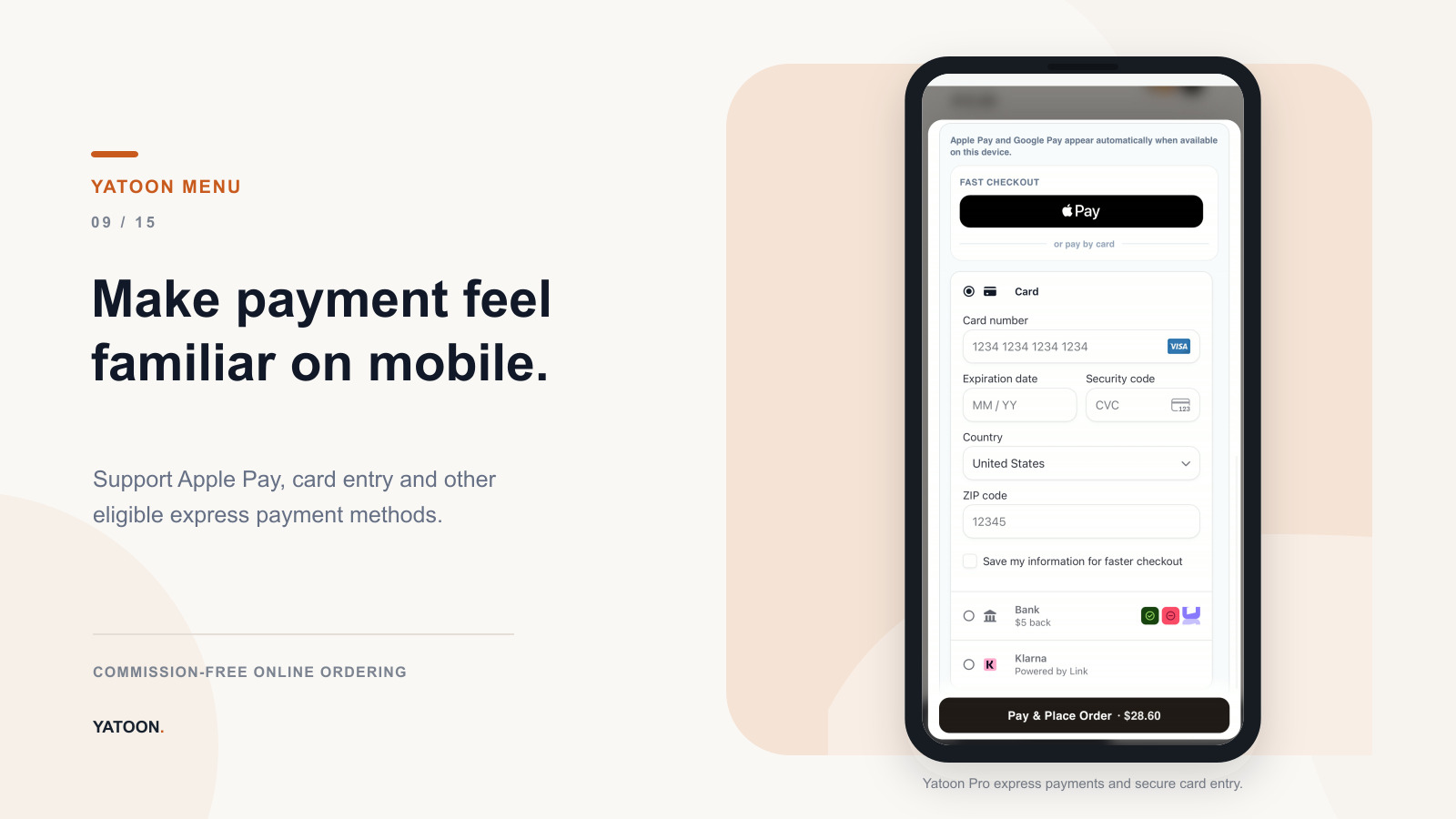
- Debit and credit cards with Stripe, plus pay in person
- Clear checkout totals: delivery fee and service fee on separate lines, standard and reduced tax rates, tax-free dishes and tax-inclusive pricing
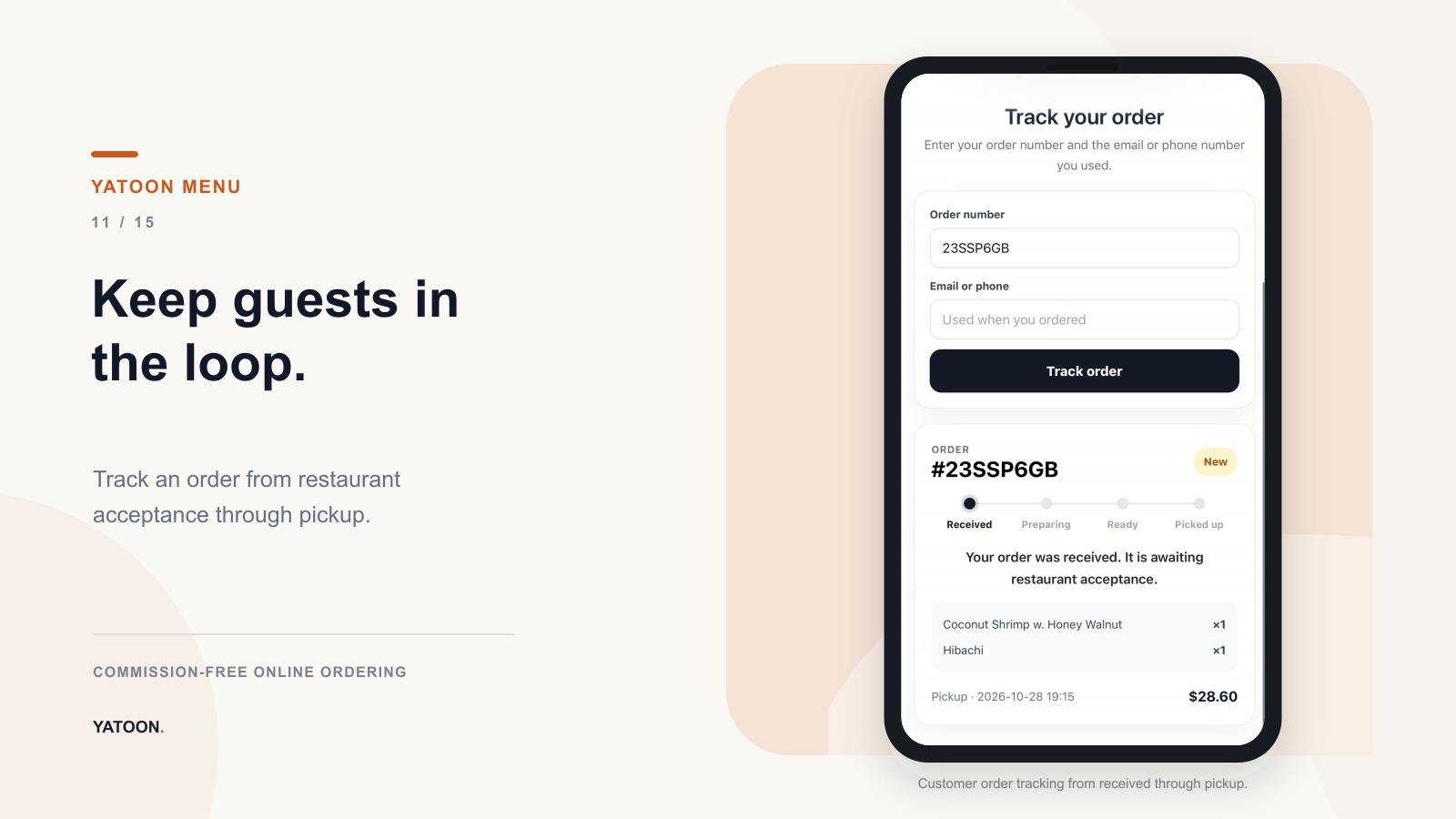
- Kitchen Display with sound alerts, order tracking page and email notifications
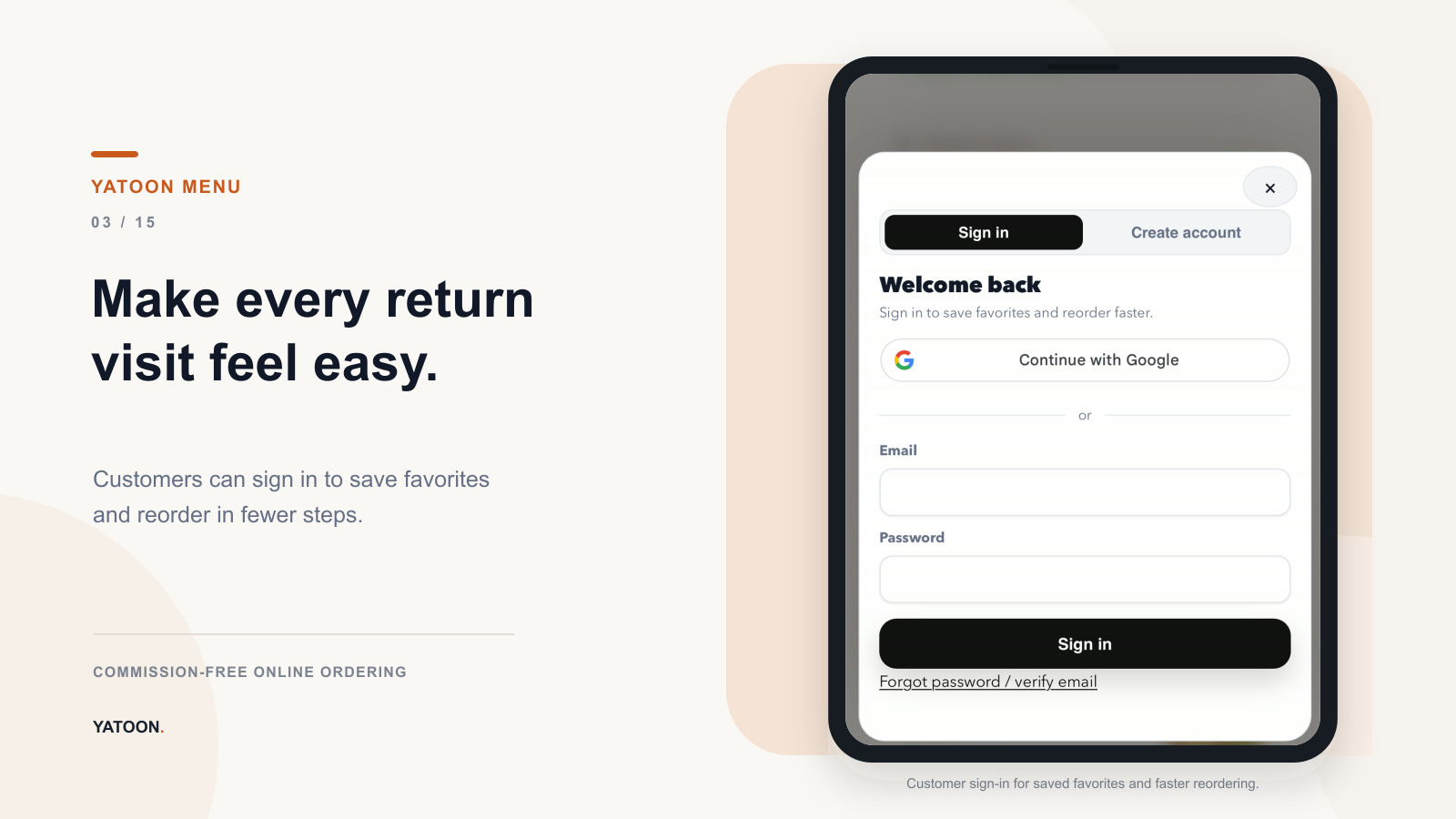
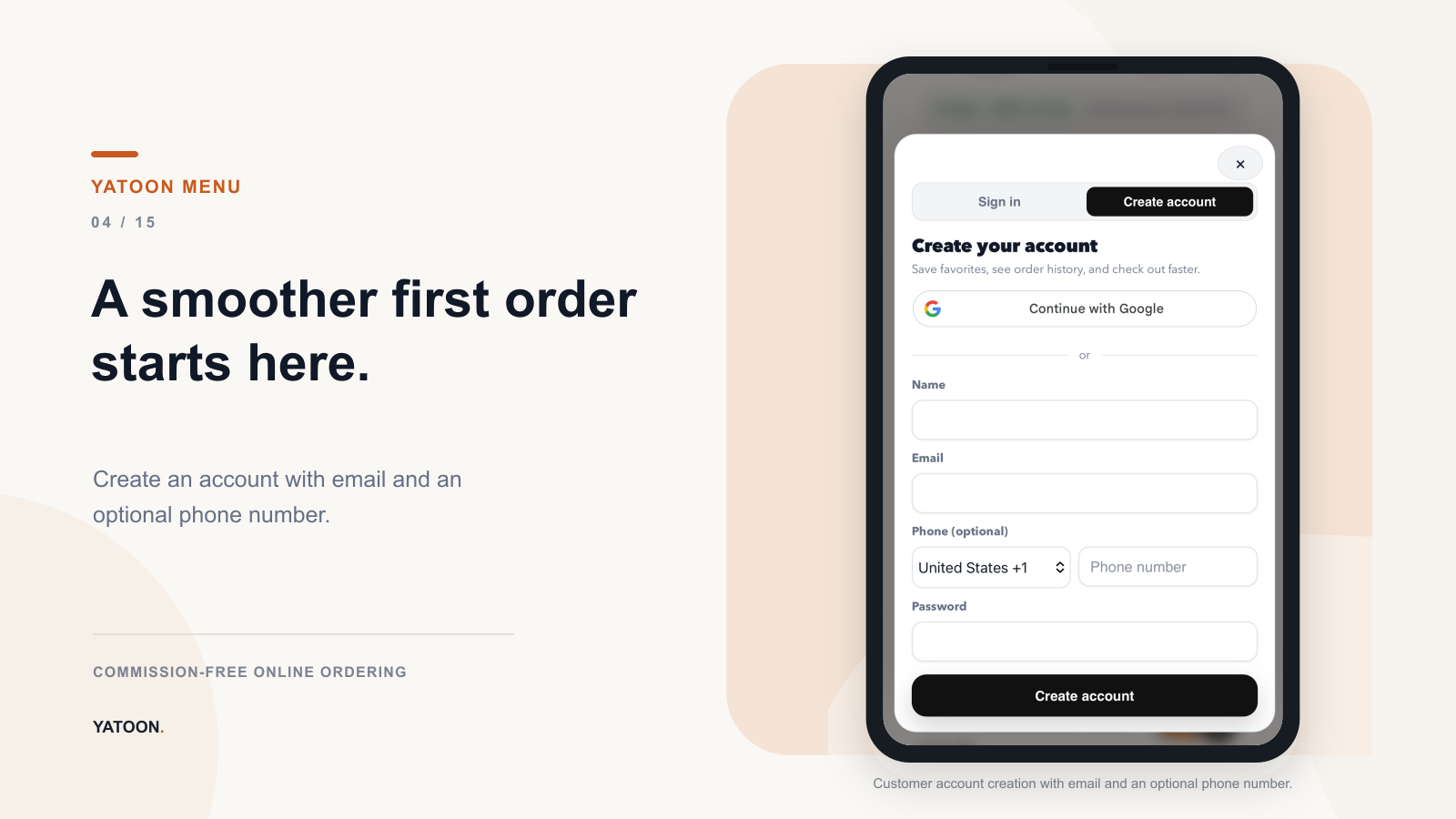
- Customer accounts, coupons and table reservations
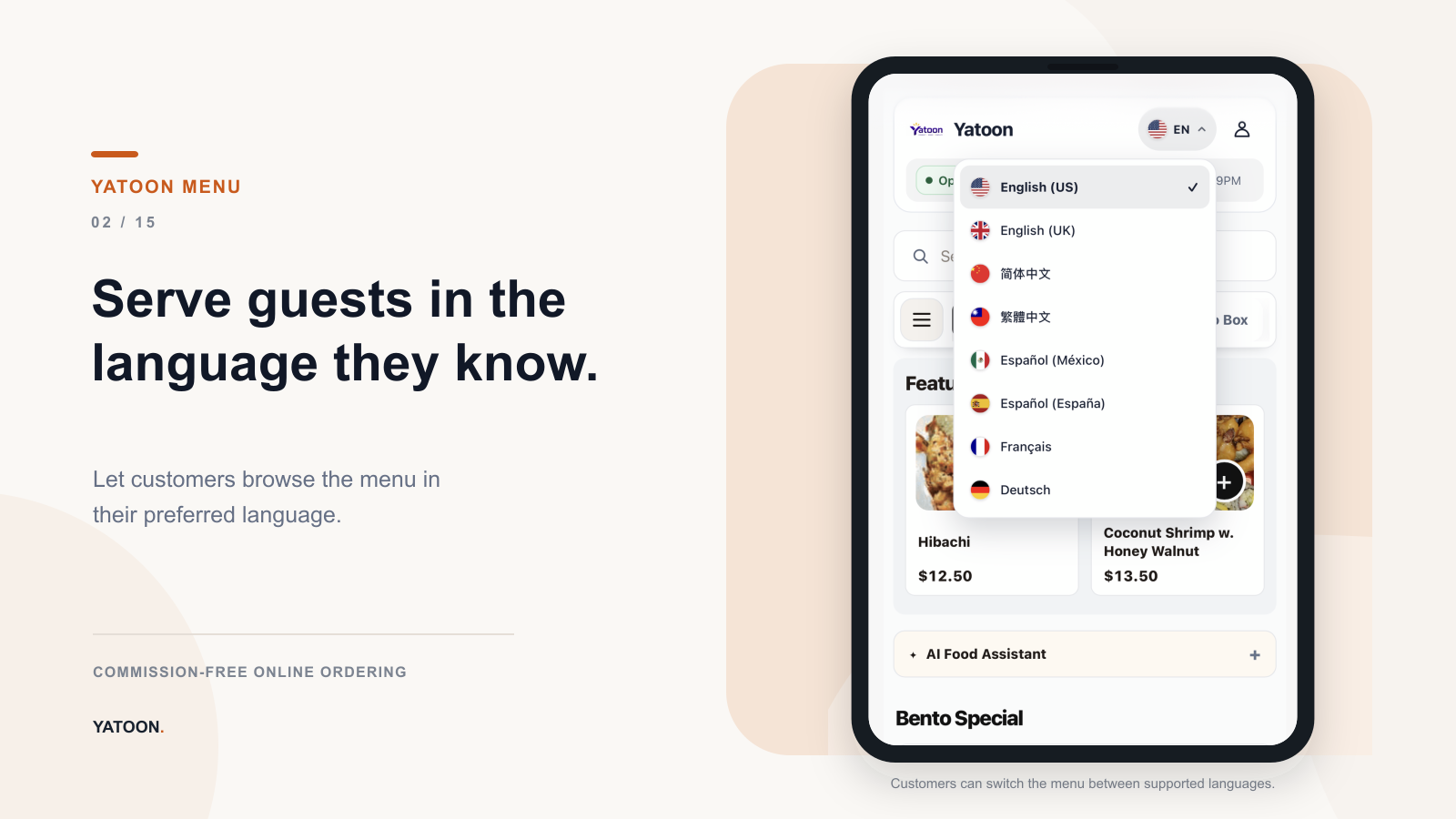
- Ordering in 8 languages, and an “add to home screen” option so regulars can keep your menu on their phone
- Privacy tools: customer data appears in WordPress’s Export and Erase Personal Data tools
Yatoon Pro adds Apple Pay and Google Pay, Square, PayPal, Alipay and WeChat Pay, SMS alerts, delivery pricing by distance, tips, dine-in and table QR ordering, multiple locations, sales reports, loyalty campaigns, gift cards, DoorDash and Uber courier delivery, cloud printing (Star and Epson), and refund and dispute tracking.
The optional AI Food Assistant suggests dishes from your menu when a WordPress AI provider is connected. Menu browsing and ordering never depend on AI.
Translation notes
Translations are provided as a convenience. Google Translate machine translation was used as a starting point for non-English catalogues. English (UK) adapts English (US) spelling and ordering terms; Mexican Spanish uses the Mexico locale, with common customer-facing ordering and checkout text reviewed. The catalogues have not received complete professional native-speaker review and may need local proofreading. Restaurant-written menu content is translated only after the owner configures and runs the translation service or enables automatic updates.
Shortcodes
- [yatoon_menu] – menu and checkout
- [yatoon_kitchen] – logged-in kitchen/operations staff only
- [yatoon_order_status] – customer tracking with the order’s private tracking key/contact
- [yatoon_reservations] – reservation requests
External Services
Stripe processes card payments when the restaurant turns on Online payments and adds its own Stripe keys. At checkout the customer’s browser loads Stripe.js from js.stripe.com to collect card details, and the site sends the order amount, currency and the customer’s email to api.stripe.com to create and confirm the payment. Card numbers never reach the restaurant’s site.
Terms: https://stripe.com/legal/ssa Privacy: https://stripe.com/privacy
The setup guide’s AI menu import sends the menu photo or PDF chosen by the administrator to the AI provider connected in WordPress Settings > Connectors (for example OpenAI, Google or Anthropic), only when the administrator uploads a file. The provider’s own terms and privacy policy apply.
Freemius provides optional account connection, licensing and updates. Its SDK controls the opt-in connection flow.
Terms: https://freemius.com/terms/ Privacy: https://freemius.com/privacy/
Optional Google sign-in loads Google Identity Services only when a client ID is configured. The identity token is sent to Google for verification.
Terms: https://policies.google.com/terms Privacy: https://policies.google.com/privacy
Optional Facebook login sends the login token to Meta to verify the app and retrieve the chosen profile/email.
Terms: https://www.facebook.com/terms.php Privacy: https://www.facebook.com/privacy/policy/
Optional Apple sign-in loads Apple’s web SDK and verifies the signed identity token against Apple’s public keys.
Terms: https://www.apple.com/legal/internet-services/terms/site.html Privacy: https://www.apple.com/legal/privacy/
The optional AI food assistant sends the customer’s request and available menu descriptions to the provider connected to the WordPress AI Client.
No AI provider keys are collected by this plugin. Provider selection is controlled by the WordPress connector and assistant settings.
Google terms/privacy: https://ai.google.dev/gemini-api/terms and https://policies.google.com/privacy
OpenAI terms/privacy: https://openai.com/policies/terms-of-use/ and https://openai.com/policies/privacy-policy/
Anthropic terms/privacy: https://www.anthropic.com/legal/commercial-terms and https://www.anthropic.com/legal/privacy
Optional translation: after the owner saves a Google Cloud Translation API key, explicit translation jobs and enabled automatic menu updates send dish names, descriptions, categories, option labels and fixed interface phrases to translation.googleapis.com. Tasks run through WordPress cron, continue after the browser closes, and retry on failure. Customer contact details and actual order records are not sent to this translation endpoint. The service may charge by translated character; the connection test translates one short phrase. A Google account sign-in does not automatically provision a billed Cloud project or API key.
Google Cloud terms/privacy: https://cloud.google.com/terms/ and https://policies.google.com/privacy
Optional GloriaFood menu import: when an administrator submits a Fetch Menu integration key, the plugin sends that key to GloriaFood’s API at pos.globalfoodsoft.com to retrieve the restaurant menu for a private preview. The key is used for that request and is not saved; customer and order records are not sent. This requires a GloriaFood account and Fetch Menu integration. Terms: https://www.gloriafood.com/terms-of-use Privacy: https://www.oracle.com/legal/privacy/
Optional order spam check: when a site owner enables Cloudflare Turnstile or hCaptcha in the plugin settings, the customer’s browser loads that provider’s script on the checkout, and the one-time check token plus the visitor’s IP address are sent to the provider by the server to verify it. Nothing is sent unless a provider and its keys are configured.
Cloudflare terms/privacy: https://www.cloudflare.com/website-terms/ and https://www.cloudflare.com/privacypolicy/
hCaptcha terms/privacy: https://www.hcaptcha.com/terms and https://www.hcaptcha.com/privacy
Order/contact information is stored in the site’s WordPress database and sent to the restaurant and customer through the site’s configured email service.
New email/password accounts must follow the emailed password setup link before signing in. The WordPress password reset flow also verifies these accounts.
Menu information and integrations
Confirm allergens while editing each dish. An empty allergen list means no information was supplied; it does not mean a dish is allergen-free. Customers should contact the restaurant about allergies and shared preparation areas.
Menu JSON-LD describes the public restaurant menu and prices. It does not guarantee a specific search result format. Sites using another menu schema provider may disable this output with the yatoon_menu_enable_schema filter.
Analytics & integrations offers an optional ecommerce event bridge for your existing Google Tag Manager/GA4 and Meta Pixel setup. It is off by default. No analytics scripts are installed. Forwarding requires explicit visitor consent through your consent manager and the documented YatoonAnalytics.setConsent interface. Customer contact details, addresses and notes are excluded. Configure the associated services and privacy disclosures before enabling this feature.
The Appearance screen offers everyday and seasonal menu themes, including Christmas. You can switch themes at any time; theme selection does not change prices or ordering settings.
Installation
- Install and activate the plugin. Deactivate any other Yatoon edition first.
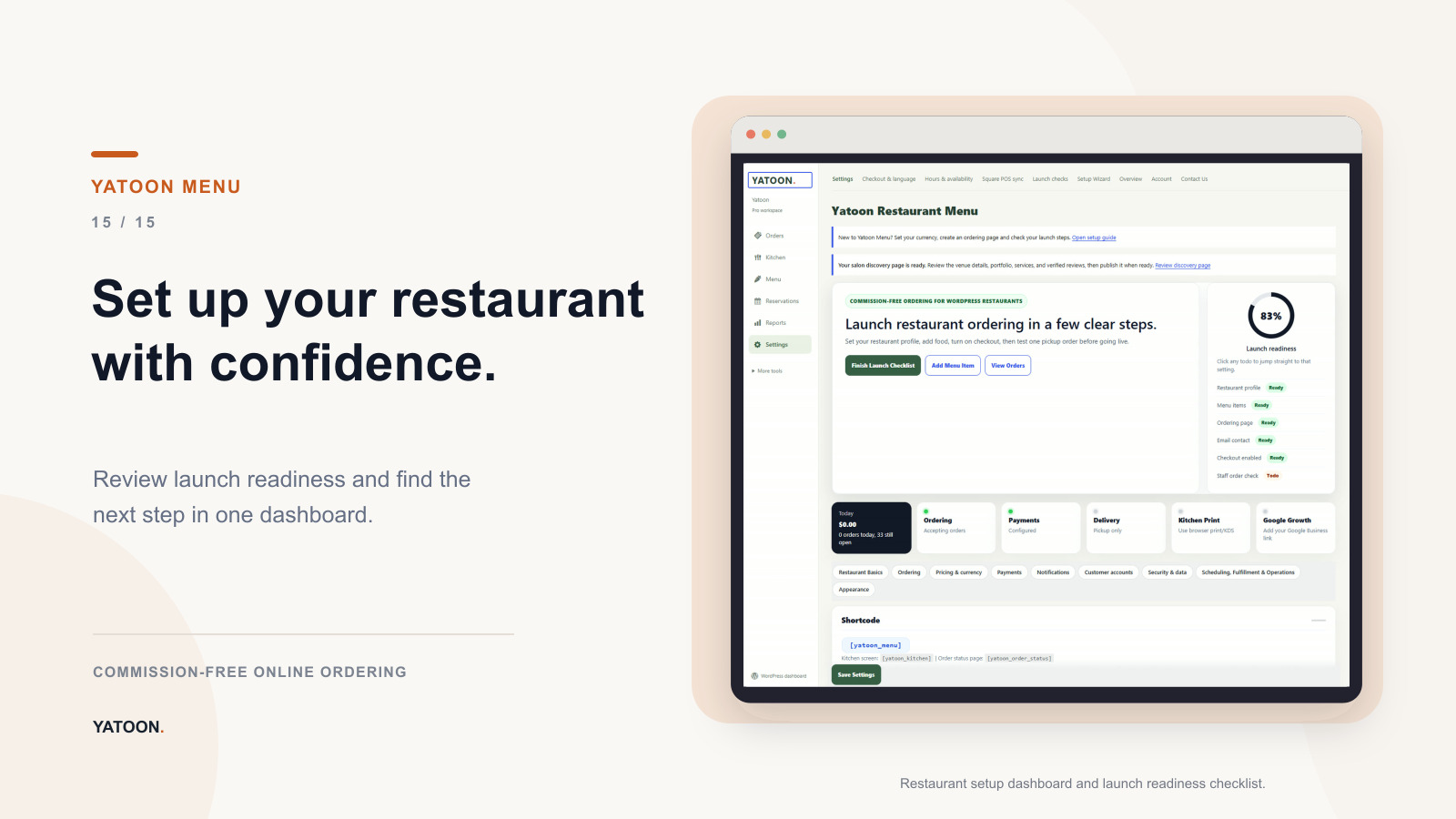
- The setup guide opens automatically: enter your restaurant name, order email and currency.
- Upload a photo or PDF of your menu for AI to read, or add dishes by hand (name, price, category). Photos and options can be added later.
- Click “Save & create my pages”. An “Order Online” page is created and pickup ordering is turned on.
- Open the ordering page on your phone and place a test order. It appears under Orders and Kitchen Display.
You can reopen the guide at any time from Yatoon Menu > Settings > Setup Wizard.
To take card payments, add your Stripe keys under Yatoon Menu > Settings > Online payments. Keep test mode on and place a test order with a Stripe test card before switching to live keys. To offer delivery, open Settings > Delivery.
FAQ
Do I need WooCommerce?
No. Menus, cart, checkout and orders are built in.
How long does setup take?
Most restaurants have a working ordering page in about five minutes with the setup guide. Three sample dishes are included so you can preview the page; the guide can remove them once your own dishes are added.
Customers can see my menu but there is no Add button. Why?
Online ordering is turned off. Go to Yatoon Menu > Settings > Ordering & pickup and tick “Enable pickup orders”, or use the “Turn on pickup ordering” button shown in the admin.
How do customers pay?
By debit or credit card with Stripe, or in person when they pick up or receive the order. Connect Stripe under Settings > Online payments. Pro adds Apple Pay, Google Pay, Square, PayPal, Alipay and WeChat Pay.
Can I offer delivery?
Yes. Turn on delivery under Settings > Delivery, set a flat fee and an optional minimum order, and list the postal codes you deliver to. Pro adds pricing by distance.
How do I import my menu from GloriaFood or another system?
Go to Yatoon Menu > Import & migration and choose GloriaFood, Orderable, WPCafe, WooCommerce, RestroPress or a universal CSV/JSON file. You can also upload a photo or PDF of your menu in the setup guide for AI to read.
Does the AI menu import need an account?
It uses the AI provider connected to WordPress (WordPress 7.0 or newer, Settings > Connectors). The menu file is sent to that provider to be read and is not stored on your site.
Can I take Apple Pay or Google Pay?
Apple Pay and Google Pay are part of Yatoon Pro. The free plugin takes debit and credit cards with Stripe.
How do I refund an order?
Refunds are made in your Stripe Dashboard. Yatoon does not issue refunds itself. Yatoon Pro records refunds and disputes reported by Stripe on the order and in its reports.
Which languages can customers use?
English (US and UK), Simplified and Traditional Chinese, Spanish (Mexico and Spain), French and German are included. Turn on the language selector under Checkout & language. Vietnamese, Korean, Japanese, Portuguese (Brazil), Filipino and Arabic become available after their interface translation is generated with a Google Cloud Translation key; Arabic uses a right-to-left layout. Dish names, descriptions, categories and options can be translated in the background with the same key, and your own edits are never overwritten.
How do I set up tax?
Under Settings > Pricing, enter your standard rate and, if you need one, a reduced rate. When editing a dish, choose Standard rate, Reduced rate or No tax. You can also choose whether the delivery fee and service fee are taxed, and whether your menu prices already include tax. Tax rules differ by location, so check with your accountant.
Can new orders pause automatically if nobody is watching the order screen?
Yes, optionally, under Operations & health. Choose the devices that keep Orders or Kitchen Display open. If all of them stop checking in for the time you set (2–30 minutes), new checkouts pause until a device reconnects. Orders already paid are not cancelled. A sleeping tablet, a closed tab or a lost connection also counts as “not watching”, so keep a backup way to hear about orders.
How do customers save the menu to their phone?
When “Let customers add the ordering page to their phone home screen” is on (Checkout & language), phones offer “Add to Home Screen” or “Install app” from the browser menu. Set a Site Icon under Settings > General for the best-looking app icon.
How do I export or erase a customer’s data?
Use Tools > Export Personal Data or Tools > Erase Personal Data in WordPress. Erasing removes the customer’s contact details from finished orders and reservations and keeps the amounts for your records. Orders still in progress and upcoming reservations are kept until they are finished.
Do you charge commission on orders?
No. Orders go directly to your restaurant.
Can I use it with my page builder or theme?
Yes. Add the [yatoon_menu] shortcode to any page or shortcode block.
Screenshots


Changelog
4.1.0
- New: tax options, separate delivery and service fees, privacy tools and add to home screen.
- New: share a dish or your order from the menu.
- New: customers can sign in with a passkey (Face ID, Touch ID, Windows Hello or a phone screen lock) after adding one from their account.
- Improved: a customer who already has an account can now sign in with Google or Apple using the same email without extra steps. Staff accounts and Facebook still need a normal sign-in first.
- Improved dish cards, order panel, customer emails and translations. Fixes for privacy erasure and kitchen language.
- Fixed: admin scripts now reload after an update instead of being served from an old browser or server cache.
- Fixed: the Square card form could appear twice at checkout, and the visible copy would ask for the card again. The payment form now loads once.
- Improved: the More tools list in the staff workspace is now grouped by job (ordering and delivery, dining room, payments and rewards, marketing, system) and sorted alphabetically inside each group. Pages that already appear in the Menu tabs are no longer repeated.
- Improved: the new-order email sent to the restaurant now uses the branded layout with logo, customer details, an Open order button, Call customer and Get directions buttons, and the restaurant address and phone.
- Fixed: Restaurant order emails use the restaurant’s original item and option names.
4.0.1
- Place customer and kitchen language controls in their respective settings and add admin navigation breadcrumbs.
- Add ordered customer and kitchen language settings and independent kitchen device selection.
4.0.0
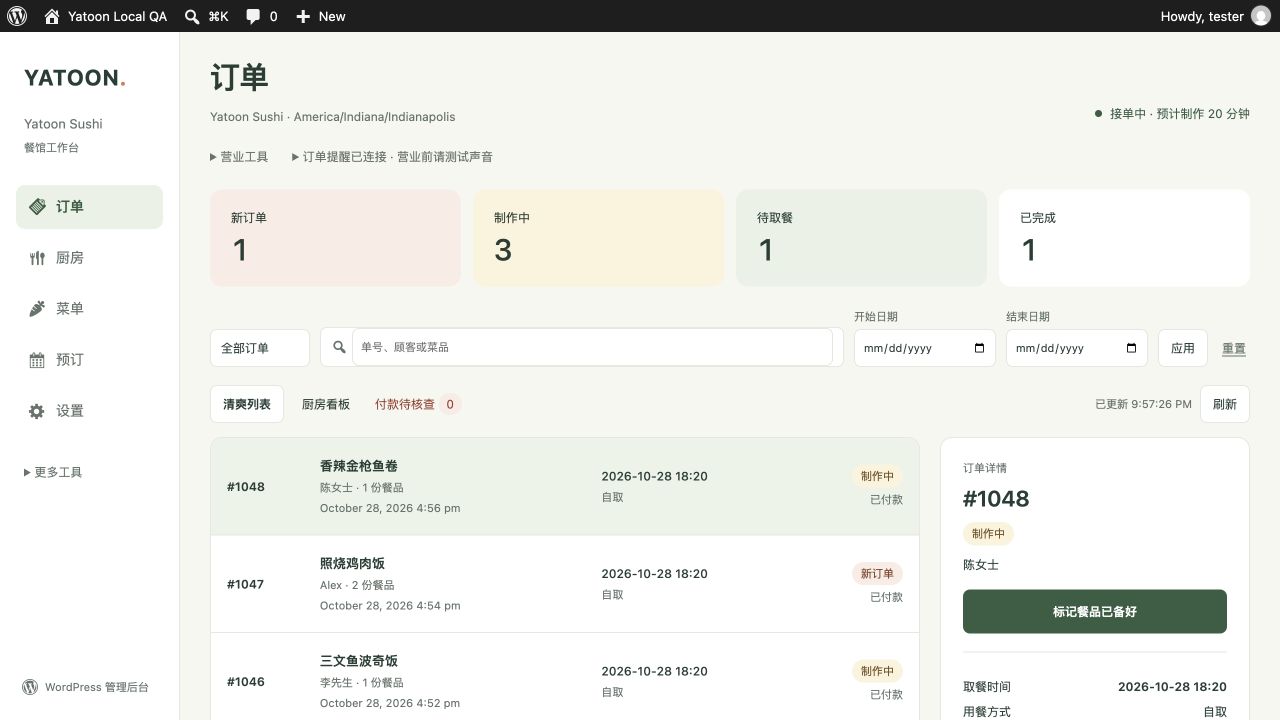
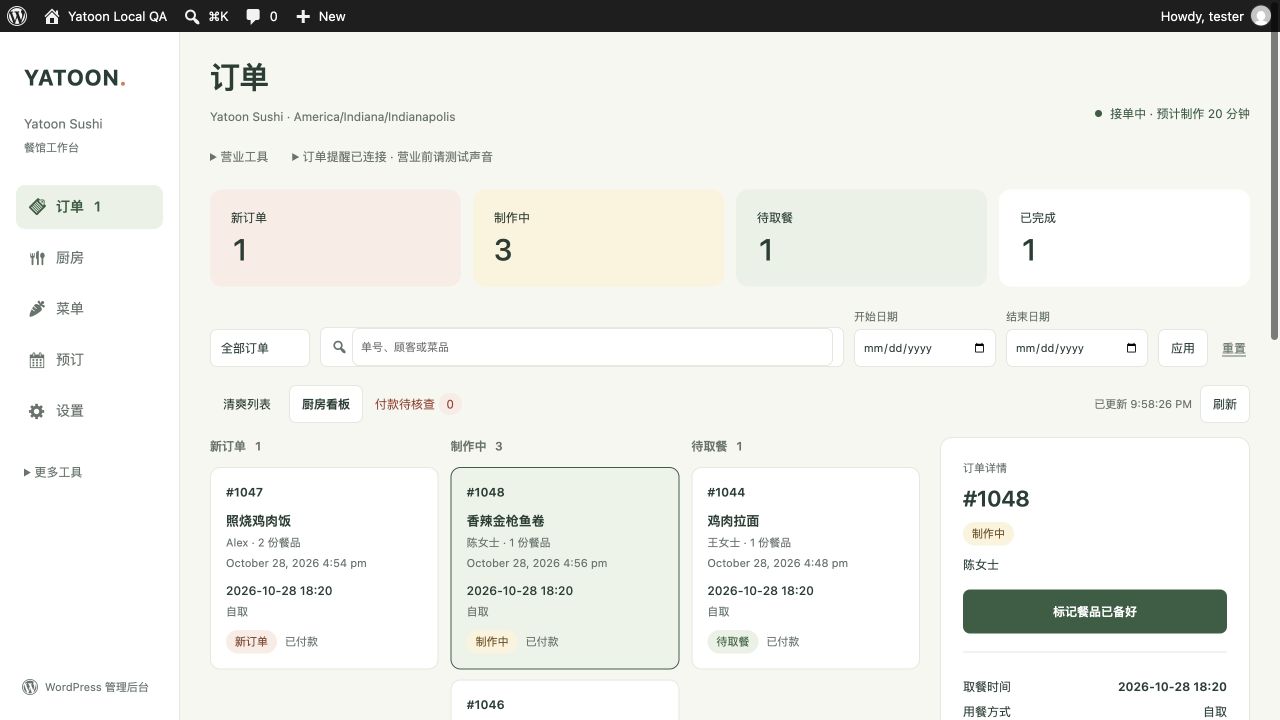
- New restaurant workspace with order status counters, search, date and location filters, pagination, order details and a kitchen board.
- Shared cash collection and audited cancellation in both editions.
- Fix hidden order filters, truncated order lists, unsafe deletion, optional phone validation and security-check bypasses.
- The optional spam check (Turnstile or hCaptcha) now also protects card, wallet and PayPal payments. If the site cannot reach the provider, limited checkout attempts may be allowed per browser session, subject to a shared IP limit.
- New: Debit and credit card payments with Stripe in the free plugin. Pay in person stays available.
- New: Delivery in the free plugin with a flat fee, minimum order and postal-code list.
- New: AI menu import in the setup guide. Upload a menu photo or PDF and the dishes, prices and categories are filled in for review (WordPress 7.0+ with an AI provider).
- New: Import links for GloriaFood, Orderable, WPCafe and RestroPress menus in the setup guide.
- New: Simple admin view for new installs until setup is finished, with a “Show all features” switch.
- New: A one-time, dismissible review request after 10 completed orders.
- Setup can add up to 200 dishes and keeps dish descriptions.
- Shorter plugin name and updated WordPress.org tags.
- AI model lists updated: Claude Haiku 5.5 (new default) and Sonnet 5.5; GPT-6.1 Terra added. Flagship models are not listed because ordering help does not need them. Saved models that are no longer listed switch to the provider’s recommended model.
3.4.8
- Open the setup guide automatically after activation.
- Turn on pickup ordering by default in the setup guide and warn the owner when ordering is off.
- Offer to remove the sample dishes and preselect a category for the first dish.
- Remove a duplicate admin navigation row, including a QR tables link that was not available in Free.
- Make the front-end Kitchen Display page optional in setup.
- Let menu-only restaurants hide the ordering-off reminder.
- Remove internal build notes from the plugin package.
3.4.7
- Refresh the language picker with local country flags and a compact account icon.
- Reduce and center the mobile sign-in sheet while keeping longer forms scrollable.
- Make Log out visible beside the signed-in customer name.
- Fix the Sign in button showing no feedback and the clipped “Continue with Google” button.
- Sign-in, Create account and account pages now follow the active menu theme.
- New Checkout & language > Customer sign-up: phone number on sign-up can be off, optional or required.
- New accounts are confirmed with a 6-digit email code and signed in automatically.
- Google, Facebook and Apple sign-in ask for a phone number first when it is required.
- Administrators who sign in on the storefront form are now told to use wp-admin.
3.4.6 performance revision
- Isolate restaurant nonce refresh from Booking on the same site.
- Reuse display menu data and output one complete language catalogue.
- Move AI capability checks and social SDK loading off the initial page path.
- Reduce frontend option queries and unnecessary admin media assets.
- Preserve the 3.4.6 seat reservation fixes.
3.4.6
- Keep queued confirmation emails and reminder deduplication intact when staff change only the table.
- Prevent overlapping table reservations, add dining/cleanup times, version-checked table changes, signed guest cancellation/rescheduling, pending expiry and arrival reminders.
- Synchronize shared reservation and header components between Free and Pro.
- Configure bookable tables and guest services in Reservations; see docs/reservations.md.
3.4.5
- Center mobile next pickup beneath the language selector using matching column widths.
-
Refined mobile header alignment into two paired rows while retaining the desktop layout.
-
Place the next pickup time beside the status badge on phones, with complete dates retained for future pickups.
-
Improved the responsive restaurant header: next pickup and hours stay together, with compact mobile language selection and availability-backed estimates.
-
Added reviewed menu migration and isolated customer/order history archives; fixed desktop column settings and clarified same-day pickup availability. See docs/migration.md for source formats and limits.
-
Pro: direct printing sends plain text in the printer’s font (UTF-8 when the printer reports support, otherwise an ASCII fallback with a warning on the Printer page) and cuts with the protocol header. The kitchen ticket and the receipt print as separate, cut tickets.
- Pro: printing continues while the printer reports paper low. Paper out, cover open, busy and offline states wait without using retries and resume automatically.
- Pro: tickets for cancelled, refunded or deleted orders are not printed and never hold up later tickets; orders awaiting payment review wait.
- Pro: staff are emailed or texted when an order ticket has not printed within a set time (default 10 minutes) or fails, independent of order escalation. Alerts say that the printer needs attention.
- Pro: every outstanding ticket is kept; printed history is limited to 80 tickets and closed tickets to 200 for 7 days.
- Pro: reprints are saved as background tasks, so a busy print queue retries without duplicate tickets.
-
Pro: honor the optional postal-code setting for distance delivery.
-
Fix legacy Chinese sushi-roll and General Tso descriptions, preserving unrelated merchant-authored translations.
- Preserve original dish names during localization so description corrections can match correctly. Repair the known Spanish Kung Pao and Smoothie mistranslations.
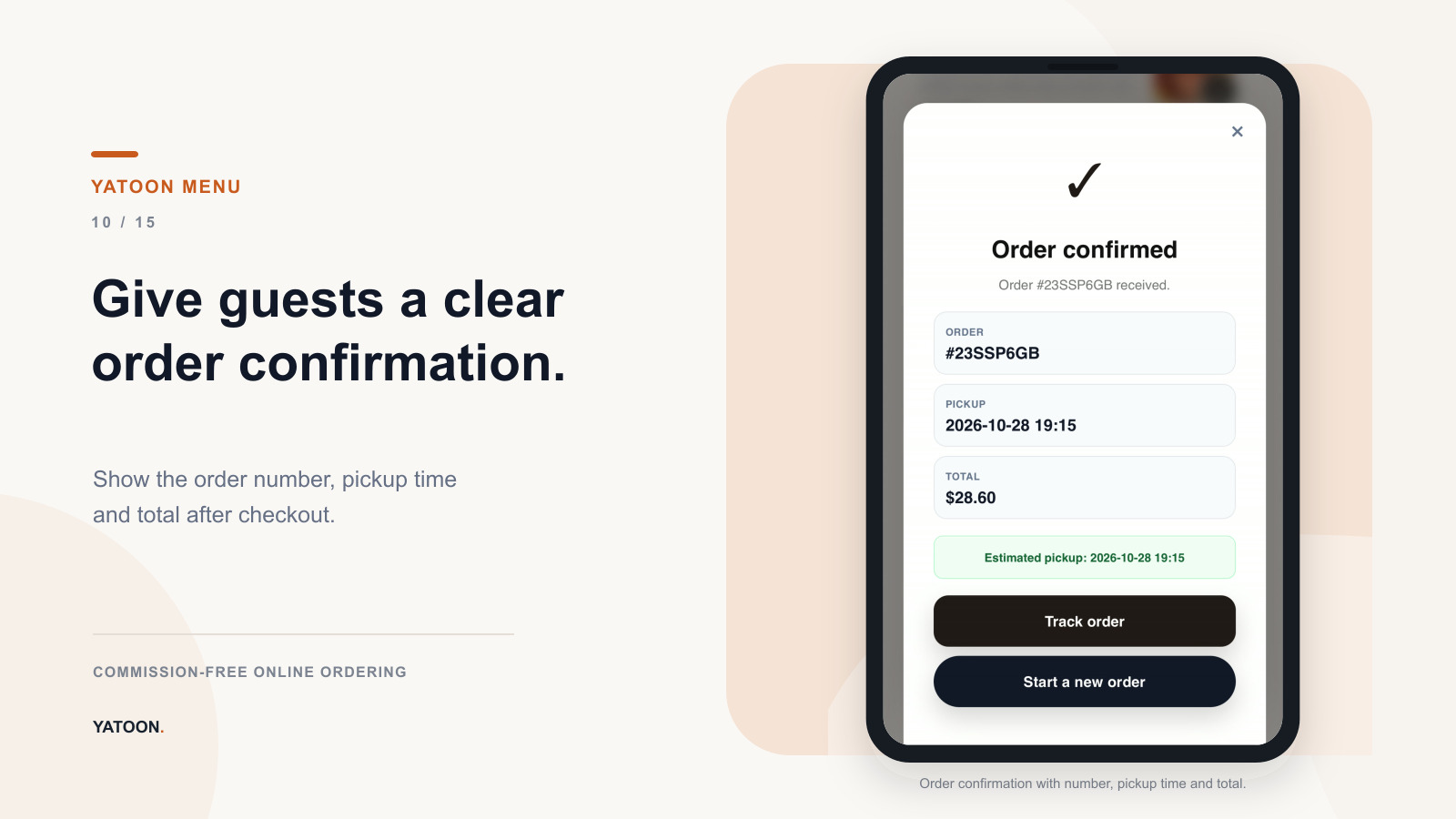
- Keep the order confirmation close button neutral and centered despite theme button styles, with a touch-friendly target and visible keyboard focus.
- Centralize pickup schedules, holiday closures, kitchen preparation and future-date controls in Hours & availability; prevent general settings from overwriting those values.
- Add optional site-wide receiver protection. Select receiving devices in Operations & health; stop new checkouts when all selected devices stop successfully checking orders, and resume after reconnection without clearing manual pauses or changing existing orders and payments.
- Refresh receiver heartbeats only after a successful order poll; recover expired staff heartbeat nonces. Keep unaccepted-order alerts separate from device connectivity.
- Clarify listed, unlisted and sold-out dishes and category actions. Refresh pickup availability during idle checkout, without refreshing while the payment button is processing.
- Redesign the live kitchen display: three lanes with countdowns, late highlighting, allergy callouts, one primary action per ticket and flicker-free updates.
- Orders page: structured item list with quantity badges and highlighted special requests; Delete moved into a More menu. Reports: summary cards and bars.
- Menu page: single sticky category bar, correct dish thumbnails and two-column dish cards on desktop.
- Front-end CSS refactor: about 4,480 !important declarations across the menu stylesheets were replaced by scoped selectors (#yatoon-app for the menu and its overlays, plus the kitchen, order-status and reservation roots). About 30 remain, only where a rule must beat an inline style set by JavaScript or style /. Unused legacy rules were removed and menu.css/menu.js ship minified (menu.min.css, menu.min.js) unless SCRIPT_DEBUG is on. Theme authors can override any rule with the same selector prefix.
- The menu and its overlays are wrapped in #yatoon-app, so block themes no longer push the cart drawer, backdrop and confirmation overlay into the content column.
- Update the bundled Freemius SDK to 2.13.5.
- Checkout: on desktop the order summary sits beside the form in a two-column sheet; the price breakdown is collapsed until opened; the pickup estimate is hidden for delivery orders.
- Admin: the many Yatoon Menu pages are grouped into Overview, Service, Menu, Grow and Settings with a two-level navigation bar; secondary pages leave the WordPress sidebar but stay one click away.
3.4.2
- Add configurable kitchen workload capacity shared by ASAP, scheduled orders and unexpired payment holds. Large orders reserve multiple windows and checkout rechecks capacity under the inventory lock.
- Include merchant identity, regional dates, payment status and complete order details in printed receipts and customer emails. Save merchant identity with new orders and support optional branch contact details.
- Add an accessible close control to order confirmation and clear the submitted basket after success.
- Keep recent overdue and staff-confirmed kitchen work reserved. Isolate tickets inactive for more than 24 hours from current capacity without completing or cancelling them; staff can continue preparation to restore their workload. Filter staff review and live-board pages before pagination, and return proper authorization errors. Expiring busy-mode delays remain available.
- Fall back to the restaurant address when an optional location or marketing address is empty.
- Complete translations for the new kitchen, receipt and settings text in the bundled languages; sanitize kitchen workload and category order input and normalize line endings flagged by Plugin Check.
3.4.1
- Add numeric category positions: moving one category automatically shifts the others. Validate saves and reject edits made against outdated category lists.
- Keep same-day pickup available by default; display Today and format future dates for the customer language / region only when future pickup is enabled. Enforce the same restaurant-local date range at checkout.
- Add independent category hide/restore controls; restoring a category preserves each dish’s own visibility. Hidden categories are excluded from public feeds and new checkout validation.
- Complete optional uninstall cleanup for marketing storage and keep consent wording versions independent of release versions.
-
Ship marketing information and upgrade access without the Pro campaign or subscription engine. Existing signed unsubscribe links remain usable after downgrade.
-
Unify centred storefront tool widths and responsive category navigation.
- Pro: optional email/SMS marketing subscriptions, campaign drafts, background sends, lapsed-customer audiences and SMS followups.
- Add signed unsubscribe links, email list-unsubscribe headers and authenticated SMS STOP handling; preserve transactional notifications.
3.4.0
- Integrated the reviewed 3.4.0 fixes; preserve canonical modifier IDs/names for checkout and separate customer display translations.
- Remove redundant closed pickup messages, improve mobile forms, long dish names and empty-image dialogs.
- Persist retryable translation tasks, track source changes, protect manual edits and support a merchant terminology glossary.
- Load JavaScript catalogues for admin, kitchen and table-board handles; honor customer language in public AJAX and order emails; protect personalized ordering pages from shared caching.
- Add operations health, device heartbeats, escalation and authenticated printer receipts.
- Improved mobile menu and checkout layout, restaurant branding, service hours and resilient total calculation. Price details open by default so customers can see subtotal, tax and fees. Checkout now defaults the phone dialing code from the restaurant’s configured country.
- Improved reservation hours, booking limits, reopening checks and retryable email notifications; clarified order status and kitchen ticket handling.
- Added allergen information, menu structured data, optional consent-based analytics, seasonal menu themes, accessibility and translation improvements.
- Improved setup guidance, category and menu management, currency handling and scheduling safeguards.
3.3.2
- Added category management and first-run setup tools; improved currency selection, responsive admin screens and checkout reliability.
3.3.1
- Improved payment and notification reliability, account security, checkout protection and mobile administration.