

Description
Auto Form Builder (AFB) is the free WordPress form builder that gives you what other plugins charge for. Build contact forms, multi-step forms, surveys, file-upload forms, product order forms and payment forms with drag and drop, no code and no monthly fees. Build a form by hand or let AI build it for you, and embed your forms, or their AI chat version, on any website, WordPress or not.
Free forever, with no paid add-ons. The “Add-Ons” screen is simply optional free modules you switch on in one click. Stripe Payments adds no fee of its own: you pay only Stripe’s standard processing fees. The AI features are optional, and the only thing you can ever pay for is AIDA credits for them, once the free trial credits are used up.
Privacy-first by design: your submissions stay on your own site, and the plugin contacts no external service unless you enable a feature that needs one.
Watch the full overview video · See all features · Support
Quiz & Lead Funnels
Turn on Funnel mode for a multi-step form and each screen shows one question on large, touch-friendly cards. Answers can move on to the next screen by themselves (auto-advance, on or off per question), and radio and checkbox options can show pictures as answer cards. “One question per screen” splits an existing form into screens in one click. Give options points for quiz scoring, then show a different result message or redirect for each score range or answer. With Form Analytics on, you see how many visitors reached each screen and where they left. Start from one of four ready-made funnel templates.
Drag & Drop Builder
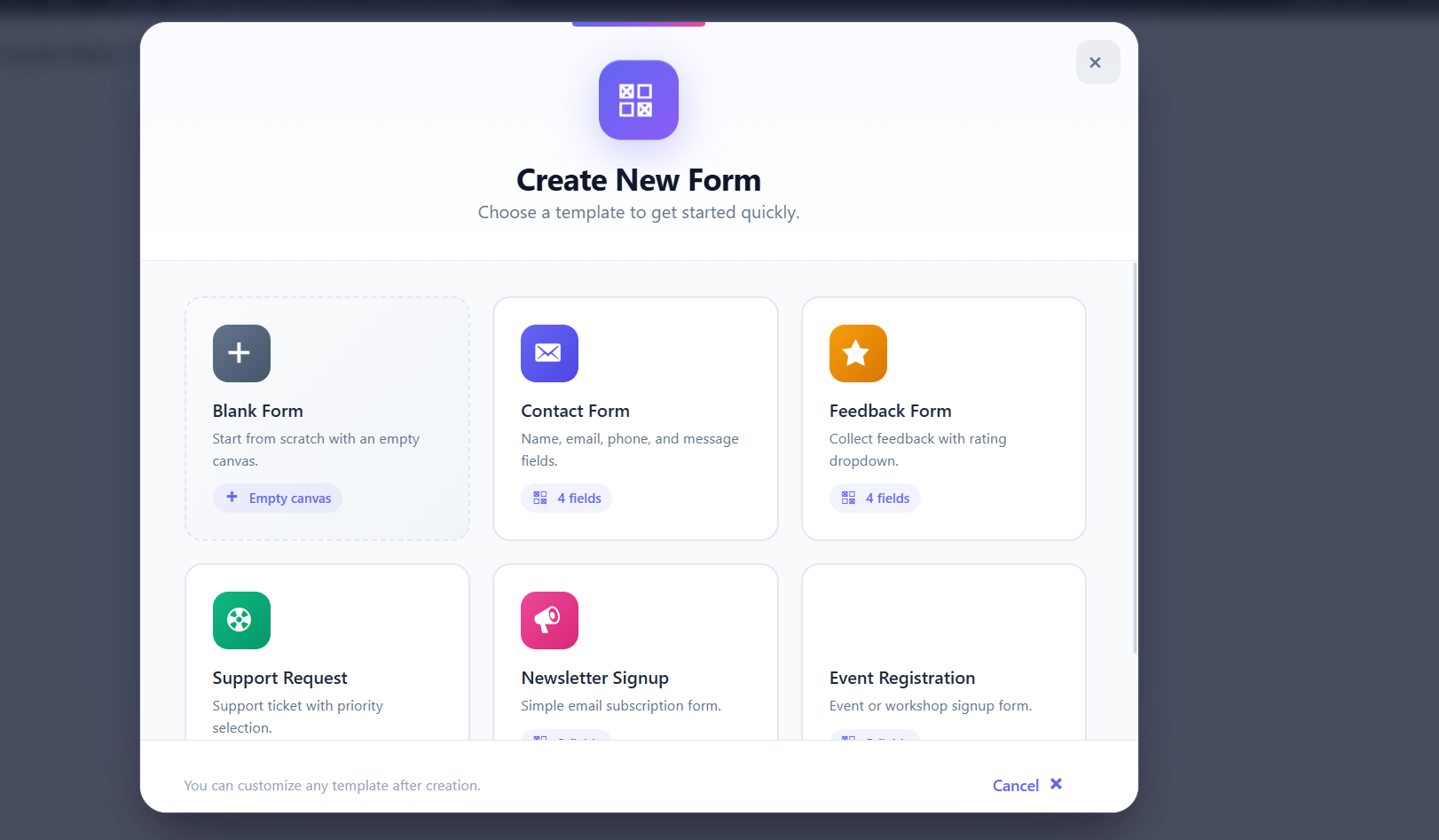
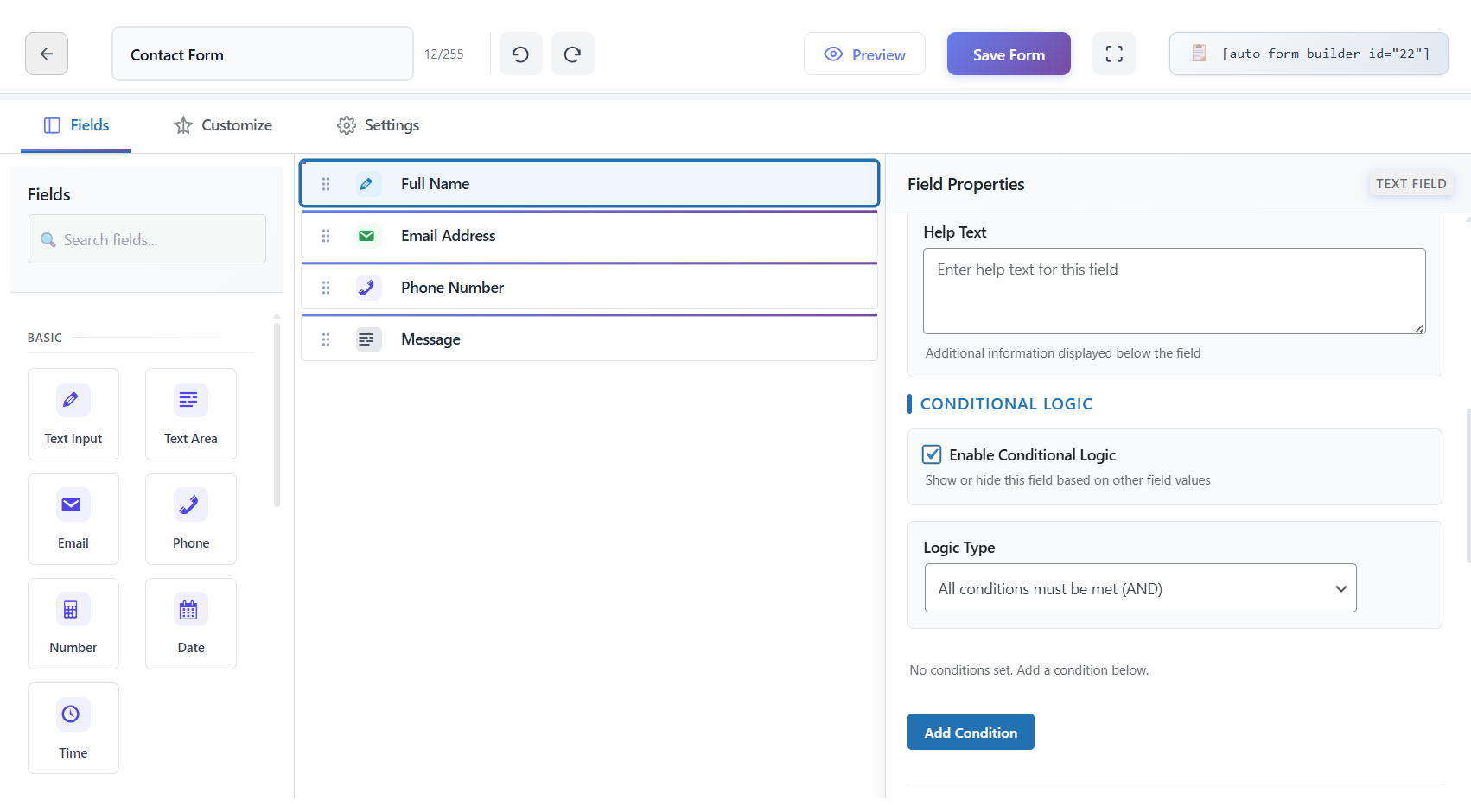
The visual drag-and-drop builder lets you add and reorder fields, undo and redo, and preview on desktop, tablet and mobile. Start from one of 32 ready-made forms in the searchable template gallery (contact, quote, booking, order, survey, job application, funnels and more), a blank canvas, or Build with AI right in the gallery: describe the form and AI builds it. Style your forms with theme presets, saved themes, a header image, colors, fonts and layout, with a live preview.
20+ Field Types
Text, Textarea, Email, Phone, Number, Date, Time, Month & Year, Checkbox, Radio, Dropdown, Name, Address, File Upload, Signature, Color Picker, Calculation, Products, an HTML content block and Page Break, plus four survey fields: Tabular Survey (Likert grid), Star Rating, NPS and Opinion Scale. Fields support validation, help text, icons, URL prefill and conditional logic. See the full field reference.
Products Field (free)
List what you sell with a price, optional description and image, shown as checkboxes, a single choice, quantity steppers or cards. Visitors pick quantities within your limits and see a live order total. Products work with conditional logic and calculations, a link can preselect products and quantities, and with Stripe Payments visitors pay through an itemized Stripe Checkout. Prices are one-time; recurring billing is not available yet.
Logic, Calculations & More
- Conditional logic — show or hide fields with AND/OR conditions, and change the success message, redirect or notification emails.
- Calculations — live totals, quotes and scores, recalculated on your server so visitors cannot change them.
- Live field values — show a visitor’s answers in labels, help text, HTML blocks, step titles and the submit button as they type, for example “Thanks, {first_name}”, with fallback text while a field is empty, for example {first_name|default:there}. The same tags work in success messages, notification emails, the Stripe product name and the AI chat’s completion message.
- Review step — an optional “Review your answers” step shows everything the visitor entered, with an Edit button per step, before the form is sent.
- Passwords — an eye button inside password fields shows or hides what was typed. Passwords are never stored in entries or sent in emails or webhooks.
- Multi-step forms — steps, a progress bar (or none) and branching that skips steps that don’t apply.
- Surveys — Likert grids, star ratings, NPS and opinion scales, with charts and an NPS trend.
- Signature — visitors sign with a mouse, finger or stylus.
- Partial entries — unfinished answers are saved and removed after the retention period you choose.
Submissions & Notifications
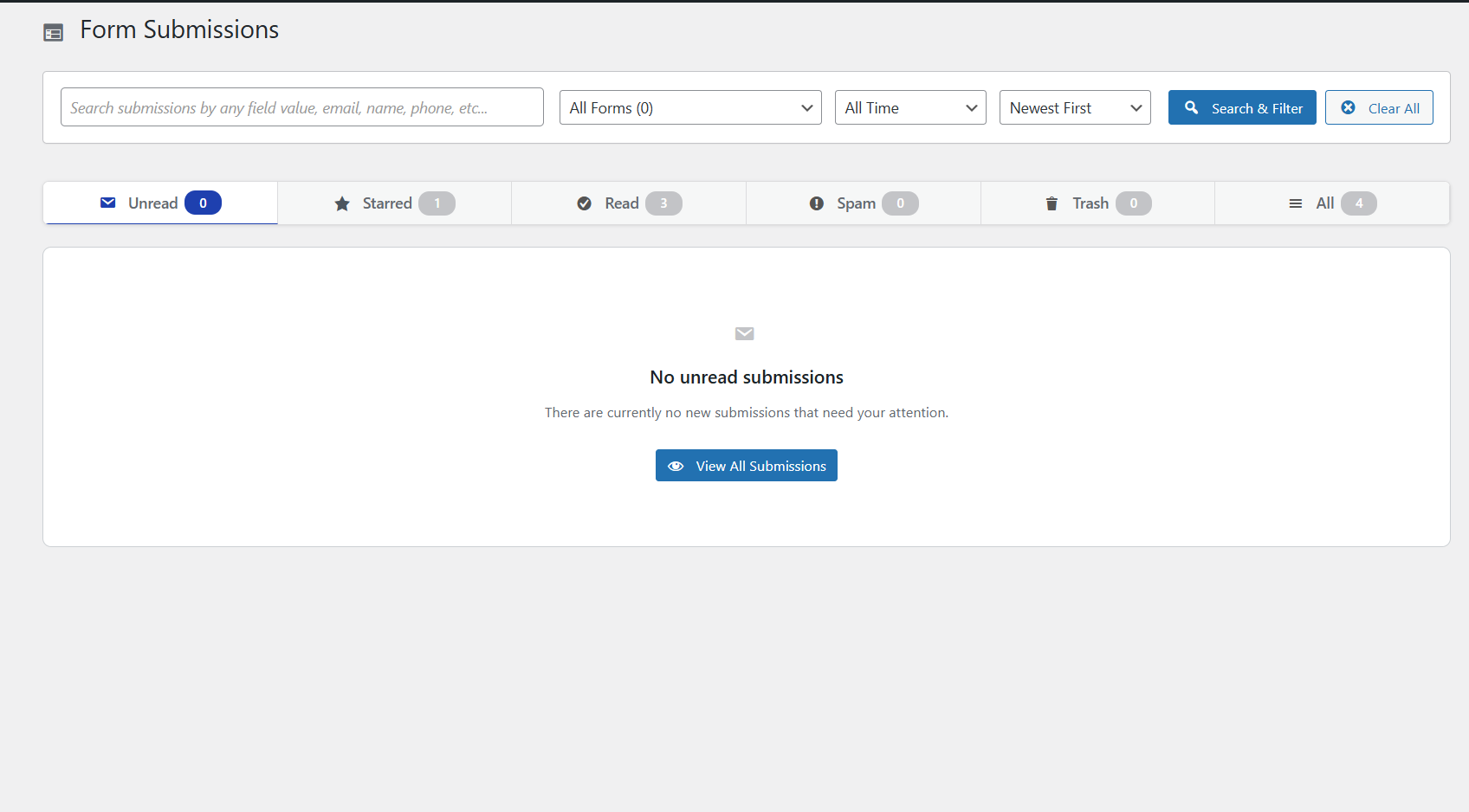
An inbox with Unread, Starred, Spam and Trash tabs, search, filters, bulk actions and CSV or JSON export. Quick view opens any entry over the list, and each entry page shows the answers first, with the details, tags and payment beside them. On a submission page, Previous, Next and “Next unread” move through your list, keyboard shortcuts save clicks, and “Reply by email” opens your email app. Admin and confirmation emails use your own recipients, subject and placeholders, in HTML or plain text, and can link to uploaded files with a login link or an expiring secure link. See submission management.
Embed Anywhere & Pass Answers On
Every form has an embed code for any site, including non-WordPress sites and page builders, plus a Gutenberg block. Prefill fields from the URL, and pass answers on through {field} tags in a redirect URL, for example to a booking page or CRM.
Free Add-Ons
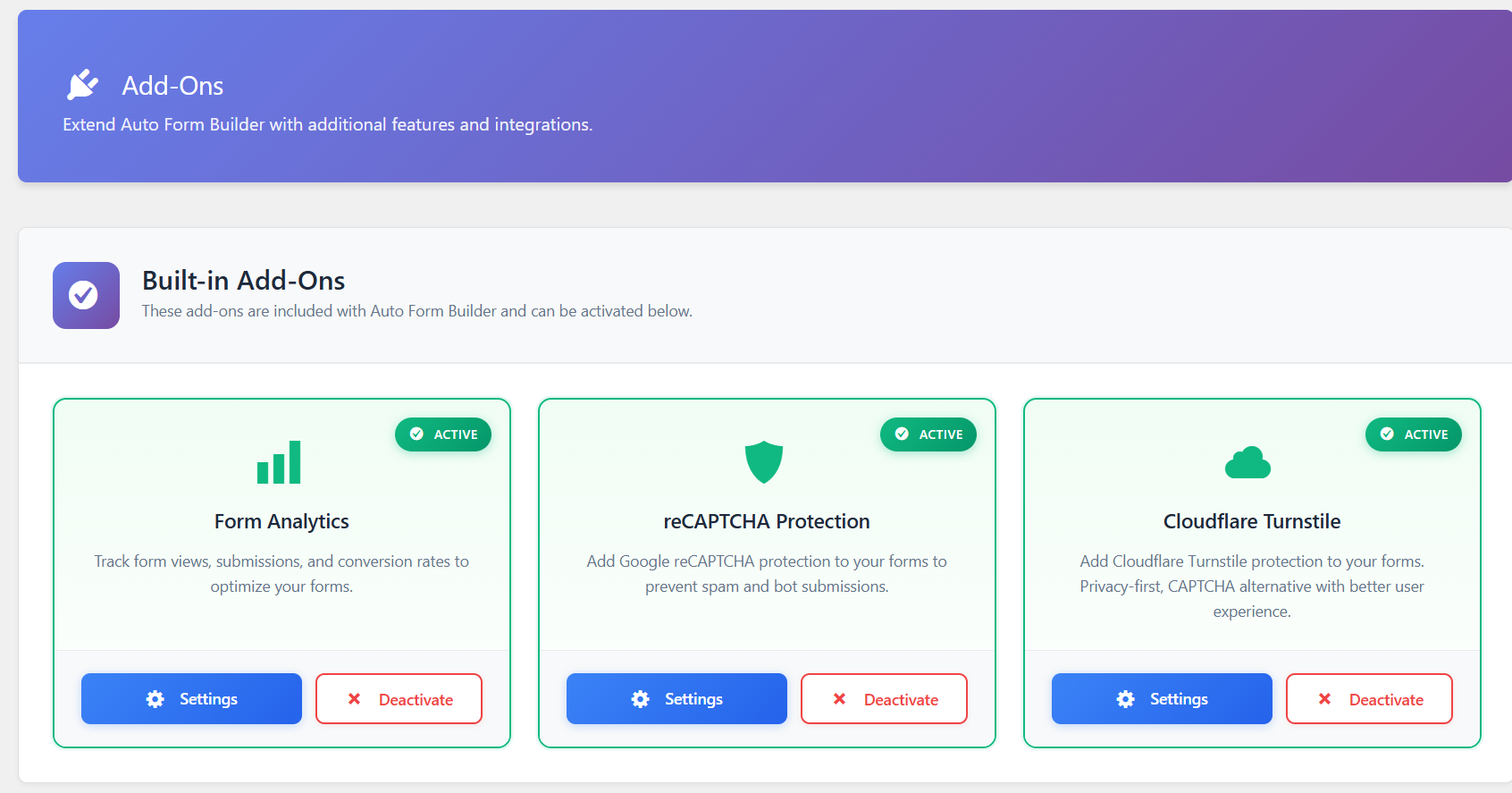
Switch these on under Auto Form Builder → Add-Ons:
- Stripe Payments — Stripe Checkout with your own Stripe account, for a fixed price, an amount the visitor enters, a Calculation result or a Products order. No added fee: you pay only Stripe’s standard processing fees.
- Popup Forms — modal, slide-in, sticky bar, full-screen, welcome mat or floating button.
- Form Analytics — views, submissions and conversion rates per form, and drop-off per screen for funnels.
- Spam Protection — Google reCAPTCHA and Cloudflare Turnstile.
- User Registration & Login — create accounts from any form and add a login form.
- Slack Notifications, Entry Tags and Google Sheets.
- Ad Tracking — remembers ad click IDs (gclid, fbclid and others) and UTM parameters in one first-party cookie, only for visitors who arrive from an ad or a tagged link, so webhooks can tell your ad platform or CRM which ad brought each lead.
Webhooks and import/export of forms and entries are built in. Send each submission to several webhooks (Zapier, Make, a CRM or any endpoint), as the standard data or as your own JSON template (for example for the Meta Conversions API), optionally signed with a secret (HMAC-SHA256), in the background with automatic retries. Templates use answer and submission tags with modifiers such as |e164 and |sha256, and any field can be set to “Never send to webhooks”.
AI Features (optional)
- AI Assistant — build a form from a description or document, generate logic, summarize submissions and draft replies.
- AI Conversation — turn any form into a friendly chat, with optional appointment booking, on your own pages or embedded on any website. Its Appearance tab styles each chat with presets (Light, Dark, Transparent or “Match my form”), your colors, Google fonts, a header and avatar, and an optional floating chat button.
They are switched on by default but send nothing until you connect an AIDA account, and you can switch them off under Auto Form Builder → Add-Ons. A free AIDA account at autoformcrm.com includes trial credits; after that, AI usage needs one-time credit packs. See “External Services” for exactly what is sent.
External Services
By default the plugin contacts no external service. Each service below is used only after you set up the feature that needs it.
AIDA — AI Assistant & AI Conversation (optional)
- Provider: AIDA by Auto Form CRM (https://autoformcrm.com/); requests are processed by Anthropic.
- When: only after an administrator connects an AIDA account, and then each time an AI feature is used. The AI modules are on by default, but nothing is sent until an account is connected. The core builder never contacts AIDA.
- Account & cost: a free AIDA account with trial credits; after that, one-time credit packs bought on autoformcrm.com in a new tab (no payment inside the plugin). All non-AI features stay free.
- Data sent (only for the action you trigger): on connect, your site address and a one-time code; the form description or document when building a form; submission content when you ask for a summary, reply or answer about submissions; messages typed into the admin assistant; and, if AI Conversation is on for a public form, the visitor’s chat messages. The AIDA token is sent server-side only and stored encrypted.
- Not sent: anything for AI features you do not use, and never WordPress passwords.
- Terms / privacy: https://autoformcrm.com/terms, https://autoformcrm.com/privacy, https://www.anthropic.com/legal/commercial-terms, https://www.anthropic.com/legal/privacy
Deactivation feedback (opt-in, one-time)
- Provider: Auto Form CRM, https://autoformcrm.com/api/v1/plugin-feedback
- When: only when an administrator clicks “Submit & Deactivate” in the deactivation dialog. Skipping or closing it sends nothing.
- Data sent: the chosen reason, an optional comment (up to 1000 characters), WordPress, PHP and plugin versions, and site locale. The exact payload is shown before sending.
- Not sent: site URL, admin name or email, user ID, IP address or form data.
- Terms / privacy: https://autoformcrm.com/terms and https://autoformcrm.com/privacy
Anonymous usage data (opt-in, off by default)
- Provider: Auto Form CRM, https://autoformcrm.com/api/v1/plugin-telemetry
- When: only if you turn on “Help improve Auto Form Builder by sending anonymous usage data” (onboarding or Settings → General): one “install” event on opt-in and one “uninstall” event on deletion.
- Data sent: a random site ID, plugin, WordPress, PHP and MySQL versions, install version, locale, multisite flag, days since install, form and submission counts as ranges, active modules and onboarding status. The full list is shown next to the checkbox.
- Not sent: site URL, admin name or email, user ID, IP address or form content.
- Terms / privacy: https://autoformcrm.com/terms and https://autoformcrm.com/privacy
Slack Notifications (off by default)
- Provider: Slack Technologies, LLC (https://slack.com/). Only hooks.slack.com webhook URLs are accepted.
- When: only after you add your own Slack webhook URL and enable it for a form: on each submission of that form and on “Send Test”.
- Data sent: the form title and site name, plus the submitted answers only if “Include answers” is on. Passwords, CAPTCHA values and file contents are never sent; files appear by name only.
- Terms / privacy: https://slack.com/terms-of-service and https://slack.com/trust/privacy/privacy-policy
Stripe Payments (add-on, off by default)
- Provider: Stripe, Inc. (https://stripe.com/). Only https://api.stripe.com is contacted, from your server, with your own Stripe API key.
- When: only after you enable the add-on and connect a key: to verify the key; to create or delete a webhook endpoint in your Stripe account; about every six hours while the settings page is open, to re-check the key; when a visitor submits a payment form (to create a Checkout session) and returns from it; when Stripe notifies your site of a payment event (signature-verified); and every ten minutes through WP-Cron while payments are still pending.
- Data sent: your API key (server-side only, stored encrypted); your webhook URL and site name; for payments, the amount, currency, product name (for a Products field, each product’s name, quantity and price), return page addresses, submission and form IDs, and the payer’s email only if you map an email field. Card details are entered on Stripe’s page and never touch your site.
- Fees: the plugin adds no fee. Payments go straight to your Stripe account; you pay only Stripe’s fees.
- Terms / privacy: https://stripe.com/legal/ssa and https://stripe.com/privacy
Google Sheets (add-on, off by default)
- Provider: Google LLC. Your server contacts oauth2.googleapis.com, sheets.googleapis.com and www.googleapis.com using a service account you create.
- When: only after you enable the add-on and save the service-account credentials: when you test the connection or pick a spreadsheet or worksheet, and after each submission of a connected form (sent in the background through WP-Cron, with retries).
- Data sent: a sign-in request signed with your service-account key (the key stays on your site, encrypted); the chosen spreadsheet and worksheet; and the mapped field values with their column names. Picking a spreadsheet lists those shared with the service account.
- Not sent: fields you have not mapped.
- Terms / privacy: https://developers.google.com/terms and https://policies.google.com/privacy
Google reCAPTCHA (add-on, off by default)
- Provider: Google LLC (https://www.google.com/recaptcha/).
- When: only after you enable the add-on, enter your keys and turn it on for a form. Pages with that form load https://www.google.com/recaptcha/api.js, and your server checks each submission with https://www.google.com/recaptcha/api/siteverify.
- Data sent: Google’s script collects what it needs to detect bots (such as IP address, browser details and page interaction). Your server sends your secret key and the response token. No form answers are sent.
- Terms / privacy: https://policies.google.com/terms and https://policies.google.com/privacy
Cloudflare Turnstile (add-on, off by default)
- Provider: Cloudflare, Inc. (https://www.cloudflare.com/).
- When: only after you enable the add-on, enter your keys and turn it on for a form. Pages with that form load https://challenges.cloudflare.com/turnstile/v0/api.js, and your server checks each submission with https://challenges.cloudflare.com/turnstile/v0/siteverify.
- Data sent: the Turnstile script collects what it needs to detect bots (such as IP address and browser details). Your server sends your secret key and the response token. No form answers are sent.
- Terms / privacy: https://www.cloudflare.com/website-terms/ and https://www.cloudflare.com/turnstile-privacy-policy/
Webhooks (off by default)
- Provider: the endpoints you enter, one per webhook (for example Zapier, Make, a CRM, Meta through your own server, or any URL). Private and local network addresses are refused, also after redirects.
- When: only after you add a webhook and turn it on: after each submission of a form the webhook covers (sent in the background after the page has loaded, or through WP-Cron, with up to 5 retries over about 8 hours), and when you send a test.
- Data sent: with the standard data, your site address, submission time, form and submission IDs, the answers (signatures as embedded images) and the form’s field settings. With a custom JSON template, only what the template contains, which can include the visitor’s IP address, browser, page address and referrer, and (with the Ad Tracking add-on) ad click IDs, UTM parameters and the Meta _fbp/_fbc values. Fields marked “Never send to webhooks” are never sent. Every request has an X-AFB-Delivery-ID header, and an X-AFB-Signature header (HMAC-SHA256) if you set a secret. A test sends only the site address and time, or the template filled with sample values.
- Terms / privacy: those of the receiving service.
Google Fonts (only for forms using a Google font)
- Provider: Google LLC (https://fonts.google.com/).
- When: only on pages showing a form styled with one of the Google fonts offered under Customize (some theme presets use one), or a Conversational Forms chat set to a Google font on its Appearance tab (also loaded in that tab’s preview). The default fonts (your theme’s font, or the system font for chats) load nothing.
- Data sent: the browser’s font request from fonts.googleapis.com, which gives Google the visitor’s IP address and browser details. No form content is sent.
- Terms …
Installation
- Go to Plugins > Add New in your WordPress admin.
- Search for “Auto Form Builder”.
- Click Install Now, then Activate.
- Open Auto Form Builder in your admin menu.
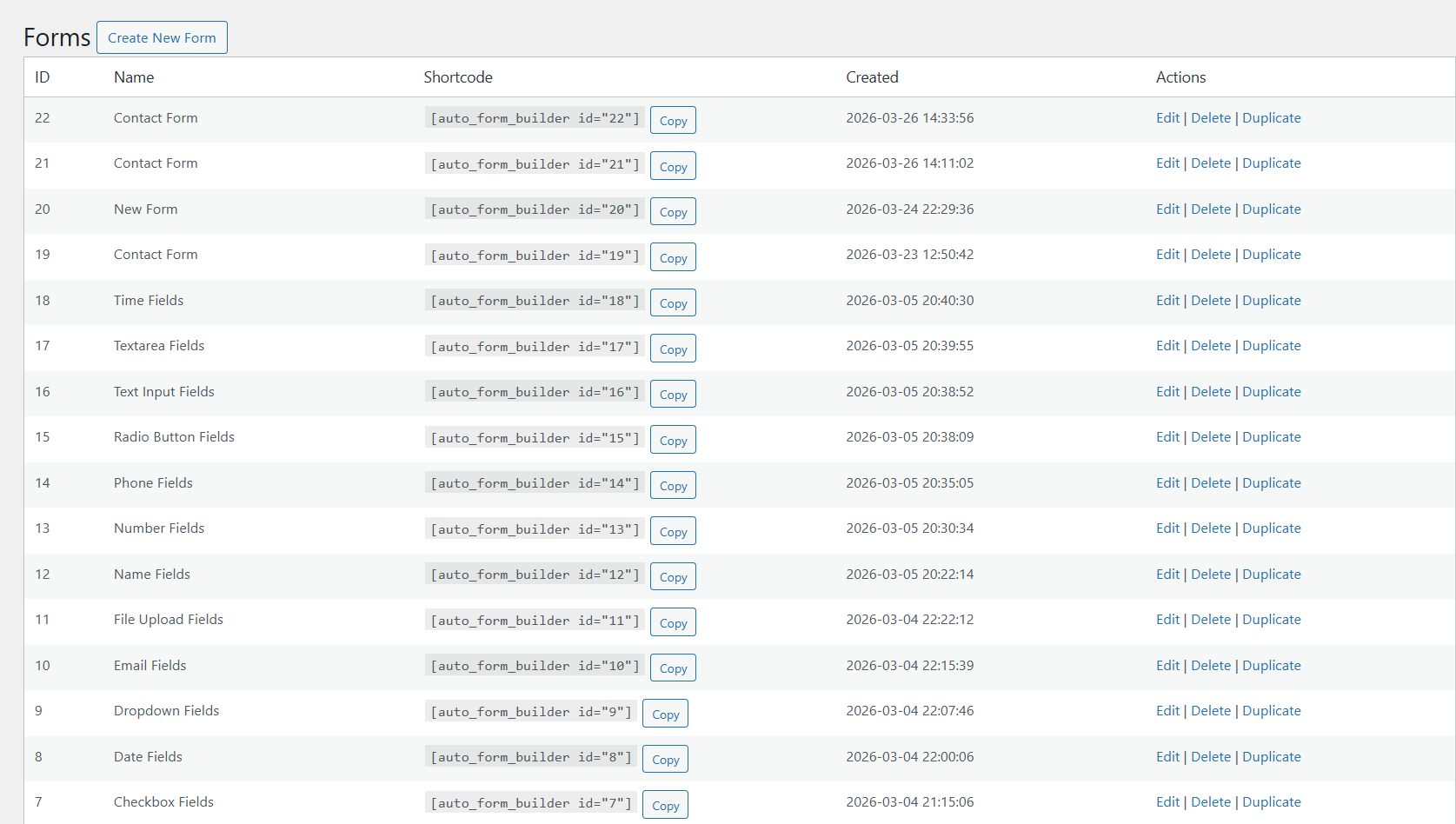
- Click Create New Form to build your first form.
- Copy the shortcode and paste it into any page or post.
FAQ
Is this plugin really free?
Yes. The drag-and-drop builder and every non-AI feature — multi-step forms, quiz and lead funnels, conditional logic, surveys, calculations, the Products field, Stripe payments, Google Sheets, Entry Tags, form analytics, spam protection, popups, user registration, submission management, webhooks, Slack notifications, import/export, and full visual customization — are 100% free. There is no premium version and there are no paid add-ons. The only thing you can pay for is AIDA credits for the optional AI features, and only after the free trial credits are used up.
Do I need to know how to code?
No. The drag-and-drop builder needs zero coding. Building, styling, and embedding are all handled through the visual interface.
What field types are available?
Text, Textarea, Email, Phone, Number, Date, Time, Month & Year, Checkbox, Radio, Dropdown, Name, Address, File Upload, Signature, Color Picker, Calculation, Products, an HTML content block, Page Break (multi-step), and four survey fields: Tabular Survey (Likert grid), Star Rating, NPS, and Opinion Scale. See the full field reference.
Can I add conditional logic?
Yes. Every field supports show/hide logic with AND/OR conditions, and logic can also change your confirmation message, redirect, or which email is sent.
Can I create multi-step forms?
Yes. Enable multi-step mode and add Page Break fields where each step starts. You get step titles, custom button labels, a choice of progress bar styles (or no progress bar), and answer-based branching that skips or jumps steps so visitors only see what applies.
How do I build a quiz or lead funnel?
Start from one of the four templates in the “Funnels” category, or open a multi-step form’s settings and turn on Funnel mode. Each screen then shows one question on large cards that move on as soon as they are answered (you can turn auto-advance off per question). “One question per screen” splits an existing form into screens for you. Give radio or checkbox options pictures (image cards) and points (quiz scoring), then use conditional confirmations to show a different result or redirect for each answer or score range, and {quiz_score} to show the score in messages and emails. With Form Analytics on, you see how many visitors reached each screen and where they left.
Can visitors check their answers before submitting?
Yes. Turn on the review step in a form’s settings. Before the form is sent, visitors see everything they entered in a “Review your answers” step, with an Edit button that takes them back to that step.
Can I use a visitor’s answers in messages and emails?
Yes. Put a field tag such as {first_name} in a label, help text, HTML block, step title or the submit button, and it fills in as the visitor types. The same tags work in success messages, notification emails and redirect addresses. Add a fallback for empty fields with |default, for example “Hi {first_name|default:there}”.
Can I embed my form on another website?
Yes. Every form has a ready-made embed code that works on any site, including non-WordPress platforms and page builders like WP Bakery, Brizy, and Elementor. The embed keeps your design, resizes automatically, and stays isolated from the host theme. You can also share a direct link to the form as its own page.
Can I embed the AI chat on another website?
Yes. When AI Conversation is on for a form, its settings have an Embed section with the code and a Copy button, and the AI Conversational Forms list has a “Copy embed code” button too. Paste the code into any website, WordPress or not. It works for logged-out and logged-in visitors and uses AIDA credits the same way as on your own pages. On a form with a Products field, the chat hands over to the regular form at the end, with the answers filled in, so the visitor can choose products there.
Can I change how the AI chat looks?
Yes. Each conversational form has an Appearance tab with a live preview that uses no AI credits. Start from a preset (Light, Dark, Transparent or “Match my form”, which takes your form’s colors and font), then change the colors, font (your theme’s, the system font or a Google font), text size, corners, header, avatar and input. Show the chat in the page or as a floating button in a corner, with an optional teaser message. Administrators can also add custom CSS for one chat.
Can I accept payments?
Yes, with the free Stripe Payments add-on (off by default; enable it under Auto Form Builder → Add-Ons). Connect your own Stripe account and visitors pay on Stripe Checkout after submitting. The amount can be a fixed price, an amount the visitor enters, a Calculation result, or a Products order. Payment status and refunds are tracked on the Submissions screen, and card details are entered on Stripe’s page, never on your site. The plugin adds no transaction fee or percentage — you pay only Stripe’s standard processing fees.
Can I sell products and take payments for free?
Yes. The Products field and the Stripe Payments add-on are both free. List what you sell with prices, turn on Stripe Payments, and visitors choose products and quantities, see the total, and pay on Stripe Checkout, with each product on its own line. Prices always come from your form, never from the visitor’s browser. The plugin adds no fee; you pay only Stripe’s standard fees. Prices are one-time; recurring billing is not available yet.
Can my form calculate totals or prices?
Yes. Add a Calculation field and write a formula that uses other fields, for example a price times a quantity plus a fee. The total updates as the visitor fills in the form and is calculated again on your server when the form is submitted, so visitors cannot change it. A Calculation field can also set the amount of a Stripe payment.
Can I send submissions to Google Sheets?
Yes, with the free Google Sheets add-on (off by default; enable it under Auto Form Builder → Add-Ons). Connect a Google service account, choose a spreadsheet and worksheet for each form, and map fields to columns. New submissions are added in the background and retried automatically if Google is slow or unavailable.
Can I show my form in a popup?
Yes, free and built in — no separate popup plugin. Display any form as a modal, slide-in, sticky bar, full-screen, welcome mat, or floating launcher, and control which pages it appears on, how it triggers, how often it shows, and what happens after submit.
Can visitors sign my forms with an e-signature?
Yes. Add the Signature field and visitors can sign with a mouse, finger, or stylus. The signature is stored securely and shown as an image in the entry details, on WordPress pages and embedded forms.
Can users register and log in through my forms?
Yes, free and built in. Pick which form creates accounts and map its fields to the account email, username, password, and name. Choose the new role, customize the welcome email, and add an independent login form (with lost password and reset) to any page via the [auto_form_builder_login] shortcode — no default WordPress login screen.
Can I protect my forms from spam?
Yes. Google reCAPTCHA and Cloudflare Turnstile are both included free — use either or both on any form.
Can I manage leads from my forms in a CRM?
Yes. Auto Form Builder integrates natively with Auto Form CRM, a premium WordPress CRM with contact management, a deal pipeline, automation, email campaigns, meeting scheduling, and live chat. Capture with Auto Form Builder, then nurture and close in Auto Form CRM. Learn more at autoformcrm.com.
Do the AI features cost money?
The core builder is free and always will be, with no account required. The optional AI features run on our AIDA service: a free AIDA account comes with free trial credits, and after those are used, continued AI usage needs one-time credit packs bought on autoformcrm.com. So AI is a paid service after the free trial, while everything else stays free. Your credit balance is always visible in the plugin.
What data is sent to external services when I use the AI features?
Only when you actually use an AI feature, and only the content it needs: the form description or uploaded document when building a form; the submission content when you summarize, reply, or “ask across submissions,” or when the admin assistant answers a question; the messages you type into the admin assistant; and — only if you enable AI Conversation on a public form — the chat messages visitors type. Requests are authenticated with your AIDA token (kept encrypted on your server) and processed by our AI provider, Anthropic. Nothing is sent unless you opt in and use the feature. See “External Services” for full details.
Can I use the plugin without the AI features?
Yes. Auto Form Builder is fully functional without any AI. The AI modules are switched on by default, but the plugin never contacts AIDA until you connect an AIDA account. If you never connect one, nothing is sent, and you can switch the AI modules off under Auto Form Builder → Add-Ons. Every other feature works the same either way.
Can a webhook send my own JSON, for example to the Meta Conversions API?
Yes. Edit the webhook under Settings → Webhooks, choose “Custom JSON template” and write the JSON, or start from the Meta Conversions API Lead example. Put tags inside quotes, for example “{email}”. Field tags are the same as in emails; system tags include {event_id}, {event_time}, {page_url}, {page_url_clean}, {referrer}, {visitor_ip}, {user_agent}, {form_id}, {form_name} and {submission_id}, and the Ad Tracking add-on adds tags such as {gclid}, {utm_source}, {fbp} and {fbc}. Modifiers run left to right: |trim, |lower and |nospace tidy a value, |e164 writes a phone number with its country code, |sha256 hashes it (it must come last, and an empty value stays empty) and |number sends a number instead of text (only when the tag is the whole value). For example {phone|e164|sha256} or “{event_time|number}”. “Validate & preview” shows the result with sample values before you save. To keep an answer out of every webhook, turn on “Never send to webhooks” in that field’s settings in the form builder.
Can notification emails link to uploaded files, and is that safe?
Yes. Choose a “File links” option in the notification’s settings. A login link opens the file only for a logged-in user allowed to view submissions. A secure link works without logging in, for one file only, until it expires (7 days by default, at most 30). Each link is signed with your site’s secret keys and holds no file name or server path, so it cannot be guessed or changed to open another file. Files are sent by the plugin with download-safe headers; only images open in the browser. A link stops working when it expires or when the entry or file is deleted, and secure links are rate-limited per visitor. Anyone who has a secure link can open that file until it expires, so use login links for sensitive files.
Can I read submissions without opening each one?
Yes. On the Submissions screen, click the eye icon on a row, or press Shift+V, to open the entry’s answers in Quick view over the list. Previous and Next (or J and K) move through the list in its order, and opening an unread entry marks it read.
How do I count a lead once when I use both a pixel and a webhook?
Use the same event ID in both. When the success message shows, the page fires an afb:lead event with the submission’s event ID, and pushes afb_lead to the dataLayer for Google Tag Manager. For the Meta pixel: document.addEventListener( ‘afb:lead’, function ( e ) { fbq( ‘track’, ‘Lead’, {}, { eventID: e.detail.event_id } ); } ). In the webhook template, send “{event_id}”. If the form redirects straight to another page, add the ID to the redirect address, for example https://example.com/thanks?eid={event_id}, and fire the pixel there.
What cookie does the Ad Tracking add-on set?
Only while the Ad Tracking add-on is switched on, and only when a visitor arrives with an ad click ID (fbclid, gclid, gbraid, wbraid, msclkid) or UTM parameters, the site sets one first-party cookie, afb_attr, for 90 days (you can change this). It holds those values for the first visit, the last visit and the last ad click, with the landing page address (without its query string) and the referring site’s name. It is set by your own site (HttpOnly, SameSite=Lax, and Secure on HTTPS), never sent to other sites, and is used to fill webhook tags and hidden fields such as {gclid} or {fbc}. The add-on reads the Meta _fbp and _fbc cookies but never writes them, and does not touch any other cookie. Suggested privacy policy text is added under Settings → Privacy. If your site is behind Cloudflare or a proxy, set “Visitor IP source” under Settings → Webhooks, so the add-on’s limit on requests per visitor counts each visitor separately.
Where can I get support?
Visit autoformbuilder.com/support for documentation and support.
Screenshots






Changelog
1.6.10
- Fix: Duplicate: tags with options such as {name|upper} or “If empty, show”, calculation formulas, Products totals and “Other” conditions in the copy now use the copy’s own fields instead of the original form’s.
- Fix: Forms duplicated before this fix are repaired when opened in the builder, and a notice says how many fields were fixed. Tags of the original’s fields that an earlier update turned into plain text ({…}) work again; your own {text} stays as typed.
- Tweak: Duplicate copies the form’s Google Sheets spreadsheet and mapping, Slack settings and AI chat settings (on/off, appearance, instructions). The copy is also added to every webhook limited to selected forms that includes the original, so it sends to the same webhooks.
- Fix: Radio, Checkbox and Dropdown options: renaming an option no longer changes its value, so entries, conditional logic, quiz scores, image cards and default selections keep matching. Only editing the value itself changes it.
- Fix: New Radio, Checkbox and Dropdown fields start with three options: “Option 1”, “Option 2” and “Option 3”.
- Fix: Form Analytics no longer counts views, reviews, screens or submissions by users who can edit forms, such as previews from the builder.
- Fix: The Cloudflare Turnstile and reCAPTCHA fields have their own icons in the field list.
- Fix: Turnstile and reCAPTCHA field settings point to Auto Form Builder → Turnstile and Auto Form Builder → reCAPTCHA.
- Fix: Entry Tags: the Preview in Create New Tag and Edit Tag shows only the tag, as it looks on entries, without a colored bar behind it.
- Tweak: Two forms placed one after another on a page have a 48px gap between them.
- Fix: Multi-step forms: “Progress bar style” has a “None (hide progress bar)” option, so the bar and step counter can be turned off again. It is the same setting as Funnel mode’s “Show progress bar” switch.
1.6.9
- Fix: Image choice cards: each option now keeps its own picture. Choosing or removing an image on one option no longer changes every option of the question.
- Fix: Radio, Checkbox and Dropdown options: editing, moving or removing one option no longer changes the others on forms made from templates or older versions; every option now gets its own ID when the form is saved.
- Fix: Form Analytics counted views and submissions twice; each now records one event, and the drop-off report counts a submission once per page view.
- Fix: Funnel keyboard: Space and Enter on a focused card select it and move on, even when it is already selected.
- Fix: Funnel label-only cards: the radio or checkbox sits beside the label instead of covering it, in LTR and RTL.
- Fix: Funnel: the first card in each group lines up with the others.
- Fix: Funnel last screen: the captcha stays inside the card and Back and Submit sit side by side.
- Fix: Two funnels on one page look the same; the outer form panel no longer shows around a funnel.
- Fix: Funnel: the back button reads “Back” on every screen, including the review.
- Fix: Funnel radio questions always show “Auto-advance” and “Score per option” in the builder after a page refresh.
- New: “Show progress bar” switch for Funnel mode; off by default for new funnels and the funnel templates. Other multi-step forms are unchanged.
- Tweak: “One question per screen” is available for every multi-step form, not only in Funnel mode.
- Fix: Submissions list Data Preview shows the country name instead of the code.
- Fix: CSV export no longer includes columns for layout fields or captchas.
- Fix: A new Dropdown field shows the same default options as a new Radio field.
1.6.8
- New: Funnel mode for multi-step forms (Settings → Multi-Step Form): visitors answer one question at a time on large, touch-friendly screens, and Turnstile or reCAPTCHA appears only on the final screen (or in the review step). Off by default; forms without it work and look exactly as before.
- New: Auto-advance in Funnel mode: a screen with one radio, star rating, NPS or opinion scale question moves on as soon as it is answered (you can turn this off per question). Works with the keyboard and screen readers, skips hidden screens, Back returns to the screen the visitor last saw, and animations respect reduced motion.
- New: Image choice cards: radio and multiple-choice checkbox options can show pictures from your Media Library, 2–4 per row, with or without captions. Images load lazily in the right size, use the option label as alt text, show in the builder preview, and appear as small thumbnails beside the answer on the entry page, Quick view, print and HTML emails. Plain-text emails, CSV, webhooks, Google Sheets and CRMs still receive the option value.
- New: Quiz scoring: give radio and checkbox options points and the total is worked out on your server when the form is sent (hidden questions don’t count). Use it as {quiz_score} in messages, emails, redirects and webhooks and as “Quiz score” in conditional confirmations; it shows on the entry page and can update live in the form.
- New: Results: in Funnel mode, show a different message or redirect for each answer combination or score range through conditional confirmations, with answers passed in the URL.
- New: Funnel drop-off in Form Analytics: how many visitors reached each screen in the last 30 days and where they left without submitting; screens skipped by branching are not counted as drop-off. Only the form, the screen number and a random ID held in the page’s memory are sent: no answers, IP address, browser details, cookies or storage, with a limit on events per visitor.
- New: Four funnel templates in the new “Funnels” gallery category: Consultation (beauty or clinic), Home Services Quote, Plan Finder (scored, with two results) and Real Estate Buyer & Seller, each with image card questions, contact details, a consent checkbox, an admin email and result messages. No pictures are included; the cards show their labels until you pick your own images.
- New: “One question per screen” button in Funnel mode adds a page break between questions that share a step, keeping your page breaks, branching and conditional logic (Undo reverts it).
- Fix: Dropdowns (multi-select and single) close on a click or tap outside, a click on the field, Esc (focus stays on the field) or Tab (focus moves to the next field). Picked options stay selected, and scrolling the page on a phone no longer counts as a tap.
- Fix: Printing an entry no longer adds a blank second page.
1.6.7
- Fix: Address field: Company/Organization is now saved with the entry and shown on the entry page, in Quick view, print and the CSV export, as it already was in emails. Entries saved before this update did not keep it and cannot show it.
- Fix: Address field: the entry page, Quick view, print, emails ({submission_data} and the field tag) and the CSV export show the country by name (“United Kingdom”) instead of its code, as the review step does. Webhooks still send the code.
- Fix: In the compact form builder (narrower than 1200px) Field Properties opens beside the admin menu, folded or not, instead of under it.
- Fix: Popups on phones keep room for the scrollbar, so it no longer covers the right edge of the fields.
- Fix: The Forms list on phones shows each form’s name with a toggle for its ID, shortcode, date and actions, as WordPress lists do, instead of a table header broken over three lines.
- Fix: Password fields ask the browser for a new password, so it no longer fills in the saved password of the signed-in admin.
- Fix: User Registration: after an account is created, the form says “Your account has been created. You can now log in.” unless you wrote your own success message.
- Developer: New filters auto_form_builder_success_message (the success message shown after a submission) and auto_form_builder_success_url_args (extra query arguments of the success page).
1.6.6
- Security: Password answers are no longer stored. Entries, emails, the entry page, Quick view, print, CSV, webhooks, Slack, Google Sheets and the AI summary show “••••••••” instead, and Conversation AI uses the normal form when a form has a password field. Imported entries are masked too. Important: after updating, passwords already saved in earlier entries, and in webhook and Google Sheets deliveries still waiting to be sent, are replaced with “••••••••” for good and cannot be recovered. Accounts created by User Registration are not affected.
- Fix: The form builder no longer slides up to show an empty grey band at the bottom when you scroll. The page stays put, each column scrolls on its own and a long admin menu scrolls by itself. On phones and small tablets the builder has a one-row toolbar with a More menu, shows the field list or the form one at a time, keeps full field names with their actions in a menu, and opens Field Properties only when you tap a field, with the AI button out of the way.
- Fix: On screens narrower than 1200px (including 1024px laptops and tablets) the form builder now uses the compact layout instead of three squeezed columns, and Save Form is always visible. Toolbar labels stay on one line, with the shortcode moving into the More menu and Edit with AI showing as an icon when space is short. File Upload fields in the form canvas now show their full note.
- Fix: The review step no longer lists a field without a label by its number; it uses the same name as the entry page and emails (for example “Address”).
- Fix: The review step and live field values in the form show the address country by name (“United Kingdom”) instead of its code.
- Fix: Popups on phones are no longer cut off on the right, and the × button sits above the content so the scrollbar no longer covers it.
- Fix: Entries from embedded forms now always show “Embedded form on” with the site name, including when the embed page was opened directly or the browser sent no referrer.
1.6.5
- New: Review step before submitting (Form Settings → Submission Behavior, off by default). Forms with the option off work exactly as before.
- The submit button (on multi-step forms, the one on the last step) becomes “Review your answers” (your own text, field values allowed) and shows the visitor’s answers as they will be sent: option labels, Products lines with their prices (“2 × Basic ($98.00)”) and the total, file names, a small signature preview, masked passwords. Hidden and empty fields are left out. Optional text above the summary.
- Multi-step forms show one group per step taken, each with its own Edit button, and the progress bar ends with a “Review” item. After an edit, “Back to review” checks every step again and first shows any step that branching added or that has an empty required field.
- “Edit answers” keeps everything entered, and the final button, with your submit button text, sends the form. The answers are checked before the review opens and again on the server as before.
- reCAPTCHA and Turnstile widgets show in the review and are drawn when it opens, so the token solved there is the one sent. Partial entries count the review as the last step.
- Form Analytics shows a “Reviews” count per form, between views and submissions.
- The Order, Job Application, Appointment and Event Registration templates come with the review step on, listed in the gallery’s setup notes.
- New: Field value tags such as {name} or {plan|default:your plan} in more places, each box with “Insert tag” and warnings:
- The success message, conditional confirmation messages and the Stripe product name show that submission’s answers (option labels for dropdowns, radios and checkboxes) as plain text, also in popups, embeds, the AI chat’s thank-you message and the payment result page. A tag naming no field shows its default text or nothing, and so does every tag when the success page is reloaded later.
- Notification and confirmation emails, including conditional email rules, take |default and the modifiers, such as {name|default:there} or {plan|upper}, and every email subject and message box has “Insert tag”. Existing email templates send exactly as before: {submission_data}, field ID, name and label tags, {field:ID:total}, {field:ID:items}, {photo|link} and the system tags are unchanged, subjects stay plain text and HTML emails still escape the visitor’s answers.
- Conversational Forms: the completion message takes tags filled from the visitor’s answers, with “Insert tag” on the form’s Configure screen.
- The review step texts get “Insert tag” too.
- One-time update: brace text in existing success messages, confirmation messages, Stripe product names and AI completion messages that is not a field tag, such as “Use code {SAVE10}”, is escaped so it keeps showing as typed. Imported forms exported from 1.6.4 or older get the same.
- Fix: Popup Forms and the Conversational Forms floating chat no longer focus a text field when they open, so the on-screen keyboard no longer pops up on phones and covers the form. Focus moves to the popup or chat panel itself; Tab reaches the first field, and Esc, the focus trap and returning focus to the opening button work as before.
- Fix: The {admin_email} tag now fills in the user confirmation email’s HTML body too; before, it showed as typed there while the admin email and plain-text emails filled it.
1.6.4
- Fix: User Registration & Login: since 1.6.2 the registration form refused every email with “Please enter a valid email address to create your account.” and created no account. The mapped Email, Password, First Name, Last Name and Username fields are read again, by field ID with the field name as a fallback for older forms.
- Fix: User Registration & Login: messages such as an invalid or already registered email, a taken username or a short password now show under the field they concern instead of starting with “Security:”. “Security” is kept for the spam checks (Turnstile and reCAPTCHA).
- Fix: Address field: each part shows once, with its own label, placeholder and required mark, exactly as set in Address Components. With the United Kingdom preset, State/Province/Region shows as County (a text box) instead of a second “Country” dropdown, and Country shows when you turn it on. Labels come from the preset (Town/City, Postcode, Street Address…) or what you typed, and examples such as SW1A 1AA appear only as the placeholder. The builder’s checkboxes and Style preview show the parts the form really shows, and parts marked Required are also checked on the server when left empty.
- Fix: Google Sheets: a field with a custom field name, such as a Number field, is now written to its mapped column.
- Fix: Partial entries: answers to fields with numeric field IDs (the default for new fields) are now saved, and kept when the partial entry is updated later.
- Fix: Live field values: a tag of a field shown by conditional logic is no longer left empty, in emails too, when the fields have numeric field IDs.
- Fix: Webhooks: with “Custom JSON template” chosen, the help under the payload choice now describes the template instead of the default payload.
- Fix: Webhooks: a saved signing secret now shows as “Secret set (ends …abcd)” with “Generate a new one” and “Remove”, instead of an empty box that looked unset. The full secret is never shown.
- Fix: Ad Tracking: {first_landing_url}, {last_landing_url} and the other landing page tags keep the page’s path and query, such as ?page_id=31. Only the click IDs and utm_* parameters, which are stored separately, are left out.
- Fix: Ad Tracking: the settings page explains how to use a tag in a form: a Text Input field with “Hidden Field” turned on.
- Fix: In HTML emails, {file|link} shows each file as a link with the file name as its text. Plain-text emails and webhooks still get the URL.
- Fix: Insert tag: “If empty, show” now comes before the field list, so you set it and then choose a field. Choosing a field whose tag is right next to the cursor updates that tag instead of adding it again, so {first_name}{first_name} no longer happens.
- Fix: Password fields: the eye button’s keyboard focus ring stays inside the field, also with rounded fields.
- Fix: Cloudflare Turnstile and Google reCAPTCHA settings: the Status box shows “API Keys Configured” right after saving valid keys, without reloading the page.
- Fix: AI chat: the progress bar counts every field the chat asks, required and optional, and only real answers count as answered, so it no longer reads “1 of 1 answered” while a field is still being asked.
- Fix: AI chat: the review card shows the option labels of choice answers (“Yes”) instead of their stored values (“yes”), the same way the emails do.
- Fix: AI chat: with the review step on, the default closing message asks the visitor to review and confirm their answers instead of saying they are being submitted.
- Fix: AI summary: the quick summary of an entry gets the real submitted date and time, labelled as such, so a Date field of the form is no longer taken for the submission date.
- Fix: AI chat Appearance: avatar Initials are taken from the chat name when the Initials box is empty (“Sara” gives “S”, “Roy’s team” gives “RT”); you can still type your own.
- Fix: AI chat Custom CSS: when the CSS is refused (for example for @import), only the reason is shown, without “Could not save. Please try again.”
- Fix: Template gallery on phones: the header and the “Build with AI” row are compact (the AI row stays on one line until you tap it), so more templates fit on the screen.
- Fix: Entry page: “Show technical details” stays open or closed after a reload, also when you reload right after clicking it.
- Fix: Printing an entry no longer prints the file Download buttons, the “Show technical details” bar or the floating AI button, and the IP address in Details is printed.
- Fix: An optional File field left empty shows as an empty answer on the entry page instead of “(0 B) (Download not available)”.
- Fix: Opening a file download link from the admin while logged out shows a message with a “Log in” button instead of an empty page. After logging in, one click downloads the file.
- Tweak: Google Sheets: the settings page shows a setup checklist (Google account connected, Spreadsheet selected, Forms linked) that follows your saved settings, instead of a fixed progress bar.
- Tweak: Entry Tags: when the name you type in the tag picker matches no tag, “Create tag ‘…’” creates that tag and adds it to the entry.
1.6.3
- New: “Create New Form” opens a template gallery with 28 ready-made forms:
- Search, categories (your last one is remembered), compact cards with badges (Payments, Multi-step, File upload, AI chat, Calculator) and a preview of each template’s fields and what comes set up before you use it. Works fully with the keyboard and screen readers, on phones (full screen, category menu, preview sheet) and in right-to-left languages.
- 23 new templates: Quote Request, Ad Landing-Page Lead Form, Real Estate Inquiry, Appointment Request, Clinic Consultation, Restaurant Reservation, RSVP, Order Form, Donation, Price Calculator, Return / Refund Request, Course Enrollment, Membership Application, Volunteer Signup, Customer Feedback (NPS), Satisfaction Survey, Feature Request, Bug Report, Damage Report with Photos, Job Application, Multi-step Onboarding, GDPR / Data Request and Conversational Lead Form.
- The Contact, Feedback, Support Request, Newsletter Signup and Event Registration templates are ready to use: a required privacy consent checkbox, an admin notification to the site admin email and a confirmation message written for the form. You can change all of it in the form’s settings.
- With Stripe Payments active, the Order Form, Donation and Course Enrollment templates come with payment settings filled in but switched off, so nothing is charged until you connect Stripe and turn payments on.
- Conversational Lead Form: with AI Conversation active, the new form opens as an AI chat with the AI consent notice turned on; without it, it works as a normal form. Choosing it while AI Conversation is off asks whether to turn it on first; cancelling changes nothing.
- Build with AI right from the gallery: describe your form in one line and press Enter. “More options” opens the full AI dialog with document upload and model choice. It needs the AI Assistant add-on connected to AIDA; until then the gallery links to where to set it up.
- New: File links in notification emails. Each admin, confirmation and conditional notification has a “File links” setting: Off (file name only, the default), Login link (opens the file only for a logged-in user allowed to view submissions) or Secure link (opens one file without logging in and expires after 1 to 30 days, 7 by default). Each file is shown on its own line with its name, linked, and its size. Files are served by the plugin, never from the uploads URL, and a link stops working when the entry or file is deleted.
- New: The |link modifier, for example {photo|link}, puts a secure link to an uploaded file in an email or webhook template. Each webhook has its own link expiry. The default webhook payload is unchanged.
- Fix: Live field values: inserting a tag into a field’s label no longer turns the field’s name and tag into a long garbled one like {field_11field1792449…}, and a field labelled only with numbers, such as “22”, is offered by its id. “Insert tag” no longer lists the field you are editing; a field’s own tag in its label or help text shows its default text, and the builder warns about it. Tags already in your forms keep working.
- Fix: Conversational Forms: in a long conversation, or a chat with a small height, the messages no longer shrink to fit the window with their text overlapping the next message; every message keeps its height and the messages scroll. The “Please review your answers” card is no longer cut off. The card, its buttons, the consent box and the progress label now use the chat’s own colours, so they stay readable with the Dark and Transparent styles and with your own colours.
- Tweak: Conversational Forms: the Forms list has a “Copy” button next to each form’s shortcode, before “Copy embed code”.
1.6.2
- Fix: Forms with Cloudflare Turnstile or Google reCAPTCHA could not be submitted since 1.5.2: every submission failed with “Please complete the verification” even after the check was completed. The verification answer is checked again, and it is still never saved with the entry.
- Fix: File fields now accept the extensions you list in the field, even those WordPress does not know, such as STL, 3MF, OBJ, STEP, IGES, glTF, DXF, DWG or G-code. A file is accepted only when its content is plain data. Scripts, web pages and programs (for example PHP, JS, HTML, SVG or EXE) are always refused, and uploads stay in the protected folder with random names.
- New: Live field values. Show a visitor’s answers elsewhere in the form while they fill it in, before they submit:
- Type a field tag such as {first_name} or {plan|default:a plan} into a label, help text, HTML block, step title or the submit button text. It updates as the visitor types or picks, including in popups, multi-step forms and embeds. Answers always show as plain text, never as HTML.
- Add |default:text to show that text while the answer is empty. A tag for a field that no longer exists shows its default text or nothing, so a raw {tag} never appears. Write { to show a brace as plain text.
- Optional modifiers: |trim, |lower, |upper, |title and |nospace.
- The builder’s new “Insert tag” button lists the form’s fields and inserts a tag at the cursor, with optional “If empty, show” text. Warnings point out tags that name no field, unsupported modifiers, fields whose answer is never shown (file uploads, signatures, passwords) and tags inside HTML attributes. The builder previews each tag as its default text.
- Emails, the entry page, Quick view and print fill tags in field labels with that entry’s answers. CSV headers, entry lists, survey results, partial entries, webhooks, Google Sheets, Slack, AI prompts and Conversational Forms show each tag’s default text.
- Webhook JSON templates accept |default:text too, for example “{city|default:unknown}”. Existing templates send exactly what they did before.
- One-time update: saved forms with brace text that is not a field tag, for example “Use code {SAVE10}”, are rewritten to “Use code {SAVE10}” so they look the same as before. Real field tags are left as they are. Forms imported from exports made before 1.6.2 get the same treatment.
- New: Password fields have an eye button inside the field to show or hide what was typed. It works with the keyboard and screen readers, in right-to-left languages and on phones, and never changes what is sent. It is on by default; turn it off with “Show/Hide Password Button” in the field’s settings.
- Fix: On the submissions list, the entry page and Quick view, icons in buttons now line up with the button text, in right-to-left languages and on phones too. “Keyboard shortcuts” is now a quiet text button that matches the toolbar.
Older versions: see changelog.txt in the plugin folder.